Visualizzazione post con etichetta Victorian Mourning. Mostra tutti i post

martedì 15 novembre 2022

VICTORIAN LADIES' WORKS OF ART: Making Jewels with Hair


If you do reflect upon it, nothing lasts forever...

Sometimes a love ends,

sometimes a friendship fades away...

How many bonds can deteriorate.

But cut a lock of hair to the person you love,

and it will keep its color, her light for decades,

indeed, even for centuries. 


The Victorians taught us that. In fact, the art of working human hair, one of the many traditions of the XIXth century, has come down to us as if it had remained frozen in time. And My Little Old World has already mentioned it to you by discussing, some time ago, the importance that, in the collective imagination, female hair had in the Victorian era, so much so that, if their robustness allowed it, they were not cut for a whole life.


Back then, locks of hair were wisely woven into jewels, wrapped around themselves to resemble flower petals, even ground to be used in pigments and what we find ourselves today to confront with are authentic masterpieces made to defeat the laws of existence. The hair of a loved one, and who had been lost, was preserved as a memento mori already during the Shakespearean period and probably from well before eras. In fact, in some Egyptian tombs there are frescoes that seem to represent scenes in which pharaohs and queens exchange locks of hair as a sign of love. From 1600-1700 a sort of cult, aimed at preserving the memory of deceased loved ones, began: at that time infant mortality was very high, but also that of adults reached exorbitant numbers. And making personal objects, especially jewelry, with locks of their hair, gradually became a custom. But in the Victorian era, this art, which became more and more widespread and practiced, was mainly aimed at making paintings with family trees, objects to be exchanged as a token of love or friendship, frames for portraits, etc. using the hair of people who were still alive. It was not unusual that to be wowen were hair of different colors because it belonged to different people, perhaps united by a family bond: for example, a gift given to a father by three daughters of his. It could also have been a simple bookmark, but to insert it in a journal assumed the meaning of having with you the true essence of who had donated that hair. In the image below, a tree represents an American Methodist congregation: the shoots covering the branches are made with the hair of each member who was part of it.


From the collection of John Whitenight and Frederick LaValley. Photo by Alan Kolc. Courtesy of the College of Physicians of Philadelphia and the Mütter Museum


And here they are some other jewels and a framed drawing to hang to a wall belonging to private collections.
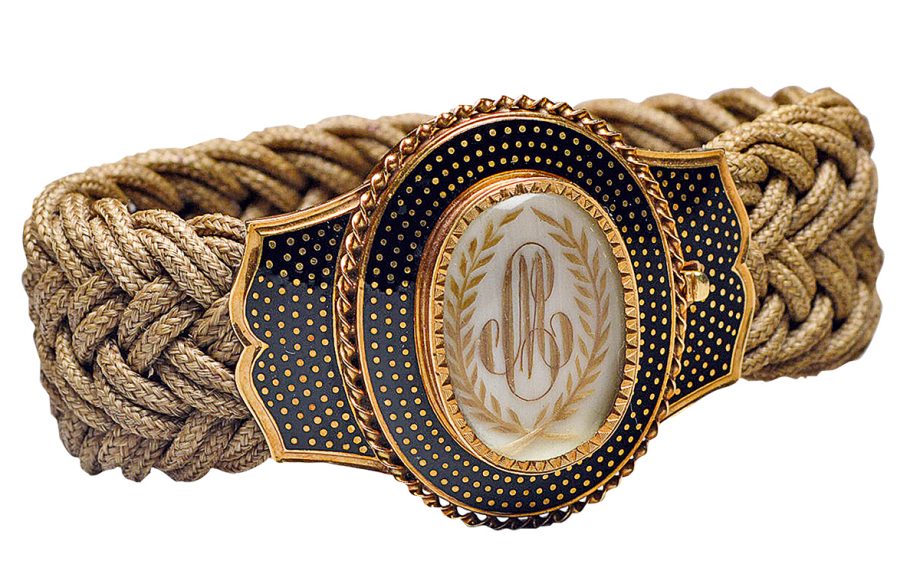


It is likely that they were, above all, the Victorian ladies who devote themselves to this art, which today appears so unusual to us and which reached the peak of its diffusion around 1850; probably it was a parlor pastime, as it was making wax flowers (click HERE to read the post that My Little Old World dedicated to this topic), to embroider, to sew, to create photocollages (click HERE to read the post that My Little Old World dedicated to this topic). But among all the artistic works mentioned, the one who worked human hair was certainly the most particular, that which required much skillness and that only high-ranking people could afford: not everybody could buy what it was needed and, let's remember it, many were the women who had to work to support their families and certainly they had no way to think about leisure.
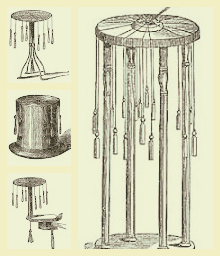
To wrap the strands of hair it was necessary to have a working table with a circular base that had to meet certain requirements. In reality there were several types of braiding tables: one was made in the shape of a pouf and was named ladies' table; it could be used while seated, but often cluttered to the point of hindering the lady who was sitting beside. The other had longer legs and was a full-fledged perch table, but it was more inconvenient to work on it because you had to lean forward. There was still another, the smallest one, which had to be anchored to a side of a table. But there were also those ladies who were clever enough to simply use an inverted cylindrical container, or a hat, on the bottom of which, in the center, they had made a hole; various pieces of twine branched off from it as many as they were required by the pattern they'd chosen, and the strands were tied to them. At the head of each piece of twine they were tied wooden shuttles or lead weights to use them easily. Finally, special patterns, collected in catalogs or manuals, were a valid help to create these very complex artistic objects. The image below represents the cover of the best known, and probably most used one, dating back to 1870.


A. Bernhard & Co. Catalogue, 1870 Manufacturers of Diamond Work & Ornamental Hair Jewelry importers of German Jewelry, Watches, Diamonds, etc.etc.
169 Broadway, Gilsey Building, Rm. 3 New York


But the more sophisticated families and the less industrious ladies went to real artisans who had handed down this art for generations. Unfortunately the names of the various artists have not reached us and all the works that have been preserved are anonymous.
The first thing to do was to prepare the hair strands by properly cleansing them following some instructions with much care. The following are taken from a 1850s serie of issues of The Godey’s Lady’s Book

Sort the tress, which is about to be used, into lengths, tie the ends firmly and quite straight with pack thread, put the hair into a small saucepan with about a pint and a half of water, and a piece of soda of the size of a nut, and boil it for a quarter of an hour or twenty minutes; take it out, shake off the superfluous moisture, and hang it up to dry, but not near a fire.”

When it has become perfectly dry, divide it into strands containing from twenty to thirty hairs each, according to the fineness of the hair or the directions given for the pattern about to be worked. It must be observed that every hair in the strand should be of the same length, and the strands should be all of an equal length.” 

"Knot each end of each strand, then take the requisite number of leaden weights, weighing about three quarters or half an ounce each, and affix about a quarter of a yard of pack thread to each of them; lay them down side by side on the table, and to the other ends of the pack thread affix the strands of hair already prepared, knotting them on with a weaver's or sailor's knot; care must be taken all this time to prevent any entanglement or derangement of the hair."

"The other ends of the strands must now be gathered together, firmly tied with pack thread, and then gummed with a cement composed of equal parts of yellow wax and shellac melted together and well amalgamated, and then rolled into sticks for use. We now come to the table and the arrangement of the strands on it."

And thus had come the time to proceed following the creativity or the chosen models, letting oneself be guided by the patterns.


Here you are some pages from the A. Bernhard & Co. Catalogue, 1870 Manufacturers of Diamond Work & Ornamental Hair Jewelry representing some models of jewels or small keepsakes in hair


I don't go into the descriptive details of every single pattern because they look like real puzzles just reading them; I limit myself to publishing some images and just the starting indications, always taken from the same issues of The Godey's Lady's Book, so that you can at least realize what these ladies of ours were capable of:


A PATTERN FOR A BRACELET (Fig. 4.)

"Sixteen strands of twenty-five or thirty hairs each, according to the fineness of the hair. For this pattern the strands must be arranged in fours, and numbered."
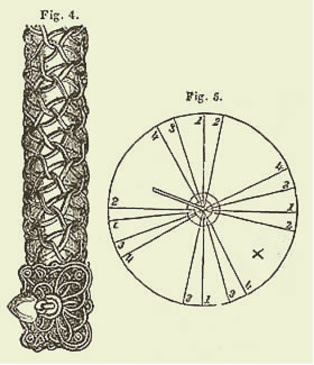


CHAIN OR GUARD PATTERN (Fig. 6.)

"Ten strands only, of about twenty hairs each, are required for this. They must be arranged thus."


A PATTERN FOR A CHAIN OR A GUARD (Fig. 2.)

"For this pattern, sixteen strands, each consisting of about twenty hairs, are required. These must be arranged in pairs on the circle on the table, at equal distances, and so that the opposite pairs shall be in direct lines with each other."


And I'm stopping here, Victorian ladies were much more patient and ingenious than us, that's sure! But it must be said that they could afford to devote much more time to leisure than we can dedicate to it today, perhaps this is what we lack most, alas!


Thanking you with all my heart for following me up to here,
I'm giving you an appointment at the next post,
while sending you much love.
See you soon ❤  


LE OPERE D'ARTE REALIZZATE DALLE LADIES VITTORIANE: Gioielli creati con capelli veri


IMMAGINE 1 - Orecchini fatti con capelli veri montati su oro

Se ci pensate bene, nulla dura per sempre...

Talvolta finisce un amore,

talvolta si logora un'amicizia...

Quanti legami possono deteriorarsi.

Ma tagliate una ciocca di capelli alla persona che avete cara,

ed essa manterrà il suo colore, la sua luce per decenni,

anzi, persino per secoli.


Ce lo hanno insegnato i Vittoriani. Infatti l'arte che lavorava capelli umani, una delle numerose tradizioni del XIX° secolo, è giunta fino a noi come fosse rimasta congelata nel tempo. My Little Old World ve ne ha già fatto cenno trattando, tempo fa, dell'importanza che, nell'immaginario collettivo, avevano, in epoca vittoriana, i capelli femminili tanto che, se la loro robustezza lo consentiva, non si tagliavano per una vita intera. 


IMMAGINE 2 - Lady vittoriana con la sua lunga chioma


A quel tempo ciocche di capelli venivano sapientemente intrecciate in gioielli, avvolte su sé stesse per assomigliare a petali di fiori, persino macinate per essere utilizzate in pigmenti e ciò con cui ci troviamo a confrontarci oggi  sono autentici capolavori realizzati per sconfiggere le leggi dell'esistenza. I capelli di una persona amata, e che si era perduta, erano conservati come memento mori già a partire dal periodo shakespeariano e probabilmente da epoche ben antecedenti. In alcune tombe egizie si trovano, infatti, affreschi che sembrano rappresentare scene in cui faraoni e regine si scambiano ciocche di capelli in segno d'amore. Dal 1600-1700 prese avvio una sorta di culto volto a preservare il ricordo dei cari deceduti: allora era altissima la mortalità infantile, ma anche quella degli adulti raggiungeva cifre esorbitanti. E fabbricare oggetti personali, soprattutto gioielli, con ciocche della loro chioma, divenne a poco a poco una consuetudine. Ma in epoca vittoriana, questa arte che divenne sempre più diffusa e praticata, era più che altro volta a fabbricare quadri con alberi genealogici, a confezionare oggetti da scambiare come pegno d'amore o d'amicizia, ad incorniciare ritratti, etc. utilizzando chiome di persone ancora in vita. Non era inusuale che venissero intrecciati capelli di colori differenti perché appartenenti a persone diverse, magari unite da un legame di parentela: per esempio un dono fatto ad un padre da tre figlie. Poteva anche trattarsi di un semplice segnalibro, ma inserirlo in un diario personale assumeva il significato di avere con sé la vera essenza di chi aveva donato quei capelli. Nell'immagine qui sotto un albero rappresenta una congregazione metodista americana: i germogli che ne rivestono i rami sono fatti con i capelli di ciascun membro che ne faceva parte.


IMMAGINE 3 - Dalla collezione di John Whitenight e Frederick LaValley. Fotografia di Alan Kolc. Courtesy of the College of Physicians of Philadelphia and the Mütter Museum


Ed eccovi altri monili ed un disegno incorniciato e da conservare appeso ad una parete come ornamento che fanno parte di collezioni amatoriali.


IMMAGINI 4-5-6-7-8-9


Si suppone che a dedicarsi a quest'arte, che oggi ci appare così inconsueta e che raggiunse il culmine della sua diffusione attorno al 1850, fossero soprattutto le ladies vittoriane e che si trattasse di un passatempo da salotto, così come lo erano fabbricare fiori di cera (clicca QUI per leggere il post che all'argomento ha dedicato My Little Old World), ricamare, cucire, creare photocollages (clicca QUI per leggere il post che all'argomento ha dedicato My Little Old World).
Ma tra tutti quelli menzionati, quello che lavorava capelli umani era di sicuro il lavoro artistico più artificioso e che potevano permettersi solamente persone altolocate, non fosse altro per ciò di cui ci si doveva munire per realizzare intrecci di ogni tipo. Non tutti potevano acquistare ciò che occorreva e, ricordiamolo, molte erano le donne che dovevano lavorare per sostentare la propria famiglia e non avevano di certo modo di dedicarsi ad occupazioni dilettevoli.


IMMAGINE 10 A SINISTRA - Esempi dei vari tavoli da lavoro utilizzati per intrecciare capelli


Per avvolgere su sé stessi i capelli era necessario munirsi di un tavolino da lavoro con base circolare che doveva rispondere a determinati requisiti. In realtà ne esistevano diversi tipi: uno era fatto a forma di pouf e veniva chiamato ladies' table - tavolino per signore; poteva essere utilizzato stando seduti, ma spesso ingombrava al punto da impicciare la dama che era seduta accanto. L'altro aveva gambe più lunghe ed era un tavolino fatto a trespolo a tutti gli effetti, ma era più scomodo lavorarvi perché si doveva stare protratti in avanti. Un altro ancora, il più piccolo, veniva ancorato su di un lato di un tavolo. Ma vi era anche chi si ingegnava ed usava semplicemente un contenitore cilindrico rovesciato, o un cappello, sul cui fondo, al centro, aveva praticato un foro; da esso si diramavano i vari fili di spago, cui venivano legate le ciocche di capelli, a capo dei quali erano fissate delle navette in legno o pesi di piombo per impugnarli agevolmente. Appositi schemi erano, infine, un valido aiuto per realizzare questi oggetti artistici così tanto complessi, ed erano raccolti in cataloghi o manuali. L'immagine riportata di seguito rappresenta la copertina di quello più noto, e probabilmente il più utilizzato, risalente al 1870.


IMMAGINE 11 - A. Bernhard & Co. Catalogue, 1870 Manufacturers of Diamond Work & Ornamental Hair Jewelry importers of German Jewelry, Watches, Diamonds, etc.etc.,169 Broadway, Gilsey Building, Rm. 3 New York


Ma le famiglie più sofisticate e le ladies poco operose si rivolgevano a veri e propri artigiani che si tramandavano questa arte da generazioni. Purtroppo i nomi dei vari artisti non sono pervenuti a noi e  tutte le opere che si sono conservate sono anonime.
La prima cosa da fare era preparare le ciocche di capelli detergendole adeguatamente seguendo scrupolosamente alcune istruzioni. Le seguenti sono tratte da alcuni numeri del  del Godey's Lady's Book risalenti agli anni '50 del 1800:

"Separare la treccia, che sta per essere utilizzata, in lunghezze, legare le estremità saldamente e abbastanza dritte con filo da impacco, mettere i capelli in una piccola casseruola con circa mezzo litro d'acqua e un pezzo di soda della dimensione di una noce e fare bollire per un quarto d'ora o venti minuti; tirare fuori i capelli, scrollare via l'umidità superflua e appenderli ad asciugare, ma non vicino al fuoco."

"Quando saranno diventati perfettamente asciutti, dividerli in ciocche contenenti da venti a trenta capelli ciascuna, secondo la finezza del capello o le indicazioni date per il disegno da lavorare. Si deve prestare attenzione a che tutti i capelli della ciocca siano della stessa lunghezza e che le ciocche siano tutte lunghe uguali."

"Annodare ciascuna estremità di ogni ciocca, quindi prendere il numero richiesto di pesi di piombo, del peso di circa tre quarti o mezza oncia ciascuno, e attaccare circa un quarto di iarda di filo da imballaggio a ciascuno di essi; adagiarli uno accanto all'altro su di un tavolo, e alle altre estremità del filo legare le ciocche di capelli già preparate, annodandole con un nodo da tessitore o da marinaio; bisogna fare molta attenzione, durante tutte queste operazioni, al fine di evitare che i capelli si aggroviglino o si scompongano".

"Le altre estremità delle ciocche devono ora essere raccolte insieme, legate saldamente con filo da impacco, quindi gommate con una malta composta da parti uguali di cera gialla e gommalacca fuse insieme e ben amalgamate, e quindi arrotolate in bastoncini per l'uso. Raggiungere infine il tavolo da lavoro e disporre le ciocche su di esso."

Era così giunto il momento di procedere seguendo la creatività o i modelli scelti, lasciandosi guidare dagli schemi.


IMMAGINE 12 - Artigiano al lavoro

IMMAGINE 13 - Alcune pagine tratte dall' A. Bernhard & Co. Catalogue, 1870 Manufacturers of Diamond Work & Ornamental Hair Jewelry che riportano modelli cui ispirarsi per creare gioielli di ogni tipo e per tutti i gusti


Non scendo nei dettagli descrittivi di ogni singolo schema perché sembrano degli autentici rompicapo solo a leggerli; mi limito a pubblicare alcune immagini e le indicazioni di partenza, sempre tratte dai medesimi numeri del Godey's Lady's Book, perché vi rendiate almeno conto di cosa erano capaci queste nostre ladies:


SCHEMA PER UN BRACCIALETTO (IMMAGINE 14

"Sono necessarie sedici ciocche di venticinque o trenta capelli ciascuna, a seconda della finezza dei capelli. Per questo modello le ciocche devono essere disposte a quattro e numerate."


SCHEMA PER INTRECCIARE UNA CATENA (IMMAGINE 15)

"Solo dieci ciocche, di circa venti capelli ciascuna, sono necessarie per questo schema. Devono essere disposte come illustrato dall'immagine:


SCHEMA PER UNA CATENA O UN GIROCOLLO (IMMAGINE 16)

"Per questo schema, sono necessarie sedici ciocche, ciascuna composta da circa venti capelli. Queste devono essere disposte in coppia sul piano del tavolo da lavoro, a pari distanze, e in modo che le coppie opposte siano perfettamente di rimpetto tra loro."


Ed io mi fermo qui, le ladies vittoriane erano decisamente molto più pazienti ed ingegnose di noi. Ma va detto anche che potevano permettersi di dedicare agli svaghi molto più tempo di quanto possiamo dedicarvi noi oggi, forse è questo che più ci fa difetto, purtroppo!


Ringraziandovi con tutto il cuore per avermi seguita fino a qui, 
vi do appuntamento al prossimo post,
e vi auguro ogni bene.
A presto 


LINKING WITH:


lunedì 8 novembre 2021

~ VICTORIAN AGE CURIOSITIES V ~


I know that whenever I find myself publishing such a post I always arouse your enthusiasm.
Well, it has been passing so a long time since I published 'VICTORIAN AGE CURIOSITIES IV' so let's not hesitate any further and let's read together!

༺♡❀♡༻

So che ogni qualvolta mi trovo a pubblicare un post come questo suscito sempre il vostro entusiasmo. 
Beh, è trascorso molto tempo da che ho pubblicato 'VICTORIAN AGE CURIOSITIES IV' quindi non esitiamo ulteriormente e leggiamo insieme!


 SIAMESE TWIN BROTHERS
This is a very curious photograph I found on a Victorian book about the oddities of those times: these are two siamese twins brother conjoined at their moustaches... do you think it to be possible?
We mustn't forget that Victorians were also keen and able in photomontages (click HERE to read what ~ My little old world ~ wrote about this topic).


 GEMELLI SIAMESI
Questa è una fotografia molto curiosa trovata su di un libro vittoriano che tratta delle stranezze di quei tempi: questi sono due gemelli siamesi che sarebbero uniti dai loro baffi... pensate che sia possibile?
Non dobbiamo dimenticare che i vittoriani erano anche appassionati e abili nei fotomontaggi (clicca QUI per leggere cosa ha scritto ~ My little old world ~ su questo argomento).


༺♡❀♡༻


 THE "HOUSEWIFE"
If uniforms jumped a button or tore, who would mend them?
The antiquated term "housewife" refers to a portable sewing kit, the term was first used in print in 1749 and comes from an era when it was common for mothers, wives and girlfriends in the 18th and 19th centuries to embroider these custom sewing kits for their men to take to war. Inside the miniature fabric roll, it could hold a thimble, needles, thread, spare buttons, and fabric scraps. The "housewife" was often contained in the bag and placed in the man's backpack.


 LA "CASALINGA"
Se alle divise saltava un bottone o se si strappavano quando i ragazzi o gli uomini che le vestivano erano lontani da casa, chi le rammendava? 
Il termine antiquato "casalinga" si riferisce a un kit da cucito portatile, utilizzato per la prima volta in un documento stampato del 1749 e deriva da un'epoca in cui era comune per madri, mogli e fidanzate - il XVIII° ed il XIX° secolo - confezionare questi kit da cucito personalizzati per i loro uomini da portare in guerra. All'interno di una tasca in tessuto veniva riposto un ditale, aghi, filo, bottoni di ricambio e ritagli di tessuto. La "casalinga" era spesso contenuta nel borsone o riposta nello zaino dell'uomo.

༺♡❀♡༻


 DID YOU KNOW THAT QUEEN VICTORIA WAS A GERMAN BLOOD QUEEN?
Maybe not everybody knows that the British crown is of German origins and that Queen Victoria belonged to the House of Hanover.
The House of Hanover, British Royal House of German origin, descended from George Louis, elector of Hanover, who succeeded to the British crown, as George I, in 1714. The dynasty provided six monarchs: George I (reigned 1714–27), George II (reigned 1727–60), George III (reigned 1760–1820), George IV (reigned 1820–30), William IV (reigned 1830–37), and Victoria (reigned 1837–1901). Hanover (an electorate, which became a kingdom in 1814) was joined to the British crown until 1837. In that year Victoria inherited the British crown but, by continental Salic Law, was barred as a woman from succession to Hanover, which went to William IV’s brother, Ernest Augustus, Duke of Cumberland.
The House of Hanover in Great Britain was succeded by the House of Saxe-Coburg-Gotha - which belonged the Prince Consort Albert to and it happened when Edward VII began King - and was renamed in 1917 the House of Windsor by King George V.
It was July 17th, 1917 when King George V issued a proclamation declaring “The Name of Windsor is to be borne by His Royal House and Family and Relinquishing the Use of All German Titles and Dignities.”
This name change saw every German reference and title being replaced with something British. The use of “Degrees, Styles, Dignities, Titles and Honours of Dukes and Duchesses of Saxony and Princes and Princesses of Saxe-Coburg and Gotha, and all other German Degrees, Styles, Dignities, Titles, Honours and Appellations,” was to be discontinued.
The decision to adopt Windsor as the family name came amid strong anti-German feeling rised during the first world war.


Queen Victoria (1819–1901) by James Hayllar (1829–1920) and George Dunlop Leslie (1835–1921), Photo credit Wallingford Town Council


 SAPEVATE CHE LA REGINA VICTORIA ERA DI SANGUE TEDESCO?
Forse non tutti sanno che la corona britannica è di origine tedesca e che la regina Victoria apparteneva alla Casa di Hannover.
La Casa di Hannover, Casa Reale Britannica di origine tedesca, discendeva da George Louis, elettore di Hannover, che successe alla corona britannica con il nome di Giorgio I, nel 1714. La dinastia fornì sei monarchi: Giorgio I (regnò dal 1714 al 1727), Giorgio II (regnò 1727–60), Giorgio III (regnò 1760–1820), Giorgio IV (regnò 1820–30), Guglielmo IV (regnò 1830–37) e Victoria (regnò 1837–1901). Hannover (un elettorato, che divenne un regno nel 1814) fu unito alla corona britannica fino al 1837. In quell'anno Victoria ereditò la corona britannica ma, per legge salica continentale, fu preclusa come donna dalla successione della corona degli Hannover, che andò al fratello di Guglielmo IV Ernesto Augusto, duca di Cumberland.
Alla Casa di Hannover in Gran Bretagna successe la Casa di Sassonia-Coburgo-Gotha - cui apparteneva al Principe Consorte Alberto e accadde esattamente nel 1901 quando Edoardo VII divenne re - e fu ribattezzata nel 1917 Casa di Windsor da Re Giorgio V.
Era il 17 luglio 1917 quando il re Giorgio V emise un proclama dichiarando "Il nome di Windsor deve essere portato dalla sua casa reale e dalla sua famiglia che deve rinunciare all'uso di tutti i titoli e le dignità tedesche".
Questo cambio di nome fece sì che ogni riferimento e titolo tedesco fosse sostituito con qualcosa di britannico. L'uso di "Gradi, Stili, Dignità, Titoli e Onorificenze di Duchi e Duchesse di Sassonia e Principi e Principesse di Sassonia-Coburgo e Gotha, e tutti gli altri Gradi, Stili, Dignità, Titoli, Onorificenze e Appellativi tedeschi" doveva essere interrotto.
La decisione di adottare Windsor come nome di famiglia fece seguito ad un forte sentimento anti-tedesco sorto durante la prima guerra mondiale.


༺♡❀♡༻

 50 SHADES OF BLACK
As well as mourning loved ones, there was another, more practical reason, why so many Victorians wore a lot of black or dark grey gowns – it was all down to pollution. Large clouds of pollution thanks to coal often left people wearing in white coming back home wearing in dark grey! Industry was booming in the Victorian era, and as such pollution was rife – particularly in the cities – meaning that women who wore light colours would find their dresses turn shades of grey, and so opted for darker clothing.


Fashion plate from 1860


 50 SFUMATURE DI NERO
Oltre al lutto per i propri cari, vi era un'altra ragione, ben più pratica, per cui così tanti vittoriani indossavano abiti neri o grigio scuro: l'inquinamento. Grandi nuvole di inquinamento dovute al carbone spesso facevano sì che persone vestite di bianco tornassero a casa vestite di grigio scuro! L'industria era in forte espansione nell'era vittoriana, e poiché tale inquinamento era molto diffuso, in particolare nelle città, significava che le donne che indossavano abiti con colori chiari avrebbero scoperto che, stando all'aperto, i loro abiti avrebbero assunto sfumature di grigio, e quindi optavano direttamente per abiti più scuri.


༺♡❀♡༻


 YOU DIDN'T LEARN THIS IN BRITISH HISTORY
We've already seen that in the Victorian age it was very usual that people sold food by the streets. This was favored by the fact that the workers had a short break for lunch and could not go home for refreshment.
But it must be said that street vendors often sold some unusual foods. One popular delicacy was sheep’s feet, which were sold hot or cold. People in Victorian Britain called them “trotters” and purchased them at low prices from slaughterhouses. Vendors would buy them and prepare them at home by skinning and parboiling them, before selling them to workers in the street. Customers would then suck the meat and fat off the bones.


Getty Images

 NON LO AVETE IMPARATO STUDIANDO STORIA INGLESE
Abbiamo già visto che in epoca vittoriana era molto comune che la gente vendesse cibo per strada.
Ciò era stato favorito dal fatto che i lavoratori avevano una breve pausa per il pranzo e non potevano rincasare per rifocillarsi.
Ma va detto che spesso i venditori ambulanti vendevano cibi insoliti. Erano considerati una prelibatezza popolare i piedi di pecora, che venivano venduti caldi o freddi. La gente nella Gran Bretagna vittoriana li chiamava "zamponi" e li acquistava a basso prezzo dai mattatoi. I venditori li compravano e li preparavano in casa scuoiandoli e sbollentandoli, prima di venderli ai lavoratori per strada. I clienti quindi succhiavano la carne e il grasso dalle ossa.


༺♡❀♡༻

 ROYALS WITH TATTOOS
Though modern-day royals are unlikely to have any tattoos in the Victorian era it was common for the nobility to adorn their bodies. It all started when Queen Victoria’s son, the Prince of Wales, visited Jerusalem during his Grand Tour in the Middle East in 1862. He saw someone getting a tattoo and decided to get one of his own. With this decision, he started a huge trend. Some estimates say that almost 100,000 people across the United Kingdom got tattoos. And
one would perhaps be surprised to learn that also Empress Elisabeth from Austria had a tattoo of an anchor on her left shoulder done in 1888 to represent her love undying love for the sea, as sailors used to have!


Albert Edward Prince of Wales at the centre with a wine bottle at his feet picnicking under a fig tree near Capernaum - a Christian site in the Galilee. Photo by Francis Bedford, 1862

 REALI TATUATI 
Sebbene sia improbabile che i reali moderni abbiano tatuaggi, nell'era vittoriana era comune per la nobiltà adornare i propri corpi con essi. Tutto ebbe inizio quando il figlio della regina Vittoria, il principe di Galles, visitò Gerusalemme durante il suo Grand Tour in Medio Oriente nel 1862. Fu allora che vide qualcuno farsi un tatuaggio e decise quindi di farsene fare uno anche lui. Da allora diede avvio ad una vera e prorpia moda. Alcune stime dicono che quasi 100.000 persone in tutto il Regno Unito erano tatuate e forse suscita sorpresa apprendere che anche l'imperatrice Elisabetta d'Austria aveva il tatuaggio di un'ancora sulla spalla sinistra fatto nel 1888 per rappresentare il suo amore eterno per il mare, come erano soliti avere i marinai!

༺♡❀♡༻

 AN IMPORTANT GIFT FROM TSAR NICHOLAS II TO QUEEN VICTORIA
A silver-gilt and enamel notebook made by Gustav Fabergé which was a gift from Tsar Nicholas II to Queen Victoria. The Queen used it to collect the signatures of guests, including ambassadors and related foreign royalty, who had joined her for her Diamond Jubilee celebrations in 1897. Many of the signatories had attended a special dinner at Buckingham Palace, including a man who the Queen noted in her journal she had sat beside - Franz Ferdinand, who had recently become the Archduke of Austro-Hungary and whose assasination 17 years later would be the catalyst for the First World War.


A silver-gilt and enamel notebook made by Gustav Fabergé

 UN IMPORTANTE DONO: PER LA REGINA VITTORIA DALLO ZAR NICOLA II
Si tratta di un dono che lo zar Nicola II fece alla regina Vittoria. Ella lo utilizzò per raccogliere le firme degli ospiti, inclusi gli ambasciatori e i relativi reali stranieri, che si erano uniti a lei per le celebrazioni del Giubileo di diamante nel 1897. Molti dei firmatari avevano partecipato a una cena speciale a Buckingham Palace, incluso un uomo cui la regina, annotò nel suo diario, si era seduta accanto: si trattava di Francesco Ferdinando, recentemente diventato arciduca d'Austria-Ungheria e il cui assassinio 17 anni dopo sarebbe stato il catalizzatore della prima guerra mondiale. 

༺♡❀♡༻
 AU NATUREL
Makeup was considered gauche for a society woman to wear, as it was used mostly by sex workers. One judge even proclaimed that lipstick was similar to witchcraft, in that it had the ability to seduce men. If you were a society woman, you would probably pinch your cheeks to give yourself a glow, and you might use cold cream to appear youthful and dewy. But nothing more than this!


Édouard Manet, Nana, 1877. Kunsthalle Hamburg. Photo via Wikimedia Commons.

 AU NATUREL
Si considerava al tempo che il trucco rendesse goffa una donna dell'alta società, poiché era usato principalmente dalle prostitute. Un giudice ebbe persino il coraggio di affermare che il rossetto era simile alla stregoneria, in quanto aveva la capacità di sedurre gli uomini. Se fossi una donna dell'alta società, probabilmente ti pizzicheresti le guance per darti un po' di colore e potresti usare la crema fredda per apparire giovane e rugiadosa. Ma niente di più! 


༺♡❀♡༻

 I'LL HAVE A BEER WITH THAT!
Clean, potable water was hard to come by in Victorian society. It was generally polluted and considered more dangerous to drink than nature’s other perfect liquid—beer. Whether you were sick, pregnant, or just a child, beer was generally safer to drink than water and was also considered genuine and nutritious. It was documented that by 1860, the River Thames was full of the raw fecal matter and sewage that was dumped into the water on a daily basis. Since the river was also the main source of drinking water for the city, people died by the thousands from dysentery, cholera, and typhoid. Once again, for people in the Victorian era, this was a great excuse to drink beer!


Getty Images


 BERRO' UNA BIRRA!
Nella società vittoriana era difficile trovare acqua pulita e potabile. Era generalmente inquinato e considerato più pericoloso da bere rispetto all'altro liquido perfetto della natura: la birra. Che tu fossi malata, incinta o solo un bambino, la birra era generalmente più sicura da bere dell'acqua ed era anche considerata genuina e nutriente. È stato documentato che nel 1860 il fiume Tamigi era pieno della materia fecale grezza e dei liquami che venivano scaricati nell'acqua quotidianamente. Poiché il fiume era anche la principale fonte di acqua potabile per la città, migliaia di persone morivano di dissenteria, colera e tifo. Ancora una volta, per le persone dell'era vittoriana, questa era un'ottima scusa per bere birra!

༺♡❀♡༻

 BOTTLING TEARS
It wasn’t just Queen Victoria mourning her husband—mourning was a serious business in Britain during the Industrial Revolution. Mourning women wore beautiful, elaborate jewelry that incorporated onyx or jet (both black stones) and even braided hair from the deceased. Tears cried for the deceased were collected in bottles. Tear bottles were prevalent in ancient Roman times, when mourners filled small glass vials or cups with tears and placed them in burial tombs as symbols of love and respect. Sometimes women were even paid to cry into “cups”, as they walked along the mourning procession. Those crying the loudest and producing the most tears received the most compensation, or so the legend goes. The more anguish and tears produced, the more important and valued the deceased person was perceived to be. … Tear bottles reappeared during the Victorian period when they were named TEARS CATCHER or LACRIMATORY and were ornately decorated with silver and pewter. Special stoppers allowed the tears to evaporate. When the tears were gone, the mourning period would end.


 IMBOTTIGLIARE LACRIME
Non fu solo la regina Vittoria a portare il lutto per la perdita di suo marito: il lutto era una cosa seria in Gran Bretagna durante la rivoluzione industriale. Le donne in lutto indossavano gioielli molto particolari ed elaborati che incorporavano onice o giaietto (entrambe pietre nere) e persino capelli intrecciati del defunto. Le lacrime versate per la persona amata e scomparsa venivano raccolte in apposite bottiglie. Esse erano molto in uso nell'antica Roma, quando le persone in lutto riempivano con le lacrime piccole fiale o coppe di vetro e le mettevano nelle tombe funerarie come simboli di amore e rispetto. A volte le donne venivano persino pagate per piangere nelle "coppe", mentre camminavano lungo la processione funebre. Coloro che piangevano più forte e piangevano più lacrime ricevevano il maggior compenso, o almeno così narra la leggenda. Più angoscia esibivano e più lacrime piangevano, più importante e stimata era la persona deceduta. Le bottiglie per le lacrime riapparvero durante il periodo vittoriano quando furono chiamate RACCOGLITRICI DI LACRIME o LACRIMATORIA ed erano riccamente decorate con argento e peltro. Tappi speciali permettevano alle lacrime di evaporare e quando esse si erano del tutto dissolte, il periodo di lutto si riteneva concluso.

༺♡❀♡༻

 DINING IN THE DARK
Victorians believed that digestion could be aided by sitting in the dark, and so, dining rooms were built in the basement, close to the kitchen. At least they got to eat the food that they could barely see while it was still hot! In later years, the room was moved to the first floor, but based on knowledge gleaned only from Downton Abbey, servants still took their meals in the basement.


Getty Images

 CENARE NELLA PENOMBRA
I vittoriani credevano che la digestione potesse essere aiutata se i cibi venivano consumati stando seduti al buio, ed ecco perché le sale da pranzo erano spesso situate nel seminterrato, vicino alla cucina. Solo così il cibo, che riuscivano a malapena a  vedere, si conservava ancora caldo! Negli anni successivi, ossia in epoca edoardiana, la sala da pranzo fu spostata al primo piano, e rimasero i servi  a consumare ancora i pasti nel seminterrato.

༺♡❀♡༻

 MODESTY BOARDS
This is something we rarely hear about, but since it was considered to be very risky and inappropriate to show one’s ankles, women wore dresses that covered their feet fully. However, when they sat down, that could expose their ankles, and that’s why modesty boards were invented.
We’ve all seen parodies of “racy” Victorian photographs, where a woman shows off a single ankle. Well, showing even a tiny bit of skin was taboo, and necessity is the mother of invention. Thus, the ever-industrial Victorians created “modesty boards.” These boards would be nailed or propped up close to the ground to ensure that women’s ankles were not visible when they were seated, maybe for a shot, like in this case!


Getty Images

 TAVOLE DI PUDORE
È qualcosa di cui si sente parlare raramente, ma poiché era considerato molto rischioso e inappropriato mostrare le caviglie, le donne indossavano abiti che coprivano completamente i piedi. Tuttavia, quando si sedevano, le caviglie si potevano intravvedere dal bordo dell'abito ed è per questo che furono inventate le 'modesty board'.
Abbiamo visto tutti parodie di fotografie vittoriane "audaci", in cui una donna mostra una sola caviglia. Beh, mostrare anche solo un pezzettino di pelle era tabù, e, come sappiamo, la necessità aguzza l'ingegno. Pertanto i vittoriani, molto industriosi, crearono "tavole di pudore". Queste tavole erano inchiodate o appoggiate al pavimento per garantire che le caviglie delle donne non fossero visibili quando erano sedute, magari per lo scatto di una fotografia come in questo caso. 

༺♡❀♡༻

 VICTORIAN MOUSTACHE SPOON or 'ETIQUETTE SPOON'
And if we started talking about mustaches, let's conclude this curious post by returning to this topic: have you ever wondered how the Victorian gentlemen kept their mustaches neat and clean? This detail was all the rage during the Victorian period; large drops of wax were dissolved and then applied to the mustaches to keep their curls intact.
And here was a problem that arose when steaming cups of coffee or tea were brought to the mouth to sip the liquid they contained. The steam melted the wax and sent it directly into the cup into the hot liquid to drink. Another problem soon became evident: sipping hot tea or coffee, the mustaches often got stained. And do you think it was easy to sip soup or broth for the conspicuously mustachioed gentlemen?
For sure you will remember that for many years important mustaches called 'favorites', which wjoined sideburns, were in vogue - it was the Emperor Franz Joseph who launched this fashion.
Well, aware of this... difficulty, Harvey Adams, an ingenious Englishman, invented the "mustache cup" in 1860 which had a metal protrusion, called the mustache guard, which ran through a side of the cup. The guard had a semicircular opening against the side of the cup which allowed the mustaches to stay safe and dry on the metal guard while the gentleman sipped his hot drink through the opening.
A further step was taken when the "mustache spoon" was invented, patented in the second half of the 19th century, to allow men to consume liquids without spilling them on their mustaches or clothes. The first patented mustache spoon dates back to March 1868 and bears the signature of a New York spoon designer, Solon Ferrer: it was a simple soup spoon with a protection that kept the mustache free and not soiled by the liquid underneath. Mustache spoons, known as "label spoons", were very popular in the Victorian era and more than twenty patents were obtained in the United States to improve their use and were created for left and right-handed gentlemen and some even had detachable protectors. Most mustache spoons date from the late 19th to the early 20th century, when mustache fashion began to decline.


 CUCCHIAIO VITTORIANO PER BAFFI O 'CUCCHIAIO DI ETICHETTA'
E se abbiamo cominciato parlando di baffi, concludiamo questo post curioso tornando su questo argomento: vi siete mai chiesti come facevano i signori vittoriani a conservare in ordine e puliti i loro baffi? Questo dettaglio era di gran moda durante il periodo vittoriano; grandi gocce di cera venivano sciolte e poi applicate sui baffi per mantenerne intatti i ricci.
E qui c'era un problema che si presentava quando fumanti tazze di caffè o tè venivano portate alla bocca per sorseggiare il liquido in esse contenuto. Il vapore scioglieva la cera e la mandava direttamente nella tazza a sciogliersi nel liquido caldo da bere. Un altro problema divenne presto evidente: sorseggiando tè o caffè caldi, i baffi spesso si macchiavano. Ed era, inoltre, facile, secondo voi, sorseggiare zuppa o brodo per i signori vistosamente baffuti?
Di sicuro vi ricorderete che per molti anni furono in voga importanti baffi chiamati 'favoriti' che erano un tutt'uno con le basette - fu l'imperatore Francesco Giuseppe a lanciare questa moda.
Ebbene, consapevole di questa...difficoltà, Harvey Adams, un ingegnoso inglese, nel 1860 inventò "la tazza per baffi" che aveva una sporgenza in metallo, chiamata guardia dei baffi, che attraversava la tazza. La guardia aveva un'apertura semicircolare contro il lato della coppa che consentiva ai baffi di rimanere al sicuro e asciutti sulla protezione in metallo mentre il gentleman sorseggiava la sua bevanda calda attraverso l'apertura.
Un ulteriore passo avanti venne fatto quando fu inventato il cucchiaio per baffi, brevettato nella seconda metà del XIX° secolo per consentire agli uomini di consumare liquidi senza versarli sui baffi o sui vestiti. Il primo cucchiaio per baffi brevettato risale al marzo 1868 e reca la firma di un designer di cucchiai di New York, Solon Ferrer: era un semplice cucchiaio da minestra con una protezione che teneva i baffi liberi e non sporchi del liquido sottostante. I cucchiai per baffi, conosciuti come “cucchiai di etichetta”, erano molto popolari in epoca vittoriana e negli Stati Uniti furono ottenuti più di venti brevetti per migliorarne l'uso e ne vennero creati per signori mancini e destrimani e alcuni avevano persino protezioni staccabili. La maggior parte dei cucchiai per baffi risale alla fine del XIX° secolo-inizi del XX° secolo, periodo in cui la moda dei baffi iniziò a declinare.


I wonder if this time too I've let you spend some time in lightheartedness 
and leisure . . . 
I hope it so very much!
I'm  leaving you with my warmest hug,
See you soon 


Chissà se anche questa volta vi ho fatto trascorrere un po' di tempo in spensieratezza e svago . . . lo spero tanto!
Vi lascio con il mio più caloroso abbraccio,
A presto 


LINKING WITH: