Visualizzazione post con etichetta servants. Mostra tutti i post

giovedì 25 novembre 2021

"Longbourn" by Jo Baker, the Downstairs World of "Pride and Prejudice"


Once upon a time there was the Bennet family: a distracted father, a suffocating mother with five daughters to marry. Jane Austen masterfully tells us her noble troubles in Pride and Prejudice, but she is silent about the servants who, from dawn until late at night, busied themselves so that the conversation in the living room could flow smoothly and everything was clean and in its own place. 
Jo Baker reveals the half of the world populated by shadows who, while cooking and cleaning for others, live their own lives and have their own hopes. And which, under their second-hand clothes, hide secrets, wounds and passions no less intense than those animating who lives at the upper floors.


In this, which could be called a historical novel since it is intertwined with the Napoleonic wars in their last steps, the authoress gives voice to the servants of the Bennet house, and does it without distorting Austen's masterpiece.
The novel is set in 1815, a historic moment in which England was precisely in the middle of a military campaign against Napoleon Bonaparte's France. Jo Baker talks about the war and describes the bloody military campaigns of Spain and Portugal, while Austen does not mention it except through the presence of the officers. Most of the young Englishmen had entered the regiments, thus causing the absence of young marriageable males and the consequent degradation of wealthy young ladies like Lydia and Kitty.


Many enlist themselves with the intention of ​​sacrificing their lives to protect the country from the French threat, while many others do it simply for the sake of boasting.
The authoress is forced to deal with the wars of those time by a character, such James Smith, whose sudden arrival will cause no small disturbance in everyone's life: his destiny is in fact much more linked than it seems to the dynamics of the Bennet family.
The arrival of this young man, who will be hired as a valet, is intertwined with the lives of the masters as well as with those of Mr and Mrs Hill, the two elderly servants, with that of the little Polly, a scullery maid, but above all it will be a cause for great upset for the young Sarah, Jane and Elizabeth Bennet's personal maid, who emerges from the plot, presenting herself more and more as the real protagonist.
No member of the servants has the courage to complain about too much work, yet it is quite tiring to polish the floors with tea leaves or wake up with the sunrise to clean the fireplaces of the ashes of the day before and of the night and bring the water inside the house. Everyone is in fact aware of the fact that this is the only way they had to live peacefully with a roof over their head rather than wandering the streets begging. They are not envious of the worldly life of the rich and Sarah herself admits that she is not resentful of the comforts of her mistresses. But the monotony that marks the daily rhythm of the Bennets and the country nobility entails a heaviness in the spirit that ordinary people couldn't bear.


Sarah, an open-minded and intelligent girls, dreams of discovering what lies beyond the hill on which the Netherfield Park residence stands. Her intentions come to life from the fear of spending the rest of her days serving as a maid in the house of nobles, such has been the fate of the good-natured Mrs Hill who has managed the Bennets' house for many years now. The young woman is thus led to feel more and more curiosity towards James, whose experience he has acquired over the years is greater than what he does want to leak.
Well, Sarah is not only intrigued by this mysterious young man, but she is also the only one to feel suspicious of him: he is a handsome boy, good-looking, but of few words and appeared out of nowhere - he will be entrusted with the care of the horses and the most strenuous work outside the Longbourn estate - and she does not hide her fear: he could be a criminal, perhaps escaped from the English army, or a thief who has crept into their house to rob them, and amazes her the enthusiasm with which he has been accepted by everyone and the apparent naivety of the other members of what has now become a real family, even if to unite those who are part of the servants are only emotional ties and not of blood (both Sarah and Polly are two orphans).
One night then, with the complicity of the dark, the young woman reaches James's room located above the stables and rummages in her pockets... thus discovering his secret.
James was the son of Mrs Hill and Mr Bennet, and therefore, as illegitimate, he was raised by the family of the neighbors, the Smiths, from whom, still a young boy, he fled one day, and no one knew anything about him for years.
But how could Mrs Hill find him and bring him back to 'his' home?

I'm leaving you with this mystery that heralds many others, but I do not want to reveal the whole plot, I only anticipate you that this novel has a happy ending.


It's needless to say that I recommend you this reading it because the authoress, very skillfully, manages to work alongside Jane Austen, giving life and voice to the shadows that she, in her masterpiece, only occasionally touches upon and because she, of Jane Austen, even takes up the narrative rhythm, which makes this writing a pleasant 'refuge' for the season we are approaching.
Ah, I forgot to tell you that this reading was highly recommended by Franca on her BLOG some  months ago: knowing her for some time, I followed her suggestion without hesitation and I sincerely thank her for letting me spend happy hours in carefree.
And when I end a book with a hint of melancholy, it means that it has given me something truly extraordinary, which has enriched my soul with pleasant emotions and sensations!


Jo Baker, Longbourn
Black Swan Publisher, 
first edition January 2014,
448 pages


In the hope to have suggested you a captivating reading for the coming days 
which will be growing shorter, colder and darker,
I'm sending my dearest love to you!

See you soon 


Longbourn di Jo Baker, il mondo 'che appartiene al piano di sotto' di Orgoglio e Pregiudizio


- IMMAGINE 1 - FRONTESPIZIO


C'era una volta la famiglia Bennet: un padre distratto, una madre soffocante con cinque figlie da maritare. Jane Austen ne racconta magistralmente i signorili affanni in Orgoglio e pregiudizio, ma tace sulla servitù che, dall'alba a tarda notte, si affaccendava perché la conversazione in salotto scorresse serena ed ogni cosa fosse linda e al proprio posto. 
Jo Baker svela una metà del mondo popolata di ombre che, mentre cucinano e puliscono per gli altri, vivono vite loro e nutrono speranze proprie. E che, sotto abiti di seconda mano, nascondono segreti, ferite e passioni non meno intense di quelle che animano chi vive ai piani superiori.


In questo, che potrebbe essere definito un romanzo storico poiché si intreccia con le guerre napoleoniche nelle loro ultime battute, l'autrice dà voce alla servitù di casa Bennet, e lo fa senza snaturare il capolavoro della Austen.
Il romanzo è ambientato nel 1815, momento storico in cui l’Inghilterra si trovava appunto in piena campagna militare contro la Francia di Napoleone Bonaparte. Jo Baker parla della guerra e descrive le sanguinose campagne militari di Spagna e Portogallo, mentre la Austen non ne fa menzione se non attraverso la presenza degli ufficiali. La gran parte dei giovani inglesi era entrata all’interno dei reggimenti, causando così l’assenza di giovani maschi sposabili e il conseguente avvilimento delle signorine benestanti come Lydia e Kitty. 


- IMMAGINE 2 - Due delle sorelle Bennet (probabilmente Jane ed Elizabeth)


Molti si arruolano con l’idea di porre in sacrificio la propria vita per proteggere il Paese dalla minaccia francese, mentre molti altri lo fanno semplicemente per motivi di vanto.
L'autrice è obbligata a trattare delle guerre del tempo da un personaggio, tale James Smith, il cui arrivo improvviso porterà non poco scompiglio nella vita di tutti: il suo destino è infatti molto più legato di quanto non sembri con le dinamiche della famiglia Bennet.
La venuta di questo giovane, che verrà assunto come valletto, si intreccia con le vite dei padroni di casa nonché con quelle di Mr e Mrs Hill, i due anziani domestici, con quella della piccola Polly, una sguattera, ma soprattutto sarà motivo di grande turbamento per la giovane Sarah, cameriera personale di Jane ed Elizabeth Bennet, che dalla trama emerge presentandosi sempre più come la vera protagonista. 
Nessun membro della servitù ha il coraggio di lamentarsi del troppo lavoro, eppure è piuttosto faticoso lucidare i pavimenti con le foglie da tè o svegliarsi con il sorgere del sole per pulire i camini dalla cenere del giorno prima e della notte e portare l’acqua in casa. Tutti sono infatti consapevoli del fatto che sia questo l’unico modo per vivere serenamente con un tetto sulla testa anziché girovagare per le strade con la mano tesa a mendicare. Non provano invidia circa la vita mondana dei ricchi e Sarah stessa ammette di non provare astio riguardo agli agi propri delle sue 'padroncine'. Ma la monotonia che scandisce il ritmo giornaliero dei Bennet e della nobiltà di campagna comporta una pesantezza nello spirito che la gente comune mal saprebbe sopportare. 


- IMMAGINE 3 -  Il desiderio di Sarah di affrancarsi da quella sua vita


Sarah, di mentalità aperta ed intelligente, sogna di scoprire cosa c’è oltre la collina sulla quale troneggia la residenza di Netherfield Park. I suoi propositi prendono vita dal timore di passare il resto dei suoi giorni a servire come cameriera in casa di nobili, tale è stato il destino della bonaria Mrs Hill che gestisce la casa dei Bennet ormai da tanti anni. La giovane è portata così a provare sempre più curiosità nei confronti di James, la cui esperienza acquisita negli anni è maggiore di quanto questi non voglia far trapelare.
Ebbene Sarah non solo è incuriosita da questo giovane misterioso, ma è anche l'unica ad avvertire sospetti nei suoi confronti: egli è un ragazzo prestante, di bell'aspetto, ma di poche parole ed apparso dal nulla - cui verranno affidati la cura dei cavalli ed i lavori più faticosi all'esterno della tenuta di Longbourn - non nasconde di temere che si tratti di un criminale, magari fuggito dall'esercito inglese, oppure di un ladro insinuatosi in casa loro per derubarli, e la stupisce l'entusiasmo con cui è stato accolto e l'apparente ingenuità degli altri componenti di quella che ormai è divenuta una vera e propria famiglia, anche se ad unire coloro che fanno parte della servitù sono solamente legami emotivi e non di sangue (sia Sarah che Polly sono due orfanelle).
Una notte quindi, con la complicità del buio, la giovane raggiunge la stanza di James situata al di sopra delle stalle e fruga nelle sua tasche... giungendo così a scoprire il suo segreto.
James era figlio di Mrs Hill e di Mr Bennet, e quindi, come illegittimo, fu allevato dalla famiglia dei vicini, gli Smith, dai quali, ancora giovinetto, un giorno fuggì, e di lui nessuno seppe più nulla per anni.
Ma come aveva fatto Mrs Hill a ritrovarlo e a ricondurlo a casa 'sua'?

Vi lascio con questo mistero che ne preannuncia ben altri, ma non voglio svelarvi l'intera trama, vi anticipo solamente che il romanzo si conclude con un lieto fine.


- IMMAGINE 4 - Indizio sul finale


Inutile dire che ve ne consiglio la lettura perché l'autrice, molto abilmente, riesce ad affiancarsi alla Austen dando vita e voce alle ombre che ella, nel suo capolavoro, solo occasionalmente sfiora e della Austen riprende persino il ritmo narrativo, il che fa di questo scritto un piacevole 'rifugio' per la stagione a cui ci stiamo approssimando.
Ah, dimenticavo di dirvi che questa lettura fu vivamente consigliata da Franca sul suo BLOG mesi fa: conoscendola ormai da tempo seguii senza esitazione il suo suggerimento e la ringrazio sinceramente per avermi fatto trascorre ore liete in spensieratezza.
E quando concludo un libro con un velo di malinconia, vuol dire che mi ha donato qualcosa di veramente straordinario, che ha arricchito il mio animo di emozioni e di sensazioni piacevoli!


- IMMAGINE 5 - Copertina dell'edizione inglese del libro di Jo Baker (il testo è stato tradotto in italiano ed in francese, trovate le edizioni on-line)


Nella speranza di avervi suggerito una lettura accattivante per i prossimi giorni
che si faranno sempre più corti, freddi e bui,
vi invio il mio più caro affetto!

A presto ❤


LINKING WITH:


giovedì 6 aprile 2017

The 'Downstairs' side of Country House Life.


Gossip on the Stairs, Otto Erdmann (1834 - 1905)


Sapete ormai quanto ami il mondo che durante il periodo vittoriano ed edoardiano si muoveva 'Downstairs' ossia nei locali che erano collocati sotto le scale delle grandi, imponenti dimore situate nella campagna inglese ... forse perché mi è sempre apparso così gaio, vivace, sempre in fermento, ho sempre visto collaborazione e corporativismo tra i componenti la servitù, li ho sempre visti come se fossero, in fondo, componenti di una grande famiglia, poiché essendo tutti accomunati dall'essere lontano da casa era naturale che nascesse tra di loro un affetto particolare ... sì, mi sarebbe piaciuto, magari solo per qualche giorno, provare a vivere in una di quelle fastose dimore, ma magari come housekeeper - governante - o come cuoca, che, in ordine gerarchico, ad essa era immediatamente sottoposta, ma con davvero poche responsabilità in meno; la governante era il corrispettivo, tra i membri femminili, del butler - e non lo traduco con maggiordomo perché sarebbe riduttivo, non esiste la parola adeguata per me per descrivere in modo calzante le responsabilità ed i compiti amministrativi dell'intera casa che gravavano su di lui - analogamente al quale non aveva mansioni servili, bensì di ordine burocratico - gestionale ( a lei toccava dare gli stipendi ai dipendenti, ordinare le vettovaglie, sorvegliare su quanto veniva operato in cucina e nell'intera casa, dare ordini alla cuoca circa i voleri dei signori ).


La cuoca - cook - aveva la responsabilità di sostenere, con i piatti che preparava, la famiglia che le dava lavoro, senza far loro mancare nulla e senza chiedere denaro in più da spendere alla governante, doveva far fare a tutti i Signori che la mantenevano un figura decorosa in caso di feste o banchetti ed aveva 'sotto di sé' la plain cook, ossia colei che preparava piccoli pasti e spuntini per lo staff dei servi e la trained cook, ossia l'aiuto cuoca che le era di sostegno per i tocchi più sofisticati, magari esotici dei piatti da portare in tavola; le più giovani collaboratrici in cucina erano la kitchen maid e la scullery maid, poiché entrambe cominciavano a lavorare al compimento del quattordicesimo anno di età: la prima era addetta alla pulizia e alla mondatura delle verdure, oltre che alla pulizia dei locali tra la preparazione di un pasto ed un altro, mentre la seconda si occupava delle componenti meno impegnative delle portate da servire.

La cucina e le stanze ad essa collegate erano in fermento per tutte le ore della giornata, durante il periodo vittoriano ed edoardiano il costume voleva che fosse sempre il momento giusto per preparare pasti o spuntini ed il personale doveva sempre essere pronto e disponibile, ovviamente: 
Consumavano abbondanti colazioni costituite da numerosi piatti - kedgeree, uova e pancetta, e cacciagione cui avrebbero poi fatto seguito spuntini a metà mattinata costituiti da uova sode e toast. Il pranzo, un pasto molto più pesante di quanto ci si aspetterebbe oggi, vi avrebbe seguito nel giro di due ore o giù di lì, e il tè del pomeriggio sarebbe stato un pasto sostanzioso in sé, con panini e torte e marmellate che il cuoco aveva preparato. La cena sarebbe constata di quattro o cinque portate, e più tardi la sera ci sarebbe stati panini a disposizione per tutti coloro che avvertivano un certo languorino.

Ovviamente queste esagerate quantità di cibo giocavano a discapito della salute dei benestanti che vedevano accorciarsi enormemente le loro aspettative di vita, anche se periodicamente trascorrevano giorni di cura presso le 'spa' e le stazioni termali del tempo e, per converso, significavano un'enorme mole di lavoro per chi doveva cucinare... di certo in cucina non vi era chi si annoiava !

Anche se noi siamo soliti pensare alla servitù come ad una realtà misera, triste, deprivata o quanto meno afflitta, era questo in Gran Bretagna un mondo di tutto rispetto, che esistesse o meno confidenza tra Signori e personale di servizio, tanto che molto spesso le giovani, di umile estrazione sociale, questo sì, partivano come donne di fatica per raggiungere traguardi talora insperati ed impensabili, dato che non dovevano sostenere spesa alcuna per mantenersi, poiché anche se le loro paghe non erano elevate e talora dovevano inviare denaro alla famiglia, riuscivano negli anni a metter da parte un bel ... tesoretto !


Vi faccio l'esempio di Rosa Ovenden (1867 - 1952), conosciuta meglio con il cognome Lewis che assunse sopo il matrimonio.
Figlia di un imprenditore di pompe funebri nacque a Leyton, in Essex e lasciò la scuola all'età di 12 anni per divenire una 'ragazza di fatica'; dopo quattro anni il caso volle che fosse richiesta presso la dimore di reali esiliati e così venne a far parte dello staff del pretendente al Trono Francese, Philippe, Conte di Parigi, dove ebbe l'opportunità di imparare la lingua e la cucina che stava dilagando e divenendo al tempo così famosa per sostituirsi a quella così sostanziosa tipicamente vittoriana.
Stiamo parlando di una ragazza intraprendente per cui ben potete immaginare che presto ella divenne Head Kitchen Maid, ossia domestica a capo delle cucine, che non avrebbe dovuto cucinare, ma che lo faceva occasionalmente per gli ospiti di riguardo, non ultimo il Principe di Galles, futuro Re Edoardo VII che la volle conoscere e che entrò in confidenza con lei divenendone 'amico' .... ( ricordate quel post che pubblicai non molto tempo fa in cui vi rendevo note le sue numerose ... debolezze ... se volete potete trovarlo qui METTERE LINK ).
Rosa si stabilì quindi presso la dimora di un altro esule, il Duca d'Orleans, e da allora si spostava da una residenza aristocratica ad un'altra quando era richiesta in occasione di banchetti o parties divenendo ormai conosciuta come THE QUEEN OF COOKS, ossia LA REGINA DI TUTTE LE CUOCHE.


Rosa stava a poco a poco venendo in contatto con i membri più autorevoli dell'aristocrazia europea che alloggiavano a Londra e nel 1902 fu in grado di acquistare i locali del Cavendish Hotel in Jermyn Street del quale divenne conduttrice senza interrompere la sua carriera di cuoca sopraffine sopravvivendo alle due guerre mondiali e ad almeno un infarto.
Ecco, questa in poche righe la prodigiosa vita di colei che venne da tutti soprannominata The Duchess of Jermin Street e divenne famosa al punto che negli anni settanta la BBC dedicò a questo personaggio unico una fiction ( The Duchess of Duke Street ) tratto dal romanzo Vile Bodies di Evelyn Waugh (1930).


Rosa in età matura ritratta con il suo cagnolino Kippy


Tornando alla gerarchia che secondo regole ferree governava il mondo 'Downstairs', di livello inferiore sia alle governante che alla cuoca era la lady's maid, equivalente al femminile del gentleman's valet: costei, che potremmo definire la cameriera personale della signora, probabilmente di estrazione sociale medio-bassa, doveva avere dei requisiti che generalmente non erano richiesti per coloro che lavoravano in cucina, ossia doveva essere generalmente di bell'aspetto e saper parlare correttamente e fluentemente - meglio se oltre l'inglese conosceva anche il francese ( di solito le lady's maid erano di origine francese o svizzera ) - essendo colei che accompagnava per tutto il giorno ed in ogni circostanza la Lady, ed era vestita o di grigio o di nero in accordo alla sobrietà di cui si faceva portatrice, essendo di fatto parte dell'immagine che al pubblico la Lady offriva di sé; essa la abbigliava per qualsiasi evento, la sera le scaldava gli indumenti per la notte prima che li indossasse, compiva le cosìdette 'calls', ossia le visite di cortesia con lei, viaggiando spesso anche per lunghe distanze al suo fianco, insomma della sua Lady era quasi l'ombra.


World of Dreams, Lady Laura Theresa Alma-Tadema, 1876.


Doveva inoltre avere delle competenze specifiche che potessero far sì che fosse all'altezza del suo ruolo, quindi faceva dei corsi che la rendevano capace nel preparare composti cosmetici, abile nell'acconciare la lunga capigliatura che connotava la Lady vittoriana, aveva competenze anche in fatto di cucito - se per esempio durante un viaggio si fosse sdrucito in parte l'orlo della sottana della sua Lady, ella avrebbe dovuto essere in grado di intervenire con successo - ed avere una certa resistenza fisica e costanza, poiché il dover essere sempre al fianco della Lady, per esempio quando si recava ad un ballo dal quale rincasava il primo mattino, significava andare a dormire quando gli altri si alzavano, se prima doveva svestire, lavare, abbigliare per il riposo e mettere a letto la propria signora stanca della sua giornata, per poi finalmente accasciarsi sul proprio letto, spesso collocato nella stanza a fianco di quella della Lady ! 


Maid with Flagon, William Powell Frith, 1858.


Ecco perché generalmente le lady's maid erano chiamate 'Miss', perché sovente lo erano davvero, non si addiceva per certo l'avere una famiglia ad una ragazza impegnata in cotal guisa e e che doveva lavorare con una tale dedizione.

Ed infine rappresentavano, sempre da un punto di vista gerarchico, un caso a sé sia le parlourmaids che la chambermaids che stavano a metà, anche da un punto di vista strettamente pratico, tra il mondo 'Downstairs' e quello 'Upstairs', essendo le prime responsabili delle stanze 'pubbliche 'della casa - la morning room, il drawing room, il parlour, la library, di cui pulivano i tappeti, le inferiate e lucidavano i mobili ed erano responsabili dell'ordine che vi doveva regnare, 


The Secret, Wilhelm Amberg (1822 - 1899)


Femme de Chambre, Joseph Caraud, 1868.


mentre alle seconde competevano le camere da letto, dal momento in cui ne aprivano le imposte il mattino fino alla sera quando infine le riaccostavano: a loro spettava il compito di portare su il tè del mattino, la pulizia delle stanze ed il portare su per le scale acqua calda per lavare i padroni e gli eventuali ospiti.

Questo per quanto riguarda il mondo femminile, della servitù al maschile vi parlerò in una prossima occasione.


Vi giunga come sempre gradita la mia più sentita riconoscenza,
carissimi lettori ed amici,
e a voi che passate di qui per la prima volta
do il mio più caloroso benvenuto !


A presto 💕


FONTI BIBLIOGRAFICHE:

Judith Flanders, The Victorian HouseHarper Perennial, 2004;

Pamela HornThe Rise and Fall of the VICTORIAN SERVANT, Sutton Publishing LTD;

Pamela Horn, Life in the Victorian Country House, Shire Publisher, 2010;

Lee Jackson Daily Life in Victorian London: an Extraordinary Anthology, Kindle Edition, 2011;

Lee Jackson, A Dictionary of Victorian London: An A-Z of the Great Metropolis, Anthem Press, 2006; 

Trevor May, The Victorian Domestic Servant, Shire Publisher, 2008;
(qui ne trovate una breve anteprima)

Michael Paterson, PRIVATE LIFE IN BRITAIN'S STATELY HOMES - Masters and Servants in the Golden AgeConstable & Robinson Ltd., 2012;

Emily Augusta Patmore, THE SERVANT'S BEHAVIOUR BOOK or Hints on Manners and Dress for Maid Servants in Small Households by Mrs. Motherly, Bell and Daldy, London, 1859
- disponibile on-line al seguente indirizzo

https://archive.org/details/servantsbehavio00patmgoog

Pamela A. Sambrook, The Country House Servant, Sutton Publisher, 1999; 

Duties of Servants: A Practical Guide to the Routine of Domestic Service
by Member of the Aristocracy.


CITAZIONI:

1 - Michael Paterson, PRIVATE LIFE IN BRITAIN'S STATELY HOMES - Masters and Servants in the Golden AgeConstable & Robinson Ltd., 2012, pag. 2012.


- picture 1 - Gossip on the Stairs, Otto Erdmann (1834 - 1905)


You know how much I love the world that during the Victorian and Edwardian age lived 'Downstairs', that is in the environments that were placed under the stairs of the large, stately homes located in the English countryside ... maybe because I've always seen it so cheerful, lively, always in turmoil, I always saw corporatism and collaboration between the members of the servitude, I have always seen them as if they were, after all, members of a large family, since, being them all united from being away from home, it was natural that it were born a special affection among them ... yes, I would have liked, if only for a few days, to try living in one of those lavish homes, but perhaps as a housekeeper or as a cook, that, in hierarchical order, was immediately subjected to her, but with very few responsibilities in less; the housekeeper was the corresponding, amongst female members, of the the butler similar to what she had not menial jobs, but bureaucratic - managerial ones (she had to give salaries to the employees, to order supplies, to monitor of what was practiced in the kitchen and throughout the house and to give orders to the cook about the wishes of the masters).


- picture 2


The cook had the responsibility to support, with the dishes she prepared, the family who gave her her work, without letting her masters leave anything and without asking for more money to spend  for the meals at the housekeeper, she had to do everything that would maintained a dignified figure to her masters in the case of parties or banquets and had 'beneath her' the plain cook, that she was who had to prepare small meals and snacks for the staff of servants and the trained cook, ie the help cook who had to support her for more sophisticated touches in her preparations, maybe exotic dishes for special occasions; the younger helpers in the kitchen was the kitchen maid and the scullery maid, since both of them began to work at the age of  fourteen: the first was involved in the cleaning and peeling of vegetables, as well as the cleaning of the rooms around the kitchen between the preparation of a meal and another, while the second took care of the less demanding components of the courses to be served.


- picture 3 on the left - The kitchen and the rooms connected to it were abuzz all hours of the day long, during the Victorian and Edwardian era, the costume ever wanted it to be the right time to prepare meals or snacks and the staff always had to be ready and willing, of course: 

They ate very large breakfasts of numerous dishes - kedgeree, bacon and eggs, and game. There would then be mid-morning snzcks prepared for them, such as boiled eggs and toast. Luncheon, a much heavier repast than we would expect today,would followw within two hours or so, and afternoon tea would be a substantial meal in itself, with sandwiches and cakes and jams that the cook would have made. Dinner would be of four or five courses, and later in the evening there would be more sandwiches laid out for anyone who was feeling peckish. 1

Obviously these exaggerated quantities of food were playing at the expense of the health of the wealthy who saw their life expectancy greatly shorten, although regularly spent days of treatment at the spas of the time and, on the other hand, it meant an enormous amount of work for those who worked in the kitchen ... certainly there was not who he was bored there !
Although we usually think of servitude as such a miserable reality, sad, deprived or at least afflicted, this was in Britain a world of all respect, whether there were confidence or not between Masters and service personnel, so that very often young people, of humble social background, started their career as a 'fatigue girl' to achieve goals sometimes unexpected and unthinkable, given that they should not support any spending for living, because even if their wages were not high and sometimes had to send money to their family, with the passing of the times they could put aside a nice ... treasure!


- picture 4 on the right - Let me give you the example of Rosa Ovenden (1867 - 1952), better known with her surname Lewis which she assumed after her wedding.
Daughter of an undertaker Rosa was born in Leyton, Essex and left school at age 12 to become a maid of all works; after four years she happened to be required at the residences of royal exile from France and so she became part of the staff of the pretender to the French throne, Philippe, Count of Paris, where she had the opportunity to learn the language and the art of the 'cuisine' that was spreading and becoming at once so famous to replace, little by little that so nourishing typically Victorian.
We are talking about a resourceful girl so you can well imagine that soon she became Head Kitchen Maid, ie domestic head of the kitchens, that is that she should not have to cook, but she did it occasionally for important guests, not least the Prince of Wales, future King Edward VII, who wanted to know her, and who grew a so very close friend of hers to become on eof her lovers .... ( remember the post that I published not long ago in which I made you aware of his many 'weaknesses' ... if you want ... you can find it HERE - PUT LINK).

Rosa settled then at the home of another exile, the Duke of Orleans, and since then she moved from an aristocratic residence to another when she was required for banquets or parties now becoming known and named THE QUEEN OF ALL COOKS.


- picture 5


Rosa was gradually coming into contact with the most influential members of the European aristocracy who were staying in London and in 1902 she was able to buy the premises of the Cavendish Hotel in Jermyn Street which she managed without interrupting her career as a superfine cook surviving two world wars and at least one heart attack.
Here, in this few lines the prodigious life of the woman who was by all dubbed The Duchess of Jermin Street and became popular to the point that in the seventies the BBC devoted to this unique character a fiction (The Duchess of Duke Street) adapted from the novel Vile Bodies by Evelyn Waugh (1930).


- picture 6 - Rose in her mature age with her little dog Kippy


Coming back to the hierarchy which according to strict rules governed the world 'Downstairs', at the lower level of the housekeeper  and  the cook there was the lady's maid, equivalent of the gentleman's valet: she, probably coming from medium-low class, must had the requirements that generally weren't necessary for those working in the kitchen, given she had to be generally good-looking and know how to speak correctly and fluently - better if besides English also knew French (usually the lady's maid were of French or Swiss origin) - being the one who accompanied the Lady throughout the day and in all circumstances, and she was usually dressed in gray or black according to the sobriety of which she was bearer, being in fact part of the image that at the public the Lady offered of herself; she dressed her for any event, the evening warmed her clothing for the night before she wore them, with her she did the so called 'calls', ie courtesy visits with her, often travelling for long distances at her side, in short, she was almost her Lady's shadow.


- picture 7 - World of Dreams, Lady Laura Theresa Alma-Tadema, 1876.


She also had to have have specific skills that made her deserve her position, that's why she did some courses that made her capable of preparing cosmetic compounds, skilled with arranging the long hair that connoted the Victorian Ladies, and also had responsibilities in terms of sewing - if for example during a journeyher Lady had torn in part the hem of her skirt, she would have to be able to intervene with success - and have a certain physical strength and constancy, since she always had to be at the side of her Lady, for example, when she went to a ball from which she came back home early in the morning, it meant going to sleep when the others got up, since she first had to undress her mistress, to wash her, to dress herlady tired for her day and then finally collapse on her own bed, often placed in the room next to the Lady's.


- picture 8 - Maid with Flagon, William Powell Frith, 1858.


That's why usually the lady's maid was called 'Miss', because often they really were not married, given such a busy life didn't suit for sure to a woman who had a family.

And finally, always from a hierarchical point of view, a special case was represented by the parlourmaids and the chambermaids who were between, also from a strictly practical point of view, the world 'Downstairs' and that 'Upstairs', being the first responsible for the 'public' rooms of the house - the morning room, the drawing room, the parlor, the library, of which they cleaned carpets, grates and polished all the furniture, and were responsible for order that was to reign there,


- picture 9 - The Secret, Wilhelm Amberg (1822 - 1899)


- picture 10 - Femme de Chambre, Joseph Caraud, 1868.


while the latter competed bedrooms, from the moment they opened the shutters in the morning until the evening when finally the closed them: they had the task of bringing upside the morning tea, of cleaning the rooms and bring up the stairs hot water to wash the masters and possible guests.

So much for the feminine world of servitude, about male servants I'm going to deal with it in a future occasion.


May it reach you welcome, as usual, my most heartfelt gratitude,
dear Readers and Friends,
and as for you who are passing by here for the first time
I give you my warmest welcome !


See you soon 💕


BIBLIOGRAPHIC SOURCES:

Judith Flanders, The Victorian HouseHarper Perennial, 2004;

Pamela HornThe Rise and Fall of the VICTORIAN SERVANT, Sutton Publishing LTD;

Pamela Horn, Life in the Victorian Country House, Shire Publisher, 2010;

Lee Jackson Daily Life in Victorian London: an Extraordinary Anthology, Kindle Edition, 2011;

Lee Jackson, A Dictionary of Victorian London: An A-Z of the Great Metropolis, Anthem Press, 2006; 

Trevor May, The Victorian Domestic Servant, Shire Publisher, 2008;
(qui ne trovate una breve anteprima)

Michael Paterson, PRIVATE LIFE IN BRITAIN'S STATELY HOMES - Masters and Servants in the Golden AgeConstable & Robinson Ltd., 2012;

Emily Augusta Patmore, THE SERVANT'S BEHAVIOUR BOOK or Hints on Manners and Dress for Maid Servants in Small Households by Mrs. Motherly, Bell and Daldy, London, 1859
- disponibile on-line al seguente indirizzo

https://archive.org/details/servantsbehavio00patmgoog

Pamela A. Sambrook, The Country House Servant, Sutton Publisher, 1999; 

Duties of Servants: A Practical Guide to the Routine of Domestic Service
by Member of the Aristocracy.


QUOTATIONS:

1 - Michael Paterson, PRIVATE LIFE IN BRITAIN'S STATELY HOMES - Masters and Servants in the Golden AgeConstable & Robinson Ltd., 2012, p. 2012.


LINKING WITH:

HAPPY HOMEMAKER MONDAY

THE ART OF HOME-MAKING MONDAYS


AWWW MONDAYS

BLUE MONDAY

THURSDAY FAVORITE THINGS - 
I was featured by Bev Carter at Ecletic Red Barn, I heartily thank you, sweet friend !!!


HOME SWEET HOME

FRIENDSHIP FRIDAY BLOG PARTY

PINK SATURDAY

I was featured by Beverly, I heartily thank you, sweet friend !!!

SATURDAY'S CRITTERS


venerdì 10 gennaio 2014

BEING IN SERVICE IN VICTORIAN TIMES: rules and wages.


Franck Antoine Bail (1858 - 1924), A Maid Watering Flowers


In ogni famiglia dell'epoca vittoriana, quando il reddito raggiungeva circa £ 150 p.a. veniva assunta una giovane adolescente come donna di servizio 'maid-of-all-works' che di solito era impegnata per 14-16 ore al giorno nei lavori più umili e se la famiglia possedeva un negozio ella avrebbe anche servito dietro il bancone; non appena il reddito aumentava, con esso, analogamente, aumentava il numero dei suoi dipendenti. 

Una cameriera ed una cuoca costituivano la priorità e solamente le persone davvero facoltose impegnavano domestici di sesso maschile perché esisteva la 'servant tax' la tassa sulla servitù che per loro doveva essere aggiuntivamente pagata allo stato.

I ricchi villeggianti che affittavano residenze per le vacanze estive spesso portavano al loro seguito solo una cameriera facente parte della servitù abituale mentre il resto era spesso affittato con la proprietà per impieghi stagionali.

Il metodo sicuramente più efficace per trovare personale di servizio era dato dalle inserzioni come appuntava il figlio di Charles Dickens " I domestici sono più svariati di quanto lo siano le materie prime. Il modo migliore per procurarsene uno è di sceglierlo leggendo gli annunci sui quotidiani .- Charles Dickens (Jr.), Dickens's Dictionary of London, 1879  ed ecco a voi, perciò, alcuni ritagli tratti dai giornali dell'epoca:


Sempre nel medesimo articolo, più avanti si legge: " I salari medi di Londra possono essere impostati come segue: Maggiordomi, £ 40 a £ 100, Facchini, £ 20 a £ 40, Paggi, £ 8 a 15 £, Cuochi, £ 18 a £ 50; Cameriere, £ 10 a £ 25; Cameriere di salotto, £ 12 a £ 30; "servi generali" e donne di fatica, £ 6 a £ 15. Il preavviso di un mese è richiesto prima di lasciare il lavoro o prima delle dimissioni, ma in quest'ultimo caso un mese di stipendio (e mance se richieste) sarà sufficiente. Se commette una grave colpa un domestico può essere licenziato senza alcun preavviso. "1


Ma cosa qualificava una domestica seria e ben educata, un maggiordomo affidabile, una governante responsabile, una cameriera solerte ?

Innanzitutto le referenze e poi, in secondo luogo, la rispondenza con quanto stabilito dai manuali che nello specifico trattavano della servitù, delle competenze e dei requisiti che al personale di servizio erano fondamentali in base alla mansione cui assolveva.
Anche per questo, come per ogni aspetto della loro vita, i vittoriani avevano pensato a regole fissate per iscritto, regole ben precise da imparare, rispettare, far rispettare.


Pensate che il vademecum per il comportamento della servitù, il  THE SERVANT'S BEHAVIOUR BOOK or Hints on Manners and Dress for Maid Servants in Small Households by Mrs. Motherly, pubblicato a Londra nel 1859 che stabiliva le regole non solo per l'atteggiamento che era conveniente assumere ma anche il modo di camminare, la postura, la modulazione dell voce, il modo di abbigliarsi etc. comincia così, titolando il primo capitolo OF THE VOICE AND SPEAKING, ovvero DELLA VOCE E DEL MODO DI PARLARE fissando come segue quelli che allora erano ritenuti i requisiti principali per una persona di servizio .. e noi che leggiamo oggi, noi che ahimè, viviamo in un mondo ormai caotico, un mondo governato dal baccano, da suoni talora tanto forti che offendono l'udito, scorriamo queste righe quasi con meraviglia ...


MAI LASCIARE CHE LA VOSTRA VOCE VENGA UDITA DALLE SIGNORE E DAI SIGNORI DELLA CASA, E QUANDO NECESSARIO, IL MENO POSSIBILE. 2 

MAI COMINCIARE A PARLARE CON LA VOSTRA PADRONA A MENO CHE NON SIA PER CONSEGNARE UN MESSAGGIO O PORRE UNA DOMANDA NECESSARIA, ED IN TAL CASO FARLO NEL PIU' BREVE TEMPO POSSIBILE. 3 


MAI PARLARE AD UN ALTRO DOMESTICO, PERSONA DEL VOSTRO STESSO RANGO O AD UN BAMBINO IN PRESENZA DELLA VOSTRA PADRONA TRANNE CHE PER NECESSITA'; ED ALLORA FATELO PIU' VELOCEMENTE POSSIBILE E SOTTOVOCE. 
4 


MAI PARLARE AD UN COMPAGNO DI SERVIZIO, A UNA PERSONA DEL VOSTRO STESSO RANGO, O AD UN BAMBINO IN UN CORRIDOIO, UN ATRIO, UNA SCALA O QUALSIASI ALTRO LUOGO AD ESSI AFFINE, A PATTO CHE NON SIA STRETTAMENTE NECESSARIO, ED IN TAL CASO FATELO SOTTOVOCE E NEL MINOR TEMPO POSSIBILE. 5 

MAI CHIAMARSI DA UNA STANZA ALL'ALTRA.
6 


RISPONDETE SEMPRE QUANDO RICEVETE UN ORDINE OD UN RIMPROVERO.
7 


e alla fine del capitolo viene ribadito per puntiglio il principio di partenza; al capitolo secondo intitolato TITLES OF RESPECT, ovvero APPELLATIVI DI RISPETTO, così si legge:

MAI RIVOLGERSI AD UNA SIGNORA O AD UN SIGNORE SENZA USARE GLI APPELLATIVI 'SIR' O 'MA'AM' O 'MISS' A SECONDA DEL CASO. 8 

MUOVERSI SEMPRE CON GRAZIA.

STATE SEMPRE FERMI E TENETE LE MANI AVANTI, O LUNGO I FIANCHI QUANDO PARLATE, O QUANDO QUALCUNO VI RIVOLGE LA PAROLA. 10 

ALZATEVI SEMPRE IN PIEDI QUANDO UNA SIGNORA, O UN SIGNORE ENTRA NELLA STANZA IN CUI SIETE VOI. 11 


E più avanti ancora:

Le balie sono spesso incoraggiate a cantare nella nursery; ma devono cessare immediatamente non appena fa il suo ingresso una signora o un signore. 12 

Mai prendere una piccola cosa della stanza in mano. Le lettere, il denaro, piccoli pacchi, un bicchiere, un cucchiaio, un coltello, una spoletta di cotone, un fazzoletto piegato, o qualsiasi altra piccola cosa, devono essere consegnati su un piccolo vassoio, che sia d'argento o no, conservato per lo scopo.


Un grande pacco, un libro così grande da apparire imbarazzante sul vassoio per le lettere, un piatto, e tutte le cose più grandi, possono essere consegnate a mano. 13 

Nulla può fare un' impressione migliore in un estraneo di un aspetto ordinato e pulito; e giustamente, giudichiamo che una ragazza che tenga le proprie mani ed i propri abiti puliti faccia lo stesso con il nostro cibo ed i nostri utensili.
14 


Non bisogna mai scegliere abiti di modelli o colori troppo azzardati . Non solo essi non sono adatti al lavoro che ogni domestica deve compiere il mattino, ma non potranno mai essere appropriati per dei dipendenti.
15 


Quanto agli stipendi il primo in ordine cronologico a dettare legge fu proprio il famoso e qui già più volte citato Mrs. Beeton's Book of Household Management (Comprising Information for the Mistress, Housekeeper, Cook, Kitchen-maid, Butler, Footman, Coachman, Valet, Upper and under house-maids, Lady’s-maid, Maid-of-all-work, Laundry-maid, Nurse and nurse-maid, Monthly, wet, and sick nurses, etc. etc. - also, sanitary, medical, & legal memoranda;) with a history of the origin, properties, and uses of all things connected with home life and comfort., scritto da Isabella Beeton e pubblicato nel 1861, altro testo miliare dell'epoca vittoriana che era doveroso consultare per qualsiasi cosa fosse pertinente alla casa e a chi la abitava, in cui, al paragrafo 21 del capitolo 1, CHAPTER I che tratta della padrona di casa, THE MISTRESS, in merito alle paghe stabilite mediamente per il personale di servizio, reca scritto quanto segue:


"La Governante da £ 10 a £ 80; Il Valletto da 25 a 50; Il Maggiordomo da 25 a 50; La Cuoca da 20 a 40; Il Giardiniere da 20 a 40; Il Lacchè da 20 a 40; Il Vice Maggiordomo da 5 a 30; Il Cocchiere da 20 a 35; Lo Stalliere da 15 a 30; Il Secondo Lacchè da 12 a 20; Il Paggio da 8 a 18; Il Garzone di Stalla da 6 a 12. "


In nome della loro puntigliosità, organizzazione, schematicità e sagacia i vittoriani tenevano persino veri e propri registri sul personale di servizio alle proprie dipendenze, ovvero molto spesso questo era uno dei doveri ascritti alla governante:


E per finire, prima di salutarvi con il mio più caloroso abbraccio, concludo con una citazione che amo


Fortunata la casa e felice il padrone quando ha un servo accorto, che ascolta sì le sue parole, ma non le segue e fa piuttosto a suo senno!


Fratelli Grimm, da Il servo accorto, in Fiabe, p. 515.


Joseph Caraud (1821 - 1905), Sharing the Chocolate


e dicendovi che qualora aveste piacere di leggere altro su questo stesso argomento 


  ☞ vi suggerisco questo mio breve racconto in due parti:


http://sweetlydreamingofthepast.blogspot.it/2013/07/upstairs-and-downstairs-una-giornata.html

http://sweetlydreamingofthepast.blogspot.it/2013/07/upstairs-and-downstairs-una-giornata_9.html


A presto 


Bibliografia:

Isabella BeetonMrs. Beeton's Book of Household Management (Comprising Information for the Mistress, Housekeeper, Cook, Kitchen-maid, Butler, Footman, Coachman, Valet, Upper and under house-maids, Lady’s-maid, Maid-of-all-work, Laundry-maid, Nurse and nurse-maid, Monthly, wet, and sick nurses, etc. etc. - also, sanitary, medical, & legal memoranda;) with a history of the origin, properties, and uses of all things connected with home life and comfort., S. O. Beeton Publishing, London, 1861
- disponibile on-line al seguente indirizzo: 
http://ebooks.adelaide.edu.au/b/beeton/isabella/household/

Judith Flanders, The Victorian HouseHarper Perennial, 2004

Pamela HornThe Rise and Fall of the VICTORIAN SERVANT, Sutton Publishing LTD

Pamela Horn, Life in the Victorian Country House, Shire Publisher, 2010

Lee Jackson Daily Life in Victorian London: an Extraordinary Anthology, Kindle Edition, 2011

Lee Jackson, A Dictionary of Victorian London: An A-Z of the Great Metropolis, Anthem Press, 2006 

Trevor May, The Victorian Domestic Servant, Shire Publisher, 2008
(qui ne trovate una breve anteprima)

Emily Augusta Patmore, THE SERVANT'S BEHAVIOUR BOOK or Hints on Manners and Dress for Maid Servants in Small Households by Mrs. Motherly, Bell and Daldy, London, 1859
- disponibile on-line al seguente indirizzo

https://archive.org/details/servantsbehavio00patmgoog

Pamela A. Sambrook, The Country House Servant, Sutton Publisher, 1999 

Duties of Servants: A Practical Guide to the Routine of Domestic Service
by Member of the Aristocracy


Citazioni: 

1 - Lee Jackson,  A Dictionary of Victorian London: An A-Z of the Great Metropolis, Anthem Press, 2006 pag. 264

2 - Emily Augusta Patmore, THE SERVANT'S BEHAVIOUR BOOK or Hints on Manners and Dress for Maid Servants in Small Households by Mrs. Motherly, Bell and Daldy, London, 1859, pag. 11
3 - op. cit., pag. 13
4 - op. cit., pag. 23
5 - op. cit., pag. 27
6 - op. cit., pag. 29
7 - op. cit., pag. 29
8 - op. cit., pag. 32
9 - op. cit., pag. 40
10 - op. cit., pag. 41
11 - op. cit., pag. 46
12 - op. cit., pag. 76
13 - op. cit., pag. 77
14 - op. cit., pag. 82
15 - op. cit., pag. 87


- picture 1 - Franck Antoine Bail (1858 - 1924), A Maid Watering Flowers


In every family of the Victorian era, when the income reached about £ 150 p.a. it was employed a young girl as ' maid-of-all-works ' which was usually engaged for 14-16 hours a day in the most menial jobs and if the family owned a store she would also have served behind the counter; as soon as the income increased, with it, similarly, increased the number of its employees.

A maid and a cook were the priority and only the really wealthy people committed domestic male because there was a ' servant tax ' a tax on to the male servants that had to be paid additionally to the state.

The wealthy vacationers who rented residences for the summer holidays often brought in their wake only a maid that was part of the usual servants while the rest was often rented with the property for seasonal jobs .

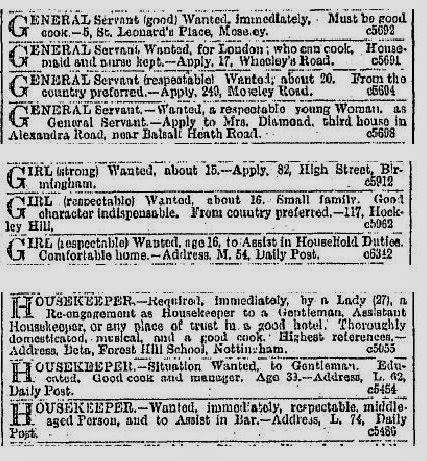
The method that was certainly the most effective way to find service staff was given by advertisment as noted by Charles Dickens jr."Servants vary even more than most commodities. The best way to get one is to select from the advertisements in the daily papers" 
Dickens's Dictionary of London, 1879; here you have, therefore, some clippings taken from the newspapers of the time:


- picture 2

- picture 3

- picture 4


Also in the same article we read further: " The average London wages may be set down as: Butlers, £40 to £100; Footmen, £20 to £40; Pages, £8 to £15; Cooks, £18 to £50; House. maids, £10 to £25; Parlour-maids. £12 to £30; “General Servants,”  Anglice Maids of all Work, £6 to £15. A month’s notice required before leaving or dismissing; but in the latter case a month’s wages (and board wages if demanded) will suffice. For serious misconduct a servant can be discharged without notice. " 1

But what qualified a serious and well-educated domestic, a reliable butler, a housekeeper in charge, a hard-working maid ? 


- picture 5 on the right - First of all, the references and then, secondly, the compliance with the provisions of the manuals that specifically dealt about servants, the skills and the requirements that were fundamental for the servants according to the task which they performed.
For this too, as with every aspect of their lives, the Victorians had thought of rules laid down in writing, precise rules to learn, observe, to make enforce.

You have to know that the specific handbook for the servant's behaviuor, the THE SERVANT 'S BEHAVIOUR BOOK or Hints on Manners and Dress for Maid Servants in Small Households by Mrs. Motherly , published in London in 1859 which established the rules not only for the attitude that it was convenient to take but also the way they had to walk, the posture, the modulation of the voice, the way of dressing etc. . so begins, headlining the first chapter OF THE VOICE AND SPEAKING setting as follows what were then considered the main requirements for a service person .. and we who are reading today, we who, alas, we live in a such cahotic world, a world ruled by the noise, by sounds sometimes so strong that offend our hearing, scroll down these lines almost with wonder ...


- picture 6


NEVER LET YOUR VOICE BE HEARD BY THE LADIES AND GENTLEMEN OF THE HOUSE EXCEPT WHEN NECESSARY AND THEN AS LITTLE AS POSSIBLE.

NEVER BEGIN TO TALK TO YOUR MISTRESS UNLESS IT IS TO DELIVER A MESSAGE OR ASK A NECESSARY QUESTION, EVEN THEN DO IT AS SHORTLY AS POSSIBLE.


NEVER TALK TO ANOTHER SERVANT, PERSON OF YOUR OWN RANK OR TO A CHILD IN THE PRESENCE OF YOUR MISTRESS UNLESS FROM NECESSITY; AND THEN DO IT AS SHORTLY AS POSSIBLE, AND IN A LOW VOICE.
4


- picture 7 on the left -  NEVER TALK TO A FELLOW-SERVANT, A PERSON OF YOUR OWN RANK, OR A CHILD IN A PASSAGE OR HALL, A STAIRCASE OR ANY SUCH PLACE, UNLESS STRICTLY NECESSARY, AND THEN IN AN UNDERTONE, AND AS LITTLE AS POSSIBLE.

NEVER CALL OUT FROM ONE ROOM TO ANOTHER.
6 


ALWAYS ANSWER WHEN YOU RECEIVE AN ORDER OR REPROOF.
7


and at the end of the chapter, to pique, it is reiterated the principle of departure; in the second chapter titled RESPECT OF TITLES, so we read:


NEVER SPEAK TO A LADY OR GENTLEMAN WITHOUT SAYING 'SIR' O 'MA'AM' OR 'MISS' AS THE CASE MAY BE. 8 

ALWAYS MOVE GENTLY.

ALWAYS STAND STILL AND KEEP YOUR HANDS BEFORE YOU, OR AT YOUR SIDES WHEN YOU ARE SPEAKING OR BEING SPOKEN TO. 10 

ALWAYS STAND UP WHEN A LADY OR A GENTLEMAN COMES INTO THE ROOM WHERE YOU ARE. 11 


- picture 8


And further:

Nursemaids are often encouraged to sing in the nursery; but they should leave off immediately on the entrance of the lady or gentleman. 12 

Never take a small thing into the room in your hand. Letters, money, small parcels, a glass, spoon, knife, reel of cotton, flded pocket-handkerchief, or any small thing, should be handed on a little tray, silver or not, kept for the purpose.


- picture 9 on the left - A large parcel, a book as so large as to look awkward on the letter tray, a plate, and all larger things, may be given in the hand. 13 

Nothing makes so favorable an impression a stranger as a neat, clean appearance; and justly so, because we judge that the girl who keeps her own hands and clothes clean will keep our food and utensils so also.
14 


Do not ever choose gay patterns or colours. Not only are such dresses unfit for morning work after they are worn, but they can never look becoming for servants.
15 


- picture 10 on the right - As for the wages the first in chronological order to lay down the law was the very famous, here already several times quoted, Mrs. Beeton's Book of Household Management (Comprising Information for the Mistress, Housekeeper, Cook, Kitchen-maid, Butler, Footman, Coachman, Valet Upper and under house-maids, Lady's-maid, Maid-of-all-work, Laundry-maid, Nurse and nurse-maid, Monthly, wet, and sick nurses, etc.. etc. - also, sanitary, medical, & legal memoranda;) with a history of the origin, properties, and uses of all things connected with home life and comfort., written by Isabella Beeton and published in 1861, another landmark text of the Victorian era that was proper to refer to whatever it was relevant to the house and who lived there, where, at paragraph 21 of CHAPTER I, THE MISTRESS, in relation to average wages established for the service staff, carries written as follows:

"The House Steward from £10 to £80; The Valet from 25 to 50; The Butler from 25 to 50; The Cook from 20 to 40; The Gardener from 20 to 40; The Footman from 20 to 40 ;The Under Butler from15 to 30; The Coachman from 20 to 35; The Groom from 15 to 30; The Under Footman from 12 to 20; The Page or Footboy from 8 to 18; The Stableboy from 6 to 12."


- picture 11


In the name of their obstinacy, organization, schematicity and sagacity the Victorians held even true registers about the staff that was working at the home, actually, very often, this was one of the duties ascribed to the Housekeeper:


And finally, first than greeting you with my warmest hug, I conclude with a quote that I love


Lucky is the home and happy the master when he has a noticed servant who listens to his words yes, but doesn't follows them and does rather follow his heart!

Brothers Grimm, The noticed servant, in Fairy Tales, p. 515.


and by saying that if you had the pleasure of reading more on this topic


- picture 13 - Joseph Caraud (1821 - 1905)Sharing the Chocolate


I suggest you this short tale of mine in two parts:


 More on the topic:

Read my posts about Victorian servants in this link:


http://sweetlydreamingofthepast.blogspot.it/2013/07/upstairs-and-downstairs-una-giornata.html

 http://sweetlydreamingofthepast.blogspot.it/2013/07/upstairs-and-downstairs-una-giornata_9.html


See you soon 


Bibliography:

Isabella BeetonMrs. Beeton's Book of Household Management (Comprising Information for the Mistress, Housekeeper, Cook, Kitchen-maid, Butler, Footman, Coachman, Valet, Upper and under house-maids, Lady’s-maid, Maid-of-all-work, Laundry-maid, Nurse and nurse-maid, Monthly, wet, and sick nurses, etc. etc. - also, sanitary, medical, & legal memoranda;) with a history of the origin, properties, and uses of all things connected with home life and comfort., S. O. Beeton Publishing, London, 1861
- disponibile on-line al seguente indirizzo: 
http://ebooks.adelaide.edu.au/b/beeton/isabella/household/

Judith Flanders, The Victorian HouseHarper Perennial, 2004

Pamela HornThe Rise and Fall of the VICTORIAN SERVANT, Sutton Publishing LTD

Pamela Horn, Life in the Victorian Country House, Shire Publisher, 2010

Lee Jackson Daily Life in Victorian London: an Extraordinary Anthology, Kindle Edition, 2011

Lee Jackson, A Dictionary of Victorian London: An A-Z of the Great Metropolis, Anthem Press, 2006 

Trevor May, The Victorian Domestic Servant, Shire Publisher, 2008
(qui ne trovate una breve anteprima)

Emily Augusta Patmore, THE SERVANT'S BEHAVIOUR BOOK or Hints on Manners and Dress for Maid Servants in Small Households by Mrs. Motherly, Bell and Daldy, London, 1859
- disponibile on-line al seguente indirizzo

https://archive.org/details/servantsbehavio00patmgoog

Pamela A. Sambrook, The Country House Servant, Sutton Publisher, 1999 

Duties of Servants: A Practical Guide to the Routine of Domestic Service
by Member of the Aristocracy


Quotations: 

1 - Lee Jackson, A Dictionary of Victorian London: An A-Z of the Great Metropolis, Anthem Press, 2006 p. 264

2 - Emily Augusta Patmore, THE SERVANT'S BEHAVIOUR BOOK or Hints on Manners and Dress for Maid Servants in Small Households by Mrs. Motherly, Bell and Daldy, London, 1859, p. 11
3 - op. cit., p. 13
4 - op. cit., p. 23
5 - op. cit., p. 27
6 - op. cit., p. 29
7 - op. cit., p. 29
8 - op. cit., p. 32
9 - op. cit., p. 40
10 - op. cit., p. 41
11 - op. cit., p. 46
12 - op. cit., p. 76
13 - op. cit., p. 77
14 - op. cit., p. 82
15 - op. cit., p. 87