Visualizzazione post con etichetta Samuel Taylor Coleridge. Mostra tutti i post

lunedì 8 dicembre 2025

Queen Charlotte of the United Kingdom and the very first Christmas as we know it


We all know that Christmas, as we celebrate it today, with the decorated fir tree and the exchange of gifts, has Victorian origins. Credit for this is attributed to Prince Albert of Saxe-Coburg, consort of Queen Victoria, as these ancient customs originate in Germany and date back to the time of the Reformation, that is the 16th century. Tradition holds that Martin Luther was the first to decorate a fir tree for his family to celebrate the birth of the Lord. A critic of Christianity and the corruption that was clouding it, and a celebrated initiator of the Protestant Reformation, he curiously was the first to place candles atop the branches of a Tannenbaum, to bring the mystical meaning of Yule, or Yuletide, as Christmas was then called, more vividly and concretely. One Winter night in 1536, legend has it, Luther was walking through a pine forest near his home in Wittenberg when he suddenly looked up and saw thousands of stars shining like jewels among the tree branches. This marvelous spectacle inspired him to create a candlelit fir tree in his home so that Christmas might remind his children of the starry sky from which the Savior descended... Indeed, even today, for each of us, in the light of a candle lies all the meaning and joy of Revelation, the magic of life, the most intimate atmosphere of Christmas.


Luther amidst his family at Wittenberg on Christmas Eve, 1536.
Engraving by J. Bannisten c.1850.
Photo: The Granger Collection, New York / Cordon Press.


Throughout the 17th century, trees of various types that were illuminated by candlelight became popular across Southern Germany whilst in Charlotte’s homeland of Mecklenburg-Strelitz, a single, mighty yew branch being decorated rather than a whole tree. Samuel Taylor Coleridge visited the country in 1799 and wrote of the traditions there. Among them, he noted, there was that of the yew branch linked to Christmas.

"There is a Christmas custom here which pleased and interested me. The children make little presents to their parents, and to each other; and the parents to the children. For three or four months before Christmas the girls are all busy; and the boys save up their pocket money, to make or purchase these presents. What the present is to be is cautiously kept secret, and the girls have a world of contrivances to conceal it -- such as working when they are out on visits, and the others are not with them; getting up in the morning before daylight; and the like. then, on the evening before Christmas day, one of the parlours is lighted up by the children, into which the parents must not go. 
A great yew bough is fastened on the table at a little distance from the wall, a multitude of little tapers are fastened in the bough, but so as not to catch it till they are nearly burnt out, and coloured paper hangs and flutters from the twings. Under this bough, the children lay out in great order the presents they mean for their parents, still concealing in their pockets what they intend for each other. Then the parents are introduced, and each presents his little gift, and then bring out the rest one by one from their pockets, and present them with kisses and embraces. 
Where I witnessed this scene there were eight or nine children, and the eldest daughter and the mother wept aloud for joy and tenderness; and the tears ran down the face of the father, and he clasped all his children so tight to his breast, it seemed as if he did it to stifle the sob that was rising within him. I was very much affected. 
The shadow of the bough and its appendages on the wall, and arching over on the ceiling, made a pretty picture, and then the raptures of the very little ones, when at last the twings and their needles began to take fire and snap! -- Oh, it was a delight for them!"

What is certain is that Albert deserves credit for the spread of these traditions, which have now become popular among all social classes and which, from England, quickly spread to embrace the entire Christian world.
It was December 1848 when a lithograph of the English royal family gathered around a decorated fir tree, illuminated and surrounded by gifts at the base, appeared in "The Illustrated London News, Christmas Supplement": it was the first time the public had seen such an image. 


Christmas Tree at Windsor Castle from ‘Illustrated London News, Christmas Supplement’, 1848 
(19th Century Collection, 19th C. Coll, 030 ILL). This illustration from the December 1848 Christmas Supplement to the Illustrated London News, shows the royal family gathered round a Christmas Tree at Windsor Castle. When this image first appeared in the Illustrated London News, it attracted a huge amount of attention. 


Two years later, in 1850, the first Christmas Tree — that very same image — appeared in American women's magazine we do know so well, " The Godey's Lady's Book". It was the beginning of the widespread diffusion of Christmas traditions, given the admiration all Americans had for the English royals.
Albert also inaugurated the custom of distributing gifts to needy children housed in orphanages and foundling homes in and around London, a custom that Queen Victoria maintained even after his untimely death.
But while it's true that the Victorian Christmas has Teutonic origins and had its cradle at the English court, it wasn't celebrated for the first time in 1848, but almost half a century earlier. It was on December 25, 1800, that the first Christmas we know as Victorian knocked on the doors of the castle of .......: it had been brought from Germany by Queen Charlotte, consort of King George III.
Her full name was Sophia Charlotte of Mecklenburg-Strelitz, and she was born a princess at Mirow Castle in northeastern Germany. She made history as the fifteen-year-old bride of a young King George III of the United Kingdom (September 8, 1761) and subsequently wore the crowns of Queen consort of Great Britain and Ireland and Electress (later Queen consort) of Hanover. The queen was a patron of the arts and knew, among others, Johann Christian Bach, Johann Sebastian's son, and Wolfgang Amadeus Mozart. She also had a passion for botany and contributed to the foundation of the royal gardens at Kew. It is said that despite never having met before their wedding, George III and Queen Charlotte were very happy together. They had fifteen children, thirteen of whom reached adulthood.


Queen Charlotte in a portrait by William Beechey dated 1796.


Charlotte was devoted to her homeland and when she came to England as a bride, she brought many traditions with her. Among them was the traditional Christmas yew branch and Charlotte used the tradition as a way to gather the royal household. She and her ladies-in-waiting positioned and decorated the bough in the centre of the Queen’s House’s largest room inside Windsor Castle. As evening fell and the tapers were lit, the court assembled around the yew and sang carols. Then, by the light of the tree, they exchanged opulent gifts to celebrate Christmas.
In 1800, Queen Charlotte was planning a Christmas Day party for the children of the most important and wealthy families in Windsor, but also the poorest in London weren't forgotten.
Dr. John Watkins, one of Queen Charlotte's biographers, described the magical scene in the "Memoirs of Her Most Excellent Majesty Sophia-Charlotte":

"Sixty poor families had a substantial dinner given them and in the evening the children of the principal families in the neighbourhood were invited to an entertainment at the Lodge. Here, among other amusing objects for the gratification of the juvenile visitors, in the middle of the room stood an immense tub with a yew tree placed in it, from the branches of which hung bunches of sweetmeats, almonds and raisins in papers, fruits and toys most tastefully arranged and the whole illuminated by small wax candles. After the company had walked round and admired the tree, each child obtained a portion of the sweets which it bore together with a toy, and then all returned home quite delighted."

From this episode guided by a  deep sense of charity and filled with joy, Christmas and its traditions, which we still love and respect today, originate.


I embrace with deep affection all ~ My little old world ~ 
dear Followers and Readers and warmly greet those who have read my words for the very first time!
See you soon 


Dany


SOURCES:

Hubert, Maria; The Great British Christmas, The History Press, Cheltenham, Gloucestershire, UK, 1999.

Kummerow, Marion; German Christmas Traditions, Create Space Independent Publishing Platform Publisher, Scotts Valley, California, USA, 2012.

Gray, Annie; THE GREEDY QUEEN - Eating with Victoria, Profile Books Ltd., London, UK, 2017.


La Regina Charlotte del Regno Unito ed il primo Natale come lo festeggiamo ancora oggi


Tutti noi sappiamo che il Natale, come lo celebriamo oggi, con l'abete decorato e lo scambio dei doni, ha origini vittoriane e se ne attribuisce il merito al principe Albert di Sassonia-Coburgo, consorte della regina Victoria, in quanto sono queste antiche usanze originarie della Germania che datano all'epoca della Riforma, ossia la XVI secolo - la tradizione vuole che sia stato proprio Martin Lutero il primo a decorare un abete per la propria famiglia per festeggiare il giorno in cui si celebra la nascita del Signore.
Critico nei confronti del cristianesimo e della corruzione che lo stava offuscando, e divenuto celebre iniziatore della riforma protestante, curiosamente, pose per primo alcune candele sulla sommità dei rami di un Tannenbaum, per rendere più vivo e concreto il significato mistico dello Yule o Yuletide, come allora si chiamava il Natale: una notte d'inverno nel 1536, così narra la leggenda, Lutero stava camminando in una pineta vicino la sua casa a Wittenberg quando improvvisamente alzò gli occhi e vide migliaia di stelle che brillavano come gioielli tra i rami degli alberi. Questo spettacolo meraviglioso lo ispirò a creare un abete illuminato da candele in casa sua affinché il Natale potesse ricordare ai suoi figli il cielo stellato da cui il Salvatore è sceso ... C'è, infatti, ancor oggi e per ognuno di noi, nella luce di una candela, tutto il significato e la gioia della Rivelazione, la magia della vita, la più intima atmosfera del Natale.


IMMAGINE - Luther amidst his family at Wittenberg on Christmas Eve, 1536.
Incisione di J. Bannisten, c. 1850.
Foto: The Granger Collection, New York / Cordon Press.


Nel corso del XVII secolo, alberi di vario tipo illuminati a lume di candela divennero popolari in tutta la Germania meridionale, mentre nella patria di Charlotte, il Meclemburgo-Strelitz, veniva decorato un singolo, imponente ramo di tasso anziché un albero intero. Samuel Taylor Coleridge visitò il paese nel 1799 e descrisse le tradizioni locali. Tra queste, notò, c'era quella natalizia del ramo di tasso.

"C'è un'usanza natalizia qui che mi è piaciuta e ha suscitato il mio interesse. I bambini fanno piccoli regali ai genitori e tra di loro; e i genitori ai figli. Per tre o quattro mesi prima di Natale le ragazze sono tutte impegnate; e i ragazzi risparmiano la loro paghetta per preparare o acquistare questi regali. Il contenuto del regalo viene tenuto accuratamente segreto, e le ragazze hanno un mondo di espedienti per nasconderlo, come lavorare quando sono fuori per visite e gli altri non sono con loro; alzarsi la mattina prima dell'alba; e simili. Poi, la sera prima di Natale, uno dei salotti viene illuminato dai bambini, in cui i genitori non devono entrare.
Un grande ramo di tasso viene fissato al tavolo a una certa distanza dal muro, una moltitudine di piccole candele sono fissate al ramo, ma in modo da non impigliarsi finché non sono quasi consumate, e carta colorata pende e svolazza dai rami. Sotto questo ramo, i bambini dispongono in grande ordine i regali che intendono fare ai genitori, nascondendoli ancora nelle loro tasche ciò che si augurano l'un l'altro. Poi vengono presentati i genitori, ognuno presenta il suo piccolo regalo, poi tirano fuori il resto, uno a uno, dalle tasche, e li offrono con baci e abbracci.
Dove ho assistito a questa scena c'erano otto o nove bambini, e la figlia maggiore e la madre piangevano forte di gioia e tenerezza; e le lacrime scorrevano sul volto del padre, che stringeva tutti i suoi figli così forte al petto, che sembrava lo facesse per soffocare il singhiozzo che gli saliva dentro. Ne fui molto commosso.
L'ombra del ramo, e di ciò che vi viene appeso, sul muro, e quella che si inarcava sul soffitto, creavano un grazioso quadro, e poi l'estasi dei più piccoli, quando finalmente i germogli e i loro aghi iniziarono a infiammarsi e a schioccare! Oh, che gioia per loro!

Quel che è certo è che ad Albert si deve il merito della diffusione di queste che sono diventate ormai tradizioni popolari presso ogni ceto sociale e che, dall'Inghilterra, si sono velocemente diffuse fino ad abbracciare per intero il mondo cristiano. 
Era il dicembre del 1800 quando su The Illustrated London News, Christmas Supplement apparve una litografia della famiglia reale inglese raccolta intorno ad un abete decorato, illuminato e circondato di doni alla base: era la prima volta che il popolo vedeva un'immagine del genere. 


IMMAGINE - Christmas Tree at Windsor Castle from Illustrated London News, Christmas Supplement, 1848 (19th Century Collection, 19th C. Coll, 030 ILL).

Due anni dopo, nel 1850, il primo albero di Natale, ovvero quella stessa immagine, fece la propria apparizione su di una rivista femminile americana che ben conosciamo, The Godey's Lady's Book. Era l'inizio della diffusione delle tradizioni natalizie su larga scala, vista l'ammirazione che tutti gli americani nutrivano per i reali inglesi. 
Albert inaugurò anche l'usanza di distribuire doni ai bambini bisognosi che erano alloggiati negli orfanotrofi e brefotrofi di Londra e dintorni, usanza che la regina Victoria volle mantenere anche dopo la sua precoce scomparsa. 
Ma se è vero che il Natale vittoriano  ha origini teutoniche ed ebbe alla corte inglese la propria culla, non si celebrò per la prima volta nel 1848, bensì quasi mezzo secolo prima. Era il 25 dicembre dell'anno 1800 quando il primo Natale che conosciamo come vittoriano bussò alle porte del castello di ....... : lo aveva portato dalla sua Germania la regina Charlotte, consorte di re Giorgio III.
Il suo nome per intero era Sophia Charlotte di Mecklenburg-Strelitz, ed era nata principessa nel castello di Mirow, nella Germania nord-orientale. Passò alla storia in quanto divenne la sposa quindicenne di un giovane re Giorgio III del Regno Unito (8 settembre 1761) e calzò quindi la corona di Regina consorte di Gran Bretagna e Irlanda e di elettrice (poi Regina consorte) di Hannover.
La regina fu una patrona delle arti e conobbe, tra gli altri, Johann Christian Bach, figlio di Johann Sebastian, e Wolfgang Amadeus Mozart. Aveva inoltre la passione per la botanica e contribuì alla fondazione dei giardini reali di Kew. Si narra che nonostante non si fossero mai visti prima delle nozze Giorgio III e la regina Charlotte siano stati molto felici insieme. Ebbero quindici figli, tredici dei quali raggiunsero l'età adulta.


IMMAGINE - Queen Charlotte, ritratto di William Beechey datato 1796.


Charlotte era devota alla sua patria e quando arrivò in Inghilterra come sposa, portò con sé molte tradizioni. Tra queste vi era quella del ramo di tasso natalizio, e Charlotte usò questa consuetudine per radunare la famiglia reale. Lei e le sue dame di compagnia posizionarono e decorarono il ramo al centro della sala più grande della Queen's House nel Castello di Windsor. Al calar della sera, quando le candele venivano accese, la corte si riunì attorno al tasso e cantò canti natalizi. Poi, alla luce dell'albero, si scambiarono doni opulenti per celebrare il Natale.
Nel 1800, la regina Charlotte stava organizzando una festa di Natale per i figli delle famiglie più importanti e ricche di Windsor, ma anche i più poveri di Londra non furono dimenticati.
Il Dr. John Watkins, uno dei biografi della regina Carlotta, descrisse la magica scena nelle "Memoirs of Her Most Excellent Majesty Sophia-Charlotte":

"Sessanta famiglie povere ricevettero un pranzo sostanzioso e la sera i figli delle famiglie più importanti del quartiere furono invitati a un intrattenimento alla Loggia. Qui, tra gli altri oggetti divertenti per la gratificazione dei giovani visitatori, al centro della stanza si trovava un'immensa tinozza con dentro un albero di tasso, dai cui rami pendevano mazzi di dolciumi, mandorle e uvetta in carta, frutta e giocattoli disposti con grande gusto e il tutto illuminato da piccole candele di cera. Dopo che la compagnia ebbe fatto il giro dell'albero e ammirato l'albero, ogni bambino ricevette una porzione dei dolci che conteneva insieme a un giocattolo, e quindi tutti tornarono a casa deliziati."

Da questo episodio, guidato da un profondo senso della carità e colmo di gioia, trae origine il Natale e le sue tradizioni, che ancora oggi amiamo e rispettiamo.


Abbraccio con profondo affetto tutti i cari Followers e Lettori 
di ~ My little old world ~ e saluto calorosamente coloro 
che leggono le mie parole per la prima volta!
A presto 

 Dany


FONTI BIBLIOGRAFICHE:

Hubert, Maria; The Great British Christmas, The History Press, Cheltenham, Gloucestershire, UK, 1999.

Kummerow, Marion; German Christmas Traditions, Create Space Independent Publishing Platform Publisher, Scotts Valley, California, USA, 2012.

Gray, Annie; THE GREEDY QUEEN - Eating with Victoria, Profile Books Ltd., London, UK, 2017.


LINKING WITH:


Once again I'm over the moon thanks to Angie @ God's Growing Garden who featured this post today!
I have no words which to thank you with, Dearie, you truly made my day 


domenica 23 aprile 2017

Lines Written in Early Spring: William Wordsworth, the Romanticism in the English poetry and Rydal Mount.


Lines Written in Early Spring.

I heard a thousand blended notes, 
While in a grove I sate reclined, 
In that sweet mood when pleasant thoughts 
Bring sad thoughts to the mind. 

To her fair works did Nature link 
The human soul that through me ran; 
And much it grieved my heart to think 
What man has made of man. 

Through primrose tufts, in that green bower, 
The periwinkle trailed its wreaths; 
And ’tis my faith that every flower 
Enjoys the air it breathes. 


The birds around me hopped and played, 
Their thoughts I cannot measure:— 
But the least motion which they made 
It seemed a thrill of pleasure. 

The budding twigs spread out their fan, 
To catch the breezy air; 
And I must think, do all I can, 
That there was pleasure there. 

If this belief from heaven be sent, 
If such be Nature’s holy plan, 
Have I not reason to lament 
What man has made of man?


William Wordsworth,  April 1798.


Along with Samuel Taylor Coleridge, William Wordsworth is considered in full-standing the poet who, at the end of the eighteenth century, introduced the Romantic movement in the English poetry scene consecrated by the LYRICAL BALLADS (1798) - at which worked they worked together in four poems, the luckiest of which by far is The Rime of the Ancient Mariner - because in his entire poetic production shows a particular sensitivity and affinity with the Nature, so much so that sometimes he's also defined as the initiator of the Naturalism, often with the Romantiscism superimposed and aligned , especially if we read the famous lines of his poetry I wandered Lonely as a Cloud, also known under the title Daffodils, which of the English Romance can be considered a sort of 'manifesto':

I wandered lonely as a cloud
that floats on high o'er vales and hills,
when all at once I saw a crowd,
a host, of golden daffodils;
beside the lake, beneath the trees,
fluttering and dancing in the breeze.

Continuous as the stars that shine
And twinkle on the milky way,
They stretched in never-ending line
Along the margin of a bay:
Ten thousand saw I at a glance,
Tossing their heads in sprightly dance.

The waves beside them danced; but they
Out-did the sparkling waves in glee:
A poet could not but be gay,
In such a jocund company.
I gazed--and gazed--but little thought
What wealth the show to me had brought:

For oft, when on my couch I lie
In vacant or in pensive mood,
They flash upon that inward eye
Which is the bliss of solitude;
And then my heart with pleasure fills,
And dances with the daffodils.


William Wordsworth, April 10th, 1815


It is Dorothy, the poet's sister whose extraordinary sensitivity became a key point of mediation in his dialogue with the Nature, who describes the occasion that gave rise to his desire to write these verses:

« When we were in the woods beyond Gowbarrow Park we saw a few daffodils close to the water side, we fancied that the lake had floated the seed ashore & that the little colony had so sprung up – But as we went along there were more & yet more & at last under the boughs of the trees, we saw that there was a long belt of them along the shore, about the breadth of a country turnpike road. I never saw daffodils so beautiful they grew among the mossy stones about and about them, some rested their heads upon these stones as on a pillow for weariness & the rest tossed and reeled and danced & seemed as if they verily laughed with the wind that blew upon them over the Lake, they looked so gay ever dancing ever changing. This wind blew directly over the lake to them. There was here & there a little knot & a few stragglers a few yards higher up but they were so few as not to disturb the simplicity & unity & life of that one busy highway – We rested again & again » 1


The empathy for Nature which Wordsworth patently manifest to exist in his mind and the 'conversation' which he entertains with It introduces he to us as a man with a keener sensitivity than what is ordinary to have, with more enthusiasm and more feeling than it's usual, with a deeper knowledge of the human nature and a soul capable of greater understanding; everything leads us to suppose that if it had not become a poet, in all likelihood he would have become a landscape designer, it's enought to have a look at how he organized the green which he designed and realized in the residence at the time that he had already chosen for his family, composed by his wife Mary, three of their children, John, William and Dora - two had died just the year before: Catherine, aged three, for seizures, and Thomas, six, for measles - and his sister Dorothy: I'm talking about Rydal Mount,


a lovely house located in the Lake District, where he spent about half of his life, ie 37 years, until his death which came in 1850: rented in 1813 it became the place that rocked each verse of his since then and where, on the other hand, he gave the final form to the poem that made him famous, and which a few minutes ago we have read just above.

Here he gave life to an extraordinary Romantic garden which still preserves intact the original imprint that he would give it, leading him to dig by his own hand four long terraces and a series of natural pools, moving the stones to vary the sound. One of them became home to some goldfish that were donated to Dorothy in a glass jar and the gesture to render them the freedom inspired in him two poems, that's why when some visitors or guests arrived at Rydal Mount, when they were shown the house, the servant so expressed himself:


“This is my master’s library... but his study is out of doors.”2


In Wordsworth the transportation for the Nature is evident and tangible, and the frequentation of Coleridge introduced him to the Kantian naturalism leading him to sharpen his sensitivity for the Voice of Creation ... like a painter who with his easel sits and immerses himself in the green to transfer it to the canvas, Wordsworth created his own poems either verbally, dictating the verses aloud to his wife Mary or his beloved daughter Dora to transcribe them while walking in the garden, or with his own hands, creating scenarios that even today speak of him through the many flowering plants that he planted, including rhododendrons and laburnum, but being particularly fond of wild flowers he did not fail to plant primroses, wild geraniums, poppies, lichens, mosses and ferns which, with their leaves, overshadowed plants of clover and wild strawberries.


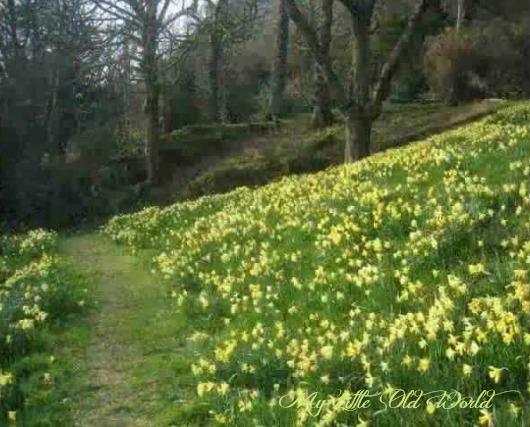
And could this enchanted universe be lacking of the daffodils, that are the spontaneous narcissus ?

Although they were not the flowers that he preferred, Wordsworth sown 1847 bulbs in a lawn to mark the year of the demise of his beloved daughter Dora who left this life at only 42 years since they were the flowers she loved so: since then they are naturalized and every April the carpet that they have created thickens increasingly:


‘When the sun streams across the lake from the fells it’s a magical sight.’3


In his Romantic, intimate and unique bond with the Nature, Wordsworth admires It as a Superior Entity, accessed through the Beauty which comes from the philosophical mind, since, even in Its mutate, It always remains equal to Itself, while the man, called to live his life, evolves, grows, suffers, thinks, often, more and more with the passing of the years to his immortality, and depresses himself discovering his frailty ... well, in Its great Benevolence the Nature becomes Protectress and almost Maternal, is able to make us understand and accept this limitation of our human existence, the Nature comforts us, welcomes us, can make us rejoice ... always ...


Then, sing, ye birds, sing, sing a joyous song!
          And let the young lambs bound
          As to the tabor’s sound!
     We, in thought, will join your throng, 
          Ye that pipe and ye that play, 
          Ye that through your hearts to-day 
          Feel the gladness of the May!
What though the radiance which was once so bright 
Be now for ever taken from my sight,
     Though nothing can bring back the hour 
Of splendour in the grass, of glory in the flower;
          We will grieve not, rather find
          Strength in what remains behind;
          In the primal sympathy
          Which having been must ever be;
          In the soothing thoughts that spring
          Out of human suffering;
          In the faith that looks through death, 
In years that bring the philosophic mind.


And 0, ye Fountains, Meadows, Hills, and Groves,
Forebode not any severing of our loves!
Yet in my heart of hearts I feel your might;
I only have relinquish’d one delight
To live beneath your more habitual sway;
I love the brooks which down their channels fret
Even more than when I tripp’d lightly as they;
The innocent brightness of a new-born day
               Is lovely yet;
The clouds that gather round the setting sun
Do take a sober colouring from an eye
That hath kept watch o’er man’s mortality; 
Another race hath been, and other palms are won.
   Thanks to the human heart by which we live,
   Thanks to its tenderness, its joys, and fears,
   To me the meanest flower that blows can give
   Thoughts that do often lie too deep for tears.

  From Intimations of Immortality from Recollections of Early Childhood, 1807


Thank you so much for having followed me up to here, 
my dear friends and loyal readers,
I'm leaving you with my warmest hug,


see you soon 💕


SOURCES:

Stephen Gill, William Wordsworth: A Life, Oxford University Press, New Ed edition, 1990;

William Wordsworth, The Poetical Works of William Wordsworth, Thomas Hutchinson Editor, Oxford University Press, 1963;


QUOTES:

1 - WIKIPEDIA;

2 - MailOnline;

3 - MailOnline.


Versi scritti all'inizio della primavera


Sentii migliaia di note mischiate tra loro,
Mentre sedevo adagiato in un boschetto,
In quel dolce stato in cui i pensieri dilettevoli
Portano alla mente pensieri tristi.

Al suo giusto lavoro la natura ha collegato
L’animo umano che è corso lungo me;
E molto si è addolorato il mio cuore a pensare
Ciò che l’uomo ha fatto all’uomo.

Attraverso i ciuffi delle primule, in quel dolce luogo ombroso,
La pervinca ha strascicato la sua corona;
E così la mia fede che ogni fiore
Apprezzi l’aria che respira.


- fotografia 1


Gli uccelli intorno a me saltellavano e giocavano:
Non potevo misurare il loro pensieri,
Ma anche il minimo movimento che facevano,
Sembrava un trillio di piacere.

I ramoscelli in erba spargevano i loro ventagli,
Per catturare l’aria fresca;
E devo pensare, facendo tutto il possibile,
Che ci fosse piacere in questo luogo.

Se questa convinzione fu inviata dal paradiso,
Se tale è il sacro piano della Natura,
Non ho forse ragione di lamentarmi
Di ciò che l’uomo ha fatto dell’uomo?


William Wordsworth,  aprile 1798.


Insieme con Samuel Taylor ColeridgeWilliam Wordsworth è considerato a pieno titolo colui che alla fine del XVIII° secolo introdusse il movimento Romantico nel panorama poetico inglese consacrato dalle LYRICAL BALLADS (1798) - a cui lavorarono a quattro mani in quattro poesie, la più fortunata delle quali in assoluto rimane The Rime of the Ancient Mariner - poiché nell'intera sua produzione poetica manifesta una particolare sensibilità ed affinità con la Natura, tanto che talora lo si trova definito come iniziatore del Naturalismo in poesia, spesso con il Romanticismo sovrapposto ed allineato, soprattutto se si leggono i famosi versi della sua poesia I Wandered Lonely as a Cloud, conosciuta anche con il titolo Daffodils, che del Romanticismo Inglese può essere considerata una sorta di manifesto:

Vagavo solitario come una nuvola
che fluttua in alto sopra valli e colline,
quando all'improvviso scorsi una folla,
un mare, di narcisi dorati;
vicino al lago, sotto gli alberi,
tremolanti e danzanti nella brezza.

Intermittenti come stelle che brillano
e luccicano nella Via Lattea,
si estendevano in una linea infinita
lungo il margine della baia:
con uno sguardo ne vidi diecimila,
che scuotevano il capo danzando briosi.

Le onde accanto a loro danzavano; ma essi
superavano in gioia le luccicanti onde:
un poeta non poteva che esser felice,
in una tale compagnia gioiosa.
Osservavo - e osservavo - ma non pensavo
a quanto bene un tale spettacolo mi avesse donato:

poiché spesso, quando mi sdraio sul mio divano
in uno stato d'animo ozioso o pensieroso,
essi appaiono davanti a quell'occhio interiore
che è la beatitudine della solitudine;
e allora il mio cuore si riempie di piacere,
e danza con i narcisi.


E' Dorothy, la sorella del poeta la cui straordinaria sensibilità divenne elemento di mediazione essenziale nel suo dialogo con la Natura, che ci descrive l'occasione che fece sorgere in lui il desiderio di scrivere tali versi:

« Arrivati nei boschi oltre Gowbarrow Park, abbiamo visto qualche giunchiglia sulla riva del lago e abbiamo immaginato che la piccola colonia fosse nata dai semi che il lago aveva portato sulla spiaggia. Ma proseguendo ne abbiamo viste sempre di più e alla fine sotto i rami degli alberi ne abbiamo notato una lunga striscia, larga più o meno quanto una strada di campagna, che costeggiava la spiaggia. Non ho mai visto giunchiglie tanto belle: crescevano tra le pietre muscose e tutt'intorno, alcune appoggiavano le corolle sulle pietre come per riposare su di un cuscino, il resto si agitava, ondeggiava, danzava e sembrava ridere sotto il vento che soffiava dal lago. Sembravano così allegre, sempre mutevoli, sempre sfuggenti. Il vento soffiava dritto su di loro dal lago. Qua e là si notava un viluppo e più in alto qualche pollone, ma erano così rade che non disturbavano affatto la semplicità, l'armonia e la vitalità di quella strada movimentata. Ci siamo fermati spesso. » 1


- fotografia 2


L'empatia che Wordsworth manifesta esistere nel suo animo per la Natura ed il colloquio che con essa intrattiene ce lo presenta come un uomo realmente dotato di una più acuta sensibilità di quanto sia ordinario, di maggiore entusiasmo e più sentimento del comune, che ha una più profonda conoscenza della natura umana e un'animo capace di maggiore comprensione; tutto ciò ci fa supporre che se non fosse divenuto un poeta, con ogni probabilità egli sarebbe divenuto un landscape-designer, ossia un paesaggista, basta osservare l'allestimento del verde che disegnò e curò nella residenza che egli aveva al tempo già scelto per la propria famiglia, composta dalla moglie Mary, da tre dei loro figli, John, Dora e William - due erano deceduti proprio l'anno prima: Catherine, di tre anni, per convulsioni, e Thomas, di sei, per morbillo - e da sua sorella Dorothy: sto parlando di Rydal Mount, 


- fotografia 3 e fotografia 4 - Rydal Mount


una deliziosa dimora situata nella regione del Lake District, dove trascorse circa metà della propria vita, ossia 37 anni, fino alla sua morte che sopraggiunse nel 1850: affittata nel 1813 divenne il luogo che cullò da allora ogni suo verso e dove, tra l'altro, diede definitiva stesura alla poesia che più lo rese famoso e che abbiamo da poco letto sopra.


Qui egli diede vita ad uno straordinario giardino Romantico che conserva ancor oggi intatta l'originaria impronta che volle conferirgli, giungendo a scavare di propria mano quattro lunghi terrazzamenti ed una serie di piscine naturali, spostando le pietre per variare il suono dell'acqua. Una di esse divenne patria di alcuni pesci rossi che erano stati donati a Dorothy in un vaso di vetro ed il gesto di render loro la libertà ispirò in lui due poesie, ecco perché quando capitavano visitatori od ospiti cui veniva mostrata la casa, il domestico così si esprimeva: 


 “Questa è la biblioteca del mio padrone ... ma il suo studio è fuori casa.”2


- fotografia 5 e fotografia 6 - Finestra della biblioteca di Rydal Mount


In Wordsworth il trasporto per la Natura è palese e tangibile e la frequentazione di Coleridge che gli fece conoscere il naturalismo kantiano lo portò ad affinare la sua sensibilità per la Voce del Creato ... come un pittore che con il proprio cavalletto si siede e si immerge nel verde per trasferirlo sulla tela, Wordsworth creava le proprie poesie e verbalmente, dettando ad alta voce alla moglie Mary o all'amata figlia Dora i versi da trascrivere mentre passeggiava in giardino, o con le proprie mani, dando vita a scenari che ancor oggi ci parlano di lui attraverso le innumerevoli piante da fiore che impiantò, tra cui rododendri e maggiociondoli, ma essendo particolarmente affezionato ai fiori spontanei non mancò di piantare primule, gerani selvatici, papaveri, licheni, muschi e felci che con le proprie foglie facevano ombra a piante di trifoglio e a fragole di bosco.


- fotografia 6


- fotografia 7


- fotografia 8


E potevano in questo universo fatato mancare le giunchiglie, ossia i narcisi spontanei, i Daffodils ?
Anche se non erano i fiori che preferiva, Wordsworth interrò ben 1847 bulbi in un prato per ricordare l'anno della scomparsa dell'adorata figlia Dora che la morte strappò a questa vita a soli 42 anni e che le amava: da allora si sono del tutto naturalizzati ed ogni anno in aprile il tappeto che hanno creato si infoltisce sempre più: 


- fotografia 9 - Daffodils a Rydal Mount


‘Quando il sole s'insinua attraverso il lago dalle colline lo spettacolo di cui si può godere è davvero magico.3


E allora cantate uccelli,

Cantate una gioiosa canzone !

E lasciate saltare i giovani agnelli

Al suono del tamburello !

Noi col pensiero ci uniamo alla folla

Quei flauti e quei suoni

Che attraversino i vostri cuori oggi

Senti la felicità di Maggio !

Ciò che per radianza era così luminoso

Sia preso per sempre dal mio sguardo

In quanto niente può far arretrare

L’ora di splendore nell'erba

Di gloria nel fiore

Non siamo più addolorati,

Piuttosto troviamo forza in ciò che è rimasto indietro

Nella primaria simpatia che è dovuta essere

Ciò che fu mai più sarà

Nei pensieri calmanti

Che fioriscono dalle sofferenze umane

Nella fede che guarda oltre la morte

Negli anni che porta con sé la mente filosofica.


E le Fontane, i Prati, le Colline, e i Boschi

Presagiscono nessun cruccio nei nostri tanti amori !

Ancora nel mio cuore sento dei cuori la tua potenza

Ho solo lasciato un diletto,

Per vivere lontano dalla tua abituale influenza

Amo i ponti sotto i quali scorrono i ruscelli

Ancor di più quando viaggiavo leggero come loro

L’innocente lucentezza di un giorno appena nato

È ancora amabile

Le nuvole che si muovono attorno al sole che tramonta

Prendono un colore sobrio

Per un occhio che ha osservato la mortalità dell’uomo

Un’altra razza è stata,

Ed altri palmi hanno vinto,

Grazie al cuore umano con cui viviamo

Grazia alla sua tenerezza, le sue gioie, e paure

Per me il più significativo dei fiori che sboccia può dare

Pensieri che spesso giacciono troppo in profondità per le lacrime.


Da Intimations of Immortality from Recollections of Early Childhood, 1807


Vi ringrazio infinitamente per avermi seguita fino a qui, 
miei cari amici ed affezionati lettori, 
e vi lascio con un caloroso abbraccio, 
dandovi appuntamento 


a presto 💕


- fotografia 10


FONTI BIBLIOGRAFICHE:

Stephen Gill, William Wordsworth: A Life, Oxford University Press, New Ed edition, 1990;

William Wordsworth, The Poetical Works of William Wordsworth, Thomas Hutchinson Editor, Oxford University Press, 1963;


CITAZIONI:

1 - WIKIPEDIA;

2 - MailOnline;