Visualizzazione post con etichetta IL FIGLIO AMERICANO DI RODOLFO D'ASBURGO. Mostra tutti i post

venerdì 30 gennaio 2026

Mayerling ~ Wednesday, January 30, 1889


On the morning of January 31, 1889, the people of Vienna awoke to a shocking news that chilled the streets, veiled by the icy winter fog, into silence. On every newspaper of the capital of the Austro-Hungarian Empire front-paged appears the news of the tragic death of the heir to the throne, Archduke Rudolf, which had occurred the previous morning from a heart failure while he was at his hunting lodge in Mayerling, in the Vienna Woods. Time seemed to stand still for a moment, for Vienna, for the whole Old Continent, for the entire world. As the hours passed, it was discovered that he wasn't alone, he was together with his lover, Marie Vetsera, and they had both died from gunshot wounds.

~ My Little Old World ~ has already dealt with this topic some years ago (click HERE to read the post published on January 30, 2014), but new developments prompt me to retract it. Let's look at what happened in order. At 6:30 that morning, the prince's personal valet, Johann Loschek, hears a shot coming from the room where Rudolf was sleeping. He had spent merrily the previous evening with his usual companions: the inseparable Josef Bratfisch, his personal coachman, a good-natured, singing man with a quick wit; Count Joseph Theodor von Hoyos, his aide-de-camp; and Johann Loschek, of course. Before retiring to his room at about midnight, Rudolf had bidden farewell, asking the latter to wake him at 7:00 a.m. He had to have breakfast and then meet up with the friends who accompanied him whenever a hunting trip was planned: Count Hoyos, already in Mayerling, and his friend and brother-in-law, Prince Philip of Saxe-Coburg-Gotha, who would be joining them from Vienna that early morning. Hearing the shot, Loschek rushes to the door of his room but finds it bolted from the inside. A first question arises here: why would Rudolf have locked the door from the inside with the latch, thus making it unopenable from the outside, when the night before he had instructed Loscheck to be woken at a very specific time? But let's return to the story of the events of that fateful morning: Loscheck is unable to open the door of Rudolf’s room by himself. It takes the strength of two men and the aid of a lever. He then turns to Hoyos for his help. Once the door is open, the scene that unfolds before their eyes is nothing short of horrifying, so much so that they cannot explain it, much less comprehend it: the small window bangs forcefully in time with the gusts of the icy north breeze caressing the snow that has continued to fall throughout the night; someone has entered through that very window, forcing the handle, and, from there, quickly escaped, leaving the ladder he used to go up and down leaning against the windowsill. The table that was against the wall now appears torn down in the center of the room, in a pool of blood; the other furniture has also been moved and stained with blood. In all honesty, blood is everywhere. Generous splashes distressingly paint the walls, especially the one supporting the bed on which lie the lifeless bodies of Rudolf and his very young lover, the seventeen-year-old Baroness Marie Vetsera, who had followed him there and joined him the night before. There were traces left by large men near the window, and footprints and blood were also visible on the ladder, demonstrating that the prince had not only resisted for a long time before surrendering to death, but had also wounded one of his attackers. But above all, it is on the floor, in the center of the room, that there is a huge pool of it... 

What does it mean? Perhaps Rudolf and Marie didn't die in the bed they were found in? That doesn't really appear to be the scene of a suicide, but, for everyone, it had to become such. Count Hoyos appears to gather courage and offers himself to bring the news of the incident to the emperors. He then sets out on foot to the Baden station where he awaits the first train to the capital. Rudolf's other three companions—Loschek, his coachman Bratfisch, and Prince Philip of Saxe-Coburg-Gotha, who had arrived in the meantime and had witnessed his heartbreaking state—ride home and will arrive in Vienna before him. But no one will ever know it. Why does Hoyos act so calmly? He should have ridden as fast as the wind to the Hofburg. Instead, he will be the last to arrive in Vienna. A few hours after hearing the news of the tragedy, the emperor summons four men before him—THE MAYERLING WITNESSES—to buy their silence. They should never have confided to anyone what they had seen in the hunting lodge where Rudolf was still laying on his deathbed. Only one man will not keep his promise, and he will do so because he feels a heavy conscience: it will be Hoyos, complicit in the death of the crown prince who had blindly trusted him. He will confess the incident and his guilt to his brother Ladislaus, and from him the truth about Mayerling will be passed from father to son for several generations. It was never made known. Until the year 2022, when the journalist François Varay published the book Mayerling, la vérite révélée. Un secret de famille dévoilé, for the Parisian publisher Michel de Maule. He was the younger half-brother of the Franco-Austrian journalist Ladislas de Hoyos, known as the man who tracked down Klaus Barbie, the Nazi leader and head of the Gestapo in Paris during the World War II, who had taken refuge in Argentina. From then on, this descendant of Rudolf's aide-de-camp went on gaining fame in France, even hosting the news on the TF1 television channel. Having no children, he orally passed on all his knowledge to the author of this book, and, obviously, what is revealed goes beyond conjecture and represents one piece of a very complex mosaic. Although these are oral evidences, that is not supported by written documents, they're are anyway worth to be considered, for they're quite interesting and make us think.

It was 13 June, 1886, when King Ludwig II of Bavaria, Sissi's forty-one-year-old beloved cousin, also known as "The Fairytale King," was found dead under suspicious circumstances. That case, too, was considered a suicide, or rather, a suicide by drowning—hard to believe, given that he was an excellent swimmer—but the proofs were silted- up. Everything was quickly hushed up. The King of Bavaria, though politically absent, was somewhat of a nuisance to Wilhelm II of Prussia, which aspired to create a confederation of German States. For his chancellor, Count Otto von Bismarck, who was his shadow, or perhaps it's better to say his right hand, it would have been easy to get rid of that man of singular sensitivity and intellect, which were never understood and were interpreted as clear signs of madness. By becoming a patron of Wagner, of whom he was a fervent admirer, he had saved him and his family from absolute poverty. His only concern was spending exorbitant sums to surround himself with castles built in keeping with medieval chivalric ideals married to Norse mythology, legends that his musician friend would adapt into operas to be performed in theaters. Given his lifestyle and the mental illness that, it was said, was afflicting him for so long, few would have believed his passing to be accidental. In everyone's eyes, he was an extremely fragile and vulnerable man. On 13 June, at 6:30 PM, he asked to take a walk with Dr. Bernhard von Gudden, whom his ministers, who thought their king to be incompetent, always wanted him to accompany him. The latter accepted, telling the guards not to follow them. The two men never returned: both were found prone, lifeless, in the waters of Lake Starnberg half an hour before midnight. But there were two others Bismarck had to "eliminate" on the orders of his Kaiser: one of them was none other than Rudolf. Two and a half years had passed since the disappearance of the King of Bavaria, first on the "Iron Chancellor's" list, and perhaps the time had come to organize another plot to eliminate the second one. United with Austria and Russia in the Triple Alliance, Prussia aspired to the most ruthless conservatism, which is why it enjoyed the sympathies of Emperor Franz Joseph, sympathies that were clearly mutual. Wilhelm II, on the other hand, harbored a clear antipathy for Crown Prince Rudolf, also mutual. In IL PICCOLO on January 30, 2019, on the occasion of the publication of the essay Mayerling, Anatomia di un Omicidio, written by Fabio Amodeo and Mario José Cereghino for Mgs Press, the following was stated:

«According to the great Hungarian-born French historian François Fejtö, author of Requiem per un impero defunto (Mondadori), it was actually the German Kaiser Wilhelm II who hatched the plot. Rudolf's sworn enemy was reciprocated: ‘At most, I would gladly meet Wilhelm on a hunting trip to rid the world of him in an elegant manner,’ Rudolf had stated. In short, a state crime, disguised as suicide, in which poor Vetsera was implicated as an inconvenient witness to be eliminated.»

François Fejtö's simple but acute intuition will be confirmed by Count Hoyos's descendant. As we have seen and will see as we read further, Count Hoyos was not only informed of the detailed course of the Mayerling conspiracy, because he was supposed to be part of it; he also knew the details of the entire plot hatched by Bismarck, of which Mayerling was merely an "episodic moment." But how did events really unfold at the hunting lodge located in the Vienna Woods of Niederösterreich (Lower Austria)?

A few days before the tragedy, some witnesses noted, in a chalet near Rudolf's castle in Mayerling, the presence of two men they had never seen before. They spoke with a remarkable Prussian accent and claimed to be hunters, but they were not carrying hunting rifles: they were two of Bismarck's snipers, tasked with eliminating the crown prince of the Danubian Dual Monarchy, one of the pawns Bismarck had placed on his chessboard. Obviously, Rudolf did not surrender to death that fateful morning. This is why the scene that originally presented itself to the first four witnesses was not that of a suicide, but rather that of a fight; and this is why Hoyos himself offered to carry news of the tragedy to the imperial palace: he had been chosen as the Prussian snipers' accomplice. He was the other pawn. At this point, it's easy to understand why he chose the longest route to Vienna: he had to stall. As soon as he left Mayerling, he passed through the neighboring village of Alland. Here he contacted the carpenter and the blacksmith, who had their workshops there, and tasked them with restoring the room where the bodies of Rudolf and the young Marie lay lifeless, prematurely stiffened by the cold that entered through the broken window. They needed time to repair it by replacing the broken handle from the outside and the shattered glass; replace the floorboards in the central part of the room, which were irreparably stained with blood; repair the furniture and put it back in its place.

«It was Bismarck who had the prince assassinated. The Emperor of Austria knew about it, but he could do nothing. The Germans sent spies who killed the prince and his mistress. And it was my ancestor, Count Hoyos, who made things easier for them by later providing false deposition. [...]» (François Varay, Mayerling, la vérite révélée. Un secret de famille dévoilé Éditions Michel de Maule, Paris, 2022, p. 174.).

The author goes so far as to compare the story to a Greek tragedy in which the king sacrifices his own son in the name of the unity of the kingdom (see François Varay, Mayerling, la vérite révélée: Un secret de famille dévoilé, op. cit. p. 183.). Indeed, enriched with these final details, Mayerling's tragedy possesses all the elements of a Greek tragedy.

The third man Bismarck had his eye on was Johann Salvator, Rudolf's great-cousin, a member of the Tuscan branch of the Habsburg-Lorraine family, his confidant and inseparable companion. Upon hearing the tragic news of what had happened at Mayerling, Franz Josef wanted to travel there to see for himself the situation, which, moreover, had already been duly distorted. Perhaps only then did he truly realize how much he had been unable to prevent it. Karl Salvator, his trusted cousin and Johann Salvator's older brother, accompanied him. When the latter learned of the tragedy, which was reported to him in detail by a direct and reliable source, he was inevitably struck by panic: he could not believe that Rudolf had disappeared in such a dramatic way and sensed that soon he too would suffer a similar fate to that of the prince he loved like a brother and with whom he shared liberal and democratic ideals. This was why they were both considered subversive and potential threats to the political stability of the empire, as well as being regarded with suspicion. As soon as he regained control of his actions and his clarity, Johann Salvator approached the emperor, asking for the renunciation of his noble titles and the privileges associated with them, which by right of blood were his, and for a new surname: he wanted to be called Johann Orth. Only by changing his identity would Johann Salvator become untraceable. Not only that, he could finally fulfill his dream of marrying his beloved Ludmilla-Milly Stübel, the  ballet dancer at the Vienna State Opera: he had long been engaged to her, but his rank prevented him from joining her and starting a family. 

Franz Josef granted him everything he had asked, but ordered him never to return to any territory of the empire. For him, this will not be a problem at all: after reaching London and taking the more Anglicized name of John, he got married and sailed for the South Americas. He disappeared by faking a shipwreck (see Daniela Lasagnini, Il figlio americano di Rodolfo D'Asburgo, Mgs Press, Trieste, 2021, chap. IV, John Orth, pp. 53-62).
Returning to Mayerling, I resume the discussion with the phrase that Franz Josef uttered after seeing his son torn apart, a phrase that only now takes on a deeper meaning:

«The truth is far worse than one can imagine!»

After the funeral, he insisted that from then on no one would ever mention Rudolf's name again: it was as if his son had never existed, although I believe not a day went by in his life when he didn't think about what he had allowed to happen. In the 1980s, the former Empress Zita, née Bourbon-Parma, consort of the last Austrian Emperor, Karl I, returned to Vienna several times after some sixty years of exile and widowhood. Determined to shed light on the "Mayerling Events," she gave a series of interviews to the Kronen Zeitung and made statements to Austrian television: she was the only one to know what had happened, both through family lineage and marriage, as Nerio De Carlo also argued in his 2013 essay, Non desiderare la patria d'altri, published by the Trieste-based publishing house Holzwege. She maintained that Rudolf had not committed suicide, but had been the victim of a conspiracy and assassinated. She was the first to speak of a conspiracy, and so far her words correspond to the reality we now know. But going further, she claimed that the perpetrators were Austrian and French secret agents, and that the motive, in the first case, was Rudolf's sympathy for Hungary, in the second the friction that had arisen with Clemenceau's France. Zita likely knew the whole truth, but fearing not to be authorized to make it public, revealed only a part of it. The fact remains that she deserves credit for rehabilitating the crown prince, who had been debased first by the theory of suicide and then by the subsequent theory of a mental illness "invented" by the emperor to obtain permission from the Holy Father to celebrate the funeral rite in church. Indeed, history portrayed him as violent towards himself, depressed by the abuse of narcotics, which he took as painkillers, and alcohol, discouraged by his father's exclusion from political affairs, and bored with life. And that night, De Carlo writes in his essay, according to the former empress,

«As a precaution, the window shutters had to remain closed, and not even the telegraph was allowed to work. There was to be no contact, not even telegraphic, with anyone [...] Baroness Mary Vetsera was staying in another part of the building so as not to be compromised. The Prince's room was carefully locked from the inside.» (Nerio de Carlo, Non desiderare la patria d’altri, Holzwege, Trieste, 2016, p. 50.).

Poor Marie was in the wrong place at the wrong time, but she was useful in giving substance to the double suicide hypothesis: murdered elsewhere and many hours before Rudolf, she was then laid next to him. The former Empress Zita knew that Rudolf did not abandon himself to death and fought long before being impeccably struck by his assassins:

«During this struggle, the fingers of the hand that was spasmodically holding the table, which had become his only protection, were severed. When it fell from his hand, he was brutally killed.» (Ibid.)

In the photograph taken of Rudolf's death body and released to the press, we see him not only with his skull wrapped in bandages, but also with his hands bandaged, so that his fingers are not visible. This explains the reason for this bandage, which even Gisella, the deceased's younger sister, could not explain herself. And it also explains why the table lay immersed in a pool of blood: it was the blood that had seeped from his brutally severed fingers, and likely from the blow that took his life. It is likely that Rudolf was mortally wounded there, and then laid on the bed, already lifeless. Even the former Emperor Karl I, while he was alive, worked to shed light on this affair, which, after decades, continued to be shrouded in mystery, and sought concrete evidence. Therefore, Zita also felt compelled to declare that:

«Karl I knew that there must be a telegram in the Vatican explaining the true causes of the heir to the throne's death. The religious authorities had, in fact, prohibited a religious burial as soon as news of the alleged suicide leaked. From his Swiss exile, Karl I attempted to obtain a copy of that clarifying telegram sent to the Holy Father. The response was that the document had indeed existed, but that the newly formed Austrian Republican Government had requested the original be returned immediately after the proclamation of the Republic. The original was returned without a copy being made.» (Nerio de Carlo, Non desiderare la patria d'altri, op. cit., p. 56.).

Hard to believe when the evidence of all the secrets that history has handed down to us are jealously guarded within the walls of the Vatican palaces…


CARRYING ARCHDUKE RUDOLF'S COFFIN IN MAYERLING.


SOURCES:

Fabio Amodeo, Mario José Cereghino, Mayerling, Anatomia di un Omicidio, Mgs Press, Trieste, 2019.

François Varay, Mayerling, la vérite révélée. Un secret de famille dévoilé, Michel de Maule, Paris, 2022. 

Daniela Lasagnini, Il figlio americano di Rodolfo D'Asburgo, Mgs Press, Trieste, 2021.

Nerio de Carlo, Non desiderare la patria d’altri, Holzwege, Trieste, 2013.


I heartily thank You for following me in this so long reading, 
Dearest Readers, 
and I hope You've found it to be interesting!
See you soon 


Dany


sabato 24 maggio 2025

♚ NOBLE MANSIONS AND CROWNS ♚ Villa Île-de-France on the French Riviera and Baroness Béatrice de Rothschild


With this post we find ourselves once again talking about the famous House of the Barons von Rothschild, the Austrian-born bankers who played a major role in promoting and keeping secret the extramarital affair of Archduke Rudolf of Austria with Princess "K"- Olga, illegitimate daughter of Tsar Alexander II and his lover, Princess Alexandra Sergejevna Dolkorukaja. I'm sure you do r remember that this love was at the center of the plot of first book I published, THE AMERICAN SON OF RUDOLPH OF HABSBURG: they were the parents of James Longstreet Cleveland, born and raised in America where the poor Russian princess took refuge after learning of the tragedy of Mayerling in which her beloved had lost his life in such a catastrophic way. The splendid villa you see in the cover image and in the one immediately below that recalls the great residences of the Italian Renaissance, dominates the Cap Ferrat peninsula in Saint-Jean-Cap-Ferrat on the French Riviera and was commissioned, in fact, by Baroness Béatrice de Rothschild at the beginning of the 20th century. At that time, the French Riviera was gaining notoriety among the high society all over Europe, and was qualifying itself as an elite holiday destination.


It was September 14, 1864 when, at the Hôtel Talleyrand in Paris, a former U.S. consulate, Charlotte Béatrice de Rothschild was born, the youngest daughter of Baron Alphonse James de Rothschild (1827-1905), a great collector of antiquities and an important donor to French museums, and Leonora von Rothschild (1837-1911) of the Rothschilds branch known as the "London" branch. She grew up between the most luxurious estate of the 19th century, that of Ferrières-en-Brie in Seine-et-Marne, where she would maintain apartments throughout her life, and the family hotel in Paris on rue Saint-Florentin, surrounded by artistic masterpieces.

On June 5, 1883, at the age of 19, she was given in marriage to the Ukrainian millionaire Maurice Ephrussi, a friend of her parents, who was then 34, fifteen years older than her. He came from a Jewish family from Odessa whose fortune was tied to grain exports and banking transactions: he was the agent that Baron Alphonse favored, to the point that he promoted him as a representative of the French Rothschilds in the Caucasus, then very rich in oil. And it was Maurice Ephrussi who first proposed to Alphonse de Rothschild the trade of Russian oil through his railway network. The Rothschilds were the official bankers of the Tsar and the Ephrussis were the Rothschilds' agents with him. And so we add another little piece to the plot of THE AMERICAN SON OF RUDOLF OF HABSBURG: if the Rothschilds were on friendly terms not only with the Habsburgs, but also with the Romanovs, that is, with Tsar Alexander II, it is easy to understand why both Princess Olga and Archduke Rudolf turned to them as guarantors of the secrecy of their relationship: they both trusted them. But let's go back to Béatrice and Maurice and our story today. Both passionate about architecture, nature and art, they enjoyed living in sumptuous residences and collecting rare and precious art objects. It was above all Béatrice's taste for 18th-century French art and exoticism that placed her in the lineage of the great collectors of the time: she carried out research and had the works transported by train to Beaulieu-sur-Mer, which she chose directly on the station platform. 
Made sterile by genital tuberculosis, the although young baroness was unable to give her husband a child, but her marriage was unhappy especially because of Maurice's addiction to gambling: he was a great gambler and in 1904 his debts had reached more than 12 million gold francs. Worried about the future, the Rothschild family decided to take him to court. The separation was inevitable and came in 1904 after 21 years of marriage. However, Béatrice, for reasons of discretion - divorce was frowned upon at the time - would still keep the surname Ephrussi. Orphaned by her father in 1905, she shared with her younger brother Édouard (Béatrice had an older sister and brother who had died much earlier) a fortune estimated at 700,000,000 euros today. It was then that she bought 7 hectares in Cap-Ferrat to build the villa of her dreams, disputing this plot of land with King Leopold II of Belgium, who wanted to expand his adjacent property. They were necessary more than five years of titanic works to create this sumptuous residence given the place was not very suitable for building a villa or creating a park: making a rocky promontory covered with trees and lashed by gusts of wind habitable was certainly a difficult task. But the baroness had the land dynamited and had enormous quantities of earth brought in to level it and make it fertile. When she moved into the villa, she filled it with antique furniture, paintings by famous old masters, sculptures, art objects, and assembled a vast collection of rare porcelain. Upon her death in 1934, the Baroness donated the property and its collections to the Académie des beaux-arts division of the Institut de France and it is now open to the public as a museum. As for the gardens, at that time they were not yet completely laid out. The first to be brought to life was the French-style one, for the design of which she created a real mobile and living decoration: her collaborators hid themselves in green cardboard pyramids representing cypresses or manipulated long strips of silver, grey or green fabric to see where it was best to place water games, paths and flowerbeds. It was in the year of Béatrice's death that the landscape architect Louis Marchand took charge of designing the themed gardens: thus were born the Spanish garden, the Florentine garden, the Japanese garden, the Mexican garden, etc. As many as nine dream gardens were created to fascinate visitors. He also filled the ponds and restored the French gardens. The result was a truly suggestive park so much so that it is classified by the French Ministry of Culture as one of the most remarkable parks in France.


The Temple of Love dominating the French Garden


The Florentine Garden


The Japanese Garden


The Provencal Garden


The Lapidary Garden


The Rose Garden


The Exotic Garden


Detail from the Spanish Garden


And with one last image taken from the terraces that draw the gaze onto the inlets of the Mediterranean gulf that opens between Monaco and Nice, and its crystalline waters, I'm ending  this quite long post of mine.


In the sincere hope of having made You spend some time daydreaming together with me,
I send You a hug filled with the scents of our Riviera
See you soon ❤


Dany


NOTE:
THE IMAGES WHICH ARE NOT SIGNED BELONGS TO THE WEBSITE VILLA & JARDINS EPHRUSSI DE ROTHSCHILD. 


♚ DIMORE NOBILIARI E CORONE ♚ 
Villa Île-de-France sulla Costa Azzurra 
e la baronessa Béatrice de Rothschild


IMMAGINE DI COPERTINA - Collage che accosta la Villa Île-de-France ad un ritratto della Baronessa Béatrice de Rothschild inserito in una cornice in argento.


Con questo post ci troviamo ancora una volta a parlare della famosa Casata dei baroni von Rothschild, i banchieri di origine austriaca che tanta parte ebbero nel promuovere e tenere celata la relazione extraconiugale dell’arciduca Rodolfo d’Austria con la Principessa "K"- Olga, figlia illegittima dello zar Alessandro II e della sua amante, la principessa Alexandra Sergejevna Dolkorukaja. Ricorderete che proprio questo amore fu al centro del mio primo libro, IL FIGLIO AMERICANO DI RODOLFO D’ASBURGO poiché furono loro i genitori di James Longstreet Cleveland, nato e cresciuto in America dove la povera principessa russa si era rifugiata dopo aver appreso della tragedia di Mayerling in cui il suo amato aveva perso la vita in modo talmente catastroficoLa splendida villa che vedete nell’immagine di copertina e in quella immediatamente qui sotto che ricorda le grandi residenze del Rinascimento italiano, domina la penisola di Cap Ferrat a Saint-Jean-Cap-Ferrat sulla Riviera Francese e fu voluta, per l’appunto, dalla baronessa Béatrice de Rothschild agli inizi del Novecento. Allora la Costa Azzurra stava conquistando notorietà presso l’alta società dell’intera Europa, e si stava qualificando come un luogo di villeggiatura elitario. Era il 14 settembre del 1864 quando, all'Hôtel Talleyrand di Parigi, ex consolato degli Stati Uniti, venne alla luce Charlotte Béatrice de Rothschild, figlia minore del barone Alphonse James de Rothschild (1827-1905), grande collezionista di antichità e importante donatore dei musei francesi, e di Leonora von Rothschild (1837-1911) appartenente al ramo Rothschild detto "di Londra". Ella crebbe tra la tenuta più lussuosa del XIX secolo, quella di Ferrières-en-Brie a Seine-et-Marne, dove manterrà degli appartamenti per tutta la vita, e l'hotel parigino di famiglia in rue Saint-Florentin, circondata da capolavori artistici. 


IMMAGINE 2 - Villa Île-de-France conosciuta anche come
 Villa Rothschild a Saint-Jean de Cap-Ferrat.


Era il 14 settembre del 1864 quando, all'Hôtel Talleyrand di Parigi, ex consolato degli Stati Uniti, venne alla luce Charlotte Béatrice de Rothschild, figlia minore del barone Alphonse James de Rothschild (1827-1905), grande collezionista di antichità e importante donatore dei musei francesi, e di Leonora von Rothschild (1837-1911) appartenente al ramo Rothschild detto "di Londra". Ella crebbe tra la tenuta più lussuosa del XIX secolo, quella di Ferrières-en-Brie a Seine-et-Marne, dove manterrà degli appartamenti per tutta la vita, e l'hotel parigino di famiglia in rue Saint-Florentin, circondata da capolavori artistici. 


IMMAGINE 3 A SINISTRA - Béatrice immortalata all'età del suo matrimonio


Il 6 giugno 1883, all'età di 19 anni, fu data in sposa al miliardario di origine ucraina Maurice Ephrussi, amico dei suoi genitori, che allora aveva 34 anni, quindici più di lei. Questi proveniva da una famiglia ebrea di Odessa la cui fortuna era legata all'esportazione di grano e alle transazioni bancarie: era l’agente che il barone Alphonse prediligeva, al punto che lo promosse come rappresentante dei Rothschild francesi nel Caucaso, allora molto ricco di petrolio. E fu proprio Maurice Ephrussi il primo a proporre ad Alphonse de Rothschild il commercio del petrolio russo per tramite della sua rete ferroviaria. I Rothschild erano i banchieri ufficiali dello zar e gli Ephrussi erano gli agenti dei Rothschild presso di lui. Ed aggiungiamo così un altro piccolo tassello alla trama de IL FIGLIO AMERICANO DI RODOLFO D'ASBURGOse i Rothschild erano in rapporti di confidenza non solo con gli Asburgo, ma anche con i Romanov, ovvero con lo zar Alessandro II, ben si comprende perché sia la principessa Olga che l'arciduca Rodolfo abbiano scelto proprio a loro come garanti della segretezza della loro relazione: entrambi nutrivano fiducia nei loro confronti. Ma torniamo a Béatrice e a Maurice e alla nostra storia di oggi. Entrambi appassionati di architettura, natura e arte, si dilettavano a vivere in residenze sontuose e a collezionare rari e preziosi oggetti d'arte. Fu soprattutto il gusto che Béatrice nutriva per l'arte francese del XVIII secolo e l'esotismo a collocarla nella stirpe dei grandi collezionisti dell'epoca: effettuava ricerche e faceva trasportare in treno le opere a Beaulieu-sur-Mer, che sceglieva direttamente sul binario della stazione. 


IMMAGINE 4 A DESTRA - Béatrice e Maurice, ancora uniti, 
fotografati all'interno della loro proprietà


Resa sterile da una tubercolosi genitale, la seppur giovane baronessa non fu in grado di dare un figlio al marito, ma il suo matrimonio fu infelice soprattutto per la dipendenza di Maurice dal gioco d’azzardo: egli era un gran giocatore e nel 1904 i suoi debiti avevano raggiunto più di 12 milioni di franchi oro. Preoccupata per il futuro, la famiglia Rothschild decise di condurlo in tribunale. La separazione fu inevitabile e giunse nel 1904 dopo 21 anni di matrimonio. Ciononostante Béatrice, per motivi di discrezione – il divorzio era mal visto a quei tempi – manterrà comunque il cognome Ephrussi. Rimasta orfana del padre nel 1905 divise con il fratello minore Édouard (Béatrice aveva una sorella ed un fratello maggiori che erano deceduti molto prima) una fortuna stimata in 700.000.000 di euro odierni. Fu allora che acquistò 7 ettari a Cap-Ferrat per costruire la villa dei suoi sogni contendendo questo appezzamento di terreno al re Leopoldo II del Belgio, che voleva espandere la sua proprietà adiacente. Per realizzare questa sontuosa residenza furono necessari più di cinque anni di lavoro titanico, dato che il luogo non era molto adatto alla costruzione di una villa o alla creazione di un parco: rendere abitabile un promontorio roccioso ricoperto di alberi e sferzato da raffiche di vento era certamente un'impresa ardua. Ma la baronessa fece dinamitare il terreno e portare enormi quantità di terra per livellarlo e renderlo fertile. Quando si trasferì nella villa, la riempì di mobili antichi, dipinti di famosi maestri del passato, sculture, oggetti d'arte e radunò una vasta collezione di porcellane rare. Alla sua morte, nel 1934, la baronessa donò la proprietà e le sue collezioni all'Académie des beaux-arts, sezione dell'Institut de France, che ora è aperta al pubblico come museo. Quanto ai giardini, a quel tempo non erano ancora completamente sistemati. Il primo a essere portato in vita fu quello alla francese, per la cui progettazione creò una vera e propria decorazione mobile e vivente: i suoi collaboratori si nascondevano in piramidi di cartone verde raffiguranti cipressi o manipolavano lunghe strisce di tessuto argentato, grigio o verde per individuare i punti migliori in cui collocare giochi d'acqua, sentieri e aiuole. Fu nell'anno della morte di Béatrice che l'architetto paesaggista Louis Marchand si occupò di progettare i giardini tematici: nacquero così il giardino spagnolo, quello fiorentino, quello giapponese, quello messicano, ecc. Ben nove giardini da sogno furono creati per affascinare i visitatori. Inoltre riempì gli stagni e restaurò i giardini alla francese. Come risultato venne a crearsi un parco talmente suggestivo da essere classificato dal Ministero della Cultura Francese come uno dei parchi più notevoli di Francia.


IMMAGINE 5 - Il Tempio di Amore che domina il Giardino alla Francese

IMMAGINE 6 - Il Giardino Fiorentino

IMMAGINE 7 - Il Giardino Giapponese 

IMMAGINE 8 - Il Giardino Provenzale

IMMAGINE 9 - Il Giardino Lapidario

IMMAGINE 10 - Il Roseto

IMMAGINE 11 - Il Giardino Esotico

IMMAGINE 12 - Dettaglio dal Giardino Spagnolo


E con un'ultima immagine scattata dai terrazzamenti che richiamano lo sguardo sulle insenature del golfo del Mediterraneo che si apre tra Monaco e Nizza, e sulle sua acque cristalline, concludo questo mio lungo post.


IMMAGINE 13


Nella sincera speranza di avervi fatto trascorrere un po' di tempo a sognare ad occhi aperti insieme a me,
vi mando un abbraccio colmo dei profumi della nostra Riviera.
A presto ❤


Dany


NOTA:
LE IMMAGINI CHE NON RECANO FIRMA SONO DI PROPRIETA' DEL SITO WEB VILLA & JARDINS EPHRUSSI DE ROTHSCHILD. 


LINKING WITH: 


mercoledì 21 giugno 2023

Princess "K", the Secret Love of Crown Prince Rudolf von Habsburg-Lorraine


My love, how many ways to reach a kiss of yours,

what a wandering loneliness up to your company!

Pablo Neruda (1904-1973) da Cento Sonetti d’Amore (1959), Sonetto II, Mattino


Left: Princess Olga, called Princess K, photographed in the late 1880's.
Right above: the princess, who was three years old at the time (1868), holds her sister Maria, two year her senior, by her hand, and their mother Aleksandra is behind them; below: she is portrayed next to her sister a year later (1869). At that time they had already been legally adopted by Pyotr Albedinsky who had married Aleksandra at the end of the year 1865. (A detail: as you can see, the chaise longue in the last image is the same on which Princess Olga sits as an adult)

When Crown Prince Rudolf von Habsburg-Lorraine, son of the Emperor of Austria-Hungary Franz Josef and of his spouse, Empress Elisabeth, named Sisi, first met her, she was just a young girl: it was 1878, the year of his Grand-Tour, and the chance was just this travel of his around the main courts of Europe and the Middle-East, made to increase his knowledge of the world and of people, of art and of history. He was aged twenty, he was a young handsome man, 


while she was at the threshold of her adolescence, but he immediately fell in love with her: her lively temper, her joy-filled way to express herself charmed him and won his heart. Actually he had never knew such a delightsome girl before than then. 

When Rudolf was twenty, he met two charming Russian girls, the illegitimate daughters of Czar Alexander II. The younger one, known to her friends as K., was enchanting: pretty, vivacious, full of mischief. He fell in love with her and she with him. It was a gay flirtation.1

They became close friends at once, indeed, theirs was surely love at first sight and it is likely that they exchanged letters which remained, however, hidden from everybody, and which were probably destroyed, along with other documents, after the Mayerling tragedy. When the Emperor decided it was the moment to find a wife to his heir, Rudolf immediately expressed his will: he wanted to marry the young girl who everybody at court went on calling Princess K., but his father showed his disappointment without any restraint.

The Emperor was appalled at the very thought - an illegitimate princess to become Empress?'Rudolf must be mad!' Less understandably the Czar was equally opposed to the match, probably because he too subscribed to the principle that an illegitimate daughter of a monarch - even his own - was not fit to become an Empress. 2

In fact this charming girl had noble blood flowing in her veins since if her father was the Emperor of Russsia, her mother was a princess, she was Princess Aleksandra Sergeyevna Dolgorukaya who was Lady of honour of the Czarina Maria Aleksandrovna. But then she was the mistress of Czar Alexander II  and theirs was an extra-marital relaxion, and both Maria and Olga were considered'royal bastards', as they were sadly called at those times.


One day Rudolf would have inherited the throne of an empire and couldn't allow himself to follow his feelings, emotions and passions, his marriage was a matter of politics, of State, which nothing has to do with real love, that was what his father thought. He, as a young romantic young man, felt very sad thinking about the rest of his life, although he was utterly devote to the future of Austria-Hungary; his was something like a mission, and satisfying his father maybe he would have brought them closer to each other, smoothing out the frequent conflicts that were making their lives so difficult - they had a completely different views of politics, which is why Franz Josef was keeping him out of State affairs. His noble blood required to join that of a princess of true and legal aristocrat roots. At that time there were only three young Catholic Princesses who were worthy of being chosen as spouses for a future Emperor, but they offered just a little as for beauty and intelligence. The least worst of the three seemed to be the second child of King Leopold II of Belgium, Princess Stephanie.


Even though she was a Rudolf's relative - Marie Henriette of Habsburg-Lorraine, the mother of Stephanie, was a Franz Josef's cousin - they had never had the chance to meet themselves before. And so it was that in May 1880 a trip was organized that had the purpouse to lead the Austrian Archduke to Brussels. Rudolf had already gone to the Belgian capital on other occasions, but only for leisure, and never went to court; this time he had to meet his future wife, so he went to the Royal Palace where his future parents-in-law were waiting for him. This engagement and wedding were immediately decided and what seemed to be the marriage of the century, advocated by the court of origin of the far young bride and that of the groom, in a couple of years became a real hell for both of them. And after less than eight years it tragically ended in the Mayerling hunting lodge, on the morning of January 30, 1889, when Rudolf died of a violent death. Bur let's come back to Princess K. Our pleasant Archduke didn't had forgotten this considerable love of his, indeed, it was becaoming important more and more as his marriage went on deteriorating. As soon as he knew that he wouldn't be able to give a future to the throne - Stephanie, a few years after the birth of the little Erszebeth Marie, became sterile as a result of a venereal desease that Rudolf had trasmitted to her - he felt as his whole life had lost its whole meaning. 

In this condition his mind began wandering back to the past, and the picture of the charming Princess K. emerged more and more vividly. She had not married. Suddenly Rudolf felt that he had to see her again. Perhaps she would cheer him, and give him new vitality. He got in touch with her, and they arranged to meet in Switzerland in strict incognito. 3

Thus he made up his mind and, taking the chance of the absence from Vienna both of his wife and of his mother, with his cousin Johann Salvador's help, he decided to meet his beloved girl. 
It was September 16, 1888 when Rudolf reached the Castel of Prégny


which was the Summer residence of Baroness Julie von Rothschild and her husband, Baron Adolf, belonging to the Viennese branch of the family of the far famous German bankers. Inside this amazing castle, facing the Lake Geneva, it was preserved and hidden the proof of this meeting of his with the Russian Princess. After two days Rudolf was back in Vienna, and nobody, except for Johann Salvador, knew what had happened. Nine months later a little boy went into the world. We should say into the'New World' given he was born in America, in Hot Springs, Arkansas, at what was at the time the St. Joseph's Infirmary.


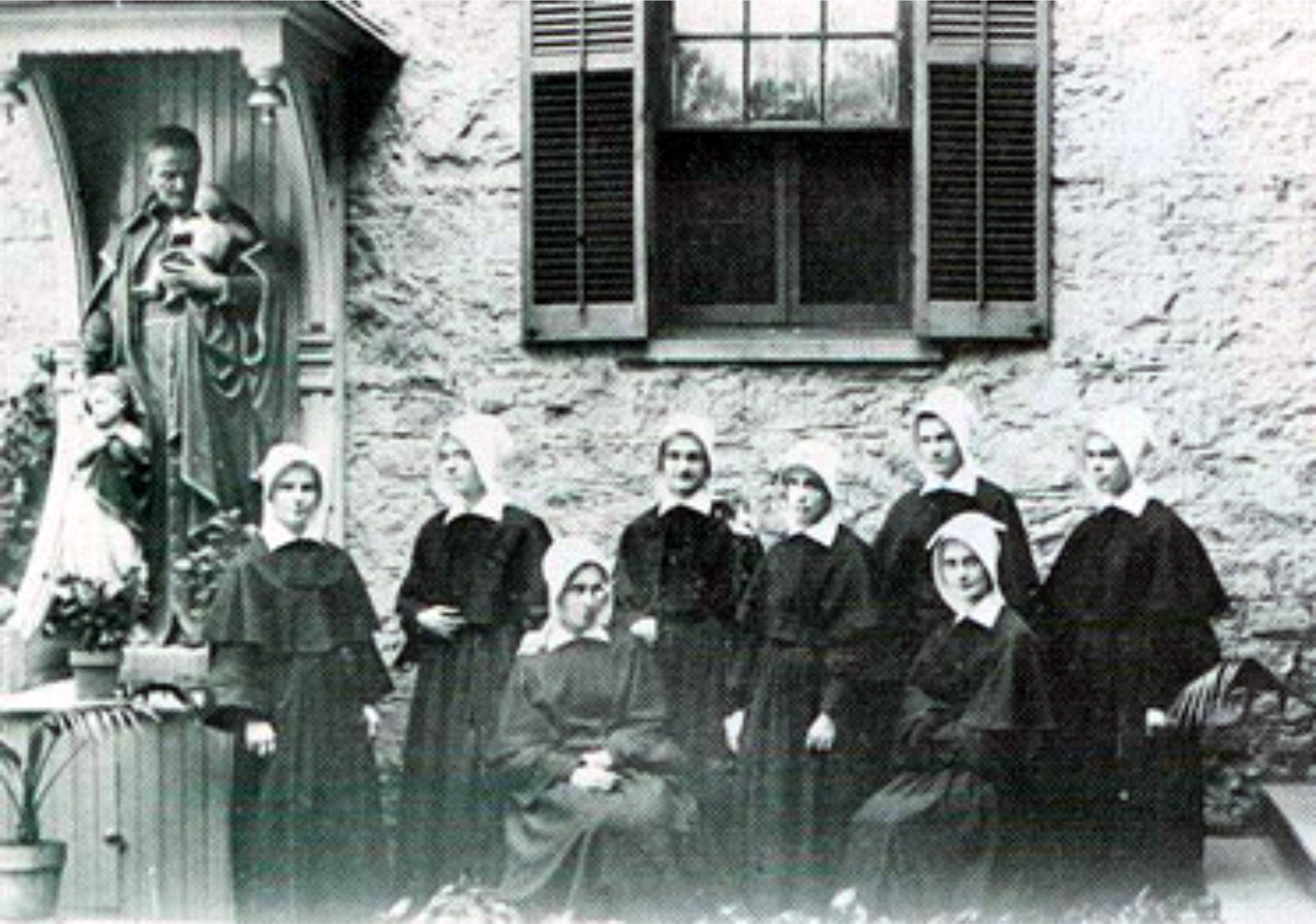
The St. Joseph Infirmary with the very first nuns who came from Kentucky 
with the order to open and to lead it.
This image dates back to September 24, 1888, 
a few months before Rudolf's son was born and was kept hidden in it. 
For sure, amongst them, there's who helped Princess K to give birth to her child and took care of them both

Probably you wonder why this child was born in America if his mother was Russian, and Rudolf's Family lived in Vienna.
Actually, as soon as Princess K. knew about the tragedy occured in Mayerling, together with her old nanny, left Russia: she was afraid to be found from the secret police from Vienna and to be forced to miscarry her baby. Everybody lost her traces, even her family. The only one she preserved contact with was her sister Princess Maria, who will go to America and arrived just in time to see the young Olga perish of hardship: she had no money with her when she left the court in St. Petersburg and, until then, they were the nuns who took care of her and of her baby as they could. Of the nanny were lost every traces: probably she went somewhere in Europe. But the child had to remain in America, that was the princess's last will, as said the nuns.
Looking at him with a loving gaze, Maria's attention was captured by her sister's gold chain, which she now saw wrapped around the small wrist of the child she had given birth to: its pendant, a cross, certainly meant to mean that whatever name would have been given to him, whatever fate befell him, no one could have ever doubted his faith.
He was so adorable! It was absolutely not easy for her to make up her mind, but at this point Maria had nothing else to do but coming back to Russia with her heart broken and filled with sadness: she had to go on living as if nothing would ever happened, forgetting everything although knowing she won't have seen her beloved younger sister and her little nephew again.
By his mother he was given a quite important name - Rudolf Franz Alexander Napoleon Augustus Maximilian Karl Josef but it was changed just to be sure that anybody could find him: he was thought to be a danger for the throne - having Habsburg roots, once became adult, he could have claimed a right to the succession at the Danubian double monarchy; he could have be seen as a threat.
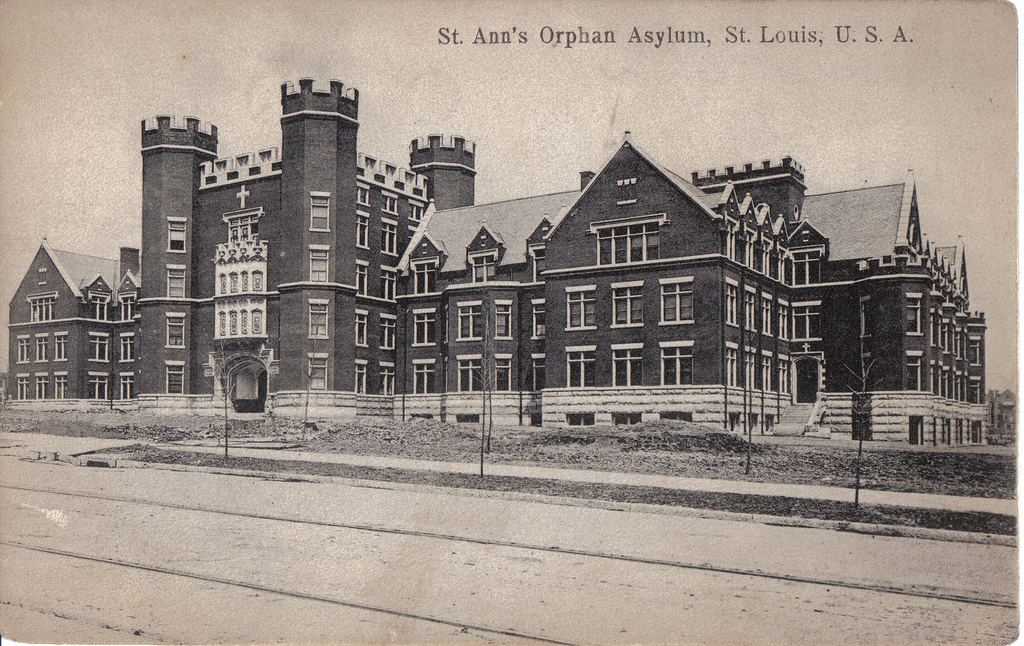
That's why his real name was forgotten. When he was a little less than two years old he entered the St. Ann's Orphan Asylum in St. Louis, Missouri, with the name of James Cleveland Longstreet and remained there until he was eleven although the other children, when they reached the age of three, went to St. Mary's Orphanage if they were  female, and to St. Joseph's Home for Boys, if they were male.


He won't have an easy life at all: he would have find himself living, as a child, without a roof on his head, side by side with pioneers, outlaws, cow-boys, gold seekers and cattle thieves, in a Land the history of which still had to be written. He wasn't aware of it, but there was always a 'special eye' looking over him: Emperor Franz Josef always knew where his grandson was and where to find him, and always instructed someone, amongst the most eminent personages of the place, to take care of him without the young boy realized of it. 
But that's another story you'll find in the book I wrote.


NOTES: 

1 - Daniela Lasagnini, Il figlio americano di Rodolfo d'Asburgo, Trieste, MGS PRESS, 2021, p. 26.

2 - CfrDaniela Lasagnini, Il figlio americano di Rodolfo d'Asburgo, Trieste, MGS PRESS, 2021, p. 27. 

3 Judith Listowel, Crown Prince Rudolph. A Habsburg Tragedy, New York, Dorset Press, 1978, p. 296.

See you soon, 

Dearest Friends and Readers of mine,

enjoy this so lovely time of the year!

❤  


La principessa "K", amore segreto del 
 

principe ereditario Rodolfo d'Asburgo-Lorena


Amore, quante strade per giungere a un bacio,

che solitudine errante fino alla tua compagnia!

Pablo Neruda (1904-1973) da Cento Sonetti d’Amore (1959)Sonetto IIMattino


 IMMAGINE DI FRONTESPIZIO - 
A sx: la principessa Olga, chiamata Principessa K, fotografata alla fine degli anni ‘80 del 1800. 
A dx: in alto la principessa, che allora aveva tre anni (1868), tiene per mano la sorella Maria, maggiore di due anni, ed è con loro la madre Aleksandra; in basso è ritratta accanto alla sorella un anno dopo (1869). Allora erano già state legalmente adottate da Pyotr Albedinsky che aveva sposato Aleksandra alla fine dell’anno 1865 (Un dettaglio: come potete vedere la chaise longue presente nell’ultima immagine è la stessa su cui si appoggia la principessa Olga da adulta).


Quando il principe ereditario Rodolfo d'Asburgo-Lorena,  figlio dell'imperatore d'Austria-Ungheria Francesco Giuseppe e della sua consorte, l'imperatrice Elisabetta, detta Sisi, la incontrò per la prima volta, non era altro che una ragazzina: era il 1878, l'anno del suo Grand-Tour, e tale occasione gli fu offerta proprio da questo viaggio che lo condusse a visitare le principali Corti europee ed il Medio -Oriente, un viaggio compiuto per incrementare le sue conoscenze del mondo e della gente, dell'arte, della storia. Egli aveva allora vent'anni, ed era un giovane di bell'aspetto,

IMMAGINE 2 - 
Il principe ereditario Rodolfo in una fotografia risalente al periodo del suo Grand-Tour


mentre ella si trovava non oltre le soglie dell'adolescenza, ma immediatamente egli se ne invaghì: il suo temperamento vivace, il suo modo di esprimersi così pieno di vita lo affascinarono e conquistarono il suo cuore. In realtà Rodolfo non aveva mai conosciuto una ragazza così piacente prima di allora.  

Quando Rodolfo aveva vent'anni, conobbe due affascinanti ragazzine russe, figlie illegittime dello zar Alessandro II. La più giovane, chiamata dagli amici 'K' , era incantevole: carina, spumeggiante e decisamente maliziosa. Egli s'innamorò di lei, lei di lui. Fu un corteggiamento giocoso.1

Al principio diventarono amici intimi, anzi, in realtà il loro fu amore a prima vista ed è verosimile che si siano scambiati lettere, che rimasero, comunque, tenute lontano dagli occhi di tutti e che andarono probabilmente distrutte, insieme con altri documenti, dopo la tragedia di Mayerling. Quando l'imperatore decise che fosse arrivato il momento di trovare una consorte per il suo erede, Rodolfo espresse nell'immediato il proprio desiderio: egli voleva sposare la giovane ragazza che tutti a Corte continuavano a chiamare principessa'K', ma suo padre espresse il suo sconcerto senza il benché minimo ritegno.

Il solo pensiero impietrì l'imperatore - una principessa illegittima futura imperatrice? 'Rodolfo deve essere impazzito!' Meno comprensibilmente anche lo zar si oppose al matrimonio, forse perché anch'egli condivideva il principio che la figlia illegittima di un monarca - anche se in questo caso era la sua - non fosse adatta a divenire imperatrice. 2

In realtà questa giovane affascinante aveva sangue nobile nelle proprie vene visto che suo padre era l'imperatore di tutte le Russie e sua madre era una principessa, la principessa Aleksandra Sergeyevna Dolgorukaya, dama d'onore della zarina Maria Aleksandrovna. Ma dello zar ella era l'amante e la loro era una relazione extraconiugale, per cui sia la principessa Olga che sua sorella maggiore Maria erano considerate figlie non legittime (a quel tempo erano chiamate 'royal bastards' ossia bastarde reali).

IMMAGINE 3 - 
Lo zar Alessandro II e la principessa Aleksandra Sergeyevna Dolgorukaya fotografati al tempo della loro relazione.

Un giorno Rodolfo avrebbe ereditato il trono di un impero e non poteva permettersi di assecondare i propri sentimenti, le proprie emozioni, le proprie passioni; il suo matrimonio era di pertinenza politica, era un affare di Stato che nulla ha a che spartire con il vero amore, ecco cosa pensava suo padre. Egli, allora giovane romantico, fu colto da un'improvvisa tristezza pensando a cosa poteva riservargli il resto della sua vita, nonostante fosse totalmente devoto al futuro dell'Austria-Ungheria: la sua era una sorta di missione, e, appagare suo padre, forse, avrebbe significato un riavvicinamento tra loro ed avrebbe appianato i frequenti dissidi che stavano rendendo le loro vite così difficili - avevano vedute completamente differenti in fatto di politica, motivo per cui Francesco Giuseppe lo teneva all'oscuro delle questioni ufficiali d'interesse nazionale e non solo. Al suo sangue nobile era necessario unire quello di una principessa le cui radici fossero davvero e legalmente aristocratiche. A quel tempo vi erano solamente tre giovani  principesse cattoliche degne di diventare spose di un futuro imperatore, ma avevano ben poco da offrire in quanto a bellezza ed intelligenza. La meno peggio delle tre sembrava essere la principessa Stefania, figlia secondogenita del re Leopoldo II del Belgio.


IMMAGINE 4 - 
La giovanissima principessa Stefania del Belgio, futura fidanzata del principe ereditario Rodolfo 


Seppure parente di Rodolfo - Maria Enrichetta d'Asburgo-Lorena, madre di Stefania, era cugina di Francesco Giuseppe - costoro non avevano mai avuto alcuna occasione d'incontrarsi prima. E fu così che nel maggio del 1880 fu organizzato un viaggio con l'intento di condurre l'arciduca austriaco a Bruxelles. Rodolfo era già stato nella capitale belga in altre occasioni, ma solo per svago, e mai si recò a Corte; questa volta doveva conoscere la sua futura sposa, così si recò al palazzo reale dove i suoi futuri suoceri lo stavano attendendo. Il fidanzamento ed il  matrimonio che vi avrebbe fatto seguito furono decisi nell'immediato e quello che sembrava lo sposalizio del secolo, caldeggiato dalle famiglie di origine di entrambi gli sposi, si trasformò, per entrambi, in un vero e proprio inferno. E dopo poco meno di otto anni si concluse tragicamente nel casino di caccia di Mayerling, il mattino del 30 gennaio 1889, quando Rodolfo morì di morte violenta.
Ma torniamo alla principessa'K'. Il nostro bell'arciduca non aveva dimenticato questo suo importante amore, anzi, esso diventava sempre più importante a mano a mano che il suo matrimonio andava deteriorandosi. Non appena seppe che non sarebbe stato in grado di dare un futuro al trono - Stefania, pochi anni dopo la nascita della piccola Erszebeth Marie, divenne sterile in conseguenza ad una malattia venerea che Rodolfo aveva contratto e che le aveva trasmesso - fu come se la sua vita avesse perso ogni suo significato.

In tali condizioni la sua mente cominciò a tornare con il pensiero al passato e l'immagine dell'affascinante principessa'K' emerse sempre più vividamente. Ella non si era ancora sposata. Rodolfo sentì che doveva incontrarla quanto prima. La contattò e si accordarono per incontrarsi in Svizzera nel più stretto riserbo. 3

Così fu deciso: cogliendo l'occasione dell'assenza da Vienna sia della madre che della moglie e contando sulla collaborazione amichevole del cugino Johann Salvador, Rodolfo si apprestava ad incontrare la sua amata ragazza.
Era il 16 settembre 1888 quando Rodolfo raggiunse il castello di Prégny

IMMAGINE 5 - 
Il castello della famiglia Rothschild situato a Prégny presso Ginevra


che era la residenza estiva della baronessa Julie von Rothschild e di suo marito, il barone Adolf, appartenente al ramo viennese della famiglia dei famosi banchieri tedeschi. All'interno di questo incantevole castello, che si affaccia sul Lago di Ginevra, fu conservata e tenuta nascosta la prova di questo suo incontro con la principessa russa. Due giorni dopo Rodolfo era già di ritorno a Vienna e nessuno, eccetto il cugino Johann Salvador, sapeva cosa era successo. Nove mesi più tardi venne al mondo un bambino. Dovremmo dire nel 'Nuovo Mondo' visto che nacque in America, ad Hot Springs, Arkansas, in quella che al tempo era la St. Joseph's Infirmary.


IMMAGINE 6 - 
La St. Joseph Infirmary con le primissime suore che vennero dal Kentucky con l'ordine di aprirla e condurla.
Questa immagine risale al 24 settembre 1888, pochi mesi prima che il figlio di Rodolfo vi nascesse e vi fosse tenuto nascosto.
Di certo, tra di loro, vi è chi fece nascere il figlio di Rodolfo e si prese cura di lui nonché della Principessa K


Probabilmente vi chiederete perché questo piccolo sia nato in America visto che sua madre era russa e la famiglia di Rodolfo viveva a Vienna.
In realtà, non appena la principessa'K' seppe della tragedia di Mayerling lasciò la Russia insieme con la sua vecchia balia: temeva di essere trovata dalla polizia segreta viennese e di essere obbligata ad abortire la propria creatura. Tutti persero le sue tracce, anche la sua famiglia. La sola con cui rimase in contatto fu sua sorella, la principessa Maria, che raggiunse l'America ed arrivò appena in tempo per vedere la giovane Olga perire di stenti: non aveva denaro con sé quando lasciò in tutta fretta la Corte di San Pietroburgo e, fino a quel momento, furono le suore dell'infermeria a prendersi cura di lei e del suo bambino come poterono. Della bambinaia fu persa ogni traccia: probabilmente fuggì in qualche parte dell'Europa. Ma il bambino doveva rimanere in America, questa era l'ultima volontà della principessa, come dissero le suore. Guardandolo con sguardo amorevole, l'attenzione di Maria fu catturata dalla catenina in oro di sua sorella, che ora vedeva avvolta al piccolo polso del bimbo che aveva dato alla luce: il suo ciondolo, una croce, voleva sicuramente stare a significare che qualunque nome gli fosse stato dato, qualunque destino gli fosse capitato, nessuno avrebbe potuto nutrire dubbi sul suo credo.
Era talmente adorabile! Non fu assolutamente facile per lei prendere una decisione, ma a questo punto a Maria non rimaneva altro da fare che tornare in Russia con il cuore spezzato e colmo di tristezza: doveva continuare la sua vita come se niente fosse accaduto, dimenticando tutto, consapevole che mai più avrebbe rivisto l'amata sorella ed il piccolo nipotino.
Sua madre gli aveva dato un nome molto importante - Rudolf Franz Alexander Napoleon Augustus Maximilian Karl Josef, ma fu cambiato per essere certi che nessuno lo potesse trovare: si pensava che potesse essere un pericolo per il trono - avendo radici asburgiche, una volta diventato adulto, avrebbe potuto vantare diritti di successione al trono della doppia monarchia danubiana; avrebbe potuto essere visto come una minaccia.
Ecco perché il suo vero nome fu dimenticato. Quando aveva poco meno di due anni fu messo nel St. Ann's Orphan Asylum a St. Louis, Missouri, con il nome di James Cleveland Longstreet, dove rimase fino all'età di undici anni sebbene tutti i bambini che vi erano alloggiati, una volta raggiunta l'età di tre anni, venivao trasferiti al St. Mary's Orphanage, se femmine, e alla St. Joseph's Home for Boys, se erano maschi.

IMMAGINE 7 - 
Il St. Ann's Orphan Asylum di Saint Louis, Missouri, fotografato come appariva nel 1903 


L'attenderà una vita non del tutto facile: si sarebbe ritrovato a vivere da bambino, senza il riparo di un tetto, accanto a pionieri, fuorilegge, cow-boys, cercatori d'oro e mandriani, in una Terra la cui storia era ancora tutta da scrivere. Ignorava che sarebbe sempre stato sorvegliato da un'occhio speciale': l'imperatore Francesco Giuseppe sapeva sempre dove si trovava suo nipote e dove poterlo trovare, ed istruiva immancabilmente qualcuno, scelto tra i più eminenti personaggi del luogo, perché sorvegliasse questo fanciullo cui tanto teneva, senza che egli se ne avvedesse. 
Ma questa è un'altra storia raccontata nel libro che ho scritto.


IMMAGINE 8 - 
Copertina de Il figlio americano di Rodolfo d'Asburgo, di Daniela Lasagnini, edito da MGS PRESS


CITAZIONI: 

1 - Daniela Lasagnini, Il figlio americano di Rodolfo d'Asburgo, Trieste, MGS PRESS, 2021, p.26 .

2 - CfrDaniela Lasagnini, Il figlio americano di Rodolfo d'Asburgo, op. cit., p.27 . 

Judith Listowel, Crown Prince Rudolph. A Habsburg Tragedy, New York, Dorset Press, 1978, p.296 .


A presto, 

miei Carissimi Amici e Lettori, 

traete diletto da questo periodo dell'anno così bello!


Dany


LINKING WITH: