Visualizzazione post con etichetta E.Brontë. Mostra tutti i post

mercoledì 19 luglio 2017

The Brontës' children teeny tiny books available on-line.


That of ingeniousness is a characteristic that cannot be acquired, it is a gift of nature which you have to be born with, and, with the passing of time, it can only be cultivated and refined.
And the Brontë siblings, in greater or lesser measure, possessed it all and gave demonstartion of it since their earliest age.


In 1829-30 Charlotte Brontë was 13 and hers brother Branwell 12 years old; they both had fun creating fantastic worlds that called Angria and Glass Town Confederacy and adventurous stories set in these fantastic worlds which they gave life to for Branwell's soldiers, who were both protagonists and listeners, stories which are contained in lovely tiny books that lies in the palm of one's hand: they measure less than 1 inch for 2 (2.5 x 5 cm), are made with recycled paper, found in the house and carefully cropped and collected (for example, they may have used the margins of the pages of a newspaper) and drawn up in athe most accurate, far too little handwriting.

Both the dimensions and the characters with which they are written make of them works of a truly inestimable value, and if we think of their authors and the time we are talking about, their value grows further beyond measure.

Page after page you enter this fantastic world through reading poems, stories, songs, illustrations, maps, building plans, and dialogues written with old nibs on such small leaves that an adult's hand has difficulty to handle, especially with the care that requires their over 200 years age.

Twenty in all have been preserved, nine of them have been recently digitized from the Houghton Library at Harvard University and are available online free and in full version:

by Charlotte Brontë:

Blackwoods young mens magazine, August 1829;

The silver cup: a tale, October 1829;

Scenes on the great bridge, November 1829;

The adventures of Mon. Edouard de Crack, February 1830;

An interesting passage in the lives of some eminent personages of the present age, June 1830;

The poetaster: a drama in two volumes, July 1830;


by Patrick Branwell Brontë:

Magazine, January 1829;

Branwells Blackwoods magazine, June 1829;

Branwells Blackwoods magazine, July 1829.


Also Emily and Anne wrote miniature books similar to these, but their copies did not survive, alas! they didn't pass the test of the passing of time.
Imagine Charlotte Brontee, who, at the age which girls still play, while she carefully pierced her sheets of paper and tied them together, without causing any damage to them, with an embroidery thread reproducing a binding that an embroidery really resembles; Branwell used a firmer yarn and his binding, which allowed him to stack a sheet at a time after writing it, did not reveal the grace used by his sister, but this does not take off prestige to the little, great treasures of this artist who would have become a poet and a painter, though, destroyed by alcohol and opium addiction, he will go off at just 31 years (you can read the post that ~ My little old world ~ long ago devoted to this fascinating and contradictory character in history of Literature and Art of the XIXth century, for me still little known and appreciated at least as much as he would deserve, by clicking HERE).


I'm sure you're wondering, at this point, how these twenti 'juvenilia' could have been preserved ...

Well, Charlotte's husband, after her death, sold the small volumes to a collector who gave them in turn to the poet Amy Lowell, who presented them at the Houghton Library in 1925 just a year before her death.

The deterioration that  the time has physiologically impressed on the paper has made necessary a work of meticulous restoration and therefore this technological intervention so that they won't be lost and now, thanks to digitization, the time for them is as if it were stopped ... even if browsing them on a screen is never how to handle them, the emotion they give, believe me, is really great!


Thanks once again for following me up to here,
my dear friends, affectionate and occasional readers,
I heartily thank you and looking forward to meet you again, 
I'm greeting you warmly,


see you soon 💕


SOURCE:


Quello della genialità è un tratto caratteriale che non può essere acquisito, è un dono con cui si nasce e che con il tempo può solamente essere coltivato ed affinato 
ed i fratelli Brontë , in maggiore od in minore misura, lo possedevano tutti e ne diedero dimostrazione fin dalla più tenera età.


immagine 1 


Nel 1829-30 Charlotte Brontë aveva 13 anni e suo fratello Branwell ne aveva 12; costoro si divertivano a creare mondi fantastici che chiamarono Angria e Glass Town Confederacy e proprio i racconti avventurosi ambientati in questi mondi fantastici creati per i soldatini di Branwell, i quali delle suddette storie erano sia protagonisti che uditori, sono contenuti in incantevoli libricini che stanno nel palmo di una mano: misurano meno di 1 pollice per 2 ( cm.2,5 X 5 ), sono fatti con carta riciclata, trovata in casa ed accuratamente ritagliata ( si poteva trattare, per esempio, dei margini delle pagine di un quotidiano ) e vergati in una più che accurata, piccolissima grafia.


Sia le dimensioni che i caratteri con cui sono scritti ne fanno opere di un valore davvero inestimabile, se poi si pensa a coloro ne furono gli autori e all'epoca di cui stiamo parlando, il loro valore cresce ulteriormente a dismisura.

Pagina dopo pagina si entra in questo mondo fantastico attraverso la lettura di poesie, storie, canzoni, illustrazioni, mappe, piani di costruzione e dialoghi vergati con antichi pennini su fogli talmente piccoli che le mani di un adulto fanno fatica a maneggiare, soprattutto con la cura che richiede la loro età che data più di 200 anni. 


Venti in tutto se ne sono conservati, nove ne sono starti recentemente digitalizzati dalla Houghton Library alla Harvard University e sono disponibili on-line gratuitamente in versione integrale:


di Charlotte Brontë:

Blackwoods young mens magazine, August 1829;

The silver cup: a tale, October 1829;

Scenes on the great bridge, November 1829;

The adventures of Mon. Edouard de Crack, February 1830;

An interesting passage in the lives of some eminent personages of the present age, June 1830;


The poetaster: a drama in two volumes, July 1830;


- immagine 2


- immagine 3


di Patrick Branwell Brontë:

Magazine, January 1829;

Branwells Blackwoods magazine, June 1829;

Branwells Blackwoods magazine, July 1829.


- immagine 4


Anche Emily ed Anne scrissero libri in miniatura simili a questi, ma le loro copie, ahimè, non ci sono pervenute, non hanno superato la prova del trascorrere del tempo.

Immaginate Charlotte Brontee che, all'età in cui ancora le fanciulle giocano, si preoccupava di forare con cura foglio per foglio i suoi libricini e di legarli infine insieme, senza arrecare loro danno alcuno, con un filo da ricamo riproducendo una rilegatura in brossura che ad un ricamo, davvero, somiglia; Branwell utilizzò un filo in lino più robusto e la sua rilegatura, che gli permetteva di accatastare un foglio alla volta dopo averlo scritto, non rivela la grazia che usò sua sorella, ma ciò non toglie prestigio ai piccoli, grandi tesori di questo artista in nuce che sarebbe diventato poeta e pittore, anche se, distrutto dalla dipendenza dall'alcool e dall'oppio, si spegnerà a soli 31 anni ( potete leggere il post che ~My little old world~ tempo fa dedicò a questo affascinante e contradditorio personaggio della storia della letteratura e dell'arte del XIX secolo per me ancora poco conosciuto ed apprezzato come meriterebbe cliccando QUI ).


immagine 5


Vi chiederete a questo punto come questi venti 'juvenilia' abbiano potuto conservarsi ...

Ebbene, il marito di Charlotte, dopo la sua morte, vendette i piccoli volumi ad un collezionista che li diede a sua volta alla poetessa Amy Lowell, la quale ne fece dono alla Biblioteca Houghton nel 1925. proprio un anno prima della sua morte.

Il deterioramento che il tempo fisiologicamente ha impresso sul materiale cartaceo ha reso necessaria un'opera di minuzioso restauro e quindi questo intervento tecnologico affinché anch'essi non andassero perduti ed ora, grazie alla digitalizzazione, il tempo, per loro, è come se si fosse fermato ... anche se sfogliarli su di uno schermo non è mai come maneggiarli, l'emozione che donano, credetemi, è davvero grande !


Grazie anche questa volta per avermi seguita fino a qui, 
miei adorati amici, lettori affezionati ed occasionali, 
vi ringrazio di cuore e vi aspetto ... ancora ...


a presto 💕


FONTE DELL'INFORMAZIONE:


LINKING WITH:


sabato 3 giugno 2017

Do you know Elizabeth Brontë?


We know so little about Maria Brontë, the firstborn and tragic genius of the family, but the least known of all the Brontë sisters is the second, Elizabeth.
Don't you think it's time to get to know her more closely?


Elizabeth was born on February 8th, 1815 in the village of Hartshead, a small, pretty village on the hills above Mirfield in West Yorkshire, where her Father Patrick was Curator of the Church of England.

She was aged two months when she moved together with her family to the new parish that had been assigned to her father, that of Thorntorn, York, where she was baptized on August 26th, more than six months after her birth, which makes us suppose she had been affected by some illness that made it impossible to baptize her before, according to the rules of the Holy Mother Church. They will stay there five years during which Patrick Brontë and his wife Maria will give birth to their full family.

In 1820, the Brontës moved to Haworth and only the following year, in 1821, when Elizabeth was six years old, her mother, weakened after giving birth to her sixth son and never completely recovered, surrender herself to an incurable  desease and died, leaving to her older daughter Maria the care of her siblings, which made her mature very early and made her responsible more than it was usual at her age (she was only seven !) and that of the house to her sister Elizabeth who soon joined them to become part of the family.


Emily, Charlotte, Elizabeth, Branwell, Maria and Anne Brontë as children, 
drawn by Joan Hassall for Margaret Lane's The Brontë Story


If we really know a little about her, it is due above all to the fact that if all the Brontë brothers died early, Elizabeth was the one who died very young, that is when she was only ten years old.
Of her, for example, we know she had a preference for the order and the cleanliness of the house, for the most practical things in life, which distinguished her from her siblings who loved playing, reading and inventing stories.

This is also confirmed by her recording ast the Clergy Daughter's School at Cowan Bridge which Elizabeth attended with her older sister Maria from July 21st, 1824 - Elizabeth and Maria were among the first twenty students attending this school - they would aggregate to them Charlotte - three weeks later  - and Emily in the fall. (Anne Brontë was too young to join them, and it was truly a fortune, we could say, according to what we now know about this school).

As soon as they joined the school they were all evaluated on the basis of the academic abilities they demonstrated and so it was desumed what was the occupation they had to choose as adults: Maria, Charlotte and Emily Brontë approached a career as future governesses, but Elizabeth is registered at the school of preparation for housekeepers. We know she did not take French lessons, music or drawing lessons, as her sisters did.

These are the notes about her:

‘Reads little. Writes pretty well. Ciphers none. Works very badly. Knows nothing of grammar, history, geography or accomplishments.’


Sampler embroidered by Elzabeth at age of 7.


It should be noticed, however, that almost all pupils received negative and particularly hard judgments on their arrival at Cowan Bridge and the note 'writes pretty well' tells us that her calligraphy was perhaps better than that of many of her school companions.

Another report on Elizabeth Brontë, always from the Cowan Bridge, is signed by Miss Evans, superintendent at the school, who noted:

‘The second, Elizabeth, is the only one of the [Brontë] family of whom I have a vivid recollection, from her meeting with a rather alarming accident, in consequence of which I had her for some days and nights in my bed-room, not only for the sake of her greater quiet, but that I might watch over her myself. Her head was severely cut, but she bore all the consequent suffering with exemplary patience, and by it won much upon my esteem.’

Certainly the worst had still to happen: in that terrible, unhealthy structure, with her sister Maria and many others, Elizabeth contracted tuberculosis.

Mary was sent home as soon as her illness was diagnosed in February 1825, while for Elizabeth the evolution of her desease was at first confused with the overlapping of a typhus epidemic that infected the girls to the structure, who were decimated for a third; Elizabeth was sent home sick on May 31st while Charlotte and Emily followed her a few days later in good health.

Maria died at home on May 6th, 1825, Elizabeth went off on June 15th.

So what do we know about Elizabeth Brontë?
That she was a patient girl, had a disgrace, liked to take care of the house and that her handwriting was better than that of many girls of her age.
But there is more about her.

Patrick Brontë


argued that her second daughter had a sound common sense, and perhaps the best tribute comes from Charlotte Brontë, who would take her closest sister (as for age) as an example. 
Elizabeth Gaskell, Charlotte's friend and biographer, remembered that she often talked of Maria and Elizabeth, and according to Charlotte's statements, she ‘used to believe them to have been wonders of talent and kindness.’

Nancy Garrs, their servant, remembers how the young Elizabeth guided her younger sisters by holding them by hand during their walks through the moors and that she was very "caring" in treating them.

And I wonder if Emily, 


choosing her pen-nickname - Ellis - wanted to make a tribute to her sister Elizabeth who had lost so very soon ...


And in the hope tho have pleased you depicting the portrait 
of such a lovely, sweet little girl,
 I'm sending my warmest hug to you, 
filled with love and gratitude !


See you soon 💕


BIBLIOGRAPHIC SOURCES:

Margaret Lane, THE BRONTE STORY, FONTANA Publisher, 1979;

WIKIPEDIA


Poco sappiamo di Maria Brontë, primogenita e genio tragico della famiglia, ma la meno nota di tutte le sorelle Brontë in assoluto è la seconda, Elizabeth. 
Non vi sembra sia giunto il momento di conoscerla più da vicino ?


- immagine 1 - 


Elizabeth era nata l'8 di febbraio del 1815 nel villaggio di Hartsheadun piccolo villaggio sulle colline sopra Mirfield nel West Yorkshire, dove il padre Patrick era Curato della Chiesa d'Inghilterra. 

Aveva due mesi la piccola quando si trasferì con la famiglia nella nuova parrocchia che era stata assegnata al padre, quella di Thorntorn, York, dove venne battezzata solamente il 26 agosto, più di sei mesi dopo la sua nascita, il che ci fa supporre che fosse stata affetta da una qualche malattia che rendesse impossibile il battezzarla prima, secondo quanto dettano le regole della Santa Madre Chiesa. Qui rimasero cinque anni durante i quali Patrick Brontë e sua moglie Maria diedero vita alla loro famiglia al completo.

Nel 1820 i Brontës si spostarono ad Haworth e solamente l'anno dopo, nel 1821, quando Elizabeth aveva sei anni, la madre, fiaccata ed indebolita dopo aver dato alla luce il suo sesto figlio e mai del tutto ripresasi, cedette ad un male incurabile e morì, lasciando alla figlia maggiore Maria la cura dei fratelli, cosa che la fece maturare molto precocemente e la rese responsabile ben più di quanto si addicesse alla sua età ( aveva solamente un anno in più di Elizabeth !) e quella della casa alla sorella Elizabeth che presto li raggiunse per far parte della famiglia.


- immagine 2 - Emily, Charlotte, Elizabeth, Branwell, Maria ed Anne Brontë in un disegno di Joan Hassall per The Brontë Story di Margaret Lane


Se sappiamo davvero poco di lei lo dobbiamo soprattutto al fatto che se è vero che tutti i fratelli Brontë morirono precocemente, Elizabeth fu colei che morì giovanissima, ossia a soli dieci anni di vita. 
Di lei per esempio sappiamo che aveva predilezione per l'ordine e la pulizia della casa, per le cose più pratiche della vita, caratteristiche che la distinguevano nettamente dai suoi fratelli che amavano giocare, leggere ed inventare storie.

Ciò è confermato anche dalla sua iscrizione nel registro della Clergy Daughter’s School at Cowan Bridge che Elizabeth frequentò con la sorella maggiore Maria a partire dal 21 luglio 1824 - Elizabeth e Maria furono tra le prime venti alunne che frequentarono il collegio - e a loro si sarebbero aggregate Charlotte tre settimane dopo ed Emily nell'autunno. (Anne Brontë era troppo piccola per unirsi a loro, per sua fortuna, potremmo dire, alla luce di quanto sappiamo ora della suddetta scuola).

Al loro ingresso nella scuola tutte venivano valutate in base alle abilità accademiche che dimostravano e ciò per cui erano portate, ovvero quale era l'occupazione che a loro si addiceva di più una volta divenute adulte: a Maria, Charlotte ed Emily Brontë si addiceva una carriera come future istitutrici, ma Elizabeth risulta registrata alla scuola di preparazione alle governanti. Sappiamo che non prese lezioni di francese, di musica o di disegno, come invece fecero le sue sorelle.

Queste sono le annotazioni che la riguardano:

Legge poco. Scrive abbastanza bene. Non ha abilità nel far di conto. Lavora molto male. Non sa nulla della grammatica, della storia, della geografia e non ha talenti’.


- immagine 3 - Sampler ricamato da Elzabeth all'età di 7 anni.


Va però notato che quasi tutti gli alunni ricevevano giudizi negativi e particolarmente duri al loro arrivo a Cowan Bridge e la nota 'scrive abbastanza bene' ci dice che forse era migliore di molte sue compagne di scuola.

Un altro rapporto su Elizabeth Brontë, sempre del Cowan Bridge, reca la firma di Miss Evans, sovrintendente alla scuola, la quale annotava:

La seconda, Elizabeth, è l'unica della famiglia [Brontë] di cui ho un vivo ricordo, dovuto ad un incidente abbastanza allarmante, ed in conseguenza al quale l'ho tenuta per alcuni giorni e notti nella mia camera da letto , non solo perché fosse così più tranquilla, ma per poterla sorvegliare. Aveva un brutto taglio alla testa, ma ha sopportato la conseguente sofferenza con pazienza esemplare, e si è conquistata la mia stima’.

Per certo il peggio doveva ancora accadere al Cowan Bridge: in quella terribile, malsana struttura, con sua sorella Maria e molti altri, Elizabeth contrasse la tubercolosi. 

Maria fu mandata a casa non appena le fu diagnosticata la malattia nel febbraio del 1825 mentre per Elizabeth l'evoluzione della malattia fu dapprincipio mascherata dal sovrapporsi di un'epidemia di tifo che colse le fanciulle alla struttura, le quali vennero decimate per un terzo; Elizabeth fu inviata a casa malata il 31 maggio mentre Charlotte ed Emily la seguirono alcuni giorni dopo in buona salute. 

Maria morì a casa il 6 di maggio del 1825, Elizabeth si spense il 15 di giugno.

Quindi cosa sappiamo di Elizabeth Brontë?
Che era una fanciulla paziente, che ebbe una disgrazia, che le piaceva prendersi cura della casa e che la sua grafia era migliore di molte ragazze della sua età.
Ma c'è più.

Patrick Brontë 


- immagine 4 - 


sosteneva che la sua seconda figlia aveva un marcato buon senso, e forse il miglior omaggio ci proviene da Charlotte Brontë, che avrebbe preso d'esempio la sorella più vicina a lei in età.
Elizabeth Gaskell, amica e biografa di Charlotte, ricordava che ella parlava spesso di Maria e di Elizabeth, e dalle dichiarazioni di Charlotte «era certa che queste fossero state meraviglie di talento e di gentilezza». 

Nancy Garrs, la domestica di casa Brontë, ricorda come la giovane Elizabeth guidasse le sue sorelle più piccole tenendole per mano durante le loro passeggiate attraverso le brughiere e che era molto "premurosa" nel trattarle. 


E chissà se Emily, 


- immagine 5 - 


nello scegliere il suo pseudonimo di penna - Ellis - non abbia voluto rendere omaggio alla sorella Elizabeth che troppo precocemente aveva perso ...


E nella speranza di avervi fatto cosa gradita nel ritrarre questa dolce fanciulla,
lasciate che vi invii il mio più caloroso abbraccio, 
colmo di affetto e riconoscenza

a presto 💕


FONTI BIBLIOGRAFICHE:

Margaret Lane, THE BRONTE STORY, FONTANA Publisher, 1979;

WIKIPEDIA


LINKING WITH:

AWWW MONDAYS

BLUE MONDAY


giovedì 28 maggio 2015

The Life and Times of the Victorian Governess.


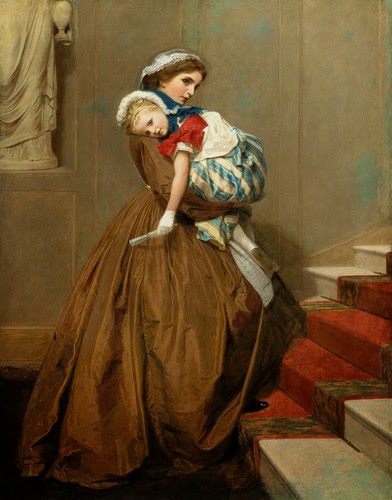
How delightful it would be to be a governess! 


James Hayllar, Miss Lily's Return from the Ball


To go into the world; to enter a new life; to act for myself: to exercise my unusual faculties; to earn my own maintenance.


Agnes Grey, Anne Brontë, 1847


Jane Eyre di Charlotte Brontë, Agnes Grey di Anne Brontë, Becky Sharp in Vanity Fair di William Makepeace Thackeray ( romanzi tutti questi pubblicati nell'anno 1847 ), Emily Morton in Amy Herbert di Elizabeth Sewell, Emma di Jane Austen, se volte, anche se leggermente anteriore ed altre ancora, la letteratura vittoriana ci viene spesso incontro, con la finzione del romanzo, aiutandoci a dar vita, nel nostro immaginario, alla figura dell'istitutrice, una figura caratteristica dei quel periodo storico, anche se sorta nel secolo precedente quale membro della servitù che componeva il seguito delle famiglie più facoltose; osservata nella realtà dei fatti quella della Victorian governess è un'immagine difficilmente connotata da un'esistenza che si svolge serenamente e che trova al fine una felice realizzazione, l'unico elemento apportatore di gioia è quello di vivere con i fanciulli seguendone passo passo lo sviluppo, dettato da una quantomeno allegra routine:

Ho visto i miei cari alle otto, felicemente seduti davanti alle loro tazze di pane e latte, poi li lasciai alla loro cameriera e feci un giro nel boschetto. Colazione alle nove, i miei amori al mio fianco a giocare con le loro bambole. Dissi loro che se avessero giocato giocato molto graziosamente certamente avrei consentito loro la lettura e la scrittura come ricompensa. accolsero subito di buon grado la mia promessa ... N.B. farli studiare non deve essere visto come una punizione dovuta alla cattiva condotta. Sono tornati al loro gioco e ho suonato l'arpa fino a mezzogiorno, poi siamo usciti nel boschetto. Il tempo molto brutto e freddo - ha consentito ai miei amori di esercitarsi. Rimasimo fuori fino alle due. Li invitai a di vestirsi e a leggere per un'ora Pietro il Grande ... Abbiamo pranzato alle tre, parlammo francese per tutto il tempo in cui fummo tavola. Dopo cena lessi loro un racconto, poi i nostri piccoli studi, poi hanno giocato mentre ero al lavoro un'ora. Il tempo pessimo ci costrinse a giocare a 'puss in a corner ' e ritrovai il mio buon umore cercando di divertire i miei cari. Li inviai con la loro domestica alle sette a cena ... Alle otto li ho sentiti recitare le loro preghiere e poi li vidi a letto. Dissi quindi le mie preghiere, e andai a letto alle undici. 1


Abraham Solomon,  Portrait of Two Girls with their Governess


E come se non bastasse, essendo una figura cui poco si attribuiva importanza, molto di ciò che ne sappiamo lo dobbiamo a scritti e a corrispondenze private ( esemplare a tal proposito risulta la trascrizione delle memorie di Anna Henriette Leonowens, scrittrice, viaggiatrice ed educatrice britannica che nel 1862 accettò l'incarico d'insegnare ai figli e alle mogli del re del Siam da cui venne tratto nel 1944 il romanzo di Margaret Landon Anna and the King of Siam e quindi il musical nel 1951 The king and I ) che fortunatamente sono giunti fino ai giorni nostri.


English School, The Governess, c.1860


Vi dicevo poc'anzi che quella dell'educatrice è un'istituzione che risale al secolo XVIII laddove nobili ed aristocratici necessitavano di una donna di modesti natali e di buone maniere in grado di educare le figlie femmine alla loro femmininità, ma dovete sapere che durante il secolo successivo i "noveau riches" vittoriani, ovvero i medio ed alto borghesi che rappresentano la nuova classe sociale andata costituendosi velocemente e che altrettanto velocemente andava arricchendosi grazie al progresso e all'industrializzazione, una classe sociale nuova senza passato e senza tradizioni, che guarda a quella superiore cercando di farne propri i modi, i gusti e gli ideali con fare emulativo, non può davvero fare a meno di una educatrice per la propria prole, cosìcchè questa figura diviene durante tutto il 1800 molto ricercata e conosce durante questo periodo l'apice del proprio successo.


Vasily Perov, Arrival of the governess to the merchant house, 1866


Generalmente quella dell'educatrice era una professione quasi obbligatoria per una giovane di famiglia modesta e non maritata, non in grado perciò di sostentarsi autonomamente .... le fanciulle più ricercate erano le figlie dei vicari, le quali, in nome delle biblioteche ben fornite dei genitori, crescevano in un clima di maggior cultura ed anche, perché no, di rigidità morale ( pensiamo proprio alle sorelle Brontë, quale esempio ) e quindi univano alle capacità in fatto di ricamo e di cucito, di musica e canto anche quel po' di cultura generale che poteva arricchire le conoscenze di una donna, senza però aprirle troppo la mente; bastava che fosse abile nella pittura ad olio, ad acquerello e a carboncino, che fosse in grado di trasmettere gli insegnamenti ed i precetti religiosi e morali, soprattutto con l'esempio - come teneva a sottolineare il Cassell's household guide to every department of practical life: being a complete encyclopaedia of domestic and social economy pubblicato nel 1869 - che conoscesse i principi generali della matematica, la storia e la geografia, un po' di francese, tedesco ed italiano ed avesse un'ottima padronanza, questo sì, della lingua inglese, il tutto insegnato con sensibilità ed amorevolezza: non dimentichiamo che l'ideale di femminilità durante il periodo vittoriano era quello dell'Angel at Heart, l'angelo del focolare, docile e remissiva, alla quale la cultura non solo non era necessaria, ma poteva essere, se 'troppa' addirittura ...'nociva' comportando il rischio di distoglierla dai propri doveri coniugali e domestici.


Ma torniamo alla nostra governess per continuare dicendo che nonostante la rilevanza del suo compito all'interno della famiglia e le responsabilità di cui le veniva fatta consegna - l'educatrice vittoriana si occupava dei figli maschi e femmine fino all'età della scolarizzazione, poi veniva affiancata da un 'tutor', generalmente rappresentato da un sacerdote, ovvero dall'uomo di maggior cultura che potesse allora esistere in quanto depositario delle lingue 'dotte' ovvero il greco ed il latino, il quale si assumeva il compito di acculturare i figli maschi mentre a lei toccava l'incombenza di occuparsi delle figlie femmine fino alla maggiore età - 


Richard Redgrave, The Governess, 1844, © Victoria and Albert Museum 


essa conduceva una vita appartata dal resto del personale della famiglia e tra tutti era colei che godeva della paga più bassa dopo la sguattera, la quale, nonostante ciò, poteva ancora ambire a fare carriera ... l'educatrice vittoriana varcava la soglia della dimora della sua nuova famiglia quale governess e tale rimaneva fino a che il trascorrere del tempo non la costringeva a trovarsi una nuova famiglia, come un'orfana 'adulta' in cerca di tutela... l'unica cosa che mutava con il trascorrere degli anni era il suo appellativo, che passava da Miss a Mrs., dopo aver raggiunto i quarant'anni d'età, quasi rappresentasse un merito del tutto onorifico, ma comunque non adeguatamente corrisposto economicamente: pensate che intorno alla metà del secolo XIX una governess era retribuita annualmente con un compenso che variava dalle 30 alle 100 guineas per le più fortunate, quando: 


... nel 1845 un ordinario maestro di musica veniva pagato 7s a lezione. Anche se dava quattro lezioni al giorno, che significava (ipotizzando una settimana di sei giorni) un reddito di oltre £ 400 l'anno ed era in grado di organizzare la sua vita con cognizione (per esempio, dedicando due o tre giorni alla settimana dando le sue lezioni in una scuola e così riducendo il tempo perso viaggiando da un cliente ad un altro), avrebbe potuto guadagnare persino molto di più. 2


George Goodwin Kilburne, The Governess, 1873


Vi confesso che dell'istitutrice vittoriana ho sempre avuto un'immagine talmente gioiosa: dovete sapere che il primo film che vidi al cinema fu Mary Poppins, tratto dal romanzo scritto da Pamela Lyndon Travers quando era adolescente e pubblicato anni dopo nel 1934, probabilmente con l'intento di render lustro e merito ad una figura troppo poco valutata, film che come sicuramente ben sapete è ambientato alla fine del secolo precedente e vede quale protagonista una meravigliosa, magica governess, così come con ogni probabilità era vista ciascuna dagli occhi dei piccoli che educava e cresceva ... ecco, questa per me è e continua ad essere la vera educatrice vittoriana, una magica signora capace di dare realizzazione ai sogni !

A presto 


Fonti bibliografiche:

Anonymous, Cassell's household guide to every department of practical life: being a 

complete encyclopaedia of domestic and social economy, 2012

https://books.google.it/books?id=90oCAAAAQAAJ&hl=it&source=gbs_book_other_versions


Ruth Brandon, Other People's Daughters. THE LIFE AND TIME OF THE GOVERNESS

London, Wiedenfeld & Nicholson, 2008;


Anne Brontë, Agnes Grey, New York. Random House, 2003;


Charlotte Brontë, Jane Eyre, New York, W. W. Norton & Company, 2001;


Gerry Holloway, Women and Work in Britain Since 1840, New York,Routledge, 2005;


Katherine Hughes, The Victorian Governess, London, Hambledon, 1993;


Coventry Patmore, The Angel in the House, Project Gutenberg, Web. 29 March 2013 -

<http://www.gutenberg.org/cache/epub/4099/pg4099.html>;


Joan Perkin, Victorian Women, London, John Murray Publishers, 1993;


Elizabeth Sewell, Amy Herbert, CreateSpace Independent Publishing Platform, 2015;


William Thackeray, Vanity Fair, Penguin Classics - Reissue edition 2003.


Citazioni:   

1 - Ruth Brandon, Other People's Daughters. THE LIFE AND TIME OF THE GOVERNESS,

 London, Wiedenfeld & Nicholson, 2008, pag. 26 ( Joanna Martins ed. A Governess in the 

Age of jane Austen: The Journals and Letters of Agnes Porter, 1998 - Journal entry, July 1791 );


2 - op. cit., pag 47.


How delightful it would be to be a governess! 


- picture 1 - James Hayllar, Miss Lily's Return from the Ball


To go into the world; to enter a new life; to act for myself: to exercise my unusual faculties; to earn my own maintenance.


Agnes Grey, Anne Brontë, 1847


Jane Eyre by Charlotte Brontë, Agnes Grey by Anne Brontë, Becky Sharp in Vanity Fair by William Makepeace Thackeray (all these novels published in 1847),  Emily Morton in Amy Herbert di Elizabeth Sewell, Emma by Jane Austen, if you want, although slightly earlier and others, the Victorian literature often, with the fiction of the novel, helps us to create, in our imagination, the figure of the governess, a characteristic figure of that period, although born in the previous century as a member of the servants who composed the 'entourage' of the wealthiest families; observed in reality that of the Victorian governess is hardly an image characterized by a serene existence and that has a  successful implementation, the only element bringing joy to her is to live with the children of which she follows step by step the development, dictated by a least cheerful routine:

Saw my darlings at eight o'clock, happily seated over their milk and bread, then left [ them] with their maid and took a turn round the shrubbery. Breakfast at nine, my loves by my side at play with their dolls. Told them if they played very prettily I would certainly allow of their reading and writing a litttle afterwards as reward. they soon claimed my promise ... N.B. the grand punishment for misconduct is not to allow them to to their studies. They returned to their play and I practicised the harpiscorde till twelve, then we walked out in the shrubbery. The weather very rough and cold  - made my love take exercise. We were out till two. Sent theam to dress and read an hour in Peter the Great ... Dined at three, spoke freanch all time at table. After dinner told them a tale, then our little studies, then played while i was at work an hour. The weather very bad so I made a party with them at 'puss in the corner' found my own spirits rise as I endeavoured to amuse my darlings. Sent them with their maid at seven to supper... At eight I heard them say their prayers and saw them in bed. Said my prayers, and to bed at eleven.1


- picture 2 - Abraham Solomon,  Portrait of Two Girls with their Governess


And to make matters worse, being a figure that was rarely attributed importance, the most of the things we know are drawn from writings and private correspondence (exemplary in this regard is the transcript of the memoirs of Anna Leonowens Henriette, writer, traveler and British educatore who in 1862 accepted to teach the children and wives of the king of Siam which was adapted in 1944 the novel by Margaret Landon Anna and the King of Siam and then in 1951 the musical the King and I) which fortunately arrived until today.


- picture 3 - English School, The Governess, c.1860


I said earlier that the governess is an institution dating back to the eighteenth century where nobles and aristocrats needed a woman of modest background and good manners able to educate their daughters to their femmininity, but you should know that during the next century the Victorian "nouveau riches", belonging to the middle and upper middle class representing the new social class gradually established and quickly enriched thanks to the progress and the growing industrialization, a new social class with no past and no traditions, which look at the top trying to learn its ways, tastes and ideals with emulation, cannot do anything else but assume a governess for their offspring, so that this figure becomes highly sought throughout 1800 and during this period she knows the pinnacle of her success.


- picture 4 - Vasily Perov, Arrival of the governess to the merchant house, 1866


Generally that of governess was a profession almost obligatory for a young girl coming from a modest family and not yet married, who wasn't therefore able to support herself independently .... The favourites girls were the daughters of the vicars, who, in the name of well-stocked libraries of their fathers, growing up in a climate of culture and, why not, of moral rigidity (let's think about just the Brontë sisters, as an example) joined to the capacity in terms of embroidery and sewing, music and singing a little of general knowledge that could enrich the knowledge of a woman, but did not open their mind too much; it was enough that she was skilled in oil painting, watercolor and charcoal, able to transmit the teachings and precepts of religion and morals, especially by example - as wished to point out the Cassell's household guide to every department of practical life: being a complete encyclopaedia of domestic and social economy published in 1869 - that she knew the general principles of mathematics, history and geography, a bit of French, German and Italian and had an excellent knowledge, yes, of the English language, all taught with sensitivity and kindness: we have not to forget that the ideal of femininity during the Victorian period was the Angel at Heart, docile and submissive, to which culture was not only not necessary, but could be, if 'too much' ...  'harmful' entailing a risk of diverting her from her domestic and marital duties.


- picture 5


But let's come back to our governess to going on with saying that despite the importance of her role within the family and the responsibility she had - the Victorian educator took care of the boys and girls up to the age of schooling, then they put beside her a 'tutor', generally represented by a clergyman, a man of great culture that would depositary of the erudite languages such as Greek and Latin, who assumed the task of acculturate the males while she was considered to be up to the task to take care of the female children until they come of age -


- picture 6 - Richard Redgrave, The Governess, 1844, © Victoria and Albert Museum 


she led a life secluded from the rest of the staff of the family and amongst all she  was the one who enjoyed the lower pay after the scullery maid, who, nevertheless, could still aspire to make a career ... the Victorian governess crossed the threshold of her new family's dwelling as governess and that remained until the flowng of the time thing that forced her to find a new family, as an 'adult' orphan in search of protection ... the only thing that changed with the years was her nickname, passing from Miss to Mrs., after the threshold of the forty years of age, represented it almost entirely a merit of honor, but wasn't adequately paid economically, just think that in the mid-nineteenth century a governess was paid annually with a fee that ranged from 30 to 100 guineas for the most fortunate, when:


- picture 7


Yet in 1845 a run-of-the-mill music master charged 7s per lesson. Even if he gave four lessons a day, that meant ( assuming a six-day week) an income of over £400 a year and, if he organized his life sensibly (for instance, by spending two or three days a week giving his lessons in a school and so cutting down on time wasted travelling between clients ), he might earn much more.


- picture 8 - George Goodwin Kilburne, The Governess, 1873


I confess that I have always had such a joyful image of the Victorian governess: you should know that the first film I saw at the cinema was Mary Poppins, based on the novel written by Pamela Lyndon Travers as a teenager and published years later in 1934, probably with the intent to render luster and justice to a figure so little considered; as you surely know the film is set at the end of the previous century and see as main character a wonderful, magical governess, as well as probability each one was seen from the eyes of each little child which she educated and grew ... well, this is for me and continues to be the true Victorian governess, a magical lady able to make dreams come true!


See you soon 


Bibliographic sources:


Anonymous, Cassell's household guide to every department of practical life: being a 

complete encyclopaedia of domestic and social economy, 2012

https://books.google.it/books?id=90oCAAAAQAAJ&hl=it&source=gbs_book_other_versions


Ruth Brandon, Other People's Daughters. THE LIFE AND TIME OF THE GOVERNESS

London, Wiedenfeld & Nicholson, 2008;


Anne Brontë, Agnes Grey, New York. Random House, 2003;


Charlotte Brontë, Jane Eyre, New York, W. W. Norton & Company, 2001;


Gerry Holloway, Women and Work in Britain Since 1840, New York,Routledge, 2005;


Katherine Hughes, The Victorian Governess, London, Hambledon, 1993;


Coventry Patmore, The Angel in the House, Project Gutenberg, Web. 29 March 2013 -

<http://www.gutenberg.org/cache/epub/4099/pg4099.html>;


Joan Perkin, Victorian Women, London, John Murray Publishers, 1993;


Elizabeth Sewell, Amy Herbert, CreateSpace Independent Publishing Platform, 2015;


William Thackeray, Vanity Fair, Penguin Classics - Reissue edition 2003.


Quotations:   

1 - Ruth Brandon, Other People's Daughters. THE LIFE AND TIME OF THE GOVERNESS,

 London, Wiedenfeld & Nicholson, 2008, pag. 26 ( Joanna Martins ed. A Governess in the 

Age of jane Austen: The Journals and Letters of Agnes Porter, 1998 - Journal entry, July 1791 );


2 - op. cit., pag 47.


This post is linked up to the lovely blogs


and