My love, how many ways to reach a kiss of yours,
what a wandering loneliness up to your company!
Pablo
Neruda (1904-1973) da Cento
Sonetti d’Amore (1959), Sonetto II, Mattino

Left: Princess Olga, called Princess K, photographed in the late 1880's.
Right above: the princess, who was three years old at the time (1868), holds her sister Maria, two year her senior, by her hand, and their mother Aleksandra is behind them; below: she is portrayed next to her sister a year later (1869). At that time they had already been legally adopted by Pyotr Albedinsky who had married Aleksandra at the end of the year 1865. (A detail: as you can see, the chaise longue in the last image is the same on which Princess Olga sits as an adult)
Right above: the princess, who was three years old at the time (1868), holds her sister Maria, two year her senior, by her hand, and their mother Aleksandra is behind them; below: she is portrayed next to her sister a year later (1869). At that time they had already been legally adopted by Pyotr Albedinsky who had married Aleksandra at the end of the year 1865. (A detail: as you can see, the chaise longue in the last image is the same on which Princess Olga sits as an adult)
When
Crown Prince Rudolf von Habsburg-Lorraine, son of the Emperor of
Austria-Hungary Franz Josef and of his spouse, Empress Elisabeth,
named Sisi, first met her, she was just a young girl: it was
1878, the year of his Grand-Tour, and the chance was just this
travel of his around the main courts of Europe and the Middle-East,
made to increase his knowledge of the world and of people, of art and of history. He was aged twenty, he was a young handsome man,

while she was
at the threshold of her adolescence, but he immediately fell in love
with her: her lively temper, her joy-filled way to express herself
charmed him and won his heart. Actually he had never knew such a
delightsome girl before than then.
When Rudolf was twenty, he met two charming Russian girls, the illegitimate daughters of Czar Alexander II. The younger one, known to her friends as K., was enchanting: pretty, vivacious, full of mischief. He fell in love with her and she with him. It was a gay flirtation.1
They
became close friends at once, indeed, theirs was surely love at first sight and it is likely that they exchanged letters
which remained, however, hidden from everybody, and which were
probably destroyed, along with other documents, after the Mayerling
tragedy. When
the Emperor decided it was the moment to find a wife to his heir,
Rudolf immediately expressed his will: he wanted to marry the young
girl who everybody at court went on calling Princess K., but his
father showed his disappointment without any restraint.
The Emperor was appalled at the very thought - an illegitimate princess to become Empress?'Rudolf must be mad!' Less understandably the Czar was equally opposed to the match, probably because he too subscribed to the principle that an illegitimate daughter of a monarch - even his own - was not fit to become an Empress. 2
In fact this charming girl had noble blood flowing in her veins since if her father was the Emperor of Russsia, her mother was a princess, she was Princess Aleksandra Sergeyevna Dolgorukaya who was Lady of honour of the Czarina Maria Aleksandrovna. But then she was the mistress of Czar Alexander II and theirs was an extra-marital relaxion, and both Maria and Olga were considered'royal bastards', as they were sadly called at those times.

One day Rudolf would have inherited the throne of an empire and couldn't allow himself to follow his feelings, emotions and passions, his marriage was a matter of politics, of State, which nothing has to do with real love, that was what his father thought. He, as a young romantic young man, felt very sad thinking about the rest of his life, although he was utterly devote to the future of Austria-Hungary; his was something like a mission, and satisfying his father maybe he would have brought them closer to each other, smoothing out the frequent conflicts that were making their lives so difficult - they had a completely different views of politics, which is why Franz Josef was keeping him out of State affairs. His noble blood required to join that of a princess of true and legal aristocrat roots. At that time there were only three young Catholic Princesses who were worthy of being chosen as spouses for a future Emperor, but they offered just a little as for beauty and intelligence. The least worst of the three seemed to be the second child of King Leopold II of Belgium, Princess Stephanie.

Even though she was a Rudolf's relative - Marie Henriette of Habsburg-Lorraine, the mother of Stephanie, was a Franz Josef's cousin - they had never had the chance to meet themselves before. And so it was that in May 1880 a trip was organized that had the purpouse to lead the Austrian Archduke to Brussels. Rudolf had already gone to the Belgian capital on other occasions, but only for leisure, and never went to court; this time he had to meet his future wife, so he went to the Royal Palace where his future parents-in-law were waiting for him. This engagement and wedding were immediately decided and what seemed to be the marriage of the century, advocated by the court of origin of the far young bride and that of the groom, in a couple of years became a real hell for both of them. And after less than eight years it tragically ended in the Mayerling hunting lodge, on the morning of January 30, 1889, when Rudolf died of a violent death. Bur let's come back to Princess K. Our pleasant Archduke didn't had forgotten this considerable love of his, indeed, it was becaoming important more and more as his marriage went on deteriorating. As soon as he knew that he wouldn't be able to give a future to the throne - Stephanie, a few years after the birth of the little Erszebeth Marie, became sterile as a result of a venereal desease that Rudolf had trasmitted to her - he felt as his whole life had lost its whole meaning.
In this condition his mind began wandering back to the past, and the picture of the charming Princess K. emerged more and more vividly. She had not married. Suddenly Rudolf felt that he had to see her again. Perhaps she would cheer him, and give him new vitality. He got in touch with her, and they arranged to meet in Switzerland in strict incognito. 3
Thus he made up his mind and, taking the chance of the absence from Vienna both of his wife and of his mother, with his cousin Johann Salvador's help, he decided to meet his beloved girl.
It was September 16, 1888 when Rudolf reached the Castel of Prégny

which was the Summer residence of Baroness Julie von Rothschild and her husband, Baron Adolf, belonging to the Viennese branch of the family of the far famous German bankers. Inside this amazing castle, facing the Lake Geneva, it was preserved and hidden the proof of this meeting of his with the Russian Princess. After two days Rudolf was back in Vienna, and nobody, except for Johann Salvador, knew what had happened. Nine months later a little boy went into the world. We should say into the'New World' given he was born in America, in Hot Springs, Arkansas, at what was at the time the St. Joseph's Infirmary.
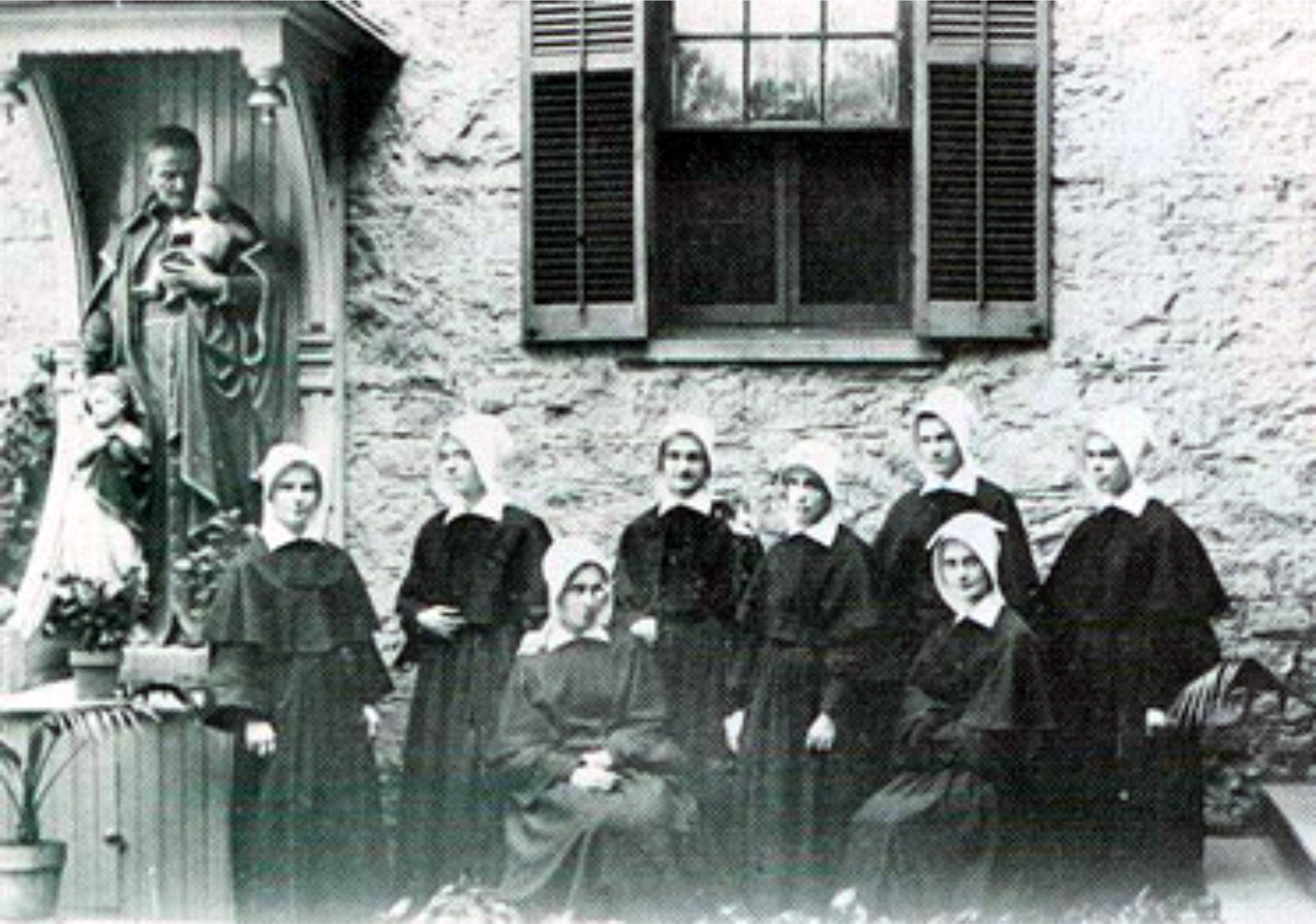
The St. Joseph Infirmary with the very first nuns who came from Kentucky
with the order to open and to lead it.
This image dates back to September 24, 1888,
a few months before Rudolf's son was born and was kept hidden in it.
For sure, amongst them, there's who helped Princess K to give birth to her child and took care of them both
Probably you wonder why this child was born in America if his mother was Russian, and Rudolf's Family lived in Vienna.
Actually, as soon as Princess K. knew about the tragedy occured in Mayerling, together with her old nanny, left Russia: she was afraid to be found from the secret police from Vienna and to be forced to miscarry her baby. Everybody lost her traces, even her family. The only one she preserved contact with was her sister Princess Maria, who will go to America and arrived just in time to see the young Olga perish of hardship: she had no money with her when she left the court in St. Petersburg and, until then, they were the nuns who took care of her and of her baby as they could. Of the nanny were lost every traces: probably she went somewhere in Europe. But the child had to remain in America, that was the princess's last will, as said the nuns.
Looking at him with a loving gaze, Maria's attention was captured by her sister's gold chain, which she now saw wrapped around the small wrist of the child she had given birth to: its pendant, a cross, certainly meant to mean that whatever name would have been given to him, whatever fate befell him, no one could have ever doubted his faith.
He was so adorable! It was absolutely not easy for her to make up her mind, but at this point Maria had nothing else to do but coming back to Russia with her heart broken and filled with sadness: she had to go on living as if nothing would ever happened, forgetting everything although knowing she won't have seen her beloved younger sister and her little nephew again.
By his mother he was given a quite important name - Rudolf Franz Alexander Napoleon Augustus Maximilian Karl Josef but it was changed just to be sure that anybody could find him: he was thought to be a danger for the throne - having Habsburg roots, once became adult, he could have claimed a right to the succession at the Danubian double monarchy; he could have be seen as a threat.
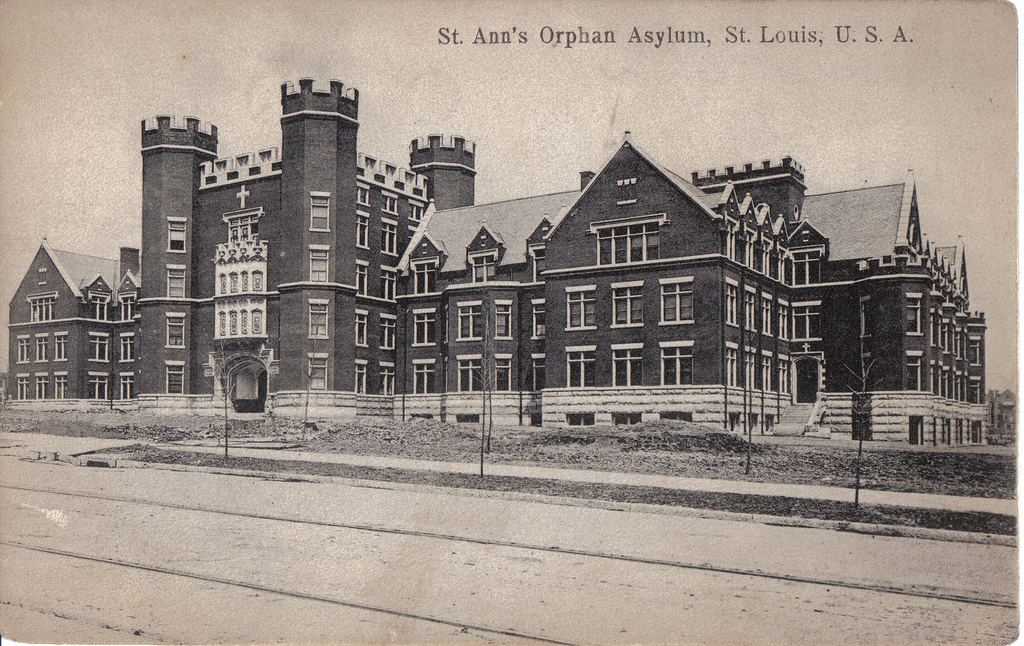
That's why his real name was forgotten. When he was a little less than two years old he entered the St. Ann's Orphan Asylum in St. Louis, Missouri, with the name of James Cleveland Longstreet and remained there until he was eleven although the other children, when they reached the age of three, went to St. Mary's Orphanage if they were female, and to St. Joseph's Home for Boys, if they were male.
He won't have an easy life at all: he would have find himself living, as a child, without a roof on his head, side by side with pioneers, outlaws, cow-boys, gold seekers and cattle thieves, in a Land the history of which still had to be written. He wasn't aware of it, but there was always a 'special eye' looking over him: Emperor Franz Josef always knew where his grandson was and where to find him, and always instructed someone, amongst the most eminent personages of the place, to take care of him without the young boy realized of it.
But that's another story you'll find in the book I wrote.

NOTES:
1 - Daniela Lasagnini, Il figlio americano di Rodolfo d'Asburgo, Trieste, MGS PRESS, 2021, p. 26.
2 - Cfr. Daniela Lasagnini, Il figlio americano di Rodolfo d'Asburgo, Trieste, MGS PRESS, 2021, p. 27.
3 - Judith Listowel, Crown Prince Rudolph. A Habsburg Tragedy, New York, Dorset Press, 1978, p. 296.
See you soon,
Dearest Friends and Readers of mine,
enjoy this so lovely time of the year!
❤


La principessa "K", amore segreto del
principe ereditario Rodolfo d'Asburgo-Lorena
Amore, quante strade per giungere a un bacio,
che solitudine errante fino alla tua compagnia!
Pablo Neruda (1904-1973) da Cento Sonetti d’Amore (1959), Sonetto II, Mattino
IMMAGINE DI FRONTESPIZIO -
A sx: la principessa Olga, chiamata Principessa K, fotografata alla fine degli anni ‘80 del 1800.
A dx: in alto la principessa, che allora aveva tre anni (1868), tiene per mano la sorella Maria, maggiore di due anni, ed è con loro la madre Aleksandra; in basso è ritratta accanto alla sorella un anno dopo (1869). Allora erano già state legalmente adottate da Pyotr Albedinsky che aveva sposato Aleksandra alla fine dell’anno 1865 (Un dettaglio: come potete vedere la chaise longue presente nell’ultima immagine è la stessa su cui si appoggia la principessa Olga da adulta).
Quando il principe ereditario Rodolfo d'Asburgo-Lorena, figlio dell'imperatore d'Austria-Ungheria Francesco Giuseppe e della sua consorte, l'imperatrice Elisabetta, detta Sisi, la incontrò per la prima volta, non era altro che una ragazzina: era il 1878, l'anno del suo Grand-Tour, e tale occasione gli fu offerta proprio da questo viaggio che lo condusse a visitare le principali Corti europee ed il Medio -Oriente, un viaggio compiuto per incrementare le sue conoscenze del mondo e della gente, dell'arte, della storia. Egli aveva allora vent'anni, ed era un giovane di bell'aspetto,
IMMAGINE 2 -
Il principe ereditario Rodolfo in una fotografia risalente al periodo del suo Grand-Tour
mentre ella si trovava non oltre le soglie dell'adolescenza, ma immediatamente egli se ne invaghì: il suo temperamento vivace, il suo modo di esprimersi così pieno di vita lo affascinarono e conquistarono il suo cuore. In realtà Rodolfo non aveva mai conosciuto una ragazza così piacente prima di allora.
Quando Rodolfo aveva vent'anni, conobbe due affascinanti ragazzine russe, figlie illegittime dello zar Alessandro II. La più giovane, chiamata dagli amici 'K' , era incantevole: carina, spumeggiante e decisamente maliziosa. Egli s'innamorò di lei, lei di lui. Fu un corteggiamento giocoso.1
Al principio diventarono amici intimi, anzi, in realtà il loro fu amore a prima vista ed è verosimile che si siano scambiati lettere, che rimasero, comunque, tenute lontano dagli occhi di tutti e che andarono probabilmente distrutte, insieme con altri documenti, dopo la tragedia di Mayerling. Quando l'imperatore decise che fosse arrivato il momento di trovare una consorte per il suo erede, Rodolfo espresse nell'immediato il proprio desiderio: egli voleva sposare la giovane ragazza che tutti a Corte continuavano a chiamare principessa'K', ma suo padre espresse il suo sconcerto senza il benché minimo ritegno.
Il solo pensiero impietrì l'imperatore - una principessa illegittima futura imperatrice? 'Rodolfo deve essere impazzito!' Meno comprensibilmente anche lo zar si oppose al matrimonio, forse perché anch'egli condivideva il principio che la figlia illegittima di un monarca - anche se in questo caso era la sua - non fosse adatta a divenire imperatrice. 2
In realtà questa giovane affascinante aveva sangue nobile nelle proprie vene visto che suo padre era l'imperatore di tutte le Russie e sua madre era una principessa, la principessa Aleksandra Sergeyevna Dolgorukaya, dama d'onore della zarina Maria Aleksandrovna. Ma dello zar ella era l'amante e la loro era una relazione extraconiugale, per cui sia la principessa Olga che sua sorella maggiore Maria erano considerate figlie non legittime (a quel tempo erano chiamate 'royal bastards' ossia bastarde reali).
IMMAGINE 3 -
Lo zar Alessandro II e la principessa Aleksandra Sergeyevna Dolgorukaya fotografati al tempo della loro relazione.
Un giorno Rodolfo avrebbe ereditato il trono di un impero e non poteva permettersi di assecondare i propri sentimenti, le proprie emozioni, le proprie passioni; il suo matrimonio era di pertinenza politica, era un affare di Stato che nulla ha a che spartire con il vero amore, ecco cosa pensava suo padre. Egli, allora giovane romantico, fu colto da un'improvvisa tristezza pensando a cosa poteva riservargli il resto della sua vita, nonostante fosse totalmente devoto al futuro dell'Austria-Ungheria: la sua era una sorta di missione, e, appagare suo padre, forse, avrebbe significato un riavvicinamento tra loro ed avrebbe appianato i frequenti dissidi che stavano rendendo le loro vite così difficili - avevano vedute completamente differenti in fatto di politica, motivo per cui Francesco Giuseppe lo teneva all'oscuro delle questioni ufficiali d'interesse nazionale e non solo. Al suo sangue nobile era necessario unire quello di una principessa le cui radici fossero davvero e legalmente aristocratiche. A quel tempo vi erano solamente tre giovani principesse cattoliche degne di diventare spose di un futuro imperatore, ma avevano ben poco da offrire in quanto a bellezza ed intelligenza. La meno peggio delle tre sembrava essere la principessa Stefania, figlia secondogenita del re Leopoldo II del Belgio.
IMMAGINE 4 -
La giovanissima principessa Stefania del Belgio, futura fidanzata del principe ereditario Rodolfo
Seppure parente di Rodolfo - Maria Enrichetta d'Asburgo-Lorena, madre di Stefania, era cugina di Francesco Giuseppe - costoro non avevano mai avuto alcuna occasione d'incontrarsi prima. E fu così che nel maggio del 1880 fu organizzato un viaggio con l'intento di condurre l'arciduca austriaco a Bruxelles. Rodolfo era già stato nella capitale belga in altre occasioni, ma solo per svago, e mai si recò a Corte; questa volta doveva conoscere la sua futura sposa, così si recò al palazzo reale dove i suoi futuri suoceri lo stavano attendendo. Il fidanzamento ed il matrimonio che vi avrebbe fatto seguito furono decisi nell'immediato e quello che sembrava lo sposalizio del secolo, caldeggiato dalle famiglie di origine di entrambi gli sposi, si trasformò, per entrambi, in un vero e proprio inferno. E dopo poco meno di otto anni si concluse tragicamente nel casino di caccia di Mayerling, il mattino del 30 gennaio 1889, quando Rodolfo morì di morte violenta.
Ma torniamo alla principessa'K'. Il nostro bell'arciduca non aveva dimenticato questo suo importante amore, anzi, esso diventava sempre più importante a mano a mano che il suo matrimonio andava deteriorandosi. Non appena seppe che non sarebbe stato in grado di dare un futuro al trono - Stefania, pochi anni dopo la nascita della piccola Erszebeth Marie, divenne sterile in conseguenza ad una malattia venerea che Rodolfo aveva contratto e che le aveva trasmesso - fu come se la sua vita avesse perso ogni suo significato.
In tali condizioni la sua mente cominciò a tornare con il pensiero al passato e l'immagine dell'affascinante principessa'K' emerse sempre più vividamente. Ella non si era ancora sposata. Rodolfo sentì che doveva incontrarla quanto prima. La contattò e si accordarono per incontrarsi in Svizzera nel più stretto riserbo. 3
Così fu deciso: cogliendo l'occasione dell'assenza da Vienna sia della madre che della moglie e contando sulla collaborazione amichevole del cugino Johann Salvador, Rodolfo si apprestava ad incontrare la sua amata ragazza.
Era il 16 settembre 1888 quando Rodolfo raggiunse il castello di Prégny
IMMAGINE 5 -
Il castello della famiglia Rothschild situato a Prégny presso Ginevra
che era la residenza estiva della baronessa Julie von Rothschild e di suo marito, il barone Adolf, appartenente al ramo viennese della famiglia dei famosi banchieri tedeschi. All'interno di questo incantevole castello, che si affaccia sul Lago di Ginevra, fu conservata e tenuta nascosta la prova di questo suo incontro con la principessa russa. Due giorni dopo Rodolfo era già di ritorno a Vienna e nessuno, eccetto il cugino Johann Salvador, sapeva cosa era successo. Nove mesi più tardi venne al mondo un bambino. Dovremmo dire nel 'Nuovo Mondo' visto che nacque in America, ad Hot Springs, Arkansas, in quella che al tempo era la St. Joseph's Infirmary.
IMMAGINE 6 -
La St. Joseph Infirmary con le primissime suore che vennero dal Kentucky con l'ordine di aprirla e condurla.
Questa immagine risale al 24 settembre 1888, pochi mesi prima che il figlio di Rodolfo vi nascesse e vi fosse tenuto nascosto.
Di certo, tra di loro, vi è chi fece nascere il figlio di Rodolfo e si prese cura di lui nonché della Principessa K
Probabilmente vi chiederete perché questo piccolo sia nato in America visto che sua madre era russa e la famiglia di Rodolfo viveva a Vienna.
In realtà, non appena la principessa'K' seppe della tragedia di Mayerling lasciò la Russia insieme con la sua vecchia balia: temeva di essere trovata dalla polizia segreta viennese e di essere obbligata ad abortire la propria creatura. Tutti persero le sue tracce, anche la sua famiglia. La sola con cui rimase in contatto fu sua sorella, la principessa Maria, che raggiunse l'America ed arrivò appena in tempo per vedere la giovane Olga perire di stenti: non aveva denaro con sé quando lasciò in tutta fretta la Corte di San Pietroburgo e, fino a quel momento, furono le suore dell'infermeria a prendersi cura di lei e del suo bambino come poterono. Della bambinaia fu persa ogni traccia: probabilmente fuggì in qualche parte dell'Europa. Ma il bambino doveva rimanere in America, questa era l'ultima volontà della principessa, come dissero le suore. Guardandolo con sguardo amorevole, l'attenzione di Maria fu catturata dalla catenina in oro di sua sorella, che ora vedeva avvolta al piccolo polso del bimbo che aveva dato alla luce: il suo ciondolo, una croce, voleva sicuramente stare a significare che qualunque nome gli fosse stato dato, qualunque destino gli fosse capitato, nessuno avrebbe potuto nutrire dubbi sul suo credo.
Era talmente adorabile! Non fu assolutamente facile per lei prendere una decisione, ma a questo punto a Maria non rimaneva altro da fare che tornare in Russia con il cuore spezzato e colmo di tristezza: doveva continuare la sua vita come se niente fosse accaduto, dimenticando tutto, consapevole che mai più avrebbe rivisto l'amata sorella ed il piccolo nipotino.
Sua madre gli aveva dato un nome molto importante - Rudolf Franz Alexander Napoleon Augustus Maximilian Karl Josef, ma fu cambiato per essere certi che nessuno lo potesse trovare: si pensava che potesse essere un pericolo per il trono - avendo radici asburgiche, una volta diventato adulto, avrebbe potuto vantare diritti di successione al trono della doppia monarchia danubiana; avrebbe potuto essere visto come una minaccia.
Ecco perché il suo vero nome fu dimenticato. Quando aveva poco meno di due anni fu messo nel St. Ann's Orphan Asylum a St. Louis, Missouri, con il nome di James Cleveland Longstreet, dove rimase fino all'età di undici anni sebbene tutti i bambini che vi erano alloggiati, una volta raggiunta l'età di tre anni, venivao trasferiti al St. Mary's Orphanage, se femmine, e alla St. Joseph's Home for Boys, se erano maschi.
IMMAGINE 7 -
Il St. Ann's Orphan Asylum di Saint Louis, Missouri, fotografato come appariva nel 1903
L'attenderà una vita non del tutto facile: si sarebbe ritrovato a vivere da bambino, senza il riparo di un tetto, accanto a pionieri, fuorilegge, cow-boys, cercatori d'oro e mandriani, in una Terra la cui storia era ancora tutta da scrivere. Ignorava che sarebbe sempre stato sorvegliato da un'occhio speciale': l'imperatore Francesco Giuseppe sapeva sempre dove si trovava suo nipote e dove poterlo trovare, ed istruiva immancabilmente qualcuno, scelto tra i più eminenti personaggi del luogo, perché sorvegliasse questo fanciullo cui tanto teneva, senza che egli se ne avvedesse.
Ma questa è un'altra storia raccontata nel libro che ho scritto.
IMMAGINE 8 -
Copertina de Il figlio americano di Rodolfo d'Asburgo, di Daniela Lasagnini, edito da MGS PRESS
CITAZIONI:
1 - Daniela Lasagnini, Il figlio americano di Rodolfo d'Asburgo, Trieste, MGS PRESS, 2021, p.26 .
2 - Cfr. Daniela Lasagnini, Il figlio americano di Rodolfo d'Asburgo, op. cit., p.27 .
3 - Judith Listowel, Crown Prince Rudolph. A Habsburg Tragedy, New York, Dorset Press, 1978, p.296 .
A presto,
miei Carissimi Amici e Lettori,
traete diletto da questo periodo dell'anno così bello!
❤

Dany

LINKING WITH:


