Visualizzazione post con etichetta Santa Claus. Mostra tutti i post

martedì 15 dicembre 2015

Victorian age Christmas Traditions and Curiosities.


Nel periodo vittoriano era considerato di cattivo auspicio 

mettere le decorazioni natalizie prima della sera della

 Vigilia di Natale. 


Diversamente dalla tradizione moderna, che impone che le decorazioni debbano essere rimosse prima della dodicesima notte (5 gennaio), coloro che vissero il XIX° secolo erano usi lasciare le proprie decorazioni fino alla Candelora (2 febbraio); gli addobbi natalizi dei nostri Victorians erano costituiti di piante sempreverdi quali l'agrifoglio, l'edera, il vischio, il lauroceraso, il bosso, l'alloro ed il rosmarino. Numerose erano le superstizioni circa l'uso di queste piante, in particolare agrifoglio ed edera: se l'agrifoglio che veniva introdotto in casa era spinoso significava che il Lord avrebbe avuto il comando della gestione della casa per il prossimo anno, mentre se aveva la corteccia liscia significava che tale potere sarebbe rimasto in mano alla Lady; analogamente, utilizzare edera da sola o farle dominare nelle decorazioni era reputato di cattivo augurio era il dibattito circa il bruciare o meno le decorazioni, una volta che erano state rimosse.


In Gran Bretagna, l'ultima Domenica prima dell'Avvento era denominata 'Stir-up Sunday' ed era il giorno in cui, per tradizione, le famiglie mettevano insieme tutti gli ingredienti per fare il proprio Christmas Pudding, che costituiva il momento clou del pranzo natalizio. Ogni membro della famiglia doveva a turno, mescolare il composto del pudding, tradizionalmente da est a ovest, in onore del viaggio dei Re Magi a Betlemme, esprimendo, nel contempo, un desiderio.

Nel periodo vittoriano il pudding era conosciuto come Plum Pudding, anche se le prugne ( PLUMS ) erano state sostituite da altri ingredienti come uvetta e ribes ben prima dell'inizio del XIX° secolo. Molte furono le varianti di tale ricetta ad esprimere i diversi gusti del tempo: tra queste, un budino non alcoolico con l'utilizzo del latte al posto della birra, il budino di Mrs Beeton 'Fruitarian' che era fatto senza grasso di rognone e un budino di verdure che comprendeva purè di patate e carote.Tradizionalmente la miscela del budino veniva posta in un panno di mussola e bollita per più di 6 ore. Il budino risultante era rotondo e scura e d assunse volgarmente il soprannome di 'palla di cannone maculata' dopo la descrizione che di esso fece Dickens in 'A Christmas Carol'. Il Pudding veniva portato sul tavolo alla fine del pranzo natalizio dopo essere stato irrorato di spirito (solitamente grappa) e dato alle fiamme. 

Questa usanza rimane una parte essenziale delle celebrazioni natalizie inglesi.

☞ Lo chef della regina Vittoria usava una ricetta che vedeva una quantità tale di ingredienti sufficiente per 150 piccoli budini da distribuire tra il personale domestico. Gli ingredienti erano 60 libbre di farina, 30 libbre di zucchero, 40 libbre di ribes, 40 libbre di uva passa, 30 libbre di canditi, 50 libbre di sugna di manzo tritata, 4 galloni di ale piuttosto robusta, 150 uova, 1 libbra di spezie miste, 1 bottiglia di rum e 1 bottiglia di brandy.


Così come i 'Carol Singers', musicisti di tutti i generi colmavano le strade nel periodo natalizio. Nel 1892
The Strand Magazine elencava alcuni dei più famosi artisti che animavano le strade vestite a festa della Londra Vittoriana: tra di essi vi era il violinista solitario, i fischiatori ciechi da quattro soldi, MacTosh il suonatore di cornamuse delle Highlands ed il suo ballerino, gli zampognari italiani, i suonatori di fisarmonica e di organetto, il suonatore indiano di tam-tam, l'uomo della ghironda, il fagottista, ‘old blowhard’( vecchio sbruffone ) il trombettiere, il campanaro con la sua serie di dieci campane, un uomo che suona i bicchieri musicali, la 'one-man band' con armonium portatile, la German Band e la troupe di menestrelli neri.


A partire dalla morte del Principe Consorte Albert, la regina Victoria  preferì trascorrere un Natale tranquillo ad Osborne House, la reale residenza sull'isola di Wight. Una delle tradizioni che ella volle mantenere durante queste feste fu quella della distribuire del 'Royal bounty' ai figli dei residenti della tenuta. Ogni Vigilia di Natale i bambini venivano condotti nella sala della servitù addobbata a festa, veniva loro distribuito il tè e poi dato un regalo, differente ogni anno, costituito da un capo di abbigliamento, come un vestito, uno scialle o un mantello per le ragazze e una sciarpa, un paio di guanti guanti o un panno per cucire un abito ai ragazzi.
I doni venivano consegnati dalla regina in persona anche se negli anni successivi tale compito fu svolto da sua figlia la principessa Beatrice. Oltre a questi capi di abbigliamento i bambini ricevevano un libro di storia, una fetta del Plum Pudding e un giocattolo preso dal grande albero di Natale. 

☞ Anche i residenti più anziani della tenuta ricevevano in dono un capo di abbigliamento, mentre ai lavoratori, che non erano invitati all'evento, veniva data una coscia di manzo per il loro pranzo di Natale. 
( Nella fotografia in alto a destra: Natale ad Osborne House nel 1896 )


I Mince pies furono tra i piatti preferiti per il pranzo di Natale in Gran Bretagna per centinaia di anni. Ispirati alle ricette del Medio Oriente riportate in Inghilterra durante le Crociate, erano tradizionalmente realizzati con un impasto di carni macinate come manzo, montone o vitello, frutta quale mela, ribes e uva passa e spezie tra cui cannella, chiodi di garofano e noce moscata. Nel periodo vittoriano le Mince pies hanno cominciato con il perdere il loro contenuto in carne e a somigliare sempre più ai moderni dolci che tradizionalmente si gustano oggi, anche se molti cuochi continuano ad usare la carne nelle loro ricette. La superstizione del XIX° secolo voleva che l'assaggiare dodici Mince pies di dodici amici o famiglie diverse durante i dodici giorni di Natale avrebbe portato fortuna per i seguenti dodici mesi dell'anno ed era inoltre considerato di cattivo augurio rifiutare la prima Mince pie che veniva offerta.


I proprietari dei negozi vittoriani erano in competizione nel cercare costantemente nuovi modi per attirare i clienti durante il periodo natalizio, che di anno in anno si diveniva sempre più redditizio. La prima 'Grotta di Babbo Natale', costruita a scopo commerciale, fu inaugurata nel 1888 da JP Robert nel suo negozio a Stratford nel West Ham appena fuori Londra. L'idea presto prese campo e dalla fine del secolo fu una parte essenziale dell'esperienza di Natale di ogni bambino benestante quella di essere condotto in un negozio e di sedersi sulle ginocchia di Babbo Natale.


Essendoci per lo più la storia della calza di Natale sconosciuta, dobbiamo affidarci alla leggenda, la quale 
narra che St.Nicholas, sentendo che un povero uomo con tre belle figlie non aveva soldi per farle maritare, decise di aiutarle segretamente. Attese fino a notte per calarsi dal loro camino con tre sacchetti di monete d'oro: notò che le calze delle ragazze erano state lì appese ad asciugare e così mise un sacchetto in ogni calza; quando l'anziano padre e le ragazze l'indomani mattina scoprirono i sacchi d'oro, erano felicissimi e, naturalmente, vissero felici e contenti realizzando i loro sogni.
☞ Durante il periodo vittoriano generalmente le calze venivano riempite con un'arancia, poi con il tempo vi si aggiunsero giocattoli e dolciumi.


L'usanza di scambiarsi un bacio sotto il vischio a Natale è stata annotata per la prima volta nel XIX° secolo e divenne rapidamente un aspetto popolare di tale festività. Nel periodo vittoriano il vischio veniva raccolto e raggruppato a formare una sorta di palla che veniva appesa in un luogo strategico nella stanza. La convinzione era che chi stava sotto il vischio non poteva rifiutare un bacio. Un'altra credenza era che dopo ogni bacio una bacca dovesse essere staccata dalla composizione di vischio e una volta che tutte le bacche erano esaurite, la pratica del bacio avesse fine. Questo rituale fa riferimento ad una rima contemporanea:

Estraete una bacca dal vischio
Per ogni bacio che viene dato.
Quando le bacche sono esaurite
Si finisce di baciarsi.


( A sinistra Gathering the Mistletoe, di Sir John Everett Millais )


I confetti erano un tipo di produzione dolciaria molto popolare nel corso del XIX° secolo e divennero collegati con il Natale grazie al loro essere nominati nella poesia 'A Visit from St. Nicholas', nota anche come 'The Night Before Christmas', ed il personaggio della Fata del Confetto nel balletto 'Lo schiaccianoci' di Tchaikovsky; essi potevano contenere una grande varietà di ingredienti, tra cui noci, semi e spezie, anche se l'ingrediente favorito per fare i confetti erano le mandorle, i germogli di chiodi di garofano, i semi di cumino, i semi di coriandolo o le strisce di cannella. Tali ingredienti venivano ricoperti ad uno ad uno da più strati di sciroppo di zucchero bollente che raffreddandosi avrebbe dato ai confetti una consistenza molto dura all'esterno, gli ultimi dei quali venivano aromatizzati con ingredienti come acqua di rose o di fiori d'arancio e colorati con l'introduzione di pigmenti commestibili (gli spinaci per dare il colore verde, lo zafferano per il giallo e la barbabietola per il rosso). 


Nella foto qui accanto potete vedere la copertina di un catalogo di fine ottocento della famosa società di Tom Smith, che ebbe grande successo in epoca vittoriana poiché vendeva una vasta gamma di articoli per le feste, ma il prodotto di gran lunga più popolare era il Christmas Cracker, ovvero il cracker di Natale, inventato proprio da Tom Smith nei primi anni del 1840.

Egli era un pasticcere che, ispirato dai bonbons francesi avvolti in carta velina ( come le moderne caramelle ) per creare una novità natalizia prese un tubo di carta ricoperto di decorazioni vivaci che quando veniva aperto rivelava un piccolo regalo e alcuni versi che vi erano scritti all'interno. Più tardi Smith vi incorporò due strisce di carta sempre di forma cilindrica, attaccate alle estremità del cilindro, entrambe rivestite con una sostanza chimica leggermente esplosiva, che, quando il cracker veniva scartato, creava un piccolo botto, da cui il nome 'cracker' ( petardo )

La novità creata da Smith catturò immediatamente l'immaginazione del pubblico ed il cracker natalizio divenne rapidamente un prodotto estremamente popolare. Tom Smith cominciò a venderne centinaia e centinaia di diverse varietà a prezzi che andavano da 4 scellini e 6 pence a 48 scellini. Solamente quelli elencati nel catalogo 1891-2 includevano i  Lilliputian crackers, Gems and Jewels, Cupid’s Playthings, Somebody’s Luggage, Fairytale crackers, Gypsy Queen, Mother Hubbard’s, Lovers’ Secrets, Darwinian Crackers, Mysterious crackers, Butterfly Ball and Bal Masque.

Gli elementi di novità contenute nei Crackers dipendevano dal loro tema. Per esempio i 'Crackers delle zitelle' racchiudevano al loro interno anelli di nozze, fiori appassiti, cuffie da notte, bussola o ditali, specchi, cipria e tinture per capelli, mentre nei 'Crackers degli scapoli' vi erano pipe, bottiglie di champagne, i biglietti di pegno, sigari, mazzi di carte e cambiali di commercianti. I Crackers moderni contengono oggetti di piccole dimensioni, articoli nuovi o piccoli giochi, una corona di carta o uno scherzo e di fatto rimangono una parte essenziale delle tradizioni di Natale in Gran Bretagna.


Ed infine, prima di prendere congedo da voi, voglio proporvi una serie mirabilmente realizzata dalla BBC che ci fa rivivere il clima in cui fervono i preparativi per il Natale Vittoriano, magnificamente ricreato nei minimi dettagli, così come era vissuto presso la fattoria di un anziano possidente terriero.
Ovviamente i dialoghi sono in inglese perciò suggerisco a chi lo volesse seguire ( e ve lo consiglio vivamente, è un video splendido !) di far scorrere la pagina fin sotto la traduzione in inglese.


Vi abbraccio con rinnovato affetto e sincera, profonda gratitudine,

a presto ♥


Source:

http://victorianfanguide.tumblr.com/


In the Victorian period it was considered extremely unlucky 

to put up any Christmas decorations 

before Christmas Eve.


- picture 1


Unlike modern superstition, which dictates that decorations must be taken down before Twelfth Night (January 5th), people in the 19th century commonly left their decorations up until Candlemas (February 2nd).
Victorian Christmas decorations took the form of evergreen plants such as holly, ivy, mistletoe, laurel, box, bay and rosemary. Several superstitions surrounded the use of these plants, particularly holly and ivy. If prickly holly was brought into the house it meant that the husband would be master for the coming year whereas if the holly was smooth it meant the power would stay with the wife. To use ivy on its own or let it be predominant was bad luck and there was sharp disagreement over whether decorations should or should not be burnt once they’d been taken down.


- picture 2 on th right - In Britain, the last Sunday before Advent is known as ‘Stir-up Sunday’ and is the day on which it is traditional for families to mix together the ingredients to make their Christmas Pudding which forms the highlight of the Christmas Day meal. Each member of the family must take turns to stir the pudding mixture, traditionally from East to West in honour of the journey of the Three Kings to Bethlehem. While they do this it is also customary to make a wish.

In the Victorian period the pudding was known as Plum Pudding, though plums had been entirely replaced by other ingredients such as raisins and currants well before the beginning of the 19th century. There were many different recipes for the pudding reflecting the different tastes of the time. These included a teetotal pudding which used milk instead of beer, Mrs Beeton’s ‘Fruitarian’ pudding which was made without suet and a vegetable pudding which included mashed potatoes and carrots.

☞ Queen Victoria’s chef used a recipe which made enough mixture for 150 small puddings to be distributed amongst the household staff. The ingredients were 60lbs flour, 30lbs sugar, 40lbs currants, 40lbs raisins, 30lbs candied peel, 50lbs chopped beef suet, 4 gallons strong ale, 150 eggs, 1lb mixed spice, 1 bottle of rum and 1 bottle of brandy.


- picture 3 on the left - In the Victorian period, as well as carol singers, musicians of all kinds filled the streets at Christmas time. In 1892 The Strand Magazine listed some of London’s most famous festive street performers. These included the lone fiddler, the blind penny-whistler, MacTosh the Highland piper and his dancing boy, Italian bagpipers, accordion-players and organ-grinders, the Indian tom-tom player, the hurdy-gurdy man, the bassoon player, ‘old blowhard’ the trumpeter, the bellringer with his string of ten bells, a man playing musical glasses, the one-man band with portable harmonium, the German Band and the troupe of black minstrels.


- picture 4 on the right: Christmas at Osborne House in 1896 - After the death of Prince Albert, Queen Victoria preferred to spend a quiet Christmas at Osborne House, her residence on the Isle of Wight. One of the traditions she maintained during these holidays was to distribute a ‘Royal bounty’ to the children of residents of the estate. Every Christmas Eve the children were brought to the festively decorated servants’ hall at Osborne, given tea and then presented with a gift. This gift was different each year and took the form of an item of clothing such as a dress, shawl or cloak for the girls and a scarf, gloves or cloth for a suit for the boys. The gifts were presented to each child by the Queen herself, though in later years this task was given to her daughter Princess Beatrice. As well as these items of clothing the children also received a story book, a slice of Christmas Pudding and a toy from the large Christmas tree. 

☞ Elderly residents would also receive a gift of clothing while labourers, who were not invited to the event itself, would be given a joint of beef for their Christmas Day meal.


- picture 5 on the left - Mince pies have been a favourite Christmas food in Britain for hundreds of years. Inspired by Middle Eastern recipes brought back to England during the Crusades, they were traditionally made with a mixture of minced meat such as beef, mutton or veal, fruits like apple, currants and raisins and spices including cinnamon, cloves and nutmeg. In the Victorian period mince pies started to lose their meat content and began to resemble the modern sweet treats which are enjoyed today, though many cooks continued to use meat in their recipes. 19th century superstition held that if you ate twelve mince pies from twelve different friends or households during the twelve days of Christmas you would have good luck for the next twelve months. It was also considered unlucky to refuse the first mince pie you were offered.


- picture 6 on the right - Victorian shop owners were constantly developing new ways to attract customers during the increasingly profitable Christmas season. The world’s first commercial Santa’s Grotto was unveiled in 1888 by JP Robert at his store in Stratford in West Ham just outside of London. The idea soon caught on and by the turn of the century it was an essential part of any well-off child’s Christmas experience to be taken to a shop and sit on Father Christmas’ knee.


- picture 7 on the left - Mostly the history of the Christmas Stocking is unknown.
Legend has it that St. Nicholas, hearing that a poor man with 3 beautiful daughters had no money to get them married, decided to secretly help out. He waited until night time then he went down the chimney with 3 bags of gold coins. He noticed that the girls’ stockings were hung up on the mantelpiece to dry so he put one bag in each stocking.
When the old man and the girls discovered the bags of gold the next morning, they were overjoyed and, of course, lived happily ever after.
☞ During the Victorian age the Christmas Stockings were filled with an orange.


- picture 8 on the right: Gathering the Mistletoe, by Sir John Everett Millais - The practice of kissing under the mistletoe at Christmas was first recorded in the early 19th century and quickly became a popular aspect of the festival. In the Victorian period mistletoe was gathered together to form a ball which was then hung in a strategic place in the room. The belief was that whoever stood under the mistletoe could not refuse a kiss. Another belief was that after each kiss a berry should be picked from the mistletoe ball and once all the berries had gone the kissing had to stop. This concept is referenced in a contemporary rhyme:

Pick a berry off the mistletoe
For ev’ry kiss that’s given.
When the berries have all gone
There’s an end to kissing.


- picture 9 on the left - Sugar-plums were a popular form of confectionery during the 19th century and became linked with Christmas through their inclusion in the poem ‘A Visit from St Nicholas’, also known as ‘The Night Before Christmas’, and the character of the Sugar Plum Fairy in the ballet ‘The Nutcracker’ by Tchaikovsky. Sugar-plums were not actually made from plums; the name refers to a range of traditional sweets known as comfits.
Comfits could contain a wide variety of ingredients including nuts, seeds and spices. The favoured ingredients for making sugar-plums were almonds, clove buds, caraway seeds, coriander seeds or cinnamon strips. These ingredients were individually coated in layers of boiling sugar syrup until they formed small balls with a thick, hard shell. They could be flavoured with ingredients such as rose or orange water and coloured by the introduction of edible pigments (spinach for green, saffron for yellow and beetroot for red) in the final layers of syrup. They were known as sugar-plums purely because of their finished size and resembled modern gobstoppers, aniseed balls or sugared almonds.


- picture 10 on the right - The front cover of an early 20th century Tom Smith’s catalogue. Tom Smith’s was a highly successful Victorian company which sold a wide variety of festive items but by far its most popular product was the Christmas Cracker. The company’s founder Tom Smith is credited with the invention of the Christmas Cracker in the early 1840s.

Smith was a confectioner who was inspired by French bonbons wrapped in tissue paper to create Christmas novelties consisting of a paper tube covered in vibrant decorations which when ripped open would reveal a small gift and written verse inside. Later Smith incorporated a ‘snap’ made of two attached strips of tough paper, one coated with a mildly explosive chemical, which when pulled apart created a small bang which gave ‘Crackers’ their name.

The novelty of Smith’s invention caught the public’s imagination and crackers quickly became an extremely popular Christmas product. Tom Smith’s began to sell hundreds of different themed varieties at prices ranging from 4 shillings and 6 pence to 48 shillings. Those listed in the 1891-2 catalogue alone include Lilliputian crackers, Gems and Jewels, Cupid’s Playthings, Somebody’s Luggage, Fairytale crackers, Gypsy Queen, Mother Hubbard’s, Lovers’ Secrets, Darwinian Crackers, Mysterious crackers, Butterfly Ball and Bal Masque.

The novelty items contained in the Crackers depended on their theme. For example ‘Spinster’s Crackers’ included wedding rings, faded flowers, night caps, thimbles, mirrors, powder puffs and hair dye and ‘Bachelor’s Crackers’ included pipes, bottles of champagne, pawn tickets, cigars, packs of cards and tradesmen’s bills. Modern crackers contain small novelty items or games, a paper crown and a joke or fact and remain an essential part of Christmas celebrations in Britain.


- picture 11 


And finally, before than taking my leave of you, I want to suggest you a series admirably realized by the BBC in which we relive the climate in which, people living in the farm of an elderly landowner during the XIX° century, got ready for the Victorian Christmas, beautifully reconstructed in the smallest detail.


I embrace you all with renewed affection and sincere, deep gratitude,

see you soon ♥


Source:

http://victorianfanguide.tumblr.com/


LINKING WITH:


sabato 5 dicembre 2015

Jack Frost, a story for the Season


 Jack Frost è un personaggio elfico risalente alla mitologia norrena, ovvero norreno-vichinga, conosciuto anche come "Jokul Frosti", che in Inghilterra e negli Stati Uniti d'America è visto come la rappresentazione allegorica dell'inverno; noto anche con il nome di Padre Inverno egli è ritenuto responsabile del tempo gelido e di tutte le sue caratteristiche, a partire dalla caduta delle foglie dagli alberi in autunno che ne preannuncia la venuta.


Ladies' Home Journal, "Jack Frost" (1926) by Oliver Herford


Egli prepara le condizioni atmosferiche favorevoli per l'arrivo di Santa Claus, di cui è amico ed alleato poiché a lui si deve il fatto che non lo si riesca mai a vedere, è portatore del vento gelido, della brina, autore dei ricami, spesso a forma di foglia di felce, che, con il suo argenteo pennello, dipinge sull'esterno dei vetri delle nostre finestre nelle notti più fredde dell'anno; ci fa raggelare il naso, le mani e le estremità durante le nostre passeggiate all'aperto in questo periodo che gli appartiene, poiché dai primi giorni di dicembre all'inizio della primavera - quando, prima di lasciarci, ci saluta creando piccoli specchi d'acqua nelle pozzanghere grazie ai quali possiamo vedere riflessa la nostra immagine - si 'diverte' spargendo fiocchi di neve e gelo saltellando tra boschi, prati e case ai cui tetti spesso appende artistiche stalattiti di ghiaccio. 

Parente del Dio Gelo, Jack Frost è spesso allegro e ama donare al mondo le sue arti invernali, è un personaggio amichevole, ma se provocato può giungere anche a congelare o ricoprire di neve le sue 'vittime'; un'altra attività attribuitagli dalla letteratura è quella di congelare le ombre separandole dai corpi che le proiettano e dando loro una propria autonomia.
Noto anche in Russia, dove il freddo regna sovrano per la maggior parte dell'anno, con il nome di Padre Gelo, rappresentato come un vecchio completamente bianco, lo si vede protagonista di remote favole e leggende.
Qui di seguito mi piace segnalarvi alcune filastrocche, tra le più note e le più antiche, di origine anglosassone, corredate da immagini risalenti agli inizi del secolo scorso.


Jacky Gelo, Jacky Gelo,
È arrivato nella notte;
Ha lasciato i prati che ha attraversato,
Tutti coperti di un bianco luccicante.
Dipinto con il suo pennello d'argento
Ha ogni vetro delle finestre.
Baciato ha le foglie e le ha fatte arrossire,
Arrossire ed arrossire ancora.

Jacky Gelo, Jacky Gelo,
Si è infiltrato intorno alla casa,
Scaltro come una volpe d'argento,
O piuttosto come un topo.
La nostra piccola Jenny è arrivata,
Tutta rossa come una rosa;
E Jacky Gelo è saltato su,
Per pizzicare anche il suo piccolo naso.


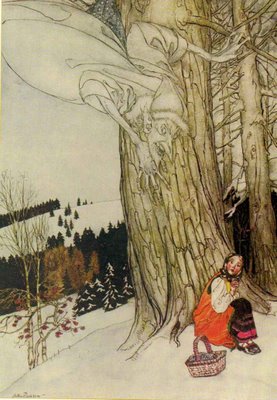
Jack Frost by Arthur Rackham (1867 - 1939)


Jacky Frost, Jacky Frost,
Came in the night;
Left the meadows that he crossed,
All gleaming white.
Painted with his silver brush
Every window-pane.
Kissed the leaves and made them blush,
Blush and blush again.

Jacky Frost, Jacky Frost,
Crept around the house,
Sly as a silver fox,
Still as a mouse.
Out our little Jenny came,
Blushing like a rose;
Up jumped Jacky Frost,
And pinched her little nose.


Jack Frost
by Laura E.Richards (1850 - 1943)


❆ ❅ ❆ ❅ ❆ ❅ ❆ ❅ ❆ ❅ ❆ ❅ ❆ ❅ ❆


Attenzione! Attenzione!
Jack Frost è arrivato!
E dopo aver lavorato le nostre mani e i nostri piedi;
E tutta la notte,
Il piccolo spiritello giocoso
Sta lavorando dove nessuno lo sa.

Salirà su ogni albero,
Lui è talmente agile,
E da lì la sua polvere argentea spargerà.
Su per i vetri delle finestre striscerà
E mentre stiamo dormendo
Che immagini meravigliose farà.

Passando tra l'erba
Che allegramente attraverserà,
Per mutare tutto il suo verde in bianco.
A casa se ne andrà
E riderà oh, oh oh!
Quanto mi sono divertito questa notte.


Rara rappresentazione di Padre Gelo che non riesce a fare a meno di guardare, incantato, una principessa russa


Look out! Look out!
Jack Frost is about!
He's after our fingers and toes;
And all through the night,
The gay little sprite
Is working where nobody knows.

He'll climb each tree,
So nimble is he,
His silvery powder he'll shake.
To windows he'll creep
And while we're asleep
Such wonderful pictures he'll make.

Across the grass
He'll merrily pass,
And change all its greenness to white.
Then home he will go
And laugh ho, ho ho!
What fun I have had in the night.


Jack Frost
by C.E. Pike ( ? )


❆ ❅ ❆ ❅ ❆ ❅ ❆ ❅ ❆ ❅ ❆ ❅ ❆ ❅ ❆


Una delizioso ruscello correva giocando
Con il piccolo Jack Frost in un freddo giorno d'inverno.
Si fermò a riposare ai piedi di una collina
Facendo un laghetto tutto tranquillo e cheto.
"Aha!" disse Jack Frost: "Non è bello ora?"
E subito tramutò l'acqua in ghiaccio.


Riproduzione di una cartolina dei primi del novecento


A pretty brook was running at play
With little Jack Frost on a cold winter's day.
It stopped to rest at the foot of a hill
Making a pond all quiet and still.
"Aha!" said Jack Frost, "Now isn't that nice?"
And quickly he turned the water to ice.


Jack Frost
by Author Unknown


❆ ❅ ❆ ❅ ❆ ❅ ❆ ❅ ❆ ❅ ❆ ❅ ❆ ❅ ❆


Il gelo sembrava ancora fermo e lontano, nella notte chiara,
Quando sussurrò: "Ora non mi mostrerò;
Quindi, attraverso la valle, e sulle alture,
In silenzio prendo la mia strada.

Non voglio andare avanti veloce come un treno impetuoso,
Il vento e la neve, la grandine e la pioggia,
Che fanno un tale trambusto e il gran rumore invano,
Ma sarò occupato come loro! "

Così volò per la montagna, e impolverò la sua vetta;
Accese gli alberi, ed i loro rami egli abbigliò
Con diamanti e perle; e sul seno
Fremente del lago diffuse

Una cotta di maglia, agganciandone il margine, 
 Qua e là, nei suoi punti più bassi,
Poiché non debba temere di essere scalfita, 
Qualora una roccia sollevasse il suo capo.

Andò alla finestra di coloro che dormivano,
E sopra ogni vetro, come una creatura fatata, avanzò furtivamente;
Ovunque respirò, ovunque si fermò,
Con la luce della mattina apparvero

Le cose più belle; c'erano fiori e alberi;
C'erano stormi di uccelli e sciami di api;
C'erano città con templi e torri; e questo
Tutto disegnato in riflessi argentei!

Ma fece anche una cosa che non fu così leale -
Curiosò nella credenza, e trovò
Che nulla era stato preparato per lui-
"Ora, giusto per farglielo notare,

Mordo questo cesto di frutta ", disse,
"Questa costosa brocca, la spezzo in tre;
E il bicchiere d'acqua che hanno lasciato per me
Farò 'schioccare' per dire loro che sto bevendo! "


Rappresentazione del secolo scorso di Padre Gelo


The Frost looked forth one still, clear night,
And whispered, "Now I shall be out of sight;
So, through the valley, and over the height,
In silence I'll take my way.

I will not go on like that blustering train,
The wind and the snow, the hail and the rain,
That make such a bustle and noise in vain,
But I'll be as busy as they!"

So he flew to the mountain, and powdered its crest;
He lit on the trees, and their boughs he drest
With diamonds and pearls; and over the breast
Of the quivering lake he spread

A coat of mail, that it need not fear
The downward point of many a spear
That he hung on its margin, far and near,
Where a rock could rear its head.

He went to the windows of those who slept,
And over each pane, like a fairy, crept;
Wherever he breathed, wherever he stepped,
By the light of the morn were seen

Most beautiful things; there were flowers and trees;
There were bevies of birds and swarms of bees;
There were cities with temples and towers; and these
All pictured in silvery sheen!

But he did one thing that was hardly fair-
He peeped in the cupboard, and finding there
That all had forgotten for him to prepare-
"Now, just to set them a-thinking,

I'll bite this basket of fruit," said he,
"This costly pitcher I'll burst in three;
And the glass of water they've left for me
Shall ‘tchick' to tell them I'm drinking!"


Jack Frost
by Hannah F. Gould (1788 - 1865)


Qui da noi Jack Frost è già arrivato ed ha cominciato a sollazzarsi spargendo un po' di brina, soprattutto le notti scorse ... mi chiedo se anche voi avete visto tracce della sua venuta ... 

Vi abbraccio tutti con tanto affetto nella speranza che giunga presto, se ancora non è arrivato, e che giunga in tempo per la discesa di Santa Claus ...

A presto, miei cari ♥


Fonti bibliografiche:

Mark Vincent Brine, THE CAROL and the True Folk Legend of Jack Frost, Brinemark & Bienemann Publishing, 2011;


Laura E. Richards, Tirra Lirra: Rhymes Old and New,  Nabu press, 2011.


Jack Frost is an elfish character dating back to the Norse, or Norse-Viking mythology, also known as "Jokul Frosti", whom in England and in the United States is seen as the allegorical representation of Winter: also known as Father Winter he is held responsible for the freezing weather and all its features, since the falling of the leaves from the trees in Autumn ( Fall ) that heralds his coming.


- picture 1 - Ladies' Home Journal, "Jack Frost" (1926) by Oliver Herford


He prepares the favorable weather conditions for the arrival of Santa Claus, of whom is a friend and an ally, since he is responsible for the fact that we never can see him, is carrier of the cold wind, frost, author of the embroidery, often shaped fern leaf, which, with its silvery brush, he paints outside of the glass of our windows during the coldest nights of the year; he makes us freeze our nose, our hands and our feet during our outdoor walk during this time that belong to him, since the first days of December to the beginning of Spring - when, before leaving us, he greets us creating tiny mirrors inside water puddles through which we can see our reflection - he has fun scattering snowflakes and frost hopping through woods, meadows and houses at the roofs of which he often hangs artistic icicles.

Relative of God Frost, Jack Frost is often cheerful and loves to give the world his wintry arts,  has a friendly character, but when provoked can also come to freeze or cover with snow his 'victims'; another activity  ascribed to him by the literature is to freeze the shadows separating them from the bodies that project them and giving them their own autonomy.
Also known in Russia, where the cold reigns as a sovereign for most of the year, with the name of Father Frost, represented as an old white man, he's protagonist in several remote fables and legends.
Here I like to tell you some nursery rhymes, the most famous and the oldest ones, of Anglo-Saxon origin, along with images belonging to the beginning of the last century.


( As for the nursery rhymes, I thought it to be nicer to you to read them in your own language under Jack Frost's pictures I've chosen, so you should scroll up the page until the images I've posted.)


Here, Jack Frost has already arrived and has began to amuse himself spreading a bit of hoar, especially during last nights ... I wonder if you've already seen traces of his coming ...

I embrace you all with much love in the hope that he'll come soon, if he hasn't arrived yet, and that he comes in time for the descent of Santa Claus ...

See you soon, my dears ♥


Bibliographic sources:

Mark Vincent Brine, THE CAROL and the True Folk Legend of Jack Frost, Brinemark & Bienemann Publishing, 2011;

Laura E. Richards, Tirra Lirra: Rhymes Old and New,  Nabu press, 2011.


I'm sharing with JES' link-up party


with Stephanie's one


 and with: