Visualizzazione post con etichetta Cicely Mary Barker. Mostra tutti i post

giovedì 20 febbraio 2014

Snowdrops, beloved early signs of Spring.


Delicati come la neve che li ha custoditi e cullati fino a pochi 

giorni fa, i primi bucaneve salutano la fine dell'inverno

e preannunciano la venuta della nuova stagione, segnando 

la fine del torpore della natura pronta ormai per il risveglio 

primaverile 


Dante Gabriel Rossetti, Snowdrops (featuring Jane Morris), 1873


SOLITARIO Fiore, orlato di nevi di cui conservi il candore
Ma di gran lunga più resistente, ancora una volta ti vedo chinare
La fronte, come se temessi di offendere,
Come un ospite non invitato. Anche se giorno per giorno,
Le tempeste, andandosene dalle vette, tracciano la via 
Del sole che sorge, e sulle pianure scendono;
Ebbene tu sei il benvenuto, benvenuto come un amico
Il cui zelo supera altresì ciò che promette!


William Wordsworth, To a Snowdrop, 1888


Timidamente, con estrema umiltà e con aspetto dimesso, quasi riverente, accolti con letizia profonda da ogni cuore che attende i palpiti della primavera quali espressione della forza e della resistenza al gelo della vita, i bucaneve, appartenenti alla famiglia dei Galanthus ( dal greco gála che significa latte e ánthos che significa fiore ), sbocciano sul finire del mese di febbraio nei boschi e nei giardini del centro Europa, e quest'anno anche il giardino segreto di Tenuta Geremia ha visto per la prima volta schiudersi le corolle di questi candidi boccioli fatti salire fin qui l'anno scorso dal bosco che costeggia l'argine del fiume.  

Acclamati con toni romantici dai poeti inglesi nel loro significato di speranza e pazienza 


Cicely Mary Barker, Snowdrop's Fairy


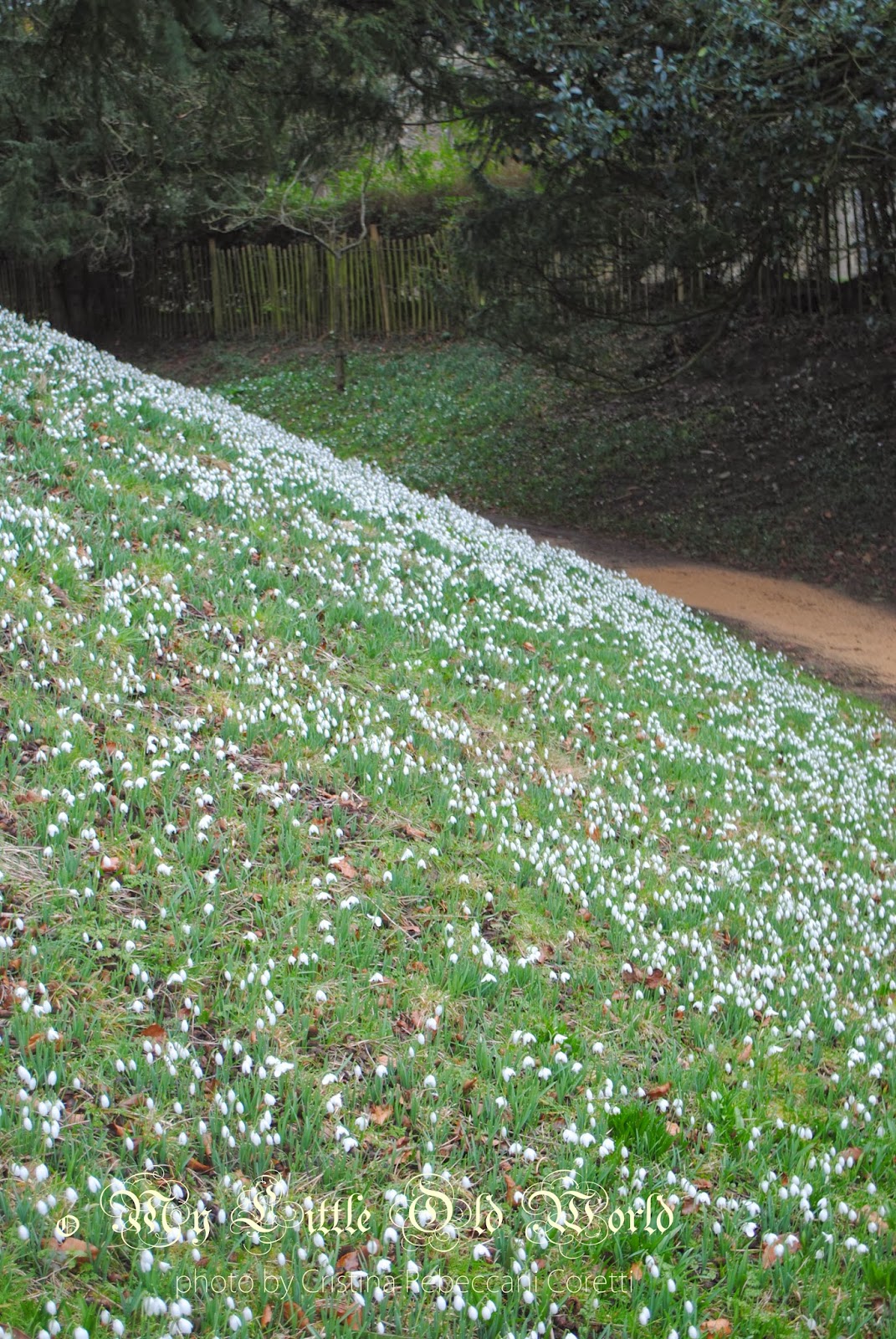
nella terra di Gran Bretagna, dove sono celebrati quali festoso presagio di primavera, i bucaneve giungono a formare bianchissime coltri in zone in cui crescono spontanei o sono stati naturalizzati.


quasi come se ogni fiocco di neve disciolto, ricamando punto per punta una fitta trapunta, avesse lasciato il posto ad una corolla.


Numerosi sono i giardini che, tra Scozia, Irlanda ed Inghilterra, vengono appositamente aperti al pubblico nel mese di febbraio allo scopo di fare ammirare i primissimi fiori della stagione ai visitatori che attendono questo gioioso momento in cui al suggestivo fascino paesistico 


e alla solennità altisonante degli elementi architettonici


intrisa di particolari dalla ricercatezza tipicamente anglosassone


si aggiunge l'amenità delle prime romantiche e poetiche pennellate di colore tra gli alberi ancora spogli e dormienti ed il verde dell'erba o dell'edera che tappezza i prati sotto le imponenti, maestose conifere senza tempo.


Tenero Bucaneve, bianco e piccolissimo,
Vai a colei la cui bellezza giace
  Sul mio essere, come la luce 
 Tra le stelle a bordo dei cieli.


S'anche la luna non fosse in cielo,
   E tutto la notte buia fosse,
Tali gemme riescono persino a vincere
     L'impenetrabile velo fosco che copre terra e mare.

George Heath (1844 - 1869), da A Bunch of Snowdrops


Vi sto con queste foto rendendo partecipi del bellissimo gesto ricevuto da una cara amica, Cristina, la quale, alcuni giorni fa, si è concessa una vacanza tra gli incantati giardini d'Inghilterra per veder sbocciare i primi fiori dell'anno proprio là dove tanto sono trattati non solo con rispetto, persino con profonda devozione ...

E di Cristina in Christina, dall'infinita poesia delle fotografie della cara amica, a cui mi sento legata da profonda gratitudine, a quella espressa dalle soavi parole di Christina Rossetti (1830 - 1894) con cui desidero ringraziarla tanto caramente per l'immensa delicatezza che mi ha usato e per il suo buon cuore.


Chissà se la linfa è già in movimento,
Se gli uccelli invernali sognano di trovare una compagna,
Se i bucaneve intirizziti avvertono già il sole
E i crochi come fuochi si accendono ad uno ad uno:
Canta, pettirosso, canta;
Io ancora dubito con dolore dell'arrivo della Primavera.


Mi chiedo se l'ondata primaverile di quest'anno
Porterà un'altra Primavera tanto cara e perduta;
Se il cuore e lo spirito troveranno la loro Primavera,
Oppure, se il mondo solo sboccerà e canterà:
Canta, speranza, canta per me;
Note dolci, speranza mia, note delicate di ricordi.


La linfa sicuramente si appresterà prima o poi,
Anche l'uccello più tardivo canterà alla propria compagna;
Così la Primavera sorgerà di nuovo con il suo tepore e con le sue fioriture,
O in questo mondo, o nel mondo che verrà:
Canta, voce di Primavera,
Fino a che anch'io fiorirò, gioirò e canterò.

Christina Georgina Rossetti, The First Spring Day


... e chissà, chissà se Cristina, nelle sue passeggiate in questa natura ancora incorrotta, avrà scorto sbocciare proprio quei bucaneve, quegli stessi che osservava la poetessa inglese in pieno periodo vittoriano, quelle stesse corolle fatte di neve che le hanno ispirato versi così delicati ...


A presto amici miei cari 


Note: 

Le fotografie di Cristina sono state scattate presso: 

Anglesey Abbey Gardens and Lode Mill ( Cambridgeshire)
Ashwood Nurseries, Kingswinford (West Midlands)
Benington Lordship Gardens (Hertfordshire)
Beth Chatto Gardens (Essex)


As delicate as the snow snow that has preserved and

lulled them till a few days ago, the first snowdrops 

greet the end of Winter and herald the coming of the 

new season, scoring the end of the  torpor of the 

nature now ready for the vernal awakening.


- picture 1 - Dante Gabriel Rossetti, Snowdrops (featuring Jane Morris), 1873


LONE Flower, hemmed in with snows and white as they
But hardier far, once more I see thee bend
Thy forehead, as if fearful to offend,
Like an unbidden guest. Though day by day,
Storms, sallying from the mountain-tops, waylay
The rising sun, and on the plains descend;
Yet art thou welcome, welcome as a friend
Whose zeal outruns his promise!


William Wordsworth, To a Snowdrop, 1888


- picture 2


Tentatively, with great humility and with a resigned look, almost reverent, welcomed with profound joy to every heart that beats waiting for the Spring as an expression of the strength and of the resistance of the frost of life, snowdrops, belonging to the family of Galanthus (from the greek 'gala' meaning milk, and 'anthos' which means flower) blooming at the end of February in the woods and gardens of Central Europe, and this year also the secret garden of Tenuta Geremia sees for the first time unfold the petals of the first snow-white buds taken last year from the forest along the riverbank.

Acclaimed with romantic tones by English poets in their meaning of hope and patience


- picture 3 - Cicely Mary Barker, Snowdrop's Fairy


in the land of Britain, where they're celebrated as festive harbinger of Spring, snowdrops come to form pure white blankets in areas where they grow wild or have been naturalized.


- picture 4

- picture 5


almost as if each dissolved snowflake, sewing point by point a thick quilt, had given the way to a corolla.


- picture 6

- picture 7


There are many gardens, including Scotland, Ireland and England, that are specially opened to the public in February in order to let the visitors admire the very first flowers of the season, for those who await this joyful moment when to the suggestive charm of the landscape


- picture 8

- picture 9

- picture 10

- picture 11


and the pompous solemnity of the architectural elements


- picture 12

- picture 13

- picture 14


drenched in with details of the typical Anglo-Saxon refinement


- picture 15

- picture 16

- picture 17


is added to that of the first romantic and poetic strokes of color among the trees still bare and the green of the grass or the ivy that makes carpets over the meadows below the towering, majestic timeless conifers


- picture 18


Tender snowdrops, wee and white,
 Go to her whose beauty lies
On my being, like the light
 Of the stars on brows of skies.


- picture 19


When the moon hath not a streak,
      And the night all gloom would be,
But for those still gems that break
      Through the mirk on land and sea.

George Heath (1844 - 1869), from A Bunch of Snowdrops


- picture 20


I'm with you by sharing these photos in my hands as the beautiful gesture received from a dear friend, Cristina, who, a few days ago, has taken a holiday among the enchanted gardens of England to see the first flowers of the year blooming right there where so much are not only treated with respect, even with deep devotion ...

And from Cristina to Christina, from the infinite poetry of the photographs of a dear friend, who I feel tied by a deep gratitude to, to that expressed by the gentle words of Christina Rossetti (date) with which I'd like to thank her so so much for her good heart and for the immense delicacy that she has made me.


I wonder if the sap is stirring yet,
If wintry birds are dreaming of a mate,
If frozen snowdrops feel as yet the sun
And crocus fires are kindling one by one:
Sing, robin, sing;
I still am sore in doubt concerning Spring.


I wonder if the springtide of this year
Will bring another Spring both lost and dear;
If heart and spirit will find out their Spring,
Or if the world alone will bud and sing:
Sing, hope, to me;
Sweet notes, my hope, soft notes for memory.


The sap will surely quicken soon or late,
The tardiest bird will twitter to a mate;
So Spring must dawn again with warmth and bloom,
Or in this world, or in the world to come:
Sing, voice of Spring,
Till I too blossom and rejoice and sing.

Christina Georgina Rossetti, The First Spring Day


- picture 21


And I wonder, I wonder if Cristina had seen, during her walks in this still so incorrupted nature, just those snowdrops blooming, the same that watched the English poet in full Victorian period, those same blooms made ​​of snow that have inspired such delicate verses ...

See you soon my dear friends 


Notes: 

Cristina's photographs were shot at: 

Anglesey Abbey Gardens and Lode Mill ( Cambridgeshire)
Ashwood Nurseries, Kingswinford (West Midlands)
Benington Lordship Gardens (Hertfordshire)
Beth Chatto Gardens (Essex)


LINKING WITH:

GOOD MORNING MONDAYS
This blog post was featured! I heartily thank you Terri, you're such a loving hostess ❤

OVER THE MOON

MERSAD'S THROUGH MY LENS


lunedì 17 giugno 2013

Il mondo fatato di Cicely Mary Barker.


                            "HOW PRETTY COMMON THINGS CAN BE !" (CMB)


Era il 1910 quando la giovane Cicely Mary Barker, di appena quindici anni, cominciò a pubblicare le prima cartoline illustrate, piccoli capolavori ispirati da una forte sensibilità verso la natura, dal bisogno di esprimerla nel linguaggio dell'infanzia pur con la maggior dovizia di particolari ed accuratezza circa i dettagli della botanica, leggendola come una realtà viva, vera, del tutto analoga alla nostra, ma così eterea, un mondo ideale, che ci appare sempre più incontaminato, in cui ognuno di noi avrebbe voluto trovarsi a vivere: da allora, questa delicata e graziosa illustratrice, diede vita ad una serie quasi incalcolabile di acquerelli, dipinti ad olio, a pastello, a penna ed inchiostro, a pubblicazioni per l'infanzia e ad alcune a sfondo più propriamente reliogioso che da più di un secolo, con la loro inesprimibile dolcezza, continuano a conquistare fanciulli ed adulti.


Nata nel 1895 a Croydon nel Surrey, una contea immersa nel verde a sud est dell'Inghilterra, da Walter Barker e da Mary Eleonor, in una famiglia piuttosto agiata dell'alta borghesia vittoriana, la piccola Cicely fu costretta da una forma di epilessia che la accompagnerà per tutta la vita a ricevere un'educazione ed un'istruzione direttamente in casa, affinando la propria attitudine per le arti figurative per mezzo di un corso per corrispondenza, prima e poi un corso serale presso la Scuola d'Arte di Croydon.
Nel 1911 gli editori
Raphael Thuck & Sons acquistarono per mezza corona quattro dei suoi primi piccoli disegni e li pubblicarono come cartoline; nello stesso anno, a novembre, la piccola venne insignita del secondo premio al concorso di poster della Croydon Art Society e poco dopo venne eletta membro più giovane della suddetta Società.
In quei giorni, nel Croydon Adviser, il critico d'arte della redazione scriveva a proposito di Cicely." Her drawings show a remarkable freedom of spirit. She has distinct promise. / I suoi disegni dimostrano una notevole libertà di spirito. Promette molto bene."
Ma la consacrazione presso il grande pubblico la ottenne nel 1923 quando l'editore Blackie diede alle stampe "Flower Fairies of the Spring", il primo dei trenta libri illustrati con fiori e fate dei fiori, composto di 24 acquerelli corredati di versi, dedicato affettuosamente alla madre : 

To mother,
This tiny cup of first fruit wine,
I call it mine,
But it is yours.
And why - because
You are the vine,
And I am yours,
And this is mine.
Thus, tendril-like, the words entwine,
The vine, the wine,
The 'mine', the 'yours',
Yet in one world they do combine,
- I and my vintage,
All are THINE.

With love from Cis,
September 1923


-----------

Per mia madre,
Questa piccola tazza di primo vino di frutta,
Io lo chiamo il mio,
Ma è il vostro.
E perché - perché
Voi siete la vite,
E io sono vostra,
E questo è il mio.
Così, come un viticcio, le parole si intrecciano,
La vite, il vino,
Il 'mio', il 'vostro',
Perciò, in un'unico mondo si uniscono,
- Io e la mia vendemmia,
Siamo tutti vostri.


Da Cis con affetto
Settembre 1923


  The Scilla Fairy


Probabilmente il clima che si respirava dopo la grande guerra era ideale per accogliere una visione così ingenua ed idillica della realtà e grande popolarità aveva già riscosso il Peter Pan di J.M.Barrie, pubblicato agli inizi del novecento .. il mondo vittoriano aveva bisogno di sognare e le "fairies" di Cicely riscossero già da subito notevole entusiasmo.


                      The Black Medic Fairies                           


                                                          The Canterbury Bell Fairy


 The Sweet - Pea Fairies


L'atmosfera che circonda i suoi disegni, come ella stessa ebbe ad osservare, scaturì dall'influenza del fascino che ella colse nelle illustrazioni di Kate Greenaway (1846 - 1901) e nella pittura preraffaelita, soprattutto nelle prime opere di John Everett Millais (1829 - 1896), pittore ed illustratore  dell'Inghilterra vittoriana e di Edward  Burn - Johnes (1833 - 1898)  che di tale movimento artistico fu il principale esponente, anche se il suo stile divenne e si mantenne sostanzialmente unico ed indipendente da qualsiasi scuola precedente: la scelta delle tinte tenui, i tono delicatamente sfumati oltre che la naturalezza e la soavità dei soggetti esprimono una romantica dolcezza che non ha precedenti.


The Forget - me - not Fairy


Il realismo che ritroviamo nei suoi dipinti lo si deve all'osservazione diretta che ebbe modo di poter svolgere nel proprio giardino, ma soprattutto presso i Kew Gardens di Londra, grazie anche alla collaborazione degli allora dipendenti;


quanto ai volti delle sue graziosissime fairies, così espressivi e ridenti, beh, si tratta di veri e propri ritratti .. Cicely si lasciava ispirare da quelli dei bambini che, numerosi, giravano per casa,


o perchè figli di parenti, o della servitù, o perchè facenti parte dell'asilo nido che la sorella Dorothy gestiva in una delle stanze della loro casa;


                          La Primrose Fairy, per la quale posò nel 1923 l'allora giovane governante Gladys Tidy


 nel 1924 i Barkers si trasferirono nei Waldrons, presso Londra, in una signorile casa vittoriana disposta su quattro livelli e l'asilo era in una stanza sul retro adiacente lo studio di Cicely ed entrambe, situate al piano terra, si affacciavano sull'ampio giardino .. immaginate che atmosfera gioiosa !!
Ed è propio una serenità interiore, un grande amore per la natura, per la vita e per l'infanzia che traspare da ogni immagine che reca la sua firma; ella progettava e realizzava da sè i costumi delle sue amate "fairies" rifacendosi ai dettagli dei fiori e delle foglie, seguendo uno stile così naturalistico, semplice, quasi nostalgico,


                                                                                 The Poppy Fairy


ma attento anche ai minimi dettagli, giungendo persino a creare ingegnosamente le ali con ramoscelli e garze per conservarli, poi, in un baule nel suo studio con l'intento di riciclarne alcune parti, qualora fosse stato necessario, per nuovi ritratti.

Nella presentazione al libello "Flower Fairies of the Wayside" (1948) si legge:
I have drawn all the plants and flowers carefully, from real ones, and everything I have said about them is as true as I could make it. But I have never seen a fairy; the fairies and everything about them is just "pretend"  (Ho disegnato tutte le piante e fiori con cura, da quelli reali, e tutto ciò che ho detto su di loro è vero, come ho potuto farlo, ma non ho mai visto una fata,. Le fate e tutto ciò che le riguarda è solamente " finzione") ..

Onestamente stento a crederlo, forse aveva solo la facoltà di vedere meglio di noi, ma per modestia, non voleva ammetterlo ...


A presto

Dany


Se avete voglia di sognare non lasciatevi sfuggire l'occasione di acquistare questa edizione speciale che in quasi duecento pagine raccoglie i versi ed i più preziosi acquerelli della nostra graziosa illustratrice vittoriana, testo molto poetico, piena espressione della profonda sensibilità artistica che Cicely Mary Barker ha voluto lasciarci in eredità.

Cicely Mary Barker,  THE COMPLETE BOOK OF FLOWER FAIRIES (Special Edition), Warne, 2010


Fonti bibliografiche:

Cicely Mary Barker, Flower Fairies of the Wayside, Penguin Books LTD, Harmondsworth, Middlesex, England

Cicely Mary Barker, A Flower Fairy Alphabet, Penguin Books LTD, Harmondsworth, Middlesex, England

Cicely Mary Barker, THE COMPLETE BOOK OF FLOWER FAIRIES, Warne LTD


Cicely Mary Barker's fairy world.

How pretty common things can be ! (CMB)


- picture 1


It was 1910 when the young Cicely Mary Barker, of just fifteen years old, began to publish the first picture postcards, small masterpieces of art inspired by a strong sensitivity to nature, by the need to express it in the language of childhood even with the most wealth of detail and accuracy about the world of botany and its laws, reading it as a living reality, a real world, quite similar to ours, but so ethereal, an ideal world, which seems more and more pure, in which each of us would have liked to live: since then, this delicate and graceful illustrator, gave birth to a nearly incalculable series of watercolors, oil paintings, crayon, pen and ink publications for children and some more properly reliogious text that, for more than a century, with their inexpressible sweetness, continue to conquer children and adults.


- Portraiton the left - 


Born in 1895 in Croydon, Surrey, a county in the green south east of England, by Walter Barker and Mary Eleanor, in a rather wealthy upper-class Victorian family, the small Cicely was forced with a form of epilepsy that to will have accompany her throughout her life to get education and instruction directly at home, honing her aptitude for arts through a correspondence course, first, and then at an evening course at the Art School of Croydon. In 1911 the editors Thuck Raphael & Sons bought for half a crown four of her first small drawings and published them as postcards and in the same year, in November, the little girl was awarded with the second prize in the poster competition of the Croydon Art Society and soon after was elected the youngest member of the above-mentioned Society. In those days, in the Croydon Adviser , the art critic wrote about the preparation of Cicely. "Her drawings show a remarkable freedom of spirit. Distinct She has promised." But the consecration to the general public got in 1923 when the editor Blackie published "Flower Fairies of the Spring", the first of thirty books illustrated with flowers and fairies flowers, composed of 24 watercolors accompanied by verses, affectionately dedicated to her mother:


To mother,
This tiny cup of first fruit wine,
I call it mine,
But it is yours.
And why - because
You are the vine,

And I am yours,
And this is mine.
Thus, tendril-like, the words entwine,
The vine, the wine,
The 'mine', the 'yours',
Yet in one world they do combine,
- I and my vintage,
All are THINE.
 
With love from Cis,
September 1923


- picture 2


Probably the atmosphere after the Great War was ideal to accommodate a so naive and idyllic vision of reality and the Peter Pan by JM Barrie, published at the beginning of the twentieth century, had already earned a great popularity,.. Victorian world needed to dream and Cicely's fairies won soon a great enthusiasm.


- picture 3


- picture 4


- picture 5


The atmosphere that surrounds her designs, as she had to observe, arose from the influence of the charm that she took in Kate Greenaway's illustrations (1846 - 1901) and in the pre-Raphaelite painting, especially in the early works of John Everett Millais (1829 - 1896), painter and illustrator of Victorian England and Edward Burn - Johnes (1833-1898) the main exponent of this artistic movement, although her style became and remained essentially unique and independent from any previous school: the choice of soft colors, the delicately nuanced tone as well as the naturalness and the gentleness of the subjects expressed a romantic sweetness that is unprecedented.


- picture 6


The realism that we find in her paintings it is due to the direct observation that she had the opportunity of being able to play in her own garden, but particularly at Kew Gardens in London, thanks to the collaboration of the employees of those years;


- picture 7


The faces of her lovely fairies, so expressive and laughing, well, they're real portraits .. Cicely let herself be inspired by those of children, who, many, walked around her home,


- picture 8


or because relatives' children, or servants' children, or because making part of the nursery that her sister Dorothy ran in one of the rooms of their home;


- picture 9


in 1924 the Barkers moved to The Waldrons, near London, in a stately Victorian home on four levels and the nursey was in a back room adjacent to the study of Cicely, and both were located on the ground floor, looked out over the large garden .. just imagine what a joyful atmosphere ! And it's a very deep inner peace, a great love for nature, for life and for children that shows in every image bearsing her signature; she planned and realized every customs of his beloved "fairies" by herself referring to the details of flowers and leaves, following a such natural, simple, almost nostalgic style,


- picture 10


but also attentive to details, going to create very ingeniously wings with twigs and gauze and preserving them, in a trunk in her study with the intent to recycle some parts, if it were necessary, for new portraits. In the introduction to the pamphlet "Flower Fairies of the Wayside" (1948) we may read:"I have drawn all the plants and flowers carefully, from real ones, and everything I have said about them is as true as I could make it. But I have never seen a fairy, the fairies and everything about them is just "pretend".. "

Honestly I can hardly believe it, maybe she was able to to see much better than we do, and, for modesty, she wouldn't admit it ...


- picture 11


See you soon  


Dany


- picture 12 - If you want to dream don't miss the opportunity to purchase this special edition that in almost two hundred pages contains the verses and the most precious watercolors of our lovely Victorian illustrator, a very poetic book, full expression of the deep artistic sensibility that Cicely Mary Barker wanted to leave us as legacy.

THE COMPLETE BOOK OF FLOWER FAIRIES (Special Edition), Warne, 2010


Bibliographyc sources:

Cicely Mary Barker, Flower Fairies of the Wayside, Penguin Books LTD, Harmondsworth, Middlesex, England

Cicely Mary Barker, A Flower Fairy Alphabet, Penguin Books LTD, Harmondsworth, Middlesex, England

Cicely Mary Barker, THE COMPLETE BOOK OF FLOWER FAIRIES, Warne LTD


This post is joining the lovely link-up party at