
Agli inizi del XIX° secolo, con la rivoluzione industriale ai propri albori, la distinzione in classi sociali andava definendosi sempre più marcatamente e sempre maggiore era il divario tra la classe operaia che viveva tra stenti ed enormi difficoltà, perseguitata dallo spettro della fame e della debolezza fisica - gli orari di lavoro negli opifici erano interminabili ed estenuanti - quella borghese, da un lato, che, appena sorta, si stava arricchendo velocemente, e quella aristocratica dall'altro, che sempre più si pasceva dei propri privilegi; probabilmente, date le contraddizioni che lo connotavano, questo secolo dapprincipio lo si può a ragione considerare come la coda del secolo precedente.
Sta di fatto che accanto a chi periva per fiaccato dalla fame, vi era chi dal troppo cibo rimaneva soffocato ... banchetti e ricevimenti, tenuti nel lusso più sfrenato, coniugati all'ozio più licenzioso, condussero al decesso più persone che passarono alla storia come gli uomini più grassi dell'epoca Regency e tra i più 'corpulenti' dell'intera storia anglosassone ... non è un caso che proprio durante questa epoca anche gli uomini furono costretti a vestire il corsetto per mascherare le proprie forme, non si poteva esibire forme sproporzionate proprio nel periodo in cui era di moda lo stile dandy, impeccabile, snello ed elegante, propugnato da Lord George Bryan Brummell !

Lo stesso principe Giorgio III da cui questa brevissima epoca trasse origine era spesso oggetto di caricature che lo ritraevano quale Prince of Pleasure - Principe del Piacere ( qui sotto lo vediamo in una vignetta satirica che reca la firma di James Gilray ) la cui voluttà, da libertino e dotato perdigiorno quale ci viene descritto dalle cronache del tempo, lo condusse dall'essere magro e slanciato a divenire pesante e pingue, ma non di lui intendo qui parlarvi, quanto piuttosto di veri e propri fenomeni.
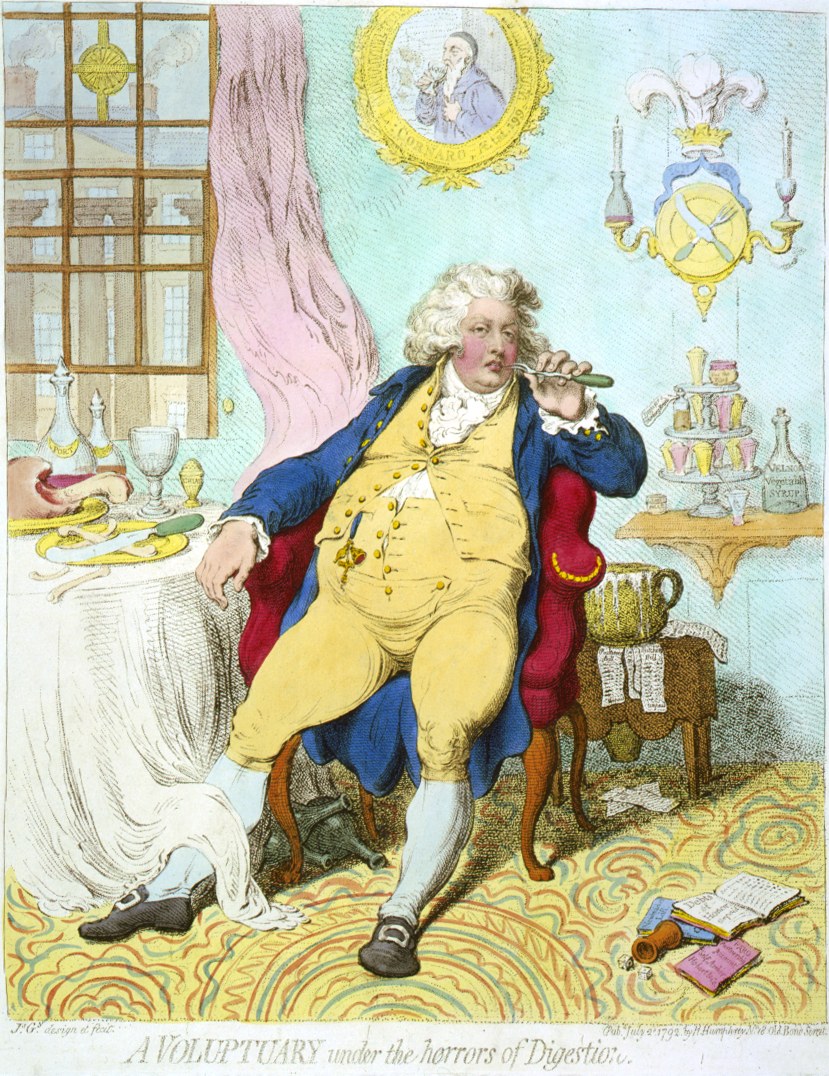
"A Voluptuary Under The Horrors of Digestion": caricatura del 1792 by James Gillray che ritrae Georgio III all'epoca ancora Prince of Wales
Furono così notevoli da passare alla storia Edward Bright di Maldon, Essex, John Love, un venditore di libri di Weymouth, Dorset, e Daniel Lambert di Leicester, East Midlands, il quale forse anche grazie alla propria 'agilità', battè entrambi in quanto a corpulenza ... ed anche in quanto a fama, poiché ancor oggi il suo nome è associato a qualcosa di dimensioni particolarmente ciclopiche.
~ IL GRANDE EDWARD BRIGHT ~
Maldon vanta l'uomo più grasso del XVIII secolo dell'intero Essex. Egli si chiamava Edward Bright e, quando morì nel 1750, all'età di soli 29 anni, il suo peso si aggirava intorno ai 44 stones ( tenuto conto del fatto che 1 stone equivale a 6,350 kg. il peso in questione dovrebbe essere di poco inferiore ai 300 chili !) Bright lavorava da ragazzo come postino e si recava regolarmente a Chelmsford e da lì faceva ritorno a casa. Viveva presso la Church House di St.Peter in High Street, dove in seguito aprì un negozio. Quando morì un buco dovette essere praticato in una parete della sua casa e una gru improvvisata lavorò per far scendere la bara. Sei forti uomini lo condussero fuori dal cancello anteriore e lo immisero sul carro funebre. 1

Egli perì per letargia - di sicuro dovuta da un eccesso di cibo - ed è inutile dire che anche la sua bara ebbe proporzioni straordinarie: si dice che fosse larga 3 piedi e 6 pollici all'altezza delle spalle ( cm.106,5 ca.), 2 piedi 3,5 pollici all'altezza della testa ( cm.70) 22 pollici ai piedi ( cm 56 ca.) e quanto a profondità la misura che gli annali riportano è la seguente: 3 piedi e 1,5 pollici (cm.95.5 ) Furono necessari circa dodici uomini per condurlo dalla chiesa al cimitero, lungo un corteo che attraversò l'intero centro richiamando persone provenienti da ogni dove per assistere ad una così straordinaria sepoltura - fu infatti necessario l'ausilio di un argano per calare la sua bara nel terreno !
~ JOHN LOVE DA WEYMOUTH ~
Chi lo conobbe da adulto stentava a credere che di lui, da fanciullo, si facessero scherno i suoi compagni di scuola e di gioco per l'eccessiva magrezza e gracilità che lo connotavano, tanto da farlo pensare affetto da rachitismo o addirittura da tubercolosi.

A causa di quella che per lui divenne una vera e propria dipendenza dal cibo e dalle bevande, egli divenne talmente obeso, ossia molto più pesante di quanto la sua struttura potesse reggere, da morire a soli 40 anni soffocato dall'adipe. I registri mostrano che al momento del suo decesso pesava 26 stones o 368 libbre, corrispondenti a circa 167 chilogrammi. Fu sepolto nel mese di ottobre del 1793 e presumibilmente la bara insieme con la salma raggiungevano il peso di circa 1 ton, ovvero 900 chili: la bara fu fatta uscire dalla finestra e fatta scendere grazie a due pali in legno conficcati nel terreno e all'aiuto di corde che su di essi la fecero scivolare.
~ DANIEL LAMBERT DI LEICESTER ~
Nonostante in quanto a peso Lambert superò sia Bright che Love, stiamo parlando di una persona affatto apatica e sedentaria, quanto piuttosto di uno sportivo che già in giovanissima età - 8 anni - insegnava nuoto ai bambini più piccoli e che mantenne sempre una certa agilità nonostante le proprie dimensioni davvero eccessive.

Per quanto ci è dato di sapere egli sembra non fosse particolarmente pesante fino a dopo il 1788 - talune fonti suggeriscono il 1791 - anno in cui egli fece ritorno a Leicester, la sua città natale, ( egli si era recato per lavoro a Birmingham ma quando la fabbrica di fibbie presso cui era impiegato chiuse tornò sui propri passi ) dove il padre lavorava presso il carcere della cittadina; quando questi si ritirò cedette il posto al figlio che divenne un rispettato carceriere, ma quando nel 1793 il carcere chiuse egli pesava 32 stones ( equivalenti a 203 chilogrammi) , e, trovandosi disoccupato, dopo aver guadagnato peso aggiuntivo, decise di trarre profitto dalla propria corpulenza.
Numerose sono le descrizioni che furono si di lui pubblicate, ma leggiamo insieme la seguente:
"Quando è seduto egli sembra essere una massa stupefacente di carne, poiché le sue cosce sono così coperte dalla sua pancia che nulla altro che le sue ginocchia emerge, mentre la carne delle gambe, che assomigliano a cuscini, sembra quasi sommergerne i piedi ".
Egli visitò in più tempi Londra, Cambridge, Huntingdon, e Stamford dove morì al Waggon and Horses Inn il 21 luglio del 1809 di conseguenza a quella che venne allora definita "degenerazione grassa del cuore": aveva da poco compiuto 39 anni.
Come ben potete immaginare non diversamente da quanto accadde per Bright e Love fu tutt'altro che semplice rimuovere la salma dei Lambert che aveva al tempo raggiunto i 53 stones ( più di 336 kg.) e per condurre i suoi resti e la sua bara fuori dalla locanda fu necessario demolirne una finestra ed un muro, e questa volta né argani né corde furono impiegati per spostarlo, quanto piuttosto ruote a motore che, seguendo una pendenza graduale, dalla locanda lo condussero al cimitero di Stamford Baron St.Martin’s dove, per interrarlo, furono necessari ben trenta minuti e la forza di 20 uomini.

Ritratto di Daniel Lambert, l'uomo più pingue del suo tempo tanto da divenire un'attrazione nel primo decennio del XIX° secolo.
Questa incisione di Robert Cooper fu pubblicata nel 1821, 12 anni dopo la morte di Lambert.
Questa incisione di Robert Cooper fu pubblicata nel 1821, 12 anni dopo la morte di Lambert.
La fama è come un fiume che porta a galla le cose leggere e gonfie, e manda a fondo quelle pesanti e massicce.
Chissà, ... se fosse vissuto due secoli più tardi, forse Sir Francis Bacon (1561 - 1626) erudito - filosofo, saggista, politico e giurista - vissuto alla corte inglese a fianco della regina Elizabeth I Tudor, prima, e di James I Stuart, dopo, avrebbe riflettuto un po' prima di tramandarci una tale citazione, perché se la leggiamo nel suo significato letterale non giustifica, anzi nega il successo di questi massicci signori ... !!!
Ammetto di aver scelto per oggi un argomento un po' insolito con cui intrattenervi, ma la storia è fatta anche di questo amici miei cari !
Spero che abbiate gradito tale bizzarro momento di evasione e lasciate che prenda il mio congedo da voi non prima di avervi augurato ogni bene.
A presto 💕


FONTI BIBLIGRAFICHE:
Sylvia Kent, Folklore of Essex;
Lynne Raymond, EDWARD BRIGHT, 'THE FAT MAN AT MALDON', 1721-1750, 2014;
The New wonderful magazine, and marvellous chronicle. Vol.1, no.1-vol.5;
WIKIPEDIA.
CITAZIONI:
1 - Sylvia Kent, Folklore of Essex

- picture 1
In the beginning of the XIXth century, with the Industrial Revolution to its early days, the distinction in social classes was defining itself openly more and more and it was increasing the gap between the working class, that lived between enormous hardships and difficulties, haunted by the specter of hunger and of physical weakness - the working hours in the factories were endless and exhausting - the middle class, on one hand, that, just sort, was getting rich very quickly, and the aristocratic one on the other hand, that was trying to keep more and more its privileges; probably, given the contradictions connoting this century at first, it can be rightly regarded as the tail of the previous one.
The thing is that beside those who perished weakened by hunger, there were those who remained stifled by too much food ... banquets and receptions, held in the most unbridled luxury, 'married' to the more licentious laziness, led to death several people who became famous in History as the fattest men of the Regency era and amongst the most burly of the entire Anglo-Saxon History ... it is not a coincidence that during this era men too were forced to wear the corset to hide their forms, they couldn't be showed disproportionate forms in the period when it was fashionable the dandy style, flawless, slender and elegant, advocated by Lord George Bryan Brummell!
- picture 2
The same Prince George III from which this brief era draws its origin was often the subject of caricatures portraying him as Prince of Pleasure (below you can see him in a satirical one bearing the signature of James Gilray) whose pleasures, as a libertine and 'equipped' idlers so as he's described in the chronicles of the time, led him from being lean and slender to become heavy and stout, but it's not my intention to talk to you about him, but rather about of real 'phenomena'.
- picture 3 - "A Voluptuary Under The Horrors of Digestion": 1792 caricature by James Gillray from George's time as Prince of Wales
Were so significant to pass to History Edward Bright of Maldon, Essex, John Love, a bookseller from Weymouth, Dorset, and Daniel Lambert of Leicester, East Midlands, who perhaps thanks to its 'agility', beated both of them as for his weight ... and also in terms of fame, since even today his name is associated with something sized very huge.
~ THE GREAT EDWARD BRIGHT ~
Maldon claims the fattest man in eighteenth-century Essex. This was Edward Bright, who, when he died in 1750 at the age of twenty-nine, weighted 44 stones. Bright was once a post boy and rode regularly to Chelmsford and back. He lived at the Church House near St.Peter's in the High Street, where he later kept a shop. When he died a hole had to be cut into the wall of his house and an improvised crane employed to lower his coffin. Six strong men carried him out of the front gate and placed him on the hearse. 1
- picture 4 on the left - Born in 1721, he soon showed his corpulence as a typical characteristic of his nature which he held throughout his short life both for his constitution and, it is said, accordingly a bet: apparently, an inveterate gambler agreed to bet that seven hundred men would be able to enter Bright's waistcoat, bet that he, of course, didn't win because the aforementioned waistcoat couldn't accommodate more than seven men who did not prevent, however, that it was duly pinned, without breaking a point or straining a button.
He perished by lethargy - certainly due to an excess of food - and it is needless to say that his coffin had extraordinary proportions: it is said that it was 3 feet and 6 inches wide at the shoulders (approx cm.106,5 ), 2 feet and 3.5 inches at the head (70 cm), 22 inches at the feet (56 cm approx) and its depth, according to what is recorded, was 3 feet and 1.5 inches ( cm.95.5); about twelve men were needed to lead it from the church to the cemetery in that which was a long procession through the entire center attracting people from all over to attend such an extraordinary burial - was in fact needed the help of a winch to lower his coffin into the ground!
~ JOHN LOVE FROM WEYMOUTH ~
Those who knew him as an adult could hardly believe that he, as a child, was teased by his classmates for his excessive thinness and frailty that connoted him, to the point to make people think that he was suffering from rickets or even consumption.
- picture 5 on the right

~ DANIEL LAMBERT OF LEICESTER ~
Although in terms of weight Lambert surpassed both Bright and Love, we are talking about a person lethargic and sedentary at all, but rather about a sportsman that already at early age - 8 years - taught swimming for younger children and always maintained a certain agility despite its dimensions.
- picture 6 on the left - As far as we know he wasn't particularly heavy until after 1788 - some sources suggest 1791 - the year in which he returned to Leicester, his hometown (he had gone to Birmingham for work but when the buckles factory where he was employed closed, he retraced his steps), where his father worked at the prison of the town; when he retired, he gave way for his son who became a respected jailer, but when in 1793 the prison closed, he weighed 32 stones (equivalent to 203 kilograms), and, finding himself unemployed, after having gained additional weight, he decided to exploit his corpulence.
There are numerous descriptions that were published about him, but let' s read together the following one:
"When he is sitting he seems to be an amazing mass of flesh, because his thighs are so covered by his belly that nothing but his knees emerges, while the meat of the legs, which look like pillows, seems almost to submerge his feet".
He visited more times London, Cambridge, Huntingdon, and Stamford, where he died at the Waggon and Horses Inn on July 21st, 1809 consequently to what was then called "fat degeneration of the heart": he had just turned 39 years old.
As you can imagine, not unlike what happened to Bright and Love it was anything but easy to remove the remains of Lambert who had at the time reached 53 stones (more than 336 kg.), and for bringing his remains and his coffin out the inn it was necessary to demolish a window and a wall, and this time neither winches or ropes were used, but rather motorized wheels that, following a gradual slope, brought him from the inn to Stamford Baron St. Martin's cemetery where, to bury him, they were necessary thirty minutes and it took the strength of 20 men.
- picture 7 - Portrait of Daniel Lambert, the most corpulent man of his time. He became an attraction in the first decade of the 19th century, being portrayed by several artists. This engraving by Robert Cooper was published in 1821, 12 years after Lambert's death.
Fame is like a river that brings up things light and swollen, and sends down those heavy and massive.
I wonder ... perhaps, if he had lived two centuries later, Sir Francis Bacon (1561 - 1626) erudite - philosopher, essayist, politician and jurist - who lived at the English court alongside the reign of Queen Elizabeth I Tudor, first, and of James I Stuart, later, would have thought a little bit before than handing down such a quote, because if we read it in its literal meaning it does not justify, indeed, it denies the success of these massive gentlemen ... !!!
I admit I chose for today a little unusual topic with which entertain you, but History is made also of this my dear friends !
I hope you enjoyed this bizarre moment of escape and let me take my leave of you not before having wished you all my best.
See you soon 💕


BIBLIGRAFIC SOURCES:
Sylvia Kent, Folklore of Essex;
Lynne Raymond, EDWARD BRIGHT, 'THE FAT MAN AT MALDON', 1721-1750, 2014;
The New wonderful magazine, and marvellous chronicle. Vol.1, no.1-vol.5;
WIKIPEDIA.
QUOTATIONS:
1 - Sylvia Kent, Folklore of Essex


%2Britratto%2Bda%2BThomas%2BLawrence%2Bnel%2B1816.jpg)


