Visualizzazione post con etichetta James Longstreet Cleveland. Mostra tutti i post

sabato 24 maggio 2025

♚ NOBLE MANSIONS AND CROWNS ♚ Villa Île-de-France on the French Riviera and Baroness Béatrice de Rothschild


With this post we find ourselves once again talking about the famous House of the Barons von Rothschild, the Austrian-born bankers who played a major role in promoting and keeping secret the extramarital affair of Archduke Rudolf of Austria with Princess "K"- Olga, illegitimate daughter of Tsar Alexander II and his lover, Princess Alexandra Sergejevna Dolkorukaja. I'm sure you do r remember that this love was at the center of the plot of first book I published, THE AMERICAN SON OF RUDOLPH OF HABSBURG: they were the parents of James Longstreet Cleveland, born and raised in America where the poor Russian princess took refuge after learning of the tragedy of Mayerling in which her beloved had lost his life in such a catastrophic way. The splendid villa you see in the cover image and in the one immediately below that recalls the great residences of the Italian Renaissance, dominates the Cap Ferrat peninsula in Saint-Jean-Cap-Ferrat on the French Riviera and was commissioned, in fact, by Baroness Béatrice de Rothschild at the beginning of the 20th century. At that time, the French Riviera was gaining notoriety among the high society all over Europe, and was qualifying itself as an elite holiday destination.


It was September 14, 1864 when, at the Hôtel Talleyrand in Paris, a former U.S. consulate, Charlotte Béatrice de Rothschild was born, the youngest daughter of Baron Alphonse James de Rothschild (1827-1905), a great collector of antiquities and an important donor to French museums, and Leonora von Rothschild (1837-1911) of the Rothschilds branch known as the "London" branch. She grew up between the most luxurious estate of the 19th century, that of Ferrières-en-Brie in Seine-et-Marne, where she would maintain apartments throughout her life, and the family hotel in Paris on rue Saint-Florentin, surrounded by artistic masterpieces.

On June 5, 1883, at the age of 19, she was given in marriage to the Ukrainian millionaire Maurice Ephrussi, a friend of her parents, who was then 34, fifteen years older than her. He came from a Jewish family from Odessa whose fortune was tied to grain exports and banking transactions: he was the agent that Baron Alphonse favored, to the point that he promoted him as a representative of the French Rothschilds in the Caucasus, then very rich in oil. And it was Maurice Ephrussi who first proposed to Alphonse de Rothschild the trade of Russian oil through his railway network. The Rothschilds were the official bankers of the Tsar and the Ephrussis were the Rothschilds' agents with him. And so we add another little piece to the plot of THE AMERICAN SON OF RUDOLF OF HABSBURG: if the Rothschilds were on friendly terms not only with the Habsburgs, but also with the Romanovs, that is, with Tsar Alexander II, it is easy to understand why both Princess Olga and Archduke Rudolf turned to them as guarantors of the secrecy of their relationship: they both trusted them. But let's go back to Béatrice and Maurice and our story today. Both passionate about architecture, nature and art, they enjoyed living in sumptuous residences and collecting rare and precious art objects. It was above all Béatrice's taste for 18th-century French art and exoticism that placed her in the lineage of the great collectors of the time: she carried out research and had the works transported by train to Beaulieu-sur-Mer, which she chose directly on the station platform. 
Made sterile by genital tuberculosis, the although young baroness was unable to give her husband a child, but her marriage was unhappy especially because of Maurice's addiction to gambling: he was a great gambler and in 1904 his debts had reached more than 12 million gold francs. Worried about the future, the Rothschild family decided to take him to court. The separation was inevitable and came in 1904 after 21 years of marriage. However, Béatrice, for reasons of discretion - divorce was frowned upon at the time - would still keep the surname Ephrussi. Orphaned by her father in 1905, she shared with her younger brother Édouard (Béatrice had an older sister and brother who had died much earlier) a fortune estimated at 700,000,000 euros today. It was then that she bought 7 hectares in Cap-Ferrat to build the villa of her dreams, disputing this plot of land with King Leopold II of Belgium, who wanted to expand his adjacent property. They were necessary more than five years of titanic works to create this sumptuous residence given the place was not very suitable for building a villa or creating a park: making a rocky promontory covered with trees and lashed by gusts of wind habitable was certainly a difficult task. But the baroness had the land dynamited and had enormous quantities of earth brought in to level it and make it fertile. When she moved into the villa, she filled it with antique furniture, paintings by famous old masters, sculptures, art objects, and assembled a vast collection of rare porcelain. Upon her death in 1934, the Baroness donated the property and its collections to the Académie des beaux-arts division of the Institut de France and it is now open to the public as a museum. As for the gardens, at that time they were not yet completely laid out. The first to be brought to life was the French-style one, for the design of which she created a real mobile and living decoration: her collaborators hid themselves in green cardboard pyramids representing cypresses or manipulated long strips of silver, grey or green fabric to see where it was best to place water games, paths and flowerbeds. It was in the year of Béatrice's death that the landscape architect Louis Marchand took charge of designing the themed gardens: thus were born the Spanish garden, the Florentine garden, the Japanese garden, the Mexican garden, etc. As many as nine dream gardens were created to fascinate visitors. He also filled the ponds and restored the French gardens. The result was a truly suggestive park so much so that it is classified by the French Ministry of Culture as one of the most remarkable parks in France.


The Temple of Love dominating the French Garden


The Florentine Garden


The Japanese Garden


The Provencal Garden


The Lapidary Garden


The Rose Garden


The Exotic Garden


Detail from the Spanish Garden


And with one last image taken from the terraces that draw the gaze onto the inlets of the Mediterranean gulf that opens between Monaco and Nice, and its crystalline waters, I'm ending  this quite long post of mine.


In the sincere hope of having made You spend some time daydreaming together with me,
I send You a hug filled with the scents of our Riviera
See you soon ❤


Dany


NOTE:
THE IMAGES WHICH ARE NOT SIGNED BELONGS TO THE WEBSITE VILLA & JARDINS EPHRUSSI DE ROTHSCHILD. 


♚ DIMORE NOBILIARI E CORONE ♚ 
Villa Île-de-France sulla Costa Azzurra 
e la baronessa Béatrice de Rothschild


IMMAGINE DI COPERTINA - Collage che accosta la Villa Île-de-France ad un ritratto della Baronessa Béatrice de Rothschild inserito in una cornice in argento.


Con questo post ci troviamo ancora una volta a parlare della famosa Casata dei baroni von Rothschild, i banchieri di origine austriaca che tanta parte ebbero nel promuovere e tenere celata la relazione extraconiugale dell’arciduca Rodolfo d’Austria con la Principessa "K"- Olga, figlia illegittima dello zar Alessandro II e della sua amante, la principessa Alexandra Sergejevna Dolkorukaja. Ricorderete che proprio questo amore fu al centro del mio primo libro, IL FIGLIO AMERICANO DI RODOLFO D’ASBURGO poiché furono loro i genitori di James Longstreet Cleveland, nato e cresciuto in America dove la povera principessa russa si era rifugiata dopo aver appreso della tragedia di Mayerling in cui il suo amato aveva perso la vita in modo talmente catastroficoLa splendida villa che vedete nell’immagine di copertina e in quella immediatamente qui sotto che ricorda le grandi residenze del Rinascimento italiano, domina la penisola di Cap Ferrat a Saint-Jean-Cap-Ferrat sulla Riviera Francese e fu voluta, per l’appunto, dalla baronessa Béatrice de Rothschild agli inizi del Novecento. Allora la Costa Azzurra stava conquistando notorietà presso l’alta società dell’intera Europa, e si stava qualificando come un luogo di villeggiatura elitario. Era il 14 settembre del 1864 quando, all'Hôtel Talleyrand di Parigi, ex consolato degli Stati Uniti, venne alla luce Charlotte Béatrice de Rothschild, figlia minore del barone Alphonse James de Rothschild (1827-1905), grande collezionista di antichità e importante donatore dei musei francesi, e di Leonora von Rothschild (1837-1911) appartenente al ramo Rothschild detto "di Londra". Ella crebbe tra la tenuta più lussuosa del XIX secolo, quella di Ferrières-en-Brie a Seine-et-Marne, dove manterrà degli appartamenti per tutta la vita, e l'hotel parigino di famiglia in rue Saint-Florentin, circondata da capolavori artistici. 


IMMAGINE 2 - Villa Île-de-France conosciuta anche come
 Villa Rothschild a Saint-Jean de Cap-Ferrat.


Era il 14 settembre del 1864 quando, all'Hôtel Talleyrand di Parigi, ex consolato degli Stati Uniti, venne alla luce Charlotte Béatrice de Rothschild, figlia minore del barone Alphonse James de Rothschild (1827-1905), grande collezionista di antichità e importante donatore dei musei francesi, e di Leonora von Rothschild (1837-1911) appartenente al ramo Rothschild detto "di Londra". Ella crebbe tra la tenuta più lussuosa del XIX secolo, quella di Ferrières-en-Brie a Seine-et-Marne, dove manterrà degli appartamenti per tutta la vita, e l'hotel parigino di famiglia in rue Saint-Florentin, circondata da capolavori artistici. 


IMMAGINE 3 A SINISTRA - Béatrice immortalata all'età del suo matrimonio


Il 6 giugno 1883, all'età di 19 anni, fu data in sposa al miliardario di origine ucraina Maurice Ephrussi, amico dei suoi genitori, che allora aveva 34 anni, quindici più di lei. Questi proveniva da una famiglia ebrea di Odessa la cui fortuna era legata all'esportazione di grano e alle transazioni bancarie: era l’agente che il barone Alphonse prediligeva, al punto che lo promosse come rappresentante dei Rothschild francesi nel Caucaso, allora molto ricco di petrolio. E fu proprio Maurice Ephrussi il primo a proporre ad Alphonse de Rothschild il commercio del petrolio russo per tramite della sua rete ferroviaria. I Rothschild erano i banchieri ufficiali dello zar e gli Ephrussi erano gli agenti dei Rothschild presso di lui. Ed aggiungiamo così un altro piccolo tassello alla trama de IL FIGLIO AMERICANO DI RODOLFO D'ASBURGOse i Rothschild erano in rapporti di confidenza non solo con gli Asburgo, ma anche con i Romanov, ovvero con lo zar Alessandro II, ben si comprende perché sia la principessa Olga che l'arciduca Rodolfo abbiano scelto proprio a loro come garanti della segretezza della loro relazione: entrambi nutrivano fiducia nei loro confronti. Ma torniamo a Béatrice e a Maurice e alla nostra storia di oggi. Entrambi appassionati di architettura, natura e arte, si dilettavano a vivere in residenze sontuose e a collezionare rari e preziosi oggetti d'arte. Fu soprattutto il gusto che Béatrice nutriva per l'arte francese del XVIII secolo e l'esotismo a collocarla nella stirpe dei grandi collezionisti dell'epoca: effettuava ricerche e faceva trasportare in treno le opere a Beaulieu-sur-Mer, che sceglieva direttamente sul binario della stazione. 


IMMAGINE 4 A DESTRA - Béatrice e Maurice, ancora uniti, 
fotografati all'interno della loro proprietà


Resa sterile da una tubercolosi genitale, la seppur giovane baronessa non fu in grado di dare un figlio al marito, ma il suo matrimonio fu infelice soprattutto per la dipendenza di Maurice dal gioco d’azzardo: egli era un gran giocatore e nel 1904 i suoi debiti avevano raggiunto più di 12 milioni di franchi oro. Preoccupata per il futuro, la famiglia Rothschild decise di condurlo in tribunale. La separazione fu inevitabile e giunse nel 1904 dopo 21 anni di matrimonio. Ciononostante Béatrice, per motivi di discrezione – il divorzio era mal visto a quei tempi – manterrà comunque il cognome Ephrussi. Rimasta orfana del padre nel 1905 divise con il fratello minore Édouard (Béatrice aveva una sorella ed un fratello maggiori che erano deceduti molto prima) una fortuna stimata in 700.000.000 di euro odierni. Fu allora che acquistò 7 ettari a Cap-Ferrat per costruire la villa dei suoi sogni contendendo questo appezzamento di terreno al re Leopoldo II del Belgio, che voleva espandere la sua proprietà adiacente. Per realizzare questa sontuosa residenza furono necessari più di cinque anni di lavoro titanico, dato che il luogo non era molto adatto alla costruzione di una villa o alla creazione di un parco: rendere abitabile un promontorio roccioso ricoperto di alberi e sferzato da raffiche di vento era certamente un'impresa ardua. Ma la baronessa fece dinamitare il terreno e portare enormi quantità di terra per livellarlo e renderlo fertile. Quando si trasferì nella villa, la riempì di mobili antichi, dipinti di famosi maestri del passato, sculture, oggetti d'arte e radunò una vasta collezione di porcellane rare. Alla sua morte, nel 1934, la baronessa donò la proprietà e le sue collezioni all'Académie des beaux-arts, sezione dell'Institut de France, che ora è aperta al pubblico come museo. Quanto ai giardini, a quel tempo non erano ancora completamente sistemati. Il primo a essere portato in vita fu quello alla francese, per la cui progettazione creò una vera e propria decorazione mobile e vivente: i suoi collaboratori si nascondevano in piramidi di cartone verde raffiguranti cipressi o manipolavano lunghe strisce di tessuto argentato, grigio o verde per individuare i punti migliori in cui collocare giochi d'acqua, sentieri e aiuole. Fu nell'anno della morte di Béatrice che l'architetto paesaggista Louis Marchand si occupò di progettare i giardini tematici: nacquero così il giardino spagnolo, quello fiorentino, quello giapponese, quello messicano, ecc. Ben nove giardini da sogno furono creati per affascinare i visitatori. Inoltre riempì gli stagni e restaurò i giardini alla francese. Come risultato venne a crearsi un parco talmente suggestivo da essere classificato dal Ministero della Cultura Francese come uno dei parchi più notevoli di Francia.


IMMAGINE 5 - Il Tempio di Amore che domina il Giardino alla Francese

IMMAGINE 6 - Il Giardino Fiorentino

IMMAGINE 7 - Il Giardino Giapponese 

IMMAGINE 8 - Il Giardino Provenzale

IMMAGINE 9 - Il Giardino Lapidario

IMMAGINE 10 - Il Roseto

IMMAGINE 11 - Il Giardino Esotico

IMMAGINE 12 - Dettaglio dal Giardino Spagnolo


E con un'ultima immagine scattata dai terrazzamenti che richiamano lo sguardo sulle insenature del golfo del Mediterraneo che si apre tra Monaco e Nizza, e sulle sua acque cristalline, concludo questo mio lungo post.


IMMAGINE 13


Nella sincera speranza di avervi fatto trascorrere un po' di tempo a sognare ad occhi aperti insieme a me,
vi mando un abbraccio colmo dei profumi della nostra Riviera.
A presto ❤


Dany


NOTA:
LE IMMAGINI CHE NON RECANO FIRMA SONO DI PROPRIETA' DEL SITO WEB VILLA & JARDINS EPHRUSSI DE ROTHSCHILD. 


LINKING WITH: 


domenica 9 gennaio 2022

"I'm glad that you're in contact with the forgotten descendants" - U.S. Hapsburgs


Mr and Mrs James Longstreet Cleveland
HAPSBURG (US) AND WIFE
© Daniela Lasagnini


"I'm glad that you're in contact with the forgotten descendants"

That's a phrase taken from an e-mail I received some days ago from a member of the House of Habsburg-Lorraine which is the further confirmation I was looking for after having written my book.
For sure you do remembrer that in late Winter of 2021 I published my history essay Il figlio americano di Rodolfo d'Asburgo - Rudolf von Habsburg's American son, for MGS PRESS, in which, after almost three years of researches and work on private documents taken hidden, I was able to rebuilt the love-story between the misterious Princess K (Tsar Alexander II's last illegitimate daughter) and Crown Prince Rudolf, the 'fruit' of which was a baby boy born in Hot Springs, Arkansas.
He lived in Missouri, Washington DC and Colorado, was known with the name of James Longstreet Cleveland and had such an adventurous life that sounds almost like a romantic novel.
But everything's true and ratified (I also received a confirmation from a descendant of His belonging to the Habsburgs).
This story is told and published for the very first time and for the first time too I succeded in giving both an identity and a face to Princess K... You can just imagine how many people grew enthusiastic, but also how many, with a soul filled with distrust and hatred, have tried to denigrate this story and have written malicious words on socials, trying to limit its diffusion, without thinking that even speaking publicly not well about something, you make it become famous and viral! 

We know that when Crown Prince Rudolf's son died, on July 1st, 1938, he left a very young wife, Mrs Gertrude, and a little child aged 4, James Gillaspy, but after the census dating back to 1940 the data colleceted are approachable only by those people who are able and demostrate consanguineity, that's why I was cut off from going on further.
But my publisher and I didn't give up... He encouraged me to go on with my researches... Ascertained that James Longstreet Cleveland was Crown Prince Rudolf's American son, how about his offspring?
It sounded like it was impossible to find it...
And after all these months I've eventually reached a result: in America, and to be more precise in the State of Missouri, they're still living the grandchildren of James Cleveland Longstreet; his child had a few children, they have now another surname - in the United States it is very easy to change identities - and they lead the life of ordinary people. Of their ancestors, Archduke Rudolph, their great-grandfather, and James, their grandfather, they keep the memory alive even in not wanting to exhibit their noble roots as well as in the remarkable similarity of the facial features.
The confirmation, as mentioned, came to us from a member of the Habsburg-Lorraine Family. For months, despite the insistent e-mails we exchanged, he managed to gloss over the question I asked him:

"Are there any descendants of James Cleveland Longstreet in America?"

Then, suddenly, after I promised him in the last e-mail that it was not our intention to spread the names of James's descendants, he put me in contact with a person who lives in Missouri ... And from this contact came the confirmation, then sealed by the phrase quoted at the beginning.
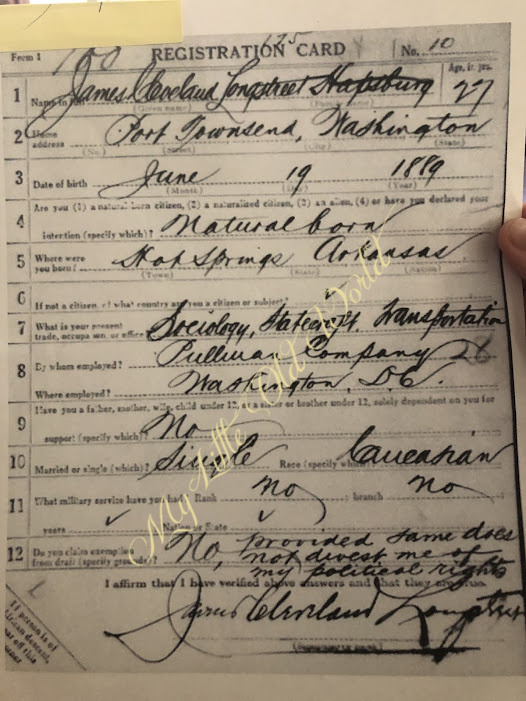
I reiterate that we firmly want to keep the word given both to the Habsburg-Lorraine and to the American branch of their descent and I conclude by saying that I have also come into possession of a document - tha enlistment certificate thanks to which he took part in the Great War - compiled by James himself, claiming to be James Cleveland Longstreet Hapsburg, document which I deal with in my book on page 64 of which there is no trace in the American public archives.
I publish it below for you!


Oh, by the way, I'm publishing below also the original of a draft of an article appeared in a newspaper or magazine in the USA on July 31st, 1934 which is a unique copy I found on the back side of the photo I put as 'frontispiece' which I bought by an antiquarian.
That's also a quite curious story.
As an antiques lover I found myself, shortly after the middle of last month, leafing through an online catalog of an Icelandic antiques dealer based in Reykjavík; it had been published only ten days earlier and dealt exclusively with images that portray famous personalities from the world of entertainment, politics, sport, culture in general who were in the limelight from the beginning to the end of the last century.
These original single-copy photographs have been found in photographic archives of mainly British and Scandinavian editorial presses; kept for many years - the most recent date back to 30/40 ago, the oldest over 100 - in the archive of a European newspaper based in Latvia (Riga), far from everyone's eyes, they have only recently been put up for sale as a collector's items.
And this is how, quite by chance, I found myself in front of the image of James Longstreet Cleveland portrayed together with his wife in a photograph that bears the stamping of a prestigious photographic studio in New York.
As I wrote before, it is dated 1934 and together with it I bought the draft of the article which, on July 31st of the same year, was published together with the image.
Obviously I purchased this material which I consider very precious!
Not only beacuse the photograph comes from New York, but since the draft is written in English, I consider for sure that the European newspaper that published both the photograph and the article bought them from a US publisher.
I hope you'll be able to read it, it's quite faded by the time which has passed since then...


U.S. HAPSBURGS TURN DOWN CHANCE TO AUSTRIAN THRONE.


© Daniela Lasagnini


And thus, after having added another small piece to the unfortunate Crown Prince Rudolph of Habsburg-Lorraine's life through his American son and his descendants still living in Missouri, our time together is ending today too, alas!
In the hope that what we dealed today with, which is the tail end of the content of my book, has also thrilled you - given it's everything absolutely unpublished -
I wish you all a happy week.

See you soon 


"Sono lieto che sia in contatto con i discendenti dimenticati" - Gli Asburgo d'America


- IMMAGINE 1 - Mr and Mrs James Longstreet Cleveland
ASBURGO (STATUNITENSE) CON LA MOGLIE
© Daniela Lasagnini


Il titolo riprende una frase tratta da una e-mail ricevuta alcuni giorni fa da un membro della Casa d'Asburgo-Lorena che rappresenta l'ulteriore conferma che cercavo dopo aver scritto il mio libro.
Di sicuro ricordereta che a fine inverno dello scorso anno pubblicai il mio saggio di storia dal titolo Il figlio americano di Rodolfo d'Asburgo per la Casa Editrice MGS PRESS, in cui, dopo quasi tre anni di ricerche e lavoro su documenti privati ​​tenuti nascosti, sono riuscita a ricostruire la storia d'amore tra la misteriosa Principessa K (ultima figlia illegittima dello zar Alessandro II) e il principe ereditario Rodolfo d'Asburgo, il cui 'frutto' fu un figlio maschio nato a Hot Springs, in Arkansas.
Egli visse in Missouri, a Washington DC ed in Colorado; conosciuto con il nome di James Longstreet Cleveland ebbe una vita talmente avventurosa e romantica da sembrare quasi un romanzo.
Ma è tutto vero e confermato (ricevetti a suo tempo conferma di questa storia da un discendente degli Asburgo).
Nel mio libro questa storia viene raccontata per la prima volta e anche per la prima volta sono riuscita a dare sia un'identità nonché un volto alla Principessa K... potete immaginare quante persone si siano entusiasmate, ma anche quante, con l'animo intossicato da diffidenza ed astio, abbiano cercato di denigrare questa storia e hanno scritto parole malevole sui social, cercando di limitare la divulgazione del libro, senza pensare che anche parlando male di qualcosa pubblicamente, la si fa diventare famosa e virale!

Sappiamo che, quando morì, il 1 luglio 1938, il figlio dell'arciduca Rodolfo lasciò una giovanissima moglie, Mrs Gertrude, e un bambino dell'età di 4 anni, James Gillaspy, ma dopo il censimento del 1940 i dati raccolti sono avvicinabile solo da coloro che sono in grado di dimostrare consanguineità, ed è così che mi si è impedito di andare oltre.
Ma il mio editore ed io non ci siamo arresi... Egli mi ha incoraggiata a proseguire con le mie ricerche ed, appurato che James Longstreet Cleveland era il figlio americano del principe ereditario Rodolfo, che ne è stato della sua discendenza?
Sembrava impossibile trovarne traccia.
E dopo tutti questi mesi alla fine sono stata in grado di raggiungere un risultato: in America, e per la precisione nello Stato del Missouri, vivono ancora i nipoti di James Cleveland Longstreet; suo figlio ebbe più figli, i quali ora hanno un altro cognome - negli Stati Uniti è molto facile cambiare identità - e conducono una vita da gente comune. Dei loro antenati, l'arciduca Rodolfo, loro bisnonno, e James, loro nonno, mantengono vivo il ricordo anche nel non voler esibire la loro nobile ascendenza oltre che nella notevole simiglianza dei tratti somatici.
La conferma, come detto, ci è arrivata da un membro della Famiglia Asburgo-Lorena. Per mesi, nonostante le mail insistenti che ci scambiavamo, Questi è riuscito a sorvolare sulla domanda che gli ponevo:

"Ci sono discendenti di James Cleveland Longstreet in America?"

Poi, all'improvviso, dopo avergli promesso nell'ultima mail che non era nostra intenzione diffondere i nomi dei discendenti di James, mi ha messo in contatto con una persona che abita nel Missouri... E da questo contatto è arrivata la conferma, poi suggellata dalla frase citata all'inizio.
Ribadisco che vogliamo fermamente mantenere la parola data sia agli Asburgo-Lorena che al ramo americano della loro discendenza e concludo dicendo che sono anche entrata in possesso di un documento - il certificato di arruolamento grazie al quale prese parte alla Grande Guerra - compilato dallo stesso James che si dichiara James Cleveland Longstreet Hapsburg, documento che ho citato nel mio libro a pagina 64, ma di cui non vi è traccia negli archivi pubblici americani.
Lo pubblico qui di seguito per voi!


- IMMAGINE 2 - FOTOGRAFIA DEL DOCUMENTO DI ARRUOLAMENTO DI JAMES CLEVELAND LONGSTREET HAPSBURG (Grande Guerra)


Ah, a proposito, pubblico qui sotto anche l'originale di una bozza di un articolo apparso su un giornale o una rivista negli USA il 31 luglio 1934 che ho trovato sul retro della foto che ho messo come 'frontespizio' acquistata da un antiquario.
Anche questa è una storia abbastanza curiosa.
Da cultrice di antiquariato mi sono trovata, poco dopo la metà del mese scorso, a sfogliare un catalogo on-line di un antiquario islandese con sede a Reykjavík; era stato pubblicato solo dieci giorni prima e trattava esclusivamente di immagini che ritraggono personaggi famosi del mondo dello spettacolo, della politica, dello sport, della cultura in generale, che furono alla ribalta delle cronache dagli inizi alla fine del secolo scorso.
Queste fotografie originali in copia unica sono state rinvenute in archivi fotografici di stampa editoriale principalmente britannici e scandinavi; custodite per molti anni – le più recenti datano 30/40 fa, le più vecchie oltre 100 – nell’archivio di una testata giornalistica europea con sede in Lettonia (Riga), lontano dagli occhi di tutti, sono state messe in vendita solo di recente come materiale da collezione.
Ed è così che, in modo del tutto fortuito, mi sono trovata di fronte l’immagine di James Longstreet Cleveland ritratto, insieme con la moglie, in una fotografia che reca il timbro di un prestigioso studio fotografico di New York, nel 1934, cui è acclusa la bozza dell’articolo che il 31 luglio dello stesso anno venne pubblicato insieme con essa.
Ovviamente ho acquistato questo materiale che ritengo decisamente prezioso.
Poiché la bozza è scritta in inglese ritengo con certezza che la testata giornalistica europea che ha pubblicato sia la fotografia che l’articolo abbia acquistato entrambi da un giornale statunitense.
Di seguito traduco il testo dello scritto:


- ASBURGO (AMERICANO) CON LA MOGLIE -

GLI ASBURGO STATUNITENSI RIFIUTANO LA POSSIBILITA' DI SALIRE AL TRONO AUSTRIACO.

PROVIDENCE, MO. --- A PROVIDENCE, IN MISSOURI, QUESTA COPPIA E' CONOSCIUTA COME COMPOSTA DAL SIGNOR JAMES CLEVELAND LONGSTREET E SIGNORA. IN AUSTRIA SAREBBERO CONOSCIUTI COME RUDOLF ALEKSANDER NICHOLAS MARIE D'ASBURGO E CONSORTE.
NONOSTANTE SIA STATO ALLEVATO IN ALCUNI ORFANOTROFI DI ST.LOUIS MR. LONGSTREET E' ACCLAMATO COME IL FIGLIO DEL PRINCIPE EREDITARIO RUDOLF D'AUSTRIA E PERCIO' DIRETTO EREDE ALLA CORONA. QUESTO PERSONAGGIO E' AVVOLTO DA UN RAGGUARDEVOLE MISTERO E ROMANTICISMO. LA CONTESSA LARISCH, NIPOTE DELLA SPOSA DEL FU IMPERATORE FRANZ JOSEF SI STA FACENDO PROMOTRICE DI UNA MOSSA MONARCHICA IN SUO FAVORE.
LA VERITA' E' CHE QUESTI NON VORREBBE SALIRE AL TRONO ANCHE QUALORA GLI VENISSE OFFERTO. EGLI SOSTIENE CHE NON LO HA MAI RECLAMATO NONOSTANTE LE PRESSIONI CHE GLI SONO STATE FATTE. TENTO' DI CONQUISTARE UN SEGGIO AL SENATO PER LO STATO DI WASHINGTON ANNI FA, MA FU BATTUTO. SI CONSIDERA UN CITTADINO AMERICANO A PIENO TITOLO.

 © Daniela Lasagnini


E così, dopo aver aggiunto un altro piccolo tassello alla vita dello sfortunato principe ereditario Rodolfo d'Asburgo-Lorena attraverso il suo figlio americano ed i suoi discendenti che vivono tutt'oggi in Missouri, 
anche oggi il nostro tempo insieme sta finendo, ahimè!
Nella speranza che ciò di cui abbiamo trattato oggi, che è 'la coda' del contenuto del mio libro, abbia entusiasmato anche voi - dato che si tratta interamente di materiale che vede la pubblicazione per la prima volta -
auguro a tutti una felice settimana.

A presto 


lunedì 2 agosto 2021

IL FIGLIO AMERICANO DI RODOLFO D'ASBURGO ~ L'intervista in diretta


AVVISO PER TUTTI GLI AMICI ED I LETTORI DI ~ My little old world ~


Dopodomani terrò un'intervista in diretta su Fb durante la quale presenterò il saggio storico che, a fronte di anni di ricerche, ho scritto per la MGS Press di Trieste.
Chi ha piacere di seguirmi può chiedermi l'amicizia sul mio profilo e sarà immediatamente sintonizzato non appena comincerà la diretta.
Vi aspetto 


TO EVERY READER AND FRIEND OF ~ My little old world ~


The day after tomorrow I will hold a live interview on Fb during which I will present the historical essay I wrote, after years of researches, for the MGS Press of Trieste.
Anyone who likes to follow me can ask me for my friendship on my profile and will be immediately on-line as soon as the live broadcast begins.
Even if it will be held in Italian, 
I'll be waiting for you ❥


By clicking HERE you'll see the video which has been recorded


LINKING WITH:

August week 2


giovedì 18 febbraio 2021

IL FIGLIO AMERICANO DI RODOLFO D'ASBURGO di Daniela Lasagnini.


Sono stata lontana da voi e dal mio Blog tre anni circa e non è stato facile rinunciare a tutta l'entusiasmo e la gioia che mi ha sempre donata, ma, sono onesta, non riuscivo a trovare tempo per ogni cosa: il libro che  uscirà tra pochi giorni di cui sono autrice per la MGS Press di Trieste ha richiesto un notevole lavoro e intendevo investire tutte le mie energie innanzitutto in questo.
Ed ora, ad essere di nuovo qui con voi e a parlarvene, sto vivendo una grandissima emozione!
Sapete quanto ami la storia vittoriana e quella delle nobili famiglie del tempo, delle dinastie che allora regnavano sovrane, ma anche delle curiosità legate alla vita di artisti nonché di gente comune, al costume che allora dettava legge anche presso le classi più umili, alla cultura ottocentesca in genere.
E proprio grazie alla mia curiosità storica, ho scoperto quasi per caso l’argomento che è diventato il motivo del mio lavoro di questi ultimi anni.
Ho cominciato conducendo ricerche d’archivio presso alcuni stati americani, per trovare le conferme ad una storia che a suo tempo era solamente detta a mezza voce, bisbigliata nei corridoi dei palazzi sede del potere, e a cui, ancora oggi, solamente documenti custoditi oltreoceano riportati alla luce sono riusciti a ridare vita. 
E l’hanno ridata al suo frutto, nato, dopo la tragedia di Mayerling, dall’amore di Rodolfo per una misteriosa principessa russa, nominata ‘K’, figlia illegittima dello zar, che egli, a suo tempo, avrebbe voluto sposare. Il matrimonio gli fu negato, ma all’amore nessuno può metter freno.
Quando finalmente questa storia mi fu confermata da un familiare discendente che preferisco mantenere anonimo, al lavoro di affinamento della ricerca si è affiancato quello della prima stesura delle bozze, seguito da un’accurata lettura e correzione effettuata in collaborazione  con lo staff editoriale cui mi sono affidata: forse non lo sapete, ma la MGS Press è la casa editrice più preparata in quanto a conoscenza di storia asburgica, collocata non a caso nell’ultima parte che l’impero austro-ungarico perse e che dovette tornare al regno d’Italia.
Ad essa neppure ambivo di riuscire ad avvicinarmi con successo, ed invece tutto questo lavoro si è concretizzato in un libro.
Ve lo presento:


Il 30 gennaio 1889 a Mayerling – in circostanze che non sono state ancora del tutto chiarite e forse mai lo saranno – muore l’erede al trono d’Austria-Ungheria, Rodolfo d’Asburgo. Cinque mesi dopo, dall’altra parte dell’Oceano, in Arkansas, nasce suo figlio, l’erede maschio che non ha avuto dalla moglie Stefania. 
Chi è la donna che il 21 giugno di quell’anno mette al mondo a Hot Springs Rudolf Franz Alexander Napoleon Augustus Maximilian Karl Josef? È davvero una principessa russa? Si dice sia una figlia illegittima dello zar Alessandro II...
Sono in molti a cercare di scoprire l’identità della misteriosa “Principessa K” di cui si invaghisce Rodolfo; così come saranno in molti a cercarne il figlio americano, perché sono tanti gli interessi che vorticano intorno a un presunto erede dell’imperatore Francesco Giuseppe. 
Il bambino dai natali regali intanto cresce in un orfanotrofio per poi incontrare, come nelle migliori fiabe, chi si prenderà cura di lui amorevolmente, aiutandolo a trovare la sua strada in una giovane America dalle mille opportunità. Ma come mai quest’orfano, apparentemente privo di relazioni, avrà la fortuna d’esser sempre circondato da personalità di una certa caratura estremamente sollecite nei suoi confronti?
Naturalmente segreti così scottanti, come quello di un figlio illegittimo di Rodolfo, sono difficili da mantenere. Ed ecco che dalla remota Austria Francesco Giuseppe ordina alla sua Polizia segreta di cercare il bambino per tentare di riportarlo nel Vecchio Continente. E chissà come sarebbe andata la Storia se il tentativo avesse avuto successo… 
Questa è la storia del nipote americano di Francesco Giuseppe ricostruita e raccontata per la prima volta.


E’ una storia talmente incredibile che sembra un romanzo scritto da un talentuoso scrittore, dotato di estro e fantasia, ma, credetemi, tutto corrisponde alla realtà, dall’inizio alla fine, è un saggio storico! Ed proprio per la sua eccezionalità, che condusse un erede al trono degli Asburgo a nascere e crescere nell’America dei pionieri e dei cercatori d’oro, che questa storia mi ha entusiasmata già dal primo momento ed ho voluto con tutta me stessa che diventasse una storia da raccontare a tutti.
E con lo stesso entusiasmo ve ne ho parlato oggi nella speranza che, in voi, divenga viva curiosità di leggerla.
Lo trovate in prevendita sul sito della casa editrice nel catalogo dedicato agli Asburgo e disponibile a partire dal 1 marzo.

DANIELA LASAGNINI, Il figlio americano di Rodolfo d’Asburgo, Trieste, MGS Press, febbraio 2021.


A presto ♥♡♥


Rudolph of Habsburg’s American son.

I have been away from you and from my Blog for about three years and it was not easy to give up all the enthusiasm and the joy that it all has always given me, but, honestly, I wasn’t able to find time for everything: the book that will be published in a few days, which I am the author of for the MGS Press of Trieste, required a lot of work and I intended to invest all my energies first of all in this.
And now, to be here with you again and to talk to you about it, oh what a great emotion it means to me!
You know how much I do love the Victorian history and that of the noble families of the time, the history of the dynasties that reigned supreme during that age, but also the curiosities related to the life of artists as well as of common people, the habits dictating law then even among the humblest classes, the culture of the XIXth century in general.
And thanks to my historical curiosity, I discovered almost by chance the topic that has become the reason for my work in these last years.
I started by conducting archival researches in some American States, to find the confirmation of a story that at the time was only said in a low voice, whispered in the corridors of the buildings seat of power, and to which, even today, only documents kept overseas brought to light have managed to restore life.
And they gave it back to its fruit too, born, after the Mayerling tragedy, from Rudolf's love for a mysterious Russian Princess, named 'K', one of the Tsar's illegitimate daughter, whom, at the time, the Austrian Crown Prince wanted to marry. Marriage was denied him, but no one can curb love.
When this story was finally confirmed to me by a descendant family member who I prefer to keep anonymous, the work of refining the research was accompanied by that of drafting, followed by an accurate reading and correction carried out in collaboration with the editorial staff I have relied on: perhaps you do not know it, but MGS Press is the most prepared publishing house in terms of Hapsburg history, not by chance located in the last part that the Austro-Hungarian Empire lost and that had to return to kingdom of Italy after the Great War.
I didn’t even aspire to be able to approach it successfully, and instead all this work has resulted in a book.
And now I’m presenting it to you:


On January 30th, 1889, in Mayerling - in circumstances that have not yet been fully clarified and perhaps never will be - the heir to the throne of Austria-Hungary, Rudolf of Habsburg, dies. Five months later, on the other side of the Ocean, in Arkansas, his son was born, the male heir that he didn't have had from his wife Stefania.
Who is the woman who gave birth to Rudolf Franz Alexander Napoleon Augustus Maximilian Karl Josef in Hot Springs on June 21st of that year? Is she really a Russian Princess? She is said to be an illegitimate daughter of Tsar Alexander II ...
Many people try to discover the identity of the mysterious "Princess K" with which Rudolf fell in love; just as many people will be looking for his American son, because there are many interests correlated with an alleged heir of the Emperor Franz Josef.
Meanwhile, the child with royal roots grows up in an orphanage and then meets, as in the best fairy tales, who will take care of him lovingly, helping him to find his way in a young America with a thousand opportunities. But how this orphan, apparently without relationships, will have the good fortune of always being surrounded by personalities of a certain caliber extremely attentive towards him?
Of course burning secrets, such as that of an illegitimate son of Rudolf, are difficult to keep. And so, from the remote Austria, Emperor Franz Josef orders his secret police to look for the child to try to bring him back to the Old Continent. And let’s try to wonder how this story would have gone on if this attempt would have been successful ...
This is the story of Franz Josef’s American grandson, reconstructed and told for the first time.


It is such an incredible story that it looks like a novel written by a talented writer, gifted with flair and imagination, but, believe me, everything corresponds to reality, from its start to its finish, it's a historical essay ! And precisely because of its exceptionality, which led an heir to the throne of the Habsburgs to be born and raised in the America of the pioneers and gold diggers, that this story thrilled me from the first moment and I wanted with all my heart that it became a story to tell everyone.
And with the same enthusiasm I talked to you about it today in the hope that, in you, it will become a keen curiosity to read it.
You may find it on the website of the publishing house in the catalog of the Habsburgs and available from the first of March.
Alas, as you can imagine, it's written in Italian, and I'm truly sorry for all my foreign readers, who cannot read it ... at least at the moment!


DANIELA LASAGNINI, Il figlio americano di Rodolfo d’Asburgo, Trieste, MGS Press, febbraio 2021


See you soon ♥♡♥


LINKING WITH:


Blue Monday

Inspire me Monday

Tesday with a Twist

You're the STAR Blog Hop

Over the Moon Party

Wonderful Wednesday Blog Hop

Create, Bake, Grow & Gather

Pink Saturday

Vintage Charm Party