"One has to shape an ideal in one's imagination,
and then one has to make that ideal accessible to the people."
Albert (Albrecht) Samuel Anker (1831 - 1910)

Die Kleinen Stricker (?)
"Ci si deve formare un ideale nella propria immaginazione,
e quindi rendere quell'ideale accessibile alla gente. "
Albert (Albrecht) Samuel Anker (1831 - 1910)
Albrecht Samuel Anker, pittore ed illustratore svizzero, fu nominato "pittore nazionale" grazie alle sue ancor oggi popolari immagini su come si svolgeva la vita del villaggio nella Svizzera del 1800.
Nato ad Ins, nel Cantone di Berna, il 1 aprile del 1831, figlio di un veterinario, Samuel Anker, egli frequentò le scuole a Neuchâtel e poi a Berna dove conseguì la maturità. Decise quindi di seguire la strada della teologia che lo condusse nel 1851 nuovamente a Berna e quindi presso l'Università di Halle, in Germania, dove il contatto con le grandi collezioni d'arte influenzò profondamente il suo animo sensibile, al punto che nel 1854 convinse il padre ad accettare il fatto che egli avrebbe potuto dedicarsi solamente a ciò che riguardava l'arte e fu così che tornato a Neuchâtel mutò il suo nome in Albert, molto più facile da pronunciare per i suoi compagni di classe di madre lingua francese.
Anker si trasferì a Parigi dove avvia la propria carriera artistica e frequentò l'École nationale supérieure des beaux-arts dal 1855 al 1860. Pur essendo il suo studio collocato nella soffitta della casa dei suoi genitori, egli non mancò di partecipare regolarmente a mostre in Svizzera e in Francia. Nel 1864 Albert Anker sposa Anna Rüfli da cui avrà sei figli, quattro dei quali - Louise, Marie, Maurice e Cécile, i soli non deceduti durante l'infanzia - appariranno più volte nei suoi dipinti
Nel 1866 vinse il primo riconoscimento, la medaglia d'oro al Salone di Parigi per Schlafendes Mädchen im Walde - La Ragazza Addormentata nel Bosco

e per Schreibunterricht - Lezione di Scrittura,


tele tutte appartenenti all'anno precedente; nel 1878 fu nominato cavaliere della Légion d'Honneur e dal 1870 al 1874 è stato membro del Gran Consiglio di Berna, sostenitore della costruzione del Kunstmuseum - Museo d'Arte - della città.
Accanto ai suoi regolari soggiorni invernali a Parigi, vanno ricordati i frequenti viaggi in Italia e in altri paesi europei. Nel 1889-1893 e 1895-1898 è stato membro della Commissione Federale d'Arte Svizzera e nel 1900 ricevette il Dottorato Onorario dall'Università di Berna. Un ictus nel 1901 limitò la sua capacità di dipingere, tanto che posiamo notare pennellate diverse sulle sue tele da quell'anno in poi.
Solo dopo la sua morte, nel 1910, fu aperta al pubblico una prima esposizione a lui dedicata, presso il Musée d'Art et d'Histoire a Neuchâtel.
Ma torniamo alle sue opere ...
Essendo il suo studio localizzato ad Ins, ben si comprende perché egli abbia dato il meglio di sé, dopo essersi dedicato alla produzione di circa una trentina di nature morte e di dipinti a contenuto biblico e a sfondo protestante, nel dipingere i suoi compaesani osservati nella più umile vita di tutti i giorni, senza nessuna pretesa, astenendosi sia dall'idealizzare il mondo rurale sia dall'esprimere alcun accenno politico-sociale, semplicemente come li vedeva dedicarsi con spirito profondamente cristiano alle loro opere.
Osserviamo questi personaggi che nel loro candore esprimono la più profonda poesia, il più profondo calore, i più elevati ideali cristiani ... si tratta della sacralità che solo nei gesti più genuini di tutti i giorni può trovare espressione ...


Sonntag Nachmittag, 1861

Mädchen mit Kätzchen im Korb, 1862

Die Arbeitsamen, 1883
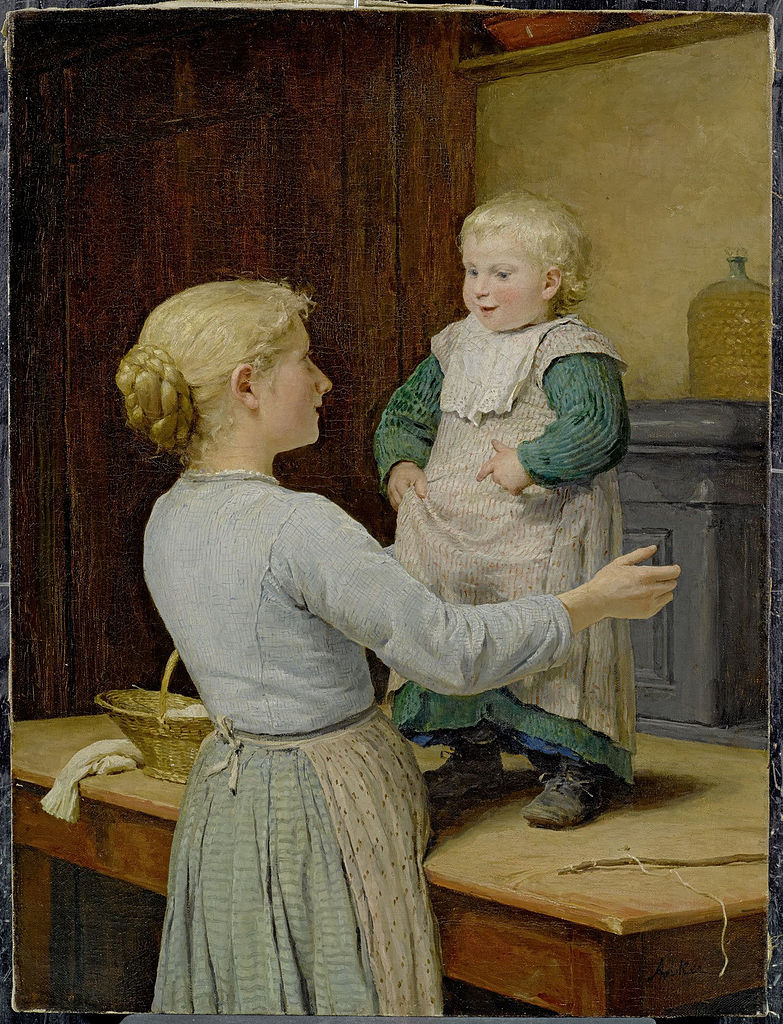
Die ältere Schwester, 1889
Bauer die Zeitung lesend, 1881

Das erste Lächeln, (?)
Die kleine Kartoffelschälerin, 1886

Stricken Mädchen ein Kleinkind in einem Kinderbett Zusehen, 1885
Mädchen mit Brot, (?)

Weitere Auflösungen, (?)

Mädchen, Das Haar Flechten, 1887

Mädchen Stricken, (?)

Die Verbannten, 1868

Junge Mutter betrachtete ihr Schlafendes Kind im Kerzenlicht, 1875

Junge mit Fagot, 1872

Die Andacht des Grossvaters, 1893

Kinderfruhstuck, (?)

Rotkäppchen, 1883

Der Dorf Schneider, (?)

Der Kleine Musiker, 1873

Alte Frau, die die Bibel Liest, 1904

Mädchen Fütterung Hühner, 1865

Titolo sconosciuto, 1831
Spero che questi dipinti vi abbiano colmato il cuore di serenità, così come accade a me ogni qualvolta mi trovo ad osservarli, perché è questo di cui oggi vorrei farvi dono !
Scriveva George Bernard Shaw (1856-1950):
Si usano gli specchi per guardarsi il viso,
e si usa l’arte per guardarsi l’anima.
Vi abbraccio con immensa gratitudine,
a presto 💕


"One has to shape an ideal in one's imagination,
and then one has to make that ideal accessible to the people."
Albert (Albrecht) Samuel Anker (1831 - 1910)
- picture 1 - Die Kleinen Stricker (?)
Samuel Albrecht Anker, Swiss painter and illustrator, was named "national artist" thanks to his still popular works of art depicting how the life of a village in the XIXth century Switzerland was.
Born in Ins, in the Canton of Bern, on April 1st, 1831, the son of a veterinarian, Samuel Anker, he attended school in Neuchâtel and then in Bern where he obtained the maturity. He decided to follow then the path of theology which led him in 1851 again in Bern and then at the University of Halle, Germany, where the contact with the great art collections profoundly influenced his sensitive soul, to the point that in 1854 he persuaded his father to accept the fact that he could devote himself to everything what was about art and so it was that he went back to Neuchâtel, where he changed his name to Albert, much easier to pronounce for his French-speaking class mates.
Anker moved to Paris where he started his artistic career and attended the École Nationale Supérieure des Beaux-Arts from 1855 to 1860. Although his studio was located in the attic of his parents' house, he did not fail to participate regularly to the exhibitions which were held in Switzerland and France. In 1864 Albert Anker married Anna Rüfli who gave him six children, four of whom - Louise, Marie, Maurice and Cécile, the only ones which didn'd die in childhood - appear repeatedly in his paintings.
In 1866 he won the first award, the gold medal at the Paris Salon for Schlafendes Mädchen im Walde - The Girl Sleeping in the Wood
- picture 2 -
and Schreibunterricht - Lesson of Scripture,
- picture 3 -
- picture 4 -
paintings all belonging to the previous year; in 1878 he was named a knight of the Legion d'Honneur, and from 1870 to 1874 he was a member of the Grand Council of Berne, supporting the construction of the Kunstmuseum - Art Museum - of the city.
Alongside his regular Winter stays in Paris, it should be mentioned the frequent trips to Italy and other European countries. In 1889-1893 and 1895-1898 he was a member of the Swiss Federal Commission of Art and in 1900 he received the Honorary Doctorate by the University of Bern. A stroke in 1901 limited his ability to paint, that's why we may see some different brush strokes on his paintings from that year onwards.
Only after his death, in 1910, it was opened to the public a first exhibition dedicated to him at the Musee d'Art et d'Histoire in Neuchâtel.
But let's come back to his works ...
Since his studio was located in Ins, we can well understand why he has given the best of his art, after having devoted himself to the production of about thirty still-lifes and paintings of Biblical content and of Protestant background, in painting his countrymen observed in the most humble life of everyday, without any pretense, abstaining himself both by idealizing the rural world and from expressing any political-social hint, just as he saw them busy with their work with deeply Christian Spirit.
We see these characters in their whiteness demonstrating the most profound poetry, the deepest warmth, the highest Christian ideals ... it is the Sacredness that only in the most genuine gestures of everyday life can express ...
- picture 5 - Sonntag Nachmittag, 1861
- picture 6 - Mädchen mit Kätzchen im Korb, 1862
- picture 7 - Die Arbeitsamen, 1883
- picture 8 - Die ältere Schwester, 1889
- picture 9 - Bauer die Zeitung lesend, 1881
- picture 10 - Das erste Lächeln, (?)
- picture 11 - Die kleine Kartoffelschälerin, 1886
- picture 12 - Stricken Mädchen ein Kleinkind in einem Kinderbett Zusehen, 1885
- picture 13 - Mädchen mit Brot, (?)
- picture 14 - Weitere Auflösungen, (?)
- picture 15 - Mädchen, Das Haar Flechten, 1887
- picture 16 - Mädchen Stricken, (?)
- picture 17 - Die Verbannten, 1868
- picture 18 - Junge Mutter betrachtete ihr Schlafendes Kind im Kerzenlicht, 1875
- picture 19 - Junge mit Fagot, 1872
- picture 20 - Die Andacht des Grossvaters, 1893
- picture 21 - Kinderfruhstuck, (?)
- picture 22 - Rotkäppchen, 1883
- picture 23 - Der Dorf Schneider, (?)
- picture 24 - Der Kleine Musiker, 1873
- picture 25 - Alte Frau, die die Bibel Liest, 1904
- picture 26 - Mädchen Fütterung Hühner, 1865
- picture 27 - Title unknown, 1831
I hope that these paintings have filled your heart with a deep serenity, given I happen every time I find myself watching them, because is this which I would like to give you as a present today !
Wrote George Bernard Shaw (1856-1950):
We use mirrors to look at our faces,
and use the art to look inside our souls.
I embrace you with utmost gratitude,
see you soon 💕


