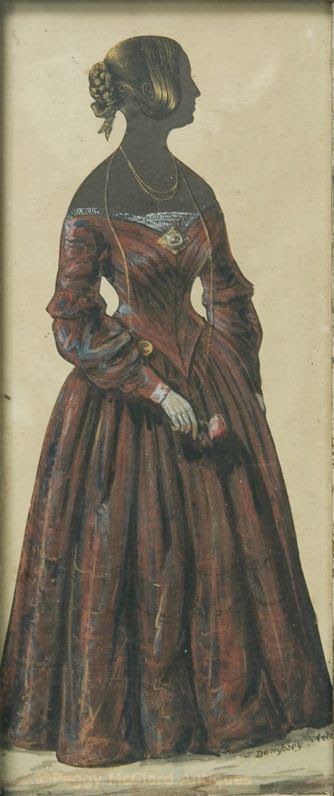
'Amongst my reminescences of personal belongings and the
charm of old portraiture, none has given me greater pleasure
than the silhouette by bygone days. The souvenir, sometimes
cut by gifted amateurs, was exchanged amongst friends
in my early days as the photograph is to-day.'
Ancient silhouette by the American silhouettist William Bache, widely famous from the period of 1760 to 1860
'Pensando alle rimembranze personali più care ed al fascino della
vecchia ritrattistica, nulla mi ha dato più piacere delle silhouette
dei tempi passati. Il ricordo, talvolta ritagliato da dilettanti
talentuosi, era al tempo della mia infanzia oggetto di scambio tra
amici come la fotografia lo è oggi '.
La storia ci insegna che fu l'antico popolo degli Etruschi il primo a subire il fascino delle ombre e a giocare con esse creando le caratteristiche immagini di profilo che ancora oggi possiamo ammirare dipinte su vasi ed anfore che si sono conservate, e potremmo dire che proprio questa forma di pittura sia la prima espressione artistica delle varie antiche civiltà del bacino del Mediterraneo, da quella Egizia, a quella Fenicia, a quella Greca, etc; intorno al I secolo d.C. Plinio il Vecchio narra la storia di una giovane ragazza corinzia del V secolo, Dibutade, che inventò questo tipo di disegno quando tracciò la sagoma o silhouette del suo amante, proiettata sulla parete da una candela, perché egli stava per partire ed ella voleva conservare un ricordo dell'amato con cui consolarsi durante la sua assenza.
Dibutade in un dipinto del pittore Neo-Classico Joseph-Benoît Suvée (1743 – 1807)
La storia di Dibutade è curiosa e merita attenzione non solo perché descrive lo stesso metodo a lume di candela utilizzato nel XIX° secolo per dipingere le silhouette, ma anche perché l'artista è una donna, una dilettante, e nel suo intento è guidata dal produrre un ricordo dell'amato, tutte circostanze, queste, che erano spesso determinanti la creazione del ritratto di profili.
Durante il 1700, l'interesse scientifico ed enciclopedico promosso dall'Illuminismo francese, condusse a studi approfonditi sull'anatomia e sulla fisiognomica, alla redazione di veri e propri trattati sull'argomento ( primo fra tutti quello di Johann Caspar Lavater (1741-1801) Von der physiognomik del 1775 da cui è tratta questa stampa a sinistra) e all'invenzione persino di una macchina detta Limomachia, necessaria a tenere perfettamente immobile il viso di chi era in posa per la creazione del profilo.
Perciò l'attenzione per i tratti caratteristici del viso fece sì che l' art de l'ombre conoscesse un nuovo impulso a diffondersi, anche se va detto che esulano completamente l'ambito scientifico i motivi che condussero questa forma d'arte al successo che ebbe durante l'epoca Regency e più tardi in quella Vittoriana ( pensate che durante l'epoca di Jane Austen divenne persino un gioco di società per le giovani donne).
Tre erano i metodi con cui poter ricavare le sagome o i ritratti di profili da conservare inserendoli in cornice:
- la pittura di un contorno scuro pieno su di una superficie di colore chiaro che fosse carta, cartone, gesso, avorio, ecc. fu in assoluto il primo metodo utilizzato in Francia per realizzare silhouette ed è legato al nome di Francis Torond (1743 - 1812) che intorno al 1770 dipinse ad inchiostro per primo sagome scure con una precisione nei dettagli a dir poco inverosimile ...
Conversation
Playing Cards
Lady with a Birdcage
Mr. and Mrs. Smith of Hailsham and Aunt Everard, c. 1777
per giungere a William Wellings (1778 -1796) che rifiniva e perfezionava le sagome dipinte con tocchi in acquerello per aggiungere alle immagini tridimensionalità e profondità
Naval's Officers
Introduction of Edward to the Knights*
acquerelli che erano, in taluni casi, composti di pagliuzze bronzate, come si nota in questi dipinti realizzati per mezzo della Royal Victoria Gallery's technique (1840's);
- un secondo metodo consisteva nell'utilizzare le forbici per tagliare un profilo da un foglio di carta nera o comunque di colore scuro per poi applicarlo su di uno sfondo, generalmente dipinto, di colore chiaro
American Victorian Silhouette
ma vi era anche chi ritagliava le sagome speculari per poi applicarle sotto il vetro;
Un raro esempio di 'reverse cut-out on glass' silhouette del XIX° secolo che ritrae una famiglia che suona strumenti musicali
- ed infine un terzo metodo era quello di ricavare con il ritaglio l'immagine del profilo nel centro di un foglio, che fosse chiaro o scuro e sovrapporre quest'ultimo ad un altro di tinta contrastante. Questa tecnica è nota come "hollow-cut". ( taglio del vuoto o taglio concavo )
Qui le silhouette sono in negativo
Ma perchè se inizialmente era definita art de l'ombre questa tecnica ritrattistica muterà nome?
Da dove proviene il nome 'Silhouette' ?
La spiegazione è legata al nome di Etienne de Silhouette (1709-1767), Ministro francese delle finanze nominato dal Re Sole, Luigi XIV, ma ci chiediamo in che modo, poichè diverse sono le ipotesi: quella più comune è che, a causa di quanto breve è il tempo necessario per portare a termine il ritratto di un profilo, si alluda in tono sarcastico alla brevità del suo mandato - eletto nel corso dell'anno 1759 da Luigi XIV, prese di mira le classi più agiate, introdusse un'imposta fondiaria che gravava sui nobili francesi e ridusse loro il reddito, tassando inoltre tutti i segni esteriori di ricchezza; ovviamente trovò una forte opposizione da parte dell'ancien régime, della nobiltà e della chiesa che prima di allora da ogni forma di gravame erano esenti e fu così che dopo solo otto mesi fu costretto a ritirarsi dal suo incarico -; un'altra spiegazione la troviamo nella passione con cui, anche se da dilettante, questi si dedicava con successo ed orgoglio proprio all'art de l'ombre tanto che la collezione che possedeva al suo castello divenne presto piuttosto nota; vi è infine una terza spiegazione, più bizzarra, ma forse più verosimile: in Francia il nome di Silhouette era diventato sinonimo di 'a buon mercato', si chiamava 'gilet à la Silhouette' il gilet da uomo senza tasche e perciò da poco non solo perché costava meno la sua realizzazione ( meno stoffa e perciò meno lavoro ), ma anche perchè il fatto che non avesse tasche suggeriva immediatamente che chi lo vestiva non possedesse denaro da mettervi dentro, ( e qui l'allusione sarebbe allora alle politiche fallimentari di Silhouette ). Come le abitudini 'à la Silhouette', quindi, anche i ritratti silhouette erano ben più economici poichè eseguiti in minor tempo rispetto a quelli tradizionali e perciò il nome rimase nel tempo.
Emily Bronte e Charlotte Bronte nelle Silhouettes di Elizabeth Baverstock
Infatti la diffusione di questa tecnica ritrattistica, soprattutto seguendo la seconda e la terza metodologia, che più si divulgarono durante il 1800, ebbe motivazioni precipuamente economiche divenendo una forma popolare di ritrarre volti e figure poichè coloro che non potevano permettersi di spendere il denaro necessario per farsi ritrarre su tela con acquerelli, pastelli o colori ad olio, potevano contare su di una seduta di pochi minuti e di poca spesa; dalla Francia perciò velocemente si diffusero Silhouettist in Inghilterra e successivamente dall'Inghilterra all'America; tra di essi figurano nomi di spicco che meritano di essere ricordati il primo dei quali, sia per importanza che per cronologia, è senza alcun dubbio Auguste Amant Constant Fidèle Edouart (1789-1861), detto più semplicemente Augustin Edouart, ritrattista francese di nascita, che acquistò fama soprattutto lavorando in Inghilterra, in Scozia e negli Stati Uniti nel corso del XIX° secolo specializzandosi in ritratti di silhouette; nato a Dunkerque lasciò la Francia nel 1814 e si trasferì a Londra dove a partire dal 1825 divenne famoso per la creazione di importanti silhouette, tra cui quella di Fanny Brawne, amata da John Keats
quella dell'Imperatore dei Francesi, Napoleone Bonaparte
quella dell'autrice Sarah Josepha Buell Hale
quelle di Sir Walter Scott ad Abbotsford
ed altre che, anche se non legate a nomi di personaggi celebri, sono prestigiose per la tecnica che le contraddistingue
The Magic Lantern
Woman in the Garden
Portrait of Sarah Wistar Pennock and her Daughter, Isabella Liddon Pennock
Ma fu all'Inghilterra che si legarono i nomi più celebri: molto spesso i Silhouettist sceglievano quartieri altolocati di grandi città, centri balneari o termali (quali Bath, per esempio), luoghi frequentati da molte persone in quanto riuscendo a portare a termine i loro ritratti in una manciata di minuti, magari per un solo penny a silhouette, si garantivano comunque una vita dignitosa contando sulla quantità di richieste.
Numerosi furono coloro che durante il XIX° secolo operarono a Brighton, per esempio, da John Gapp of the Chain Pier, così nominato perchè lavorava alla Third Tower nel centro del Chain Pier
ad Edgard Adolphe, come Edouart nato in Francia (1808 - 1890)
a George Cutter Atkinson ( ? - ? )
Ma ci pensate che al tempo vi erano artisti, tra cui si distinse Jane Read ( ? - ? ), capaci di dipingere silhouette a rovescio sul vetro, il vetro concavo da cornice ...
Saranno stati anche artisti dei poveri, così come furono definiti al tempo, ma che arte era la loro, quale talento possedevano ...
Conversation avec une lettre, c.1850
A tale proposito mi piace ricordare William Morris (1834 - 1896) che proprio in quegli anni scriveva:
Il più grande nemico dell'arte è il lusso.
- La bellezza della vita, 1880
A presto amici miei cari, vi abbraccio con affetto, vi ringrazio e vi aspetto per nuovi ...
' viaggi ' tra le meraviglie che appartengono al nostro tempo passato ♥
Citazioni e Note:
1 - Emily Neville Jackson, THE HISTORY OF SILHOUETTES, The Connoisseur Publisher, London, 1861, prefazione
* Durante l'epoca Regency non era infrequente che famiglie con prole numerosa dessero in adozione almeno uno dei propri figli a parenti facoltosi; così accadde per Edward Austen, fratello di Jane, che venne adottato dalla famiglia Knight.
'Amongst my reminescences of personal belongings and the
charm of old portraiture, none has given me greater pleasure
than the silhouette by bygone days. The souvenir, sometimes
cut by gifted amateurs, was exchanged amongst friends
in my early days as the photograph is to-day.'
- picture 1 -
History teaches us that it was the ancient Etruscans people the first to undergo the charm of the shadows and play with them creating the characteristic profile image that we can still admire painted on the vases and the amphorae that are preserved, and we could say that this form of painting is the first artistic expression of the various ancient civilizations of the Mediterranean area, from the Egyptian one, to the Phoenician, to the Greek one, etc.; around the first century AD Pliny the Elder tells the story of a young Corinthian girl from the Vth century, Dibutade, who invented this type of design when she traced the outline or silhouette of her lover, projected on the wall by a candle, because he was about to leave and she wanted to keep a remembrance from her lover with which to console herself during his absence.
- picture 2 - Dibutade in a Neo-Classical painting by Joseph-Benoît Suvée (1743 - 1807)
The story of Dibutade is curious and deserves attention not only because it describes the same method, by candlelight, used in the XIXth century to paint the silhouette, but also because the artist is a woman, an amateur, and to her goal is guided by producing a memory of her beloved, all circumstances, these, which often determined the creation of the portrait of profiles.
- picture 3 on the left - During the 1700s, the scientific and encyclopedic interest promoted by the French Illuminism, conducted to extensive studies on the anatomy and physiognomy, to the preparation of real treatises on the subject (first of all that of Johann Caspar Lavater (1741-1801 ) Von der Physiognomik in 1775 from which is taken this print on the left) and even the invention of a machine called Limomachia, necessary to keep motionless the face of who was posing for the creation of the profile.
- picture 4 on the right - Therefore, the attention to the characteristic features of the face meant that the 'art de l'ombre' knew a new impulse to spread, although it must be said that are completely outside the domain of science the reasons that led this form of art to the succes it had was during the Regency and, later, the Victorian era (just think that during the Jane Austen's era it even became a parlor game for young women).
There were three methods by which to obtain the silhouettes or portraits of profiles to be stored by placing in the frame:
- the painting of a dark full outline of an area of pale color that could be of paper, cardboard, plaster, ivory, etc.. it was the very first method ever used in France to make silhouette and is linked to the name of Francis Torond (1743 - 1812) who in the 1770s painted in ink the first dark shapes with a precision and so fine detail so to say almost unbelievable ...
- picture 5 - Conversation
- picture 6 - Playing Cards
- picture 7 - Lady with a Birdcage
- picture 8 - Mr. and Mrs. Smith of Hailsham and Aunt Everard, c. 1777
till arriving to William Wellings (1778 -1796) who improved and perfected his silhouettes with the addition of touches in watercolor to add to his paintings the three-dimensional component and the depth
- picture 9 - Naval's Officers
- picture 10 - Introduction of Edward to the Knights*
watercolors that were, in some cases, made of bronzed particles, as you can see in these paintings made with the Royal Victoria Gallery's technique (1840's);
- picture 11
- picture 12
- a second method was to use scissors to cut a profile from a sheet of black paper or of another dark color and then apply it on a light-colored background, usually painted,
- picture 13 - American Victorian Silhouette
but there were those who also cut out the shapes in mirror image and applied them under the glass;
- picture 14 - A rare example of 'reverse cut-out on glass' silhouette of the XIXth century that depicts a family playing musical instruments
http://boxhouse-antiques.com/english-regency-period-silhouette-picture.html
- and, finally, a third method was that to obtain with the clipping the profile image in the center of a sheet, it could be dark or light, and overlay the latter to another of contrasting color. This technique is known as "hollow-cut".
- picture 15 - Here the silhouette are negative
But why if this portraiture technique was initially defined 'art de l'ombre' will change its name ?
Where does the name 'Silhouette' come from ?
The explanation is linked to the name of Etienne de Silhouette (1709-1767), French Minister of Finance appointed by the Sun King, Louis XIV, but it is to be seen in which way, because there are different hypothesis: the most common is that, due to how short is the time required to complete the portrait of a profile, it alludes sarcastically to the brevity of his term - elected in the year 1759 by Louis XIV, took aim at the better-off classes, introduced a 'property tax' that weighed on the French nobles and reduced their income by taxing, furthermore, all the outward signs of wealth; obviously he found a strong opposition from the 'ancien regime', the nobility and the church which before then from were exempt from any form of appeal and so it was that after only eight months he was forced to retire from his post -; another explanation is found in the passion with which, although as an amateur, he devoted himself with success and pride in the 'art de l'ombre' so that the collection he had in his castle became soon quite well known; and there is finally a third explanation, most bizarre, but perhaps more likely: in France the name of Silhouette had become synonymous of ' cheaply ', a 'gilet à la Silhouette' was a man gilet without pockets and therefore cheap not only because it was cheaper its realization ( less fabric and therefore less work ), but also because the fact that if it had no pockets immediately suggested that those who wore it didn't have any money to put in ( and hence the allusion would then be to the failed policies of Silhouette). As the habits ' à la Silhouette ', therefore, the portraits of silhouette were well cheapest as performed in less time compared to the traditional ones, and that's why the name remained in time.
- picture 16 - Emily Bronte and Charlotte Bronte in Silhouettes by Elizabeth Baverstock
In fact, the spread of this technique portraiture, especially following the second and third method, which were more popularized during the 1800s, was primarily owned to economic reasons and became a popular form of portraying faces and figures as those who could not afford to spend the money necessary to be portrayed on canvas with watercolors, pastels or oil paints, could count on a few minutes of sitting and on a few money of outlay; from France therefore the Silhouettist quickly spread to England and then from England to America; among them there are prominent names that deserve to be remembered, the first of which, both in importance and in history, is without any doubt Auguste Amant Constant Fidele Edouart (1789-1861): known simply as Augustin Edouart, he was a French-born portrait painter who gained fame mainly working in England, Scotland and in the United States during the XIXth century, specialized in portraits of silhouette; born in Dunkerque he left France in 1814 and moved to London, where since 1825 became famous for the creation of important silhouettes, among which that of Fanny Brawne , loved by John Keats
- picture 17
that of the Emperor of the French, Napoleon Bonaparte
- picture 18
that of the author Sarah Josepha Buell Hale
- picture 19
those of Sir Walter Scott at Abbotsford
- picture 20
and others which, although not related to famous personalities' names, are prestigious for the technique that distinguishes them
- picture 21 - The Magic Lantern
- picture 22 - Woman in the Garden
- picture 23 - Portrait of Sarah Wistar Pennock and her Daughter, Isabella Liddon Pennock
- picture 24 - Selfportrait
, 1828
But it was to England that were tied the most celebrated names: the Silhouettist very often chose high-ranking districts of large cities, seaside resorts or spas towns (such as Bath, for example), places frequented by many people for, as being able to carry out their portraits in a matter of minutes, even for a single penny a silhouette, they could however guarantee themselves a decent life relying on the volume of the requests.
Many were those who during the XIXth century worked in Brighton, such as John Gapp of the Chain Pier, so named because he worked at the Third Tower in the center of the Chain Pier
- picture 25
to Edgard Adolphe, as Edouart born in France (1808 - 1890)
- picture 26
- picture 27
to George Atkinson Cutter (? -?).
- picture 28
But do you think that at the time there were artists, among which Jane Read (? -?) distingued, able to paint silhouette upside down on the glass, the concave frame glass ... ?
- picture 29
- picture 30
- picture 31
They will also have been artists of the poor, as they were called at the time, but that was their art, what a talent they had ...
- picture 32 - Conversation avec une lettre, c.1850
By the way I like to remember William Morris (1834 - 1896) who wrote just in those years:
The greatest enemy of art is the luxury.
- The beauty of life, 1880
Thank you so much my dearest friends, I embrace you with much love and .. see you soon for new 'travels' amongst the wonders belonging to our past time ♥
Quotations and Notes:
1 - Emily Neville Jackson, THE HISTORY OF SILHOUETTES, The Connoisseur Publisher, London, 1861, foreword
* During the Regency period wasn't uncommon for families with numerous offspring to give up for adoption at least one of their children to wealthy relatives, so it happened to Edward Austen, Jane's brother, who was adopted by the Knight family.
Composite image by 4 silhouettes by Augustin Edouart (1789 - 1861), from left to right:
- John Henry Alexander; Mr Weekes; John Francis Theodon; John Lloyd , 1832
- Mrs Robert Beveridge; Anne Beveridge; Andrew Beveridge; Hugh Beveridge; Robert Beveridge, 1832
- Jane Anderson; Esther Ainslie; Helena Anderson; Mrs Arkley; Charles Atherton, circa 1830
- Sarah Siddons; Tyrone Power; Tyrone Power, 1832
LINKING WITH: