Visualizzazione post con etichetta Regency bonnets. Mostra tutti i post

martedì 28 marzo 2023

⊰ Victorian Spring and Easter Traditions ⊱


For much of History, Easter was a more festive day then Christmas and, as it happened for this last one's traditions we still preserve today, the Victorians brought us also the evolution of Easter celebrations. No season was so celebrated as Spring as a promise of rebirth. 
Easter was just the beginning.


FLOWERING SUNDAY MADE CEMETERY BECOME FESTIVE ZONES ~

To be more precise, it all begaun with Flowering Sunday. In southern Wales and nearby portions of England, Palm Sunday is called 'Sul y Blodau' ('Flowering Sunday') and it is traditional to decorate graves with flowers on that day, especially in the industrial towns and villages. Scholars Alan and Karen Jabbour have postulated that Flowering Sunday might be connected to Appalachian cemetery decoration traditions. 


Dressing the grave with flowers by Thomas Onwyn (1853)


Welsh cemetery whitecleaning and decoration traditions may have begun as an Easter celebration or seasonal rite before becoming more commonly associated with Palm Sunday.
The Early Tourists in Wales website catalogues tourists’ comments about Wales from 18th and 19th century books, magazines, newspapers and elsewhere. According to Early Tourists in Wales, by the middle of the 19th century, Flowering Sunday attracted large crowds:
“The number of visitors reported to have visited the cemeteries were very large (10,000 to the new cemetery in Cardiff in 1879, 20,000 in 1889 and 50,000 in 1898; 25,000 to Swansea cemetery in 1906). There were problems with crowd control resulting in the need for extra police or the distribution of tickets only to those visiting relatives’ graves. The demand for flowers for this custom was so great that they were sent from London.”
Cemeteries begun a place where to meet in and where to gather for a party or a Spring pic-nic.
It might seem strange from our perch in the present to imagine cemeteries as a party site. But they offered a popular destination for picnics at a time before parks were created for urban populations. Pic-nics were very popular on holidays especially Easter or Easter Monday.


 EASTER DECORATIONS ~

As for churches where people attended Easter services they would be decorated with flowers, as were homes. Women in particular would create lace and beadwork in floral designs in order to cover their tables and shelves and dressed their homes with wreats, branches of blossoming trees or bunches of flowers: they tended to be simple yet beautiful ones such as lilacs, lilies, pansies and tulips.

 EASTER GREETING CARDS ~ 

It was the very beginning of the Victorian age when Sir Rowland Hill created the Uniform Penny Post meaning: in fact January 1840 marked the advent of the Uniform One Penny Postage Rate. Since then cards became a more economical way of staying in touch than ever, especially around Easter time.


Greetings cards featuring symbolic images such as the cross or spring imagery such as lambs and bunnies were distributed. They tended to be printed on brightly coloured paper in order to emphasise the happy and lively nature of spring. People either bought the cards at a cheap price or made their own ones.


 HAVING FUN WITH DYEING, ROLLING AND HUNTING FOR EGGS ~ 

Whilst eggs had always been distributed between people, chocolate eggs were properly introduced around the Victorian era. The famed chocolatier John Cadbury was already releasing them in 1842, but in 1875 in particular, his company released the Cadbury’s Creme Egg. 


An Easter Holiday, the Children of Bloomsbury Parochial School in a Wood at Watford 
by James Aumonier, 1874


The tradition of the Easter egg hunt and egg roll was introduced from Germany to England during the Victorian era. Children still hunt for colorful eggs, with the one with the most declared the winner, often going home with a prize. Egg rolling involves children rolling eggs down hillsides to see who can roll their egg the farthest. Eggs were often given up for Lent, so the eggs used in the hunt and rolling were eaten on Easter Sunday. 
Of course, eggs had to be dyed days before: in order to make different colors eggs were boiled with leaves or onions. They  got red ones by boiling them with onion skins and beetroot, gold with marigold flower, violet with mallow flower, and green with periwinkle leaves.
During the early Victorian age also cardboard eggs were often lined with bits of satin and contained little sweet treats. 


 EASTER BONNETS AND EASTER PARADE ~

The Easter parade as we know it today has its origin in the Victorian era, too. Victorians were devout, and after attending Easter services, were known to stroll through the streets showing off their spring finery. The tradition of the Easter bonnet, born during the Regency period,  became very popular during this age. (HERE you may read My little old world's post about it) 


During Victorian times, a beau might give a pair of gloves to his sweetheart. If she wore them during the parade, it was considered an announcement of her acceptance of his proposal.
One of the biggest Easter parades takes place still today in New York City, where it has been part of the spring tradition for more than 100 years. Fifth Avenue from 49th to 57th Streets plays host from 10 a.m. to 4 p.m. on Easter Sunday to the biggest stroll of finery, including some very fancy bonnets.


EASTER MEAL ~

Easter meals were also a popular Victorian tradition. As we have seen at the very beginning of this reading, Easter was for many centuries far more important than Christmas. And thus it was at table too. Chief among the food associated with it in Great Britain in the XIXth century were new season lamb, paired with vegetable dishes (Pray, today let's pay respect to our lambs!). Accompanying them were hot chocolate buns and Easter breads. Additionally, egg dishes were served so as to not waste eggs from the easter egg hunts. As for cakes, particular favourite of the Victorians was the SIMNEL CAKE, 
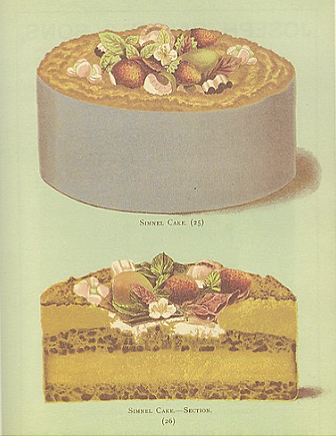

The Victorian Book of Cakes: Treasury of Recipes, techniques and decorations from the golden age of cake-making: a classic Victorian book reissued for the modern reader 
by Lewis, T. Percy; Bromley, A. G.


a light fruit cake with eleven marzipan balls on top representing Jesus’ disciples (excluding Judas, who had infamously betrayed Jesus to the Romans).
By the way, we must say that in Avis' time it wasn't associated with Easter, but it was more a Mothering Sunday bake, being Mothering Sunday the fourth Sunday in Lent also named Refreshment Sunday of Lent, or Simnel Sunday – just after the cake. It was the day that children working away in service traditionally returned to their Mother Church and saw their families. Over the years Mothering Sunday has become a celebration of real mothers rather than the Mother Church, the largest church in the diocese. They were the Victorians who made of it the Easter Cake par excellence. Today Simnel Cake is enjoyed both on Easter Day and on Mothering Day. 


I'm leaving You with the best wishes for a serene remainder of your week
thanking You as usual for Your kindness and goodwill.
See you soon 


⊰ Tradizioni vittoriane legate alla primavera e alla Pasqua 


IMMAGINE DI COPERTINA - Da una cartolina pasquale tardo vittoriana

Per gran parte della storia la Pasqua è stata un giorno più festivo del Natale e, come è successo per le tradizioni di quest'ultimo che conserviamo ancora oggi, i vittoriani ci hanno portato anche l'evoluzione delle celebrazioni pasquali. Per loro nessuna stagione era celebrata come la primavera in quanto promessa di rinascita.
La Pasqua era solo l'inizio.


~ LA DOMENICA DELLA FIORITURA TRASFORMAVA I CIMITERI IN ZONE DI FESTA ~

Per essere più precisi, tutto cominciava con la Domenica della Fioritura. Nel Galles meridionale e nelle parti vicine dell'Inghilterra, la Domenica delle Palme è chiamata "Sul y Blodau" ("Domenica della fioritura") ed è tradizione decorare le tombe con fiori in quel giorno, specialmente nelle città e nei villaggi industriali. Gli studiosi Alan e Karen Jabbour hanno ipotizzato che la Domenica della Fioritura potrebbe essere collegata alle tradizioni di decorazione dei cimiteri tipica degli Appalachi.


IMMAGINE 2 - Dressing the grave with flowers di Thomas Onwyn (1853)


Le tradizioni di pulitura e decorazione dei cimiteri gallesi potrebbero essere iniziate come celebrazione pasquale o rito stagionale prima di diventare più comunemente associate alla Domenica delle Palme.
Il sito web Early Tourists in Wales cataloga i commenti dei turisti sul Galles da libri, riviste, giornali del XVIII e XIX secolo. Secondo Early Tourists in Wales, verso la metà del XIX secolo, la Domenica della Fioritura attirava grandi folle:
“Il numero di visitatori che hanno riferito di aver visitato i cimiteri era molto elevato (10.000 nel nuovo cimitero di Cardiff nel 1879, 20.000 nel 1889 e 50.000 nel 1898; 25.000 nel cimitero di Swansea nel 1906). Ci sono stati problemi con il controllo della folla che hanno portato alla necessità di polizia extra o alla distribuzione di biglietti solo a coloro che visitavano le tombe dei parenti. La richiesta di fiori per questa usanza era così grande che venivano inviati da Londra.
I cimiteri sono diventati un luogo dove incontrarsi e dove riunirsi per una festa o un pic-nic primaverile.
Potrebbe sembrare strano dal nostro punto di vista oggi immaginare i cimiteri come un luogo di festa. Ma essi offrivano una destinazione popolare per i pic-nic in un'epoca precedente alla creazione di parchi per le popolazioni urbane. I pic-nic erano molto popolari nei giorni festivi, specialmente a Pasqua o Pasquetta.


  ~ LE DECORAZIONI PASQUALI ~

Per quanto riguarda le chiese in cui le persone si recavano per le funzioni pasquali, esse venivano addobbate con fiori, così come lo erano le case. Le donne in particolare creavano pizzi e puntine con disegni floreali per coprire i loro tavoli e le loro mensole e vestivano le loro case con ghirlande, rami di alberi in fiore o mazzi di fiori: essi tendevano ad essere semplici ma, nella loro semplicità, belli come lillà, gigli, viole del pensiero e tulipani. 


~ I BIGLIETTINI AUGURALI ~

Era proprio l'inizio dell'era vittoriana quando Sir Rowland Hill creò il significato di Uniform Penny Post: infatti il gennaio 1840 segnò l'avvento dell'Uniform One Penny Postage Rate. Da allora le carte sono diventate un modo più economico che mai per rimanere in contatto, soprattutto nel periodo pasquale.


IMMAGINE 3 - Cartolina pasquale vittoriana


Venivano consegnati biglietti augurali con immagini simboliche come la croce o con immagini primaverili come agnelli e coniglietti. Essi erano generalmente stampati su carta dai colori vivaci per enfatizzare la natura felice e gioiosa della primavera. Le persone compravano le cartoline a un prezzo basso o ne creavano di proprie.


~ DIVERTIRSI TINGENDO, FACENDO ROTOLARE E CACCIANDO LE UOVA ~

Mentre le uova sono sempre state distribuite tra le persone, quelle di cioccolato sono state propriamente introdotte in epoca vittoriana. Il famoso cioccolatiere John Cadbury le aveva già progettate nel 1842, ma fu nel 1875 in particolare, che la sua azienda mise in commercio le Cadbury's Creme Egg.


IMMAGINE 4 - An Easter Holiday, the Children of Bloomsbury Parochial School in a Wood at Watford by James Aumonier, 1874


Le tradizioni della caccia alle uova di Pasqua e quella di farle rotolare lungo i pendii furono introdotte dalla Germania all'Inghilterra durante l'era vittoriana. I bambini vanno ancora a caccia di uova colorate, e quella che ne trova di più torna a casa vincitrice con un premio. Il rotolamento delle uova coinvolge i bambini che rotolano le uova lungo i declivi per vedere chi può rotolare il proprio uovo più lontano. Le uova venivano spesso non consumate durante la Quaresima, quindi le uova utilizzate nella caccia e nel rotolamento venivano mangiate la domenica di Pasqua.
Certo, le uova dovevano essere tinte giorni prima: per ottenere colori diversi le uova venivano bollite con foglie o cipolle. Se ne ottenevano di rosse facendole bollire con rezzole di cipolla e barbabietole, di dorate con fiori di calendula, di violette con fiori di malva e verdi con foglie di pervinca.
Durante la prima età vittoriana anche le uova di cartone erano spesso rivestite con pezzetti di raso e contenevano piccoli dolcetti.


  ~ I CAPPELLINI DI PASQUA E LA PARATA PASQUALE ~

Anche la parata pasquale come la conosciamo oggi ha origine nell'era vittoriana. I vittoriani erano persone molto devote e, dopo aver assistito alle funzioni pasquali, erano note per passeggiare per le strade sfoggiando i propri abiti primaverili. La tradizione del cappellino pasquale, nata durante il periodo Regency, divenne molto popolare proprio in questa epoca.
(QUI potete leggere il post che My little old world dedicò all'argomento).


IMMAGINE 5 - Cartolina raffigurante una giovane Lady che sfoggia il suo cappellino di Pasqua ed il suo nuovo abito della festa


Durante l'epoca vittoriana, un fidanzato poteva regalare un paio di guanti alla sua dolce metà. Se questa li indossava durante la sfilata, significava che accettava la sua proposta.
Una delle più grandi parate pasquali si svolge ancora oggi a New York City, dove fa parte della tradizione primaverile da oltre 100 anni. La Fifth Avenue dalla 49a alla 57a strada ospita dalle 10:00 alle 16:00 la domenica di Pasqua la più grande passeggiata di raffinatezza, comprese alcuni cappellini molto fantasiosi.


~ IL PRANZO DI PASQUA ~

Anche i pasti pasquali erano una popolare tradizione vittoriana. Come abbiamo visto proprio all'inizio di questa lettura, la Pasqua è stata per molti secoli molto più importante del Natale. E così lo era anche a tavola. Il primo tra i cibi ad essa associati in Gran Bretagna nel XIX secolo era l'agnello di nuova stagione, abbinato a piatti di verdure (Vi prego, rispettiamo i nostri agnelli oggi!). Ad accompagnarli c'erano focacce al cioccolato caldo e pani pasquali. Inoltre, venivano serviti piatti a base di uova per non sprecare le uova della caccia alle uova di Pasqua. Per quanto riguarda le torte, particolarmente apprezzata dai vittoriani era la SIMNEL CAKE,


IMMAGINE 6 - La SIMNEL CAKE tratta da The Victorian Book of Cakes: Treasury of Recipes, techniques and decorations from the golden age of cake-making: a classic Victorian book reissued for the modern reader di Lewis, T. Percy; Bromley, A. G.


una torta leggera alla frutta con undici palline di marzapane in cima che rappresentano i discepoli di Gesù (escluso Giuda, che lo aveva infamemente tradito consegnandolo ai romani).
A proposito, dobbiamo dire che ai tempi degli avi essa non era associata alla Pasqua, ma era più un dolce della Domenica della Madre, essendo la Domenica della Madre la quarta domenica di Quaresima chiamata anche Domenica del Ristoro di Quaresima, o Domenica di Simnel – nome mutuato dalla torta, appunto. Era il giorno in cui i bambini che lavoravano lontano da casa tornavano tradizionalmente alla loro Chiesa Madre e vedevano le loro famiglie. Negli anni la Domenica della Madre è diventata una festa delle vere madri piuttosto che della Chiesa Madre, la chiesa più grande della diocesi. Furono i vittoriani a farne il dolce pasquale per eccellenza. Oggi la SIMNEL CAKE si gusta sia il giorno di Pasqua che il giorno della Festa della Mamma.


 Vi lascio con i migliori auguri per un sereno prosieguo di settimana,
ringraziandoVi come sempre 
per la Vostra gentilezza e benevolenza.
A presto 


Dany


LINKING WITH:


martedì 1 giugno 2021

The Chalon Family in London by Jacques-Laurent Agasse.


"Humility and simplicity are the two real sources of beauty."

Johann Joachim Winckelmann (Stendal, December 9, 1717 - Trieste, June 8, 1768)


The Chalon Family in London by Jacques-Laurent Agasse 

(Geneva, April 24, 1767 – London, December 27, 1849)


Today I want to show you a painting, which, despite its naturalness, has unique characteristics.

THE AUTHOR- Born in Geneva, Jacques-Laurent Agasse went to Paris, when he wasn’t twenty yet, to attend a veterinary school before devoting himself to painting, which is why his first paintings portray horses and other animals. Back in Switzerland, it seems that he was so appreciated by a rich Englishman to whom he had painted the dog, that he followed his mentor to England, where he began to paint landscapes and life scenes.
Unfortunately, like most of the artists of his time, he wasn’t appreciated during his life and died in the same poverty which he was born in.

THE PROTAGONISTS - Forced to leave France after the French Revolution, as a Protestant family, the Chalon first took refuge in Switzerland to settle permanently, at the end of the 18th century, in London. The two sons, Alfred and John Chalon, both became artists and it seems likely that they came to know Agasse, a colleague who emigrated from Switzerland and who knew their Paris.

What we have before our eyes is a painting - it is an oil on canvas - which fascinated me as soon as I saw it precisely for its informality: it is in fact the type of image that artists created and gave as a gift to friends or which painted for mere pleasure- the thing is also suggested to us by its limited size (it measures only about 5 "x 7" - 13.7 x 19.7 cm.). Unfortunately, the specific identities of the people portraiyed have been forgotten, but we can still say with certainty that this looks like the portrait of a peaceful and comfortable family. The women are engaged in their manual labor, while the men speak over the wall and although it is not documented, it would not be surprising if the man leaning outside the boundary wall in the upper left was Agasse himself.


The first thing that catches your eye in this painting is probably the light, which takes us back to the late afternoon hours of a Summer day.
Also worth of note is the wealth of detail in the clothing of the four women.

The older woman, probably the mother, sitting alone and looking at the artist with modest eyes, is dressed in the style of a previous generation, with a simple dress, a handkerchief and a ruffled bonnet. She is also wearing a floral print apron over which she has superimposed a cloth maybe for not to get it dirty; instead of sewing, she is busy peeling white turnips, perhaps to prepare dinner: a plate of those already peeled appears on the ground next to her on her right, while other turnips with leaves still attached and still dirty with earth are at her feet on the left.

The young women who are intent on sewing are dressed in a much more elegant way with hats, shoes and high-waisted dresses typically belonging to the Regency era (in fact the painting is dated around 1800). Gathered around a wooden table and seated on chairs that were probably brought outside from an indoor living room, they are trying to keep the most of the daylight with their work-baskets close at their hands. 

The woman in the center wears glasses, and I wonder if the woman on the right, who keeps her head down, wears them too. A curiosity: at the time the glasses that were used for manual work didn’t have rods and didn’t hook around the ears, but were fixed with a ribbon at the nape ... and I wonder if the blue ribbons that go down under the hat on the sides of her face are just those which should tie the glasses, perhaps simply resting on the nose like pince-nez.
Finally I want to point out the 'spencer' that this young woman is wearing: it seems to be in brown velvet, and it was a real 'gem' of Regency women's clothing, not to mention the beige crocheted or knitted ‘bolero’ that dresses the one at center.

I wanted to present this oil on canvas to you because it communicates a particular tranquility to me, it portrays the calm and the sweetness of family life lived peacefully, in that peace so longed-for and, after so much wandering, finally conquered. But not only for that: it is so rich in details, especially as regards the clothes, that it looks like a photograph of the fashion of the time, something that the painter certainly, while painting, had absolutely not thought about.

Look at this print below taken from the Parisian fashion magazine The Journal des Dames et des Modes of 1799: even if the model is a lady and not a young woman, don't you find perfect correspondence in the clothes and accessories?


And what about these hats dating back to the early 1800s from The Ackermann Repository?


If you love Regency fashion, read that post that ~ My little old world ~ published some time ago on this subject: click HERE and enjoy!


Alas, our time has run out, my dear friends and readers, and I always tell you this with a hint of regret; I therefore wish you all the best while waiting to find you here on our next journey among the romantic and curious wonders belonging to our past.
See you soon ♥


 ∗⊱♡❀♡⊰∗


"L'umiltà e la semplicità sono le due vere fonti della bellezza."

Johann Joachim Winckelmann (Stendal, 9 dicembre 1717 - Trieste, 8 giugno 1768)


 The Chalon Family in London by Jacques-Laurent Agasse 

(Ginevra, 24 Aprile 1767 – Londra, 27 Dicembre 1849)


Oggi voglio proporvi un dipinto, che, pur nella sua genuinità, presenta delle caratteristiche uniche.

L’AUTORE – Nato a Ginevra, Jacques-Laurent Agasse si recò a Parigi non ancora ventenne per frequentare la scuola di veterinaria prima di dedicarsi alla pittura, ecco perché i suoi primi dipinti ritraggono cavalli ed altri animali. Tornato in Svizzera, sembra che sia stato talmente apprezzato da un ricco inglese al quale aveva dipinto il cane, che seguì il suo anfitrione in Inghilterra, dove si diede alla pittura paesistica e alle scene di vita. 
Purtroppo, come la maggior parte degli artisti del tempo, non fu apprezzato in vita e si spense nella stessa povertà in cui nacque.

I PROTAGONISTI – Costretta a lasciare la Francia dopo la Rivoluzione francese, in qualità di protestante, la famiglia Chalon si rifugiò prima in Svizzera per stabilirsi definitivamente, sul finire del XVIII° secolo, a Londra. I due figli maschi, Alfred e John Chalon, diventarono entrambi artisti e sembra probabile che siano così giunti a far conoscenza di Agasse, una collega emigrato dalla Svizzera che conosceva la loro Parigi.

Quello che abbiamo sotto gli occhi è un dipinto – si tratta di un olio su tela – che mi ha affascinata appena lo vidi proprio per la sua informalità: si tratta infatti di quel tipo di immagine che gli artisti creavano e davano in dono agli amici o che dipingevano per mero diletto, cosa che ci è suggerita  anche dalla sua limitata dimensione (misura solo circa 5 "x 7"- 13,7 x 19,7 cm.). Purtroppo le identità specifiche delle persone sono andate dimenticate, ma possiamo comunque dire con certezza che questo appare come il ritratto di una famiglia serena e a proprio agio. Le donne sono impegnate nel proprio lavoro manuale, mentre gli uomini parlano oltre il muro e pur non essendo documentato, non ci sarebbe da sorprendersi se l'uomo appoggiato all’esterno del recinto in alto a sinistra fosse proprio lo stesso Agasse.


La prima cosa che salta agli occhi è la luce di questo dipinto, che ci riporta alle ore del tardo pomeriggio di un giorno d’estate.
Da notare è inoltre la ricchezza di dettagli nell'abbigliamento delle quattro donne.
 

La donna più anziana, probabilmente la madre, seduta da sola e che guarda, con occhi dimessi l'artista, è vestita nello stile proprio di una generazione precedente, con un abito semplice, un fazzoletto ed una cuffietta arruffata. Indossa anche un grembiule con stampa floreale a cui ha sovrapposto un drappo probabilmente per non sporcarlo; ella, invece che nel cucire, è impegnata a sbucciare rape bianche forse per preparare la cena: un piatto di quelle già sbucciate figura per terra accanto a lei alla sua destra, mentre altre rape con le foglie ancora attaccate ed ancora sporche di terra sono ai suoi piedi sulla sinistra.
Le giovani donne che sono intente a cucire sono vestite in modo molto più elegante con cappellini, scarpette ed abiti a vita alta tipicamente appartenenti all’epoca Regency (infatti il dipinto è datato 1800 ca.). Riunite attorno a un tavolo in legno e sedute su sedie che probabilmente sono state portate all'aperto da un salotto interno, stanno sfruttando al massimo la luce del giorno con i cestini da lavoro a portata di mano. 

La donna al centro porta gli occhiali, e mi chiedo se li indossi anche la donna a destra che tiene il capo chino. Una curiosità: all'epoca gli occhiali che venivano utilizzati per i lavori manuali non avevano bacchette e non si agganciavano intorno alle orecchie, ma venivano fissati con un nastro alla nuca… e chissà che i nastri azzurri che le scendono sotto il cappellino ai lati del viso siano proprio quelli che dovrebbero legare gli occhiali, magari semplicemente appoggiati al naso come pince-nez.

Infine voglio farvi notare lo ‘spencer’ che veste la giovane sulla sinistra: sembra essere di velluto marrone, ed era una vera ‘chicca’ dell’abbigliamento femminile epoca, per non parlare del bolerino beige fatto all’uncinetto o a maglia che veste quella al centro. 

Ho voluto presentarvi questo olio su tela perché a me comunica una particolare tranquillità, ritrae la calma e la dolcezza della vita famigliare vissuta pacificamente, in quella pace agognata e, dopo tanto peregrinare, finalmente conquistata. Ma non solo: così ricco di dettagli, soprattutto per quanto concerne gli abiti, sembra una fotografia della moda del tempo, cosa a cui il pittore sicuramente, dipingendo, non aveva assolutamente pensato.

Guardate questa stampa qui sotto tratta dalla rivista di moda parigina il Journal des Dames et des Modes del 1799: la modella è una lady e non una giovane donna, ma non trovate comunque una perfetta rispondenza negli abiti e negli accessori?


E che dire di questi cappellini riportarti nei primi anni del 1800 dall’Ackermann Repository


Se amate la moda Regency riprendete quel post che  ~ My little old world ~ pubblicò tempo fa sull’argomento: cliccate QUI e buona lettura!


Il nostro tempo si è esaurito, miei carissimi amici e lettori, e ve lo dico sempre con un pizzico di rammarico; vi auguro quindi ogni bene nell'attesa di ritrovarvi qui nel nostro prossimo viaggio tra le romantiche e curiose meraviglie che appartengono al nostro passato.
A presto 


LINKING WITH:


sabato 19 aprile 2014

HISTORY OF FASHION ~ Regency Easter Bonnets and the Vanity Fair.


Ackermann Easter Bonnet, 1823


Durante l'epoca Regency il periodo pasquale segnava l'inizio della Season, la stagione dei balli (immancabile quello delle debuttanti ), delle cene, dei ricevimenti, del teatro, dei grandi eventi di beneficenza, dei concerti, la stagione della mondanità; la maggior parte della gentry aveva eletto come residenza ufficiale la propria dimora di campagna, essendo per la maggior parte costituita da proprietari terrieri di antica tradizione la cui ricchezza era ancora proveniente dalla rendita delle grandi proprietà agricole ( la classe borghese al tempo non esisteva, si sarebbe costituita solamente più tardi con la rivoluzione industriale che avrebbe anche modificato quella dei benestanti che diverrà sempre meno costituita da aristocratici e proprietari terrieri, sempre più numerosi saranno gli imprenditori ) e solamente con l'avvento della primavera, che coincideva non a caso con l'avvio delle sessioni parlamentari, lasciava la conduzione di tale residenza ai domestici e dei terreni ai lavoranti per recarsi in quella di città, Londra o Bath: alla campagna avrebbero fatto ritorno solamente sul finire dell'estate quando, nel periodo compreso tra la fine di Luglio ed il 12 di Agosto, il Parlamento si sarebbe chiuso e l'inizio della stagione della caccia, congiuntamente con il caldo afoso che avrebbe reso ostile la permanenza tra i palazzi e le polverose strade di città, avrebbe richiamato tutti verso le antiche residenze di famiglia.


John Pettie, Two Strings to her Bow, 1882


E cosa vi era di meglio, visto che stiamo parlando dell'epoca dell'eleganza e della femminilità, se non sfoggiare un nuovo abito con cui presentarsi a conoscenti e cittadini del ceto meno abbiente che erano rimasti in città, ai negozianti che mai avevano abbandonato la loro attività nelle botteghe ai bordi delle strade, anche se meno frequentate durante l'inverno, ad amici e corteggiatori ritrovati con rinnovato interesse ed entusiasmo ?


The Brave Deserve the Fair by Henry Gillard Glindoni (1852 - 1913)


Probabilmente catturare sguardi ammirati indossando un cappellino nuovo all'ultima moda .. proveniente dalle modisterie di Parigi, s'intende !


Millinery in Paris, 1822


La moda del tempo disegnava per l'occasione i cosìdetti Easter Bonnets, i cappellini primaverili creati appositamente per essere inaugurati la mattina della S.Pasqua, l'evento che per eccellenza segna il culmine della primavera: questo nel dipinto sottostante probabilmente è tra i primi dell'epoca Regency visto che risale agli ultimissimi anni del settecento


mentre quelli sotto appartengono al pieno periodo Regency; come potete notare erano per lo più in paglia o comunque in tessuti di cotone, adornati con nastri, guarnizioni floreali e piumate, erano i cappellini che avrebbero accompagnato chi li inaugurava la mattina di Pasqua per tutta la primavera e l'estate successive.


Regency Easter Bonnets, 1811


Regency Spring Walking Dress, 1819


Regency Easter Bonnets, 1812


E' indubbio che la moda del periodo Regency, in ogni suo dettaglio, fosse volta all'esaltazione delle caratteristiche più femminili di ogni Lady ...


 Portrait of a Woman in a Cave, c1805


1810, cappello in paglia con nastri in seta, Luise Kleider der Konigen


Andrew Geddes, Portrait of a Lady, c1803 -1810


Sul finire dell'epoca Regency gli Easter Bonnet acquisteranno falde sempre più ampie per assumere la più la forma definita Poke, così definita perchè riuscivano non solo a contenere tutti i capelli di chi li indossava, ma anche a celarne romanticamente l'identità ( il verbo 'to poke' significa sia 'infilare' che 'cercare a tastoni' ); avranno grande fortuna nell'ambito della moda Vittoriana, accolti con entusiasmo anche dalla giovane, graziosissima, regina Victoria, nei primi anni del suo regno, da che troveranno larga diffusione soprattutto a partire dagli anni '30 del 1800 ".. quando la regina Vittoria era ancora molto giovane ed andava di moda per le ragazze indossare cappellini di paglia a forma di secchio per il carbone" scriveva Virginia Woolf ... ma questa è un'altra storia e desidero parlarvene in un'altra occasione.


1815-1820 Poke Bonnet realizzato in stretta treccia di paglia lucida foderato con seta blu con una pannello di carta interposto. Fatto a mano con più strati di paglia intrecciati e sovrapposti. Il Poke Bonnet è rifinito con crine e trecce di paglia e un'ampia fascia di nastro a fiori crema e blu appuntata su tutti i lati e sotto la corona. Ci sono lunghi lacci da legare dello stesso nastro.


Lasciate quindi che infine, in questo modo un po' informale, auguri ad ognuno di voi, miei carissimi amici e lettori, ovunque vi troviate nel mondo, che celebriate la S.Pasqua oppure no, che il sole splenda per voi in questo fine settimana di primavera,


che splenda in voi,
che ogni sorriso vi rallegri il cuore,
e che l’amicizia, l'amore ed i gesti condivisi,
siano fonte di gioia profonda.


Riproduzione di un biglietto augurale dei primi anni del XIX° secolo


A presto 


- picture 1 - Ackermann Easter Bonnet, 1823


During the Regency Era the Easter period marked the beginning of The Season, the ball season (  you had not to miss the rookies' one ), of dinners, receptions, theater, major charity events, concerts, in one word the season of worldliness; most of the gentry elected as their official residence their home country, being for the most part made ​​up of landowners of ancient tradition whose wealth was still coming from the income of large agricultural properties ( the middle class at the time didn't exist yet, it would consist only later with the Industrial Revolution that would also modified that of the wealthy people that will become increasingly composed of always fewer aristocrats and landowners, and more and more entrepreneurs ) and only with the advent of Spring, which not by case coincided with the start of Parliamentary sessions, left the conduct of such residence for the household and land to the workers for leaving to that in the cities, London or Bath: to the country they would return only at the end of the Summer when, in the period between the end of July and August 12th, the Parliament would be closed and the start of the hunting season, together with the extreme heat that would have made hostile to remain between the buildings and the dusty streets of the city, will called them to all the former residences of family.


- picture 2 - John Pettie, Two Strings to her Bow, 1882


And there was something better, since we're talking about the era of elegance and femininity, if not to show off a new dress with which appear to acquaintances and citizens who had remained in the city, shopkeepers who had never abandoned their activities in the shops by the roadside, although less popular during the Winter, to friends and admirers gathered with renewed interest and enthusiasm?


- picture 3 - The Brave Deserve the Fair by Henry Gillard Glindoni (1852 - 1913)


Probably to catch admiring glances wearing a new hat at the latest fashion .. coming from the millineries of Paris, of course!


- picture 4 - Millinery in Paris, 1822


The fashion of the time was drawing for the occasion, the so-called Easter Bonnets, hats spring specifically designed to be opened on the Easter morning, the event par excellence that marks the culmination of Spring; in this picture below you can see that was probably one of the first Regency Easter Bonnet that dates back to the last years of the XVIIIth century


- picture 5


while those below belong to the full Regency period; as you can see they were mostly thatched or otherwise in cotton fabrics, adorned with ribbons, trimmings and floral feathered hats were that would accompany those who inaugurated the morning of Easter throughout the Spring and Summer coming.


- picture 6 - Regency Easter Bonnets, 1811

- picture 7 - Regency Spring Walking Dress, 1819

- picture 8 - Regency Easter Bonnets, 1812


And there's no doubt that the fashion of the Regency period, in every detail, was studied for the exaltation of every Lady's femininity ...


- piture 9 - Portrait of a Woman in a Cave, c1805

- picture 10 - 1810, cappello in paglia con nastri in seta, Luise Kleider der Konigen

- picture 11 - Andrew Geddes, Portrait of a Lady, c1803 -1810


At the end of the Regency era the Easter Bonnets will have more and more wide foot to take more definite Poke shape, so called because they only could contain all the hair of the wearer, but also concealed romantically her identity (the verb 'to poke' means both 'insert' that 'groping'); they will have great luck in the Victorian fashion, greeted with enthusiasm by the young, very pretty, Queen Victoria, in the early years of her reign, and will be widely distributed, especially since the 30s of 1800 ".. when Queen Victoria was still very young and it was fashionable for girls to wear straw hats shaped bucket for coal, " Virginia Woolf wrote ... but that's another story and I want to tell you about it another time !


- picture 12 - 1815-1820 Poke Bonnet made ​​of straw braid tight shiny lined with blue silk with a panel of paper interposed. Made by hand with multiple layers of woven straw and stacked. The Poke Bonnet is finished with horsehair and straw braids and a wide cream and blue flowered ribbon pinned on all sides and under the crown. There are long strings to tie with the same ribbon.


So let me finally, in this way a little informal to wish to each of you, my dear friends and readers, wherever you are in the world, whenever you to celebrate Easter or not, that the sun shine for you this weekend of Spring


- picture 13


that it shines in you, 
that every smile rejoice your heart, 
and that friendship, love and shared gestures  
will to you a source of deep joy.


- picture 14 - Reproduction of a greeting card from the early nineteenth century


See you soon 


LINKING WITH: