SILVESTER, ovvero la vigilia di Capodanno,
nelle più antiche regioni della Germania,

custodisce tutt'ora ataviche tradizioni, veri e propri riti di passaggio verso il nuovo anno che hanno antichissime origini; quest'oggi mi piace passarle in rassegna con voi, perché sono davvero molto curiose ed interessanti, alcune molto lontane dalle nostre proprio perché dettate dalle così diverse radici culturali e linguistiche e risalenti ad epoche precedenti l'avvento del Cristianesimo ...
- RAUNÄCHTE
La prima citazione ufficiale della Raunacht risale al 1725, a Waldkirchen (Baviera orientale).
Secondo le più antiche credenze popolari, cominciava con il 25 dicembre il periodo mistico delle Raunächte, le notti dell'incenso (Räuchern) che perdurava fino al 6 di gennaio. Il termine "Raunächte" ("Rau" o "Rauch" significa "fumo") ricorda che un tempo si pensava di fermare l'azione malvagia degli spiriti maligni che potevano agire durante la notte riempiendo la casa e la stalla di fumo d'incenso ( da sempre, inoltre, queste notti sono considerate anche importanti notti oracolari in cui si predice il clima dei dodici mesi successivi ): per tenerli sotto controllo si usava far bruciare dell'incenso la notte della Vigilia, a Capodanno e il giorno dell'Epifania. L’assenza di un membro della famiglia durante la celebrazione di questo rito era un segno funesto che faceva presagire sfortuna o disgrazia. In una grande padella piena di brace ardente venivano gettate erbe e resine che producevano incenso con cui la famiglia contadina "purifica" tutti i locali recitando preghiere.

L'usanza delle Raunächte è tipica soprattutto della Baviera e dell'Austria, mentre il rito di incensare le stalle è una tradizione ancora più diffusa: anche in Svizzera, in Boemia e in Alto Adige (Tirolo) si ritrovano tutt'oggi elementi di questo antico uso.
L'incenso era, ed è tutt'ora generato, in quelle regioni che ne serbano il rito, facendo ardere in mezzo ai tizzoni angelica, semi di frassino, resina di pino, fiori di sambuco, lavanda, imperatoria, vischio, salvia e barba di bosco.
Queste piante o resine venivano utilizzate singolarmente o insieme a seconda del gusto; l'incenso, così prodotto, veniva condotto e sparso per tre volte in senso antiorario all'interno dell'abitazione e della stalla.
Altre piante adatte per produrre il "Rauch" sono: radice di mandragola, artemisia, giusquiamo, alloro, ed achillea.
- PERCHTEN & HOLZMANDL
Soprattutto nell'Alta, nella Bassa Baviera ed in Austria fino alla festa dell'Epifania (6 gennaio) è possibile imbattersi specialmente nelle aree alpine poco frequentate in mostruose figure che indossano bizzarre maschere fatte con radici: i Perchten.

La leggenda vuole che queste figure appartengano alla Signora Percht (che significa "la luminosa") la quale simboleggia il sole, che a partire dal solstizio d'inverno ricomincia a crescere in forza e altezza. Secondo l'etimologia del suo nome, questa figura dovrebbe portare gioia, ma nei racconti più antichi è predominante un significato negativo e malvagio. Dell'usanza dei Perchten fanno parte anche gli Holzmandl, piccole creature simili ad elfi, facili da riconoscere in quanto rivestiti di pigne, corteccia, licheni, muschi che ricoprono in inverno gli alberi e null'altro che non sia materiale proveniente dalla foresta, capaci di assumere fattezze umane: se però un essere umano li incontra, si trasformano all'istante in radici !
Soprattutto nell'Alta, nella Bassa Baviera ed in Austria fino alla festa dell'Epifania (6 gennaio) è possibile imbattersi specialmente nelle aree alpine poco frequentate in mostruose figure che indossano bizzarre maschere fatte con radici: i Perchten.
La leggenda vuole che queste figure appartengano alla Signora Percht (che significa "la luminosa") la quale simboleggia il sole, che a partire dal solstizio d'inverno ricomincia a crescere in forza e altezza. Secondo l'etimologia del suo nome, questa figura dovrebbe portare gioia, ma nei racconti più antichi è predominante un significato negativo e malvagio. Dell'usanza dei Perchten fanno parte anche gli Holzmandl, piccole creature simili ad elfi, facili da riconoscere in quanto rivestiti di pigne, corteccia, licheni, muschi che ricoprono in inverno gli alberi e null'altro che non sia materiale proveniente dalla foresta, capaci di assumere fattezze umane: se però un essere umano li incontra, si trasformano all'istante in radici !
- BLEIGIEßEN
Silvester era anche il momento propizio per predire il futuro e a questo serviva il Bleigießen: in un cucchiaino si faceva fondere un pochino di piombo e poi lo si versava in acqua fredda e, a seconda della forma che esso assumeva, la persona o i suoi amici potevano predire cosa avrebbe riservato oro l'anno venturo: se il piombo assumeva la forma di un cuore o di anello il significato era palese, matrimonio in arrivo, se assomigliava ad una barca si trattava di un viaggio, ad un maiale o ad un grasso animale prosperità, se ad una balena allora sarebbero stati necessari espedienti per dimagrire; l’unica forma non auspicabile era una perfetta sfera che significava che la fortuna sarebbe 'rotolata' via.

Altre tradizioni legate al Capodanno tedesco riguardano i portafortuna che vengono tutt'ora scambiati o regalati la notte di San Silvestro, in genere a forma di cioccolatino, che rappresentano piccoli maiali, sempre simbolo di prosperità, trifogli, ferri di cavallo e spazzacamini, simbolo di pulizia in attesa del nuovo anno ( in Austria è di buon auspicio scambiarsi anche figurine a forma di fungo e quadrifoglio ).
- SILVESTER ABENDESSEN
La tradizione legata alla cena di capodanno più diffusa impone di lasciare un po’ della cena preparata e consumata nelle ore precedenti i festeggiamenti fin dopo la mezzanotte: è un omaggio al nuovo anno in modo che appena arrivato inizi nel segno dell’abbondanza. Il piatto più tradizionale servito nel corso del cenone di Capodanno è da sempre a base di aringa accompagnata con un contorno di verze, carote e patate. Anche condividere forme di formaggio è considerato di buon auspicio, e così, come in molti altri Paesi Europei, mangiare insieme le lenticchie. I piatti sono preparati non solo per gli invitati, ma anche per i vicini, con scambi che servono a cementare la reciproca conoscenza. La cena di Capodanno non è completa senza la Fondue o il Raclette, preparati direttamente a tavola con piastre calde. E poi naturalmente i dolci di mandorle, le Neujahrsbretzeln,
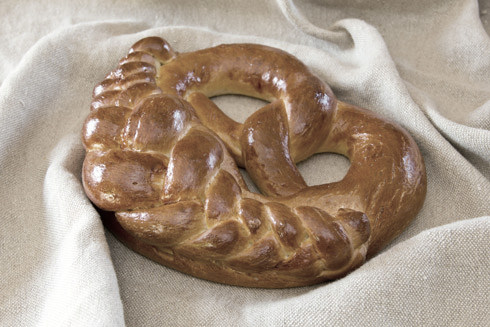
le ciambelle di Capodanno. Dopo la cena, mentre si mangiano noci, nocciole e uvetta, tutti simboli portafortuna, si beve birra o vino e allo scoccare della mezzanotte si brinda bevendo Feuerzangenbowle, la bevanda della fraternità.
- FEUERZANGENBOWLE
Per la preparazione del Feuerzangenbowle serve un'attrezzatura del tutto simile a quella che serve per preparare la fonduta. La scodella è riempita però con vino rosso speziato con cannella, chiodi di garofano e bucce d'arancia (processo del tutto simile alla preparazione del vin brulé). A questo punto viene posta sulla sommità della scodella una Feuerzange (pinza da fuoco, dalla forma simile a quella di un graticcio), su cui verrà appoggiato il Zuckerhut (blocco di zucchero a forma di cono). Al blocco di zucchero, già impregnato di rum (preferibilmente ad altissima gradazione, almeno 54%), si dà fuoco, in modo tale che lo zucchero - caramellandosi - vada a cadere dentro il vino rosso sottostante che intanto si scalda con il sistema della fonduta. Naturalmente, più rum si andrà a versare sullo zucchero, maggiore gradazione avrà la bevanda finale che andrà bevuta in tazze e gustata ben calda.

Era inoltre frequente, un tempo, imbattersi, di giorno e di notte, in fanciulli che facevano suonare i loro campanacci per le vie dei borghi, quasi a voler scacciare l'anno vecchio, che venivano accolti a fondo valle e fatti entrare nelle abitazioni donando loro dolci, soprattutto i
Lebkucken, che mai mancavano in casa durante tutto il periodo natalizio (conosciuti anche come Pfefferkuchen, Gewürzkuchen e più anticamente come Honigkuchen sono biscotti speziati originari di Norimberga i cui ingredienti sono frutta secca - nocciole, noci o mandorle - agrumi canditi, uova, miele, farina, zucchero, marzapane e varie spezie come cannella, anice, zenzero, pimento, chiodi di garofano, noce moscata. Spesso i Lebkuchen vengono ricoperti di cioccolata o di glassa) e, sempre nelle regioni alpine, già durante i secoli scorsi, allo scoccare della mezzanotte le campane delle chiesette che costellano le vette suonavano a festa salutando così il nuovo anno, venivano sparati petardi e le famiglie più facoltose brindavano con Champagne ed incendiavano i costosi fuochi artificiali che avevano posto in mezzo ai pascoli innevati.

Altri antichi mercati natalizi che vantano tradizioni storiche sono quello di Strasburgo, che risale al 1570, e quello di Norimberga che si tenne per la prima volta nel 1628, che già si protraevano fino al giorno dell'Epifania.
E salutiamo quindi quest'anno che sta per lasciarci ...
Come spirito glorificato
L'angelo dell'anno dice addio, depone le vesti,
Verdi in primavera
O rilucenti dell'azzurro estivo.
E avendo compiuto la sua missione in terra,
Riempite di biondo grano mille valli,
Frutteti di rosei frutti,
E sparsi i suoi fiori intorno ...
Indugia per un attimo a ponente,
Mentre il sole calante volge al tutto
Un dolce sorriso di saluto
e poi ritorna a Dio.1
Possa il Nuovo Anno portare a ciascuno di voi, miei carissimi ed affezionati amici e lettori, salute, gioia, prosperità in gran copia !
A presto ♥


Bibliografia:
Johann Beerens, Von Neujahr bis Silvester: Brauchtum und Tradition im Jahreslauf, Books on Demand, 2011;
Eva Biegert, Das Große Weihnachts-und Silvester-Buch: Brauchtum & Tradition, Weihnachtsgeschichten & Gedichte, Weihnachtslieder, Backrezepte & Festmenüs, Burda Verlag, 2012;
Wikipedia.
Citazioni:
1 - Edith Holden, IL DIARIO DI CAMPAGNA DI UNA SIGNORA INGLESE DEL PRIMO NOVECENTO, Arnoldo Mondadori Editore, Milano, 1979, pag. 135.

SILVESTER, or New Year's Eve,
in the oldest regions of Germany,
- picture 1
still keeps ancestral traditions, real rites of passage to the New Year which have far ancient origins; today I like to review them with you because they are very curious and interesting, some very far from ours because dictated by very different cultural and linguistic roots dating back to the times before the advent of Christianity ...
- RAUNÄCHTE
The first official mention of Raunacht dates back to 1725, in Waldkirchen (Eastern Bavaria).
According to the most ancient folk beliefs, it begun with December 25th the mystical period of Raunächte, the nights of the incense (Räuchern) which lasted until January 6th January. The term "Raunächte" ("Rau" or "Rauch" means "smoke") recalls that it was once thought to stop the negative influences of evil spirits that could act at night, filling the house and the stable of incense smoke (since ever, also, these nights are also considered important oracular nights where could be predict the climate of the following twelve months): to control them they used to burn incense on Christmas Eve, on the New Year's Eve and on the day of Epiphany. The absence of a family member during the celebration of this rite was an ominous sign that presaged bad luck or misfortune. In a large skillet full of hot coals were thrown herbs and resins producing incense with which the peasant family "purifiedy" all the rooms saying prayers.
- picture 2
The custom of Raunächte is typical especially in Bavaria and Austria, while the rite of incense the stables is a tradition even more widespread: in Switzerland, in Bohemia and in South Tyrol (Tirol) we may still today find elements of this ancient use.
The incense was generated, and still it is in those regions preserving this ritual, burning, amid the embers, angelica seeds, ash, pine resin, elderflower, lavender, imperious, mistletoe, sage and beard forest.
These plants or resins were used individually or together depending on taste; the incense, thus produced, was conducted and shed for three times counterclockwise inside the home and the stable.
Other plants suitable for producing "Rauch" are: mandrake root, mugwort, henbane, laurel, and yarrow.
- PERCHTEN & HOLZMANDL
Especially in the Upper, Lower Bavaria and Austria until the day of the Epiphany (January 6th) it was quite common to find, especially in Alpine areas unlived-in monstrous figures wearing strange masks made with roots: the Perchten.
- picture 3
Legend has it that these figures belong to Mrs. Percht (which means "light") who symbolizes the sun, that, from the winter solstice, begins to grow in strength and height. According to the etymology of her name, this figure should bring joy, but in the oldest stories it is predominan a negative and evil meaning. The custom of Perchten also includes the Holzmandl, small creatures like elves, easy to recognize as coated with pine cones, bark, lichens, mosses that cover the trees in Winter and nothing else which is not material coming from the forest, capable of assuming human features: but if a human being met them, they immediatly transform themselves into roots !
- BLEIGIEßEN
Silvester was also the most suitable moment in which to predict the future and for this was used the Bleigießen: in a teaspoon it was melt a little of lead and then it was poured into cold water and, depending on the form it took, to the person or his friends, was predicted what would the coming year bring: if the lead took the shape of a heart or of a ring the meaning was clear, wedding coming up, if resembled a boat it meant a trip, if a pig or a fat animal it meant prosperity, if a whale then it would be necessary to do something to loose weight; the only undesirable shape was a perfect sphere which meant that luck would be 'rolled' away.
- picture 4
Other traditions associated with the German New Year concern lucky charms that are still today exchanged or given as gift during the New Year's Eve, usually in the form of chocolate, representing little pigs, always a symbol of prosperity, clovers, horse shoes and chimney sweeps, symbolizing cleaning in anticipation of the new year (in Austria bodes to exchange also little figures shaped like mushrooms and four-leaf clover).
- SILVESTER ABENDESSEN
The widespread tradition of the New Year's Eve dinner imposes to leave some dinner prepared and eaten in the evening till after midnight as a tribute to the new year just arrived in the early sign of abundance. The most traditional dish served during the New Year's Eve is always based on herring accompanied with a side dish of cabbages, carrots and potatoes. Also to share cheese wheels is considered auspicious, and so, as in many other European countries, eating together lentils. The dishes are prepared not only for the guests, but also for the neighbors, with exchanges useful to cement mutual understanding and benevolence. New Year's dinner is not complete without the Fondue or the Raclette, prepared right at the table with hot plates. And then, of course the cakes made of almonds, the Neujahrsbretzeln,
- picture 5
a New Year's cake braid-shaped. After dinner, while you eat walnuts, hazelnuts and raisins, all symbols of luck, you drink beer or wine, and at midnight you toast drinking Feuerzangenbowle, the drink of brotherhood.
- FEUERZANGENBOWLE
For the preparation of the Feuerzangenbowle it's necessary a piece of equipment similar to that which is used to prepare the fondue, but the bowl is filled with red wine spiced with cinnamon, cloves and orange peel (process very similar to the preparation of mulled wine). At this point it is placed on the top of the bowl a Feuerzange (caliper for the fire, with a shape similar to a trellis-work), on which will be laying the Zuckerhut (a block of sugar cone-shaped). The block of sugar, already impregnated with rum (preferably with a very high alcohol content, at least 54%), is set on fire, so that the sugar, candying, goes to fall into the red wine below that in the meanwhile is heated with the system of the fondue. Of course, more rum you will pour on the sugar, more alcohol will have the final beverage that will be drunk in cups very hot.
- picture 6
It was also frequently once, day and night, to run into children who were playing their cowbells in the streets of the smallest villages, as if to chase away the old year, which were welcomed in the valley and ushered in the homes by donating their desserts, especially the Lebkucken, who never lacked at home during the Christmas period (also known as Pfefferkuchen, Gewürzkuchen and more anciently as Honigkuchen, these are spiced cookies originating in Nuremberg whose ingredients are nuts, hazelnuts, walnuts or almonds, candied citrus fruits, eggs, honey, flour, sugar, marzipan and various spices such as cinnamon, anise, ginger, allspice, cloves, nutmeg. Often Lebkuchen are covered with chocolate or icing) and, always in the Alpine regions, already during the past centuries, as soon as the midnight arrived, the bells of the little churches that dot the peaks sounded so festive greeting the new year just arrived, they were fired firecrackers and wealthy families, toasting with Champagne, lit their expensive fireworks that had set in the snow-covered pastures.
- picture 7
And finally, in the centers of the most important cities, in the XIXth century it was a custom already established that of the Christmarktkindl, the Christmas Market which has so ancient origins - contrary to what we tend to think today - for the first of which we have some certain news is that of Dresden dating back, think, to 1400: the first document that speaks of a Christmas Market is in fact dated 1434 and cites a Striezelmarkt which was held in Dresden, the Monday before Christmas and was named after the typical sweet, called 'Striezel', precisely; later, the Reformation, changed the name to Christkindlmarkt, for opposition to the cult of Saints.
Other ancient Christmas Markets that boast historical traditions are those of Strasbourg, which dates back to 1570, and of Nuremberg, which was held for the first time in 1628, both already went on until the day of the Epiphany.
And so let's say goodbye to this year which is about to leave us ...
in the oldest regions of Germany,
- picture 1
still keeps ancestral traditions, real rites of passage to the New Year which have far ancient origins; today I like to review them with you because they are very curious and interesting, some very far from ours because dictated by very different cultural and linguistic roots dating back to the times before the advent of Christianity ...
- RAUNÄCHTE
The first official mention of Raunacht dates back to 1725, in Waldkirchen (Eastern Bavaria).
According to the most ancient folk beliefs, it begun with December 25th the mystical period of Raunächte, the nights of the incense (Räuchern) which lasted until January 6th January. The term "Raunächte" ("Rau" or "Rauch" means "smoke") recalls that it was once thought to stop the negative influences of evil spirits that could act at night, filling the house and the stable of incense smoke (since ever, also, these nights are also considered important oracular nights where could be predict the climate of the following twelve months): to control them they used to burn incense on Christmas Eve, on the New Year's Eve and on the day of Epiphany. The absence of a family member during the celebration of this rite was an ominous sign that presaged bad luck or misfortune. In a large skillet full of hot coals were thrown herbs and resins producing incense with which the peasant family "purifiedy" all the rooms saying prayers.
- picture 2
The custom of Raunächte is typical especially in Bavaria and Austria, while the rite of incense the stables is a tradition even more widespread: in Switzerland, in Bohemia and in South Tyrol (Tirol) we may still today find elements of this ancient use.
The incense was generated, and still it is in those regions preserving this ritual, burning, amid the embers, angelica seeds, ash, pine resin, elderflower, lavender, imperious, mistletoe, sage and beard forest.
These plants or resins were used individually or together depending on taste; the incense, thus produced, was conducted and shed for three times counterclockwise inside the home and the stable.
Other plants suitable for producing "Rauch" are: mandrake root, mugwort, henbane, laurel, and yarrow.
- PERCHTEN & HOLZMANDL
Especially in the Upper, Lower Bavaria and Austria until the day of the Epiphany (January 6th) it was quite common to find, especially in Alpine areas unlived-in monstrous figures wearing strange masks made with roots: the Perchten.
- picture 3
Legend has it that these figures belong to Mrs. Percht (which means "light") who symbolizes the sun, that, from the winter solstice, begins to grow in strength and height. According to the etymology of her name, this figure should bring joy, but in the oldest stories it is predominan a negative and evil meaning. The custom of Perchten also includes the Holzmandl, small creatures like elves, easy to recognize as coated with pine cones, bark, lichens, mosses that cover the trees in Winter and nothing else which is not material coming from the forest, capable of assuming human features: but if a human being met them, they immediatly transform themselves into roots !
- BLEIGIEßEN
Silvester was also the most suitable moment in which to predict the future and for this was used the Bleigießen: in a teaspoon it was melt a little of lead and then it was poured into cold water and, depending on the form it took, to the person or his friends, was predicted what would the coming year bring: if the lead took the shape of a heart or of a ring the meaning was clear, wedding coming up, if resembled a boat it meant a trip, if a pig or a fat animal it meant prosperity, if a whale then it would be necessary to do something to loose weight; the only undesirable shape was a perfect sphere which meant that luck would be 'rolled' away.
- picture 4
Other traditions associated with the German New Year concern lucky charms that are still today exchanged or given as gift during the New Year's Eve, usually in the form of chocolate, representing little pigs, always a symbol of prosperity, clovers, horse shoes and chimney sweeps, symbolizing cleaning in anticipation of the new year (in Austria bodes to exchange also little figures shaped like mushrooms and four-leaf clover).
- SILVESTER ABENDESSEN
The widespread tradition of the New Year's Eve dinner imposes to leave some dinner prepared and eaten in the evening till after midnight as a tribute to the new year just arrived in the early sign of abundance. The most traditional dish served during the New Year's Eve is always based on herring accompanied with a side dish of cabbages, carrots and potatoes. Also to share cheese wheels is considered auspicious, and so, as in many other European countries, eating together lentils. The dishes are prepared not only for the guests, but also for the neighbors, with exchanges useful to cement mutual understanding and benevolence. New Year's dinner is not complete without the Fondue or the Raclette, prepared right at the table with hot plates. And then, of course the cakes made of almonds, the Neujahrsbretzeln,
- picture 5
a New Year's cake braid-shaped. After dinner, while you eat walnuts, hazelnuts and raisins, all symbols of luck, you drink beer or wine, and at midnight you toast drinking Feuerzangenbowle, the drink of brotherhood.
- FEUERZANGENBOWLE
For the preparation of the Feuerzangenbowle it's necessary a piece of equipment similar to that which is used to prepare the fondue, but the bowl is filled with red wine spiced with cinnamon, cloves and orange peel (process very similar to the preparation of mulled wine). At this point it is placed on the top of the bowl a Feuerzange (caliper for the fire, with a shape similar to a trellis-work), on which will be laying the Zuckerhut (a block of sugar cone-shaped). The block of sugar, already impregnated with rum (preferably with a very high alcohol content, at least 54%), is set on fire, so that the sugar, candying, goes to fall into the red wine below that in the meanwhile is heated with the system of the fondue. Of course, more rum you will pour on the sugar, more alcohol will have the final beverage that will be drunk in cups very hot.
- picture 6
It was also frequently once, day and night, to run into children who were playing their cowbells in the streets of the smallest villages, as if to chase away the old year, which were welcomed in the valley and ushered in the homes by donating their desserts, especially the Lebkucken, who never lacked at home during the Christmas period (also known as Pfefferkuchen, Gewürzkuchen and more anciently as Honigkuchen, these are spiced cookies originating in Nuremberg whose ingredients are nuts, hazelnuts, walnuts or almonds, candied citrus fruits, eggs, honey, flour, sugar, marzipan and various spices such as cinnamon, anise, ginger, allspice, cloves, nutmeg. Often Lebkuchen are covered with chocolate or icing) and, always in the Alpine regions, already during the past centuries, as soon as the midnight arrived, the bells of the little churches that dot the peaks sounded so festive greeting the new year just arrived, they were fired firecrackers and wealthy families, toasting with Champagne, lit their expensive fireworks that had set in the snow-covered pastures.
- picture 7
And finally, in the centers of the most important cities, in the XIXth century it was a custom already established that of the Christmarktkindl, the Christmas Market which has so ancient origins - contrary to what we tend to think today - for the first of which we have some certain news is that of Dresden dating back, think, to 1400: the first document that speaks of a Christmas Market is in fact dated 1434 and cites a Striezelmarkt which was held in Dresden, the Monday before Christmas and was named after the typical sweet, called 'Striezel', precisely; later, the Reformation, changed the name to Christkindlmarkt, for opposition to the cult of Saints.
Other ancient Christmas Markets that boast historical traditions are those of Strasbourg, which dates back to 1570, and of Nuremberg, which was held for the first time in 1628, both already went on until the day of the Epiphany.
And so let's say goodbye to this year which is about to leave us ...
As glorified spirit
The angel of the year says goodbye, put his outer garments,
Green in spring
O glittering of the summer blue.
And, having fulfilled his mission on earth,
Filled with blond wheat thousand of valleys,
Orchards of rosy fruits,
And scattered of his flowers all around ...
Lingers for a moment to the west,
While the setting sun gives to the whole
A sweet smile of greeting
and then return to God.1 page 153
See you soon ♥


Bibliography:
Johann Beerens, Von Neujahr bis Silvester: Brauchtum und Tradition im Jahreslauf, Books on Demand, 2011;
Eva Biegert, Das Große Weihnachts-und Silvester-Buch: Brauchtum & Tradition, Weihnachtsgeschichten & Gedichte, Weihnachtslieder, Backrezepte & Festmenüs, Burda Verlag, 2012;
Wikipedia.
Quotations:
1 - Edith Holden, IL DIARIO DI CAMPAGNA DI UNA SIGNORA INGLESE DEL PRIMO NOVECENTO, Arnoldo Mondadori Editore, Milano, 1979, page 135.
LINKING WITH:

.jpg)


.jpg)


