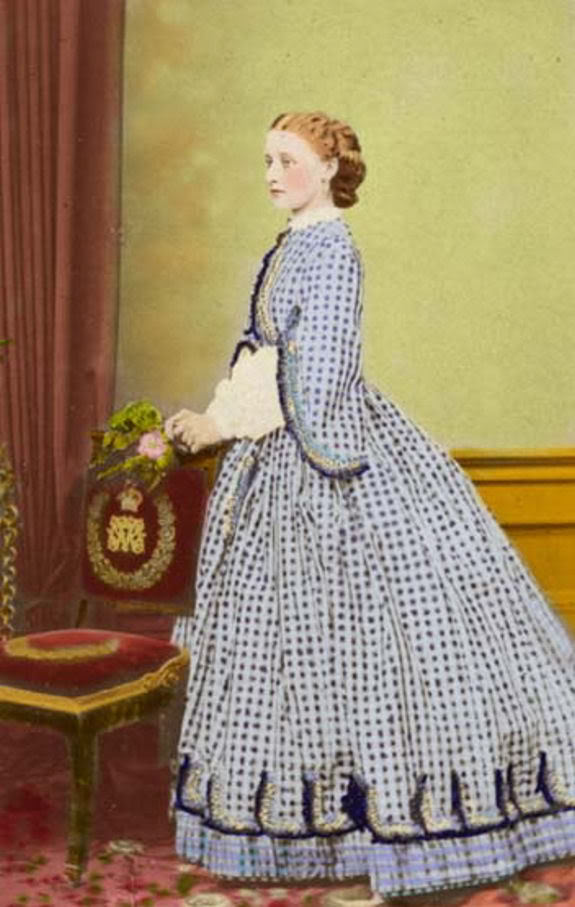
Fotografia colorata di Princess Louise risalente ai primi anni '80 by The Society Photographer Alexander Bassano
~ INCANTEVOLE, MA INCOMPRESA ~
Soprannominata "la nouvelle" dai suoi fratelli, Princess Louise, sestogenita e quarta femmina nata dalla real coppia britannica, ovvero dalla felice unione della Regina Victoria con il Principe Albert, Louise Caroline Alberta venne alla luce il 18 marzo del 1848, un anno particolarmente incandescente in cui ribellioni e moti rivoluzionari infervoravano l'intera Europa; considerata alla sua nascita la bellezza della famiglia,
Franz Xaver Winterhalter,1849 - A painting showing four of Queen Victoria's children. From left, Princess Alice, Princess Victoria, Princess Louise and Princess Helena
Miniatura by William Charles Ross (1794 – 1860), 1850.
dotata di intelligenza vivace e di talento artistico, fu messa in ombra dalla nascita dei fratelli minori, soprattutto dall'ultima nata, Beatrice, 'Little Bee' per la quale la regina mostrava una vera e propria predilezione.
The Royal Family.
Forse perché entrambi artisti, sia Victoria che Albert non vedevano l'inclinazione per le arti figurative che Louise, già durante le primissime lezioni, ricevute a partire dall'età di tre anni, palesava e che il royal tutor, Edmund Corbald non mancava di far notare; la sua crescente, marcata emotività la rendeva talvolta impacciata e Victoria cominciò a convincersi che la piccola fosse affetta da un qualche ritardo mentale e di questo rimase persuasa fino a che non la vide adulta, abile e talentuosa artista.
Sta di fatto che durate la sua infanzia Louise soffrì di questo disamore da parte della madre che spesso la lasciava in disparte rispetto agli altri royal children apostrofandola come 'Poor Louise' e crebbe consapevole di non essere del tutto normale come gli altri suoi fratelli.
Miniatura by William Charles Ross, (1794 – 1860), 1851.
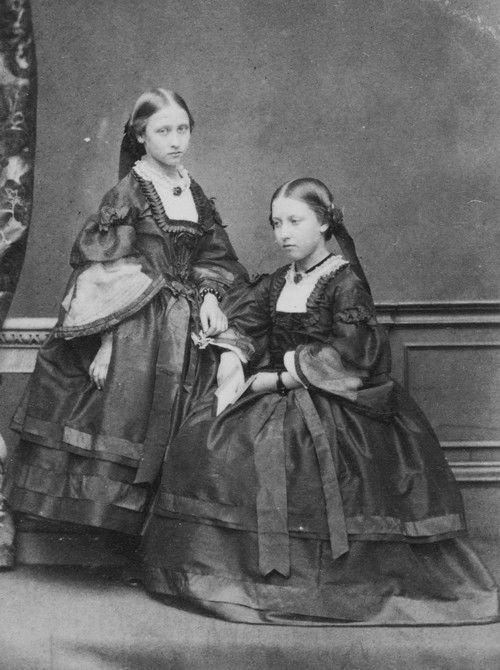
Helena Augusta Victoria and Louise Caroline Alberta, autore sconosciuto.
Helena Augusta Victoria e Louise Caroline Alberta in 1858 (autore sconosciuto).
La morte improvvisa e prematura dell'amato padre, il Principe Albert, occorsa il 14 dicembre del 1861, rappresentò per tutti - ma soprattutto per la nostra piccola che, avendo solamente tredici anni, si trovava in periodo molto delicato della sua vita, non più bambina,
Princess Louise immortalata nell'autunno del 1861 dal pittore John Jabez Edwin Mayall.
non ancora adolescente - un vero trauma: tutti i royal children erano molto affezionati al padre forse anche perché, più lontano dalle tensioni e dalle responsabilità che turbavano la regina rendendola spesso scontrosa e fredda, egli era colui che era emotivamente più vicino ai figli e che concedeva loro più tempo, attenzioni ed affetto.
Princess Louise and Princess Helena vestite a lutto per il Natale del 1861.
Victoria, ignara che i suoi piccoli potessero essere turbati e soffrire non meno di lei, anzi, assolutizzava il suo dolore, lo mostrava e lo viveva come esclusivo, il lutto era solo suo, palesava scarsa pazienza e disponibilità nei confronti dei figli, dai quali, invece, avrebbe potuto trarre il dovuto conforto data la perdita che li accomunava ( solo la sua Little Bee la risollevava dal suo dolore, ella la avvolgeva nella vestaglia del defunto marito e la poneva a dormire accanto a sé la sera ).
Princess Louise, Ghémar Frères photography, October 1862,
Royal Collection Trust /© Her Majesty Queen Elizabeth II 2014.
Il quattordicesimo compleanno rappresentò per Louise un lieto evento, la sua amabile cognata, la Principessa del Galles Alexandra, moglie del fratello maggiore Bertie, sposatosi poco dopo la scomparsa del padre, arrecando in tal guisa l'ennesimo dolore per la regina, era divenuta la sua migliore amica, confidente ed affezionata sostenitrice ed aveva così trovato, all'interno dell'entourage familiare, visto che nulla al di fuori le era concesso, una figura benevola e favorevole che la incoraggiava a perseguire la sua arte,
Princess Louise, painting by Albert Gräfle (1809 - 1899), 1864,
Royal Collection Trust /© Her Majesty Queen Elizabeth II 2014.
la scultura, ed aveva sedici anni quando presentò quale dono per il compleanno della piccola Bee un busto che la ritraeva e che lasciò la regina letteralmente senza parole, appunto perché ignara del suo talento che stava continuando a coltivare:
Louise's bust of Baby is charming and so like. 1
~1866 - '67, GLI ANNI DEL MISTERO: la famiglia Locock ~
Colpita da una grave malattia che risultava quasi sempre fatale per chi aveva la disgrazia di contrarla, la meningite tubercolare, ma da cui riuscirà a rimettersi, senza riportare danno alcuno, all'età di diciotto anni venne accusata dalla madre di aver avuto una relazione amorosa da cui sarebbe nato un figlio da Walter Stirling, tutore del fratello Leopold,
Siblings - Prince Leopold and Princess Louise, 1866.
affetto da emofilia e perciò bisognoso di continue attenzioni, e di accattivarsi, in seguito, le simpatie del reverendo Duckworth che aveva assunto l'incarico al suo posto dopo che Stirling era stato allontanato dalla corte, per farsi maritare e nascondere così il misfatto. ( Dovete sapere che nell'Inghilterra vittoriana l'abbandono di un figlio oppure il darne alla luce uno illegittimo era per una donna non solo disdicevole, ma perseguibile legalmente e punibile con l'impiccagione )
Erano quelli gli anni 1866-67 e la moda, a quel tempo, consentiva con una certa facilità, tanto di enfatizzare quanto di occultare le forme del corpo femminile, bastava una mantella, uno scialle, una gonna dalla vita un po' più larga e tenuta nascosta per celare una gravidanza .. e comunque di ciò è impossibile trovare conferma nei memoirs della regina, trascritti e rielaborati da Beatrice secondo le indicazioni che dette la regina prima di lasciare questa sua vita.
Louise era abile nel cucire, si confezionava da sé gli abiti, in quel periodo non voleva che nessuno del personale di servizio l'aiutasse nel vestirsi e sul finire dell'anno 1866 presenziava scarsamente in pubblico ( prenderà parte solamente ad un ballo nell'autunno del 1866 in costume scozzese coperta generosamente da uno scialle in tartan ) e quando era obbligata a mostrarsi al suo popolo rimaneva seduta in carrozza; era inoltre molto malinconica come testimoniano due lettere che ella scrisse quell'estate ed nel dicembre seguente ad un'amica:
Era nel luglio 1866 ( quando avrebbe dovuto essere stata incinta di Henry ....) che Louise scrisse la lettera a Louisa Bowater in cui confessava di essere "a terra e triste". La lettera continuava:
'[Io] siedo nella mia stanza e piango. Non posso scrivere e dire perché, ci sono tante cose non dovrebbero essere come sono ... si aspettano che sia d'accordo con loro, ma non riesco a quando so che una cosa è sbagliata'.
Nel mese di dicembre scrisse nuovamente alla sua amica, 'Sono spesso triste, ma non voglio mai che gli altri lo vedano.'
Nell'autunno del 1867, Prince Arthur scrisse una lettera alla sorella. Doveva essere nei guai per aver citato un argomento tabù e ora scrive per spiegare: 'Per quanto riguarda il grande segreto, non sapevo che non potevo farne menzione a te, naturalmente non ne parlerei con chiunque altro.' 2
e dalle poche righe che ricevette un anno più tardi dalla sua amabile cognata Alix, Principessa del Galles ...
Il 1 dicembre 1867 Alix inviò a Louise un'affetuosa lettera da Sandringham, in cui scrisse:
'Mio povero piccolo cucciolo, temo non te la stia passando molto bene ultimamente'.
Se, come Henry avrebbe attestato più tardi, rimase con la madre principessa Louise all'inizio della sua vita, Alix avrebbe inviato la sua lettera proprio mentre Louise stava facendo i preparativi per separarsene. 3
Ed erano quelli gli anni in cui divenne importante per la vita di Louise il nome della famiglia Locock ...
Con il finire dell'anno 1867 Frederick, uno dei figli di Sir Charles Locock,
Sir Charles Locock, 1862.
ginecologo della regina, decide di maritarsi improvvisamente ed adotta un bimbo, che chiamerà Henry, il giorno dopo aver ricevuto la visita di Lady Stirling, madre del luogotenente Walter Stirling ( che del supposto bimbo illegittimo sarebbe stata la nonna ) e riscuote misteriosamente un sostanzioso vitalizio da parte della principessa Louise, somma che aumenterà cospicuamente nel 1911 di conseguenza alla sua morte, tanto da raggiungere la cifra di una vera fortuna, ovvero le £100,000.
Tuttora, Nick Locock, nipote di Henry, custodisce un busto che ritrae un bimbo che poteva avere circa un anno nel 1867 fatto e donato in quei giorni dalla principessa Louise sul cui scrittoio, ancor oggi, possiamo trovare esposta la fotografia di un bimbo di cui non si conosce l'identità.
Secondo i Lococks, Louise continuò con il seguire e visitare Henry per tutta la sua infanzia: la principessa era nota infatti per adorare trascorrere l'estate nella sua casa di campagna di Dornden nel Kent ...e secondo voi era davvero un caso che la casa accanto fosse di proprietà di Sir Charles Locock e che il piccolo Henry con i suoi genitori adottivi fossero ospiti abituali ?
Apro una breve parentesi per tornare ai giorni nostri, ed esattamente all'anno scorso, il 2014, quando Nick Locock ha portato in tribunale un caso giudiziario a tal proposito, poichè non essendo l'unico discendente di Henry cui fu detto che la sua madre naturale era la principessa Louise, ma era risaputo anche presso i suoi undici cugini, chiese l'esumazione del corpo dell'antenato per effettuare il prelievo di un campione di osso dallo scheletro in modo da poter fare effettuare l'esame del DNA e quindi confrontarlo con quello di uno dei facenti parte la casa reale, ma il permesso gli è stato negato, poiché essendo questi stato sepolto in suolo consacrato l'esumazione avrebbe rappresentato una violazione della sacralità di tale sepoltura.
~ SPOSA DELL'ARTE, MARCHESA DI LORNE E FINALMENTE LIBERA ~
Louise torna alla vita in discreta salute, riprendendo anche le sue abitudini protocollari, quando la regina finalmente, su sprone della scultrice di corte, Mary Thornycroft, acconsente che l'artista di famiglia frequenti una scuola pubblica per affinare le sue abilità, trattandosi della scuola d'arte fondata dal Principe Albert che avendo progettato e promosso la Great Exibition - la Grande Esposizione del 1851 ed essendo completamente responsabile dei proventi che da essa erano stati ricavati, decise di investirli per intero in opere che promuovessero la cultura ed il progresso sociale; si trattava della National Art Training School dove insegnava il famoso scultore Sir Joseph Edgard Boehm, di natali viennesi ma di origine ungherese,
Biglietto da visita di Sir Joseph Edgard Boehm, 1860.
ed era proprio questo che voleva la regina, che Louise diventasse sua alunna.
Dopo un periodo di studio in Inghilterra, egli ebbe un tale come espositore alla Great Exibition del 1862 che decise di dedicare più tempo a busti e alle piccole statue, soprattutto di tema equestre, si trasferì in Inghilterra nel 1862, e divenne suddito britannico tre anni dopo. Una colossale statua della regina Vittoria, scolpita su marmo per Windsor Castle (1869) ed il monumento del Duca di Kent in St.George Chapel furono le sue prime grandi opere, così completamente rispondenti al gusto dei suoi protettori reali che aumentò notevolmente e rapidamente la stima ed il favore che la Corte aveva per lui tanto che recano la sua firma anche una serie di monete fate appositamente coniare per celebrare il Royal Jubilee nel 1887.
E così fu, Louise non solo divenne alunna di Boehm, ma i due divennero partner, nel lavoro, ed, ahimè, anche nella vita ed essendo egli maritato, non appena Victoria fu assalita dal sospetto di tale relazione venne indotta a cercare quanto prima un marito per 'Loosy' la figlia che sempre più le creava problemi, non meno dell'erede al trono al quale, non a caso era così tanto simile per indole.
Sir Joseph Edgard Boehm e Princess Louise ritratti nel 1885 ca.
Ella non voleva essere allontanata dalla sua terra e perciò acconsentì a sposare una persona che non appartenesse a case regnanti europee, cosa che l'avrebbe indotta ad andare a risiedere nella patria della suocera; la regina non era del tutto contraria, in quel momento storico stabilire della alleanze ed indovinarle era un atto di estrema delicatezza giacché il conflitto Franco-prussiano che era in pieno svolgimento aveva del tutto alterato gli equilibri politici del vecchio continente.
Si fecero avanti l' VIII Duke of Argyll e sua moglie, appartenenti al clan dei Campbell, nelle Higlands, proponendo come sposo per la principessa il figlio John George, Marchese di Lorne;
Victoria non fu del tutto contrariata e si preparò per celebrare, dopo 1515 anni, l'unione tra di una principessa di sangue reale ed un suddito, anche se nobile (tanti infatti ne erano trascorsi da che Mary Tudor sposò il I Duke di Suffolk).

Foto ufficiale del fidanzamento della Principessa Louise con il Marchese di Lorne.
A portrait of Princess Louise before her marriage.
Copyright 2012 - 2014 by the Cascapedia River Museum.
Il matrimonio tra Princess Louise Caroline Alberta e John George Edward Henry Douglas Sutherland Campbell ebbe luogo il 21 marzo 1871 nella St.George Chapel a Windsor Castle
The Wedding of Princess Louise and the Marquess of Lorne, Prior Hall, c1878.
Royal Collection Trust / © Her Majesty Queen Elizabeth II 2014.
Princess Luise in abito da sposa.
Princess Louise’s wedding veil, which she designed herself.
Royal Collection Trust / © Her Majesty Queen Elizabeth II 2014.
e la coppia cominciò la propria luna di miele a Claremont House, nel Surrey, un grazioso edificio in stile palladiano costruito nel 1774 il cui parco fu progettato da tra gli altri dal ben noto e prestigioso Capability Brown.
Michel Charles Fichot (1817-1903), Visite à Claremont House.
Questo matrimonio, più di convenienza che d'altro, con una uomo colto e simpatico ma che gradiva più la compagnia del sesso maschile che di quello femminile, diede la possibilità a Louise di conservare la propria libertà, di continuare a frequentare Boehm ( il quale morirà per un aneurisma proprio facendo l'amore con lei nel suo studio di Fulham, a Londra, il 12 dicembre del 1890, cosa che spaventò la principessa al punto che, da allora, si dice, non ebbe più amanti ) e di praticare i membri della confraternita artistica dei Pre-Raphaelites e dell'Art and Craft Movement, facenti parte dell'estetismo vittoriano londinese.
Nel 1878 il Primo Ministro Britannico Disraeli scelse il Marchese di Lorne quale Nuovo Governatore Generale del Canada e Louise divenne Consorte di un Vicerè non appena questi fu immediatamente insignito dell'incarico dalla regina; il 25 novembre approdarono ad Halifax e Louise fu la prima a risiedere a Rideau Hall, la residenza reale ufficiale ad Ottawa.
I Canadesi serbano ancora oggi cari ricordi della bella principessa dal cuore gentile, sempre disponibile ed animata da estrema umiltà, che amava pattinare sui loro ghiacci e pescare salmoni nei loro fiumi ( [...] nell'autunno del 1879, una nave di ritorno a Liverpool dal Canada fu fornita con una partita di 'nove bellissimi salmoni' catturati dalla principessa Louise e inviati come regalo per la madre, i fratelli ed ogni membro della famiglia reale. ) 4
Si può dire che il matrimonio resse grazie alle frequenti separazioni poichè spesso Louise tornava in patria; nel 1892 entrambi fecero ritorno a Kensington Palace poichè egli ricevette la nomina di Constable di Windsor Castle nel 1892; dal 1895 sedette alla Camera dei Comuni quale deputato per il South Manchester ed 24 aprile 1900, alla morte del padre, divenne il IX°Duke of Argyll.
Louise, divenuta Duchess of Argyll,
Qui la vediamo magnificamente abbigliata il giorno dell'incoronazione di suo fratello quale re Edoardo VII il 9 agosto 1902.
male sopportò la perdita del marito, avvenuta nel 1914, nonostante il loro fosse un matrimonio molto anticonvenzionale, e continuò a soggiornare nelle sue stanze a Kensington Palace dedicandosi ad opere di beneficenza e di promozione dei diritti femminili fino a che il 3 dicembre del 1939 si spense per complicazioni polmonari.
Una fotografia di Princess Louise mentre attraversa il Cascapedia River sul traghetto.
Copyright 2012 - 2014 by the Cascapedia River Museum
Un'immagine di Princess Louise mentre pesca sulle rive del Cascapedia River.
Copyright 2012 - 2014 by the Cascapedia River Museum
Il Canada volle rendere onore alla principessa Louise istituendo e dedicandole, nel 1905, la Provincia dell'Alberta ( il suo nome era per intero Louise Caroline Alberta ), sita nel territorio sud occidentale tra la Columbia Britannica ed il Saskatchewan, il suo lago, Lake Louise, la cittadina di Caroline ed una delle vette più alte delle sue Montagne Rocciose il Mount Alberta.
Ringrazio sentitamente Lucinda Hawksley autrice della bellissima e coinvolgente biografia della principessa Louise intitolata The Mystery of Princess Louise: Queen Victoria's Rebellious Daughter da cui ho attinto queste preziose e recenti nuove e come sempre tutti voi, per l'affetto con cui sempre seguite ~ My little old world ~.
A presto ♥
Bibliografia:
The Mystery of Princess Louise: Queen Victoria's Rebellious Daughter,
Chatto & Windus, Vintage Books, LONDON, UK, 2014
Citazioni:
1 - Lucinda Hawksley, The Mystery of Princess Louise: Queen Victoria's Rebellious Daughter, op. cit., pag. 65;
2 - Ibidem, pag. 91;
3 - Ibidem, pag. 89;
4 - Ibidem, page 179.
- picture 1 - Colored photograph of Princess Louise from the early '80s by The Society of the Photographer Alexander Bassano
~ LOVELY BUT NEGLECTED ~
Nicknamed "la nouvelle" by her siblings, Princess Louise, the sixth children and fourth daughter born of the Royal British couple, ie from the happy marriage of Queen Victoria to Prince Albert, Louise Caroline Alberta was born on March 18th, 1848, a particularly incandescent year when rebellions and uprisings lighted the whole Europe; considered at its birth the beauty of the family,
- picture 2 - Franz Xaver Winterhalter,1849 - A painting showing four of Queen Victoria's children. From left, Princess Alice, Princess Victoria, Princess Louise and Princess Helena
- picture 3 - Miniatura by William Charles Ross (1794 – 1860), 1850
with lively intelligence and artistic talent, she was overshadowed by her younger siblings, especially the last born, Beatrice, 'Little Bee' for whom the queen showed a real fondness.
- picture 4 - The Royal Family
Perhaps because both artists, Victoria that Albert didn't see the inclination for the arts that Louise, already during the first few lessons, receipts from the age of three, revealed, and that the royal tutor, Edmund Corbald, never failed to make note; her growing, strong emotional character made her sometimes awkward and Victoria began to be convinced that the little girl was suffering from some mental retardation and of this remained convinced until she saw her as a adult, able and talented artist.
The thing is that during her childhood Louise suffered from this lack of love by the mother who often left her aloof than the other royal children calling her 'Poor Louise' and grew conscious of not being completely normal like the other siblings of hers.
- picture 5 - Miniatura by William Charles Ross, (1794 – 1860), 1851
- picture 6 - Helena Augusta Victoria and Louise Caroline Alberta ( unknown author )
- picture 7 - Helena Augusta Victoria and Louise Caroline Alberta in 1858 (unknown author)
The sudden and untimely death of the beloved father, Prince Albert, which occurred on December 14th,1861, was for everyone - but especially for our little Louise who, being only thirteen, was in a very delicate moment of her life, not more baby girl,
- picture 8 - Princess Louise portrayed in the Autumn of the year 1861 by John Jabez Edwin Mayall
not yet a teenager - a real trauma: all royal children were very fond of their father perhaps because, far away from the tensions and the responsibilities that troubled the Queen making her often surly and cold, he was the one who was emotionally closer to the children granting them more time, attention and affection.
- picture 9 - Princess Louise and Princess Helena in mourning dress for Christmas of 1861
Victoria, unaware that her children could suffer not less than her, indeed, thought her pain to be utter, she showed it and lived it as exclusive, the mourning was only hers, revealing just a little of patience and disposability to their children, from which instead, she could have taken the due comfort because of the loss they were sharing (just her Little Bee was able to relieve her grief, she enveloped her baby in the robe of her late husband and put her to sleep next to her at night).
- picture 10 - Princess Louise, Ghémar Frères photography, October 1862, Royal Collection Trust /© Her Majesty Queen Elizabeth II 2014.
The fourteenth birthday was for Louise a happy event, hes lovely sister-in-law, the Princess Alexandra of Wales, wife of her elder brother Bertie, who married soon after the death of his father causing in this way yet another pain for the Queen, had become her best friend, a confidant and a loyal supporter within the family entourage, since nothing outside she was allowed, a benevolent and favorable figure who encouraged her to pursue her art,
- picture 11 - Princess Louise, painting by Albert Gräfle (1809 - 1899), 1864, Royal Collection Trust /© Her Majesty Queen Elizabeth II 2014
sculpture, and she was sixteen when she presented as a gift for the birthday of the Little Bee a bust portraying the baby leving the Queen literally speechless, just because she was unaware of her talent that was continuing to grow:
Louise's bust of Baby is charming and so like 1
~ 1866 - '67, THE YEARS OF MYSTERY: the Locock family ~
Struck by a serious illness that was almost always fatal for those who had the misfortune of contracting it, the tuberculous meningitis, but which she was able recover, without suffering any harm, at the age of eighteen Louise was accused by her mother of having an affair with Walter Stirling, his brother Leopold's tutor, relationship from which was going to born a child,
- picture 12 - Siblings - Prince Leopold and Princess Louise, 1866
ill of haemophilia and therefore in need of constant attention, and to try to conquer, then, the Reverend Duckworth which had been appointed in his place after that Stirling had been dismissed by the Court, to get marry and hide thus her wrongdoing. (You should know that during the Victorian age the abandonment of a child or to give birth to the illegitimate one was for a woman not only unbecoming, but actionable by law and punishable by hanging)
- picture 13
Those were the years 1866-67 and fashion, at that time, allowed, with a certain ease, both to emphasize and to hide the shape of the female body: it was enough a cape, a shawl, a skirt from the waist a little wider to keep hidden a pregnancy ... and anyway it's impossible to find a confirmation of it in Queen's memoirs, transcribed and processed by Beatrice according to the indications that her mother gave her before leaving this life.
Louise was good at sewing, she sewewd by herself her clothes, at that time she didn't want anyone of the servitude to help her in dressing up and at the end of the year 1866 she was seen quite seldom in public (she took part in a dance during the fall of 1866 in Scottish costume generously covered by a tartan shawl) and when she was obliged to show herself to her people she remained seated in her carriage; she was also very sad as evidenced from two letters she sent that summer and that winter to a friend of hers:
It was in July 1866 ( when she would have been pregnant with Henry .... ) that Louise wrote the letter to Louisa Bowater in which she confessed to be "low and sad". The letter went on:
'[ I ] sit in my room and cry. I cannot write and tell you why, there are so many things ought not to beas they are ... I'm expected to agree with them, and yet I cannot when I know a thing to be wrong.'
In December she wrote to her friend again,'I am often sad, but I never let them others see that I am.'
In the autumn of 1867, Prince Arthur wrote a letter to his sister. He had to be in trouble for mentioning a taboo subject and he now wrote to explain: 'As to the great secret, I did not know that I could not mentioning it to you, of cours I would not speak of it to anybody else.' 2
and from a few lines she received one year later from her amiable sister-in-law Alix, princess of Wales ...
On 1 December 1867 Alix sent a sympathetic letter to Louise from Sandringham, in which she wrote:
'My poor little pet I'm afraid you have not been enjoying yourself so very well lately'.
If, as Henry would later attest, he remained with his mother princess Louise at the start of his life, Alix's letter would have been sent as Louise was preparing to give him up. 3
And those were the years when it became important for the life of Louise the name of the Locock family ...
By the end of 1867 Frederick, a son of Sir Charles Locock,
- picture 14 - Sir Charles Locock, 1862
gynecologist of the Queen, suddenly decides to marry and to adopt a baby who will call Henry, the day after receiving the visit of Lady Stirling, mother of the Lieutenant Walter Stirling (who's supposed to be the illegitimate child's grandmother) and mysteriously he receives a substantial annuity by Princess Louise, a sum that will increase conspicuously in 1911 as a result of his dye, much to reach the amount of a real fortune, that is to say £ 100,000.
Still today, Nick Locock, Henry's grandson, holds a portrait bust of a child who could be one year or so in 1867 and which was made and donated by the Princess Louise in those days and, when we vsit her room, we can find on her desk a photograph of a child about whose identity we do ignore.
According the Lococks, Louise continued with following and visiting Henry throughout his whole childhood: the Princess was in fact known to worship spending the summer in her home country of Dornden in Kent ... and do you think it was really a case that the house next door was owned by Sir Charles Locock and that the little Henry with his adoptive parents were regular guests?
I open a brief parenthesis to return to the present days, and exactly to last year, 2014, when Nick Locock brought to court a legal case in this regard, because he's not the only descendant of Henry whom it was told that his natural mother was Princess Louise, but it was well known even by his eleven cousins; he asked the exhumation of the body of the ancestor to carry out the removal of a sample of a bone from his skeleton for analyzing its DNA and then to compare it with that of a member of the royal house, but this permission was denied, since he was buried in consecrated ground and his exhumation would represent a violation of the sanctity of this kind of burial.
~ BRIDE OF ART, MARCHIONESS OF LORNE AND FINALLY FREE ~
Louise comes back to life in reasonably good health, also taking back her habits of protocol, when the Queen finally, on a spur of the sculptor of the Court, Mary Thornycroft, agrees that the family's artist attends a public school to hone her skills, since the school of art was founded by Prince Albert who, having designed and promoted The Great Exhibition of 1851 and being fully responsible for the proceeds that it had been obtained, he decided to invest them entirely in works promoting culture and social progress; it was The National Art Training School where the famous sculptor Sir Joseph Edgar Boehm taught, native Viennese but of Hungarian origin,
- picture 15 - Carte de Visite of Sir Joseph Edgard Boehm, 1860
and it was just him that the Queen wanted, so as Louise would have become his pupil.
After a period of study in England, he had such a seccess when he exhibit at the Great Exhibition of 1862 that he decided to devote more time to busts and small statues, especially themed equestrian, moved to England that same year, and became a British subject three years after.
A colossal statue of Queen Victoria, carved on marble for Windsor Castle (1869) and the monument of the Duke of Kent in St.George Chapel were his first major works, thus fully satisfying, with them both, the real taste of his patrons which increased significantly and quickly the esteem and the favor that the Court had for him so that bear his signature also a series of coins specially minted to celebrate the Royal Jubilee in 1887.
And so it was, Louise became not only a Boehm's pupils, but the two became partners in the work, and, alas, also in their life and being he married, when Victoria was attacked by the suspected of this relationship was induced to find, as soon as possible, a husband for 'Loosy', the daughter who more and more created problems to her, not least of the heir to which, not coincidentally, she was so similar in her character.
- picture 16 - Sir Joseph Edgard Boehm e Princess Louise ritratti nel 1885 ca.
Louise didn't want to leave her Land and therefore agreed to marry someone who didn't belong to royal families of Europe, which would have caused her to go to reside in the home of the new mother-in-law; the Queen was not quite to the contrary, at that historic moment establishing alliances and to guess them was an act of extreme delicacy since the Franco-Prussian war, which still was in full swing, had completely altered the political balance of the old continent.
They came forward the VIII Duke of Argyll and his wife, belonging to the clan of Campbell, in the Highlands, proposing as husband for the Princess their son John George, Marquis of Lorne;
- picture 17
Victoria was not entirely displeased and got ready to celebrate, after 1515 years, a marriage between a Princess of royal blood and a subject, although noble (so many years had indeed passed since that Mary Tudor married the Duke of Suffolk)
- picture 18 - Official photo of the engagement of Princess Louise and of the Marquis of Lorne
- picture 19 - A portrait of Princess Louise before her marriage. Copyright 2012 - 2014 by the Cascapedia River Museum.
The marriage of Princess Louise Caroline Alberta, and John George Edward Henry Douglas Sutherland Campbell took place on March 21st, 1871 in the St.George Chapel in Windsor Castle
- picture 20 - The Wedding of Princess Louise and the Marquess of Lorne, Prior Hall, c1878. Royal Collection Trust / © Her Majesty Queen Elizabeth II 2014
- picture 21 - Princess Luise in her wedding dress
- picture 22 - Princess Louise’s wedding veil, which she designed herself. Royal Collection Trust /
© Her Majesty Queen Elizabeth II 2014
and the couple began their honeymoon in Claremont House, Surrey, a lovely Palladian style building built in 1774 whose park was planned and landscaped, among the others, by the well-known and prestigious Capability Brown.
- picture 23 - Michel Charles Fichot (1817-1903), Visite à Claremont House
This marriage of convenience, more than anything else, with a cultured and very nice man who enjoyed the company of males more than females, gave Louise the opportunity to preserve her freedom, to continue to attend Boehm (who died from an aneurysm just making love with her in his studio in Fulham, London, 12 December 1890, fact that frightened the Princess to the point that, since then, it is said, she won't have lovers anymore) and to spend most of her time with the members of the brotherhood of the Pre-Raphaelites and The Art and Craft Movement, part of Aestheticism of the Victorian London.
- picture 24
In 1878, the British Prime Minister Disraeli chose the Marquis of Lorne as New Governor-General of Canada and Louise became a Viceroy's Consort as soon as they were appointed by the Queen; on November 25th they landed to Halifax and Louise was the first to reside at Rideau Hall, the official royal residence in Ottawa.
Canadians still preserve cherished memories of the beautiful princess kind-hearted, always helpful and animated by extreme humility, who loved to skate on their ice and to catch salmon in their rivers. ( [...] in autumn 1879, a ship returning to Liverpool from Canada was entrusted with a consignment of 'nine fine salmon' caught by Princess Louise and sent as a gift to her mother, siblings and member of the royal household.)4
It can be said that this marriage lasted thanks to the frequent separations of the partners as often Louise was coming back to London; both in 1892 they returned to Kensington Palace as he received the appointment of Constable of Windsor Castle in 1892; since 1895 he sat in the Commons as MP for South Manchester and April 24th, 1900, when his father died, he became the IX Duke of Argyll.
Louise, became Duchess of Argyll,
- picture 25 - Here we can see her, beautifully dressed, the day of the coronation of her brother as King Edward VII on August 9th, 1902
sadly accepted the loss of her husband, in 1914, although their marriage was very unconventional, and continued to dwell in her rooms in Kensington Palace devoting herself to works of charity and of promotion of women's rights until December 3rd,1939 when she died from pulmonary complications.
- picture 26 - A photograph of Princess Louise crossing the Cascapedia River by ferry.
Copyright 2012 - 2014 by the Cascapedia River Museum
- picture 27 - A picture of Princess Louise fishing along the banks of the Cascapedia River. Copyright 2012 - 2014 by the Cascapedia River Museum
Canada wanted to honor Princess Louise establishing and dedicating, in 1905, the Province of Alberta (her name was entirely Louise Caroline Alberta), located in the area between the south western territories, that is to say British Columbia and Saskatchewan, its lake, Lake Louise, the town of Caroline and one of the highest peaks of their Rocky Mountains, Mount Alberta.
I fondly thank Lucinda Hawksley author of this so beautiful biography titled The Mystery of Princess Louise: Queen Victoria's Rebellious Daughter from which I draw all these valuable and recent news and as usual all of you for the affection with which always follow ~ My little old world ~.
See you soon ♥
Bibliography:
Lucinda Hawksley,
The Mystery of Princess Louise: Queen Victoria's Rebellious Daughter,
Chatto & Windus, Vintage Books, LONDON, UK, 2014
Quotations:
1 - Lucinda Hawksley, The Mystery of Princess Louise: Queen Victoria's Rebellious Daughter, op. cit., page 65;
2 - Ibidem, page 91;
3 - Ibidem, page 89;
4 - Ibidem, page 179.
This post is joining the link-up party at