Visualizzazione post con etichetta Spring. Mostra tutti i post

lunedì 1 maggio 2023

What did Spring-time whisper?


WHAT did Spring-time whisper?
O ye rivulets,
Waking from your trance so sad,


Pleased to welcome fisher-lad
With his little nets,
Speed, for summer's in the air,


Prattle, for the breeze is warm,
Chatter by the otter's lair,
Bubble past the ivied farm;


Wake the primrose on the banks,
Bid the violet ope her eyes,
Hurry in a flood of thanks


Underneath serener skies!
What a revel's coming soon—
Fairies trooping o'er the leas,
Making magic by the moon,


Crowned with wood anemones!
What a haunted heart the thrush
Nurses in the blackthorn bush,


Full of splendid songs to sing,
Cheery welcomes of the Spring—
Spring has come!

NORMAN ROWLAND GALE (1862-1942), 
Spring, Collected Poems, 1914


Dearest Friends and Readers,
may your days be filled with touches of Beauty, 
and may you enjoy sprinkles of Joy 
throughout this wonderful period of the year, 
that is full Spring.
See you soon ❤

P.S.: All the shots were taken inside Tenuta Geremia


COSA ha sussurrato la primavera?


1 - IMMAGINE DI COPERTINA - Piccolo cespo di anemoni di bosco


COSA ha sussurrato la primavera?
O voi fiumicelli,
Svegliatevi dal vostro triste torpore,


IMMAGINE 2 - Ansa del fiume che fa stagno 


Date lieti il benvenuto 
al giovane pescatore, 
che reca le sue piccole reti,
Presto, perché l'estate è nell'aria,


IMMAGINE 3 - Rivo


Mormorate, perché la brezza è tiepida,
Chiacchierate presso la tana della lontra,
Borbottate oltre la fattoria avvolta dall’edera;


IMMAGINE 4 - Cespuglio di primule


Svegliate la primula sulle sponde,
Ordinate alla viola di aprire gli occhi,
Affrettatevi in una marea di ringraziamenti


IMMAGINE 5 - Collage di viole


Sotto cieli più sereni!
Che festa si sta approssimando—
Fate si adunano sulle praterie,
A far magie al chiaror della luna,


IMMAGINE 6 - Anemoni di bosco che stanno per fiorire


Con il capo incoronato da anemoni di bosco!
Che cuore ammaliato ha il tordo,
Che cova nel cespuglio del prugnolo,


IMMAGINE 7 - Tordo nascosto tra un cespuglio di Ligustro e dell'Edera selvatica


Prodigo di splendide canzoni da cantare,
Gioiosi omaggi di benvenuto alla primavera—
La primavera è arrivata!

NORMAN ROWLAND GALE (1862-1942), 
Spring, Collected Poems, 1914


Carissimi Amici e Lettori,
possano i vostri giorni essere colmati da 'pizzichi' di Bellezza, 
e possiate godere di 'spruzzi' di Gioia 
per tutto questo incantevole periodo dell'anno, 
che è la primavera avanzata.
A presto ❤

P.S.: tutte le fotografie sono state scattate all'interno di Tenuta Geremia


Dany


LINKING WITH:


martedì 28 marzo 2023

⊰ Victorian Spring and Easter Traditions ⊱


For much of History, Easter was a more festive day then Christmas and, as it happened for this last one's traditions we still preserve today, the Victorians brought us also the evolution of Easter celebrations. No season was so celebrated as Spring as a promise of rebirth. 
Easter was just the beginning.


~ FLOWERING SUNDAY MADE CEMETERY BECOME FESTIVE ZONES ~

To be more precise, it all begaun with Flowering Sunday. In southern Wales and nearby portions of England, Palm Sunday is called 'Sul y Blodau' ('Flowering Sunday') and it is traditional to decorate graves with flowers on that day, especially in the industrial towns and villages. Scholars Alan and Karen Jabbour have postulated that Flowering Sunday might be connected to Appalachian cemetery decoration traditions. 


Dressing the grave with flowers by Thomas Onwyn (1853)


Welsh cemetery whitecleaning and decoration traditions may have begun as an Easter celebration or seasonal rite before becoming more commonly associated with Palm Sunday.
The Early Tourists in Wales website catalogues tourists’ comments about Wales from 18th and 19th century books, magazines, newspapers and elsewhere. According to Early Tourists in Wales, by the middle of the 19th century, Flowering Sunday attracted large crowds:
“The number of visitors reported to have visited the cemeteries were very large (10,000 to the new cemetery in Cardiff in 1879, 20,000 in 1889 and 50,000 in 1898; 25,000 to Swansea cemetery in 1906). There were problems with crowd control resulting in the need for extra police or the distribution of tickets only to those visiting relatives’ graves. The demand for flowers for this custom was so great that they were sent from London.”
Cemeteries begun a place where to meet in and where to gather for a party or a Spring pic-nic.
It might seem strange from our perch in the present to imagine cemeteries as a party site. But they offered a popular destination for picnics at a time before parks were created for urban populations. Pic-nics were very popular on holidays especially Easter or Easter Monday.


 ~ EASTER DECORATIONS ~

As for churches where people attended Easter services they would be decorated with flowers, as were homes. Women in particular would create lace and beadwork in floral designs in order to cover their tables and shelves and dressed their homes with wreats, branches of blossoming trees or bunches of flowers: they tended to be simple yet beautiful ones such as lilacs, lilies, pansies and tulips.

 ~ EASTER GREETING CARDS ~ 

It was the very beginning of the Victorian age when Sir Rowland Hill created the Uniform Penny Post meaning: in fact January 1840 marked the advent of the Uniform One Penny Postage Rate. Since then cards became a more economical way of staying in touch than ever, especially around Easter time.


Greetings cards featuring symbolic images such as the cross or spring imagery such as lambs and bunnies were distributed. They tended to be printed on brightly coloured paper in order to emphasise the happy and lively nature of spring. People either bought the cards at a cheap price or made their own ones.


 ~ HAVING FUN WITH DYEING, ROLLING AND HUNTING FOR EGGS ~ 

Whilst eggs had always been distributed between people, chocolate eggs were properly introduced around the Victorian era. The famed chocolatier John Cadbury was already releasing them in 1842, but in 1875 in particular, his company released the Cadbury’s Creme Egg. 


An Easter Holiday, the Children of Bloomsbury Parochial School in a Wood at Watford 
by James Aumonier, 1874


The tradition of the Easter egg hunt and egg roll was introduced from Germany to England during the Victorian era. Children still hunt for colorful eggs, with the one with the most declared the winner, often going home with a prize. Egg rolling involves children rolling eggs down hillsides to see who can roll their egg the farthest. Eggs were often given up for Lent, so the eggs used in the hunt and rolling were eaten on Easter Sunday. 
Of course, eggs had to be dyed days before: in order to make different colors eggs were boiled with leaves or onions. They  got red ones by boiling them with onion skins and beetroot, gold with marigold flower, violet with mallow flower, and green with periwinkle leaves.
During the early Victorian age also cardboard eggs were often lined with bits of satin and contained little sweet treats. 


 ~ EASTER BONNETS AND EASTER PARADE ~

The Easter parade as we know it today has its origin in the Victorian era, too. Victorians were devout, and after attending Easter services, were known to stroll through the streets showing off their spring finery. The tradition of the Easter bonnet, born during the Regency period,  became very popular during this age. (HERE you may read My little old world's post about it) 


During Victorian times, a beau might give a pair of gloves to his sweetheart. If she wore them during the parade, it was considered an announcement of her acceptance of his proposal.
One of the biggest Easter parades takes place still today in New York City, where it has been part of the spring tradition for more than 100 years. Fifth Avenue from 49th to 57th Streets plays host from 10 a.m. to 4 p.m. on Easter Sunday to the biggest stroll of finery, including some very fancy bonnets.


~ EASTER MEAL ~

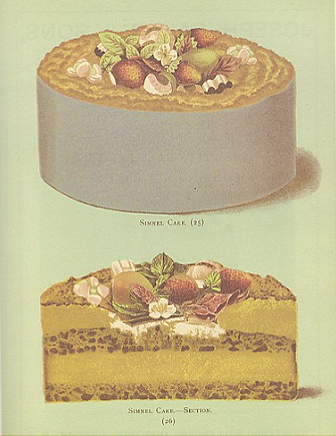
Easter meals were also a popular Victorian tradition. As we have seen at the very beginning of this reading, Easter was for many centuries far more important than Christmas. And thus it was at table too. Chief among the food associated with it in Great Britain in the XIXth century were new season lamb, paired with vegetable dishes (Pray, today let's pay respect to our lambs!). Accompanying them were hot chocolate buns and Easter breads. Additionally, egg dishes were served so as to not waste eggs from the easter egg hunts. As for cakes, particular favourite of the Victorians was the SIMNEL CAKE, 


The Victorian Book of Cakes: Treasury of Recipes, techniques and decorations from the golden age of cake-making: a classic Victorian book reissued for the modern reader 
by Lewis, T. Percy; Bromley, A. G.


a light fruit cake with eleven marzipan balls on top representing Jesus’ disciples (excluding Judas, who had infamously betrayed Jesus to the Romans).
By the way, we must say that in Avis' time it wasn't associated with Easter, but it was more a Mothering Sunday bake, being Mothering Sunday the fourth Sunday in Lent also named Refreshment Sunday of Lent, or Simnel Sunday – just after the cake. It was the day that children working away in service traditionally returned to their Mother Church and saw their families. Over the years Mothering Sunday has become a celebration of real mothers rather than the Mother Church, the largest church in the diocese. They were the Victorians who made of it the Easter Cake par excellence. Today Simnel Cake is enjoyed both on Easter Day and on Mothering Day. 


I'm leaving You with the best wishes for a serene remainder of your week
thanking You as usual for Your kindness and goodwill.
See you soon ❤


⊰ Tradizioni vittoriane legate alla primavera e alla Pasqua⊱ 


IMMAGINE DI COPERTINA - Da una cartolina pasquale tardo vittoriana

Per gran parte della storia la Pasqua è stata un giorno più festivo del Natale e, come è successo per le tradizioni di quest'ultimo che conserviamo ancora oggi, i vittoriani ci hanno portato anche l'evoluzione delle celebrazioni pasquali. Per loro nessuna stagione era celebrata come la primavera in quanto promessa di rinascita.
La Pasqua era solo l'inizio.


~ LA DOMENICA DELLA FIORITURA TRASFORMAVA I CIMITERI IN ZONE DI FESTA ~

Per essere più precisi, tutto cominciava con la Domenica della Fioritura. Nel Galles meridionale e nelle parti vicine dell'Inghilterra, la Domenica delle Palme è chiamata "Sul y Blodau" ("Domenica della fioritura") ed è tradizione decorare le tombe con fiori in quel giorno, specialmente nelle città e nei villaggi industriali. Gli studiosi Alan e Karen Jabbour hanno ipotizzato che la Domenica della Fioritura potrebbe essere collegata alle tradizioni di decorazione dei cimiteri tipica degli Appalachi.


IMMAGINE 2 - Dressing the grave with flowers di Thomas Onwyn (1853)


Le tradizioni di pulitura e decorazione dei cimiteri gallesi potrebbero essere iniziate come celebrazione pasquale o rito stagionale prima di diventare più comunemente associate alla Domenica delle Palme.
Il sito web Early Tourists in Wales cataloga i commenti dei turisti sul Galles da libri, riviste, giornali del XVIII e XIX secolo. Secondo Early Tourists in Wales, verso la metà del XIX secolo, la Domenica della Fioritura attirava grandi folle:
“Il numero di visitatori che hanno riferito di aver visitato i cimiteri era molto elevato (10.000 nel nuovo cimitero di Cardiff nel 1879, 20.000 nel 1889 e 50.000 nel 1898; 25.000 nel cimitero di Swansea nel 1906). Ci sono stati problemi con il controllo della folla che hanno portato alla necessità di polizia extra o alla distribuzione di biglietti solo a coloro che visitavano le tombe dei parenti. La richiesta di fiori per questa usanza era così grande che venivano inviati da Londra.
I cimiteri sono diventati un luogo dove incontrarsi e dove riunirsi per una festa o un pic-nic primaverile.
Potrebbe sembrare strano dal nostro punto di vista oggi immaginare i cimiteri come un luogo di festa. Ma essi offrivano una destinazione popolare per i pic-nic in un'epoca precedente alla creazione di parchi per le popolazioni urbane. I pic-nic erano molto popolari nei giorni festivi, specialmente a Pasqua o Pasquetta.


  ~ LE DECORAZIONI PASQUALI ~

Per quanto riguarda le chiese in cui le persone si recavano per le funzioni pasquali, esse venivano addobbate con fiori, così come lo erano le case. Le donne in particolare creavano pizzi e puntine con disegni floreali per coprire i loro tavoli e le loro mensole e vestivano le loro case con ghirlande, rami di alberi in fiore o mazzi di fiori: essi tendevano ad essere semplici ma, nella loro semplicità, belli come lillà, gigli, viole del pensiero e tulipani. 


~ I BIGLIETTINI AUGURALI ~

Era proprio l'inizio dell'era vittoriana quando Sir Rowland Hill creò il significato di Uniform Penny Post: infatti il gennaio 1840 segnò l'avvento dell'Uniform One Penny Postage Rate. Da allora le carte sono diventate un modo più economico che mai per rimanere in contatto, soprattutto nel periodo pasquale.


IMMAGINE 3 - Cartolina pasquale vittoriana


Venivano consegnati biglietti augurali con immagini simboliche come la croce o con immagini primaverili come agnelli e coniglietti. Essi erano generalmente stampati su carta dai colori vivaci per enfatizzare la natura felice e gioiosa della primavera. Le persone compravano le cartoline a un prezzo basso o ne creavano di proprie.


~ DIVERTIRSI TINGENDO, FACENDO ROTOLARE E CACCIANDO LE UOVA ~

Mentre le uova sono sempre state distribuite tra le persone, quelle di cioccolato sono state propriamente introdotte in epoca vittoriana. Il famoso cioccolatiere John Cadbury le aveva già progettate nel 1842, ma fu nel 1875 in particolare, che la sua azienda mise in commercio le Cadbury's Creme Egg.


IMMAGINE 4 - An Easter Holiday, the Children of Bloomsbury Parochial School in a Wood at Watford by James Aumonier, 1874


Le tradizioni della caccia alle uova di Pasqua e quella di farle rotolare lungo i pendii furono introdotte dalla Germania all'Inghilterra durante l'era vittoriana. I bambini vanno ancora a caccia di uova colorate, e quella che ne trova di più torna a casa vincitrice con un premio. Il rotolamento delle uova coinvolge i bambini che rotolano le uova lungo i declivi per vedere chi può rotolare il proprio uovo più lontano. Le uova venivano spesso non consumate durante la Quaresima, quindi le uova utilizzate nella caccia e nel rotolamento venivano mangiate la domenica di Pasqua.
Certo, le uova dovevano essere tinte giorni prima: per ottenere colori diversi le uova venivano bollite con foglie o cipolle. Se ne ottenevano di rosse facendole bollire con rezzole di cipolla e barbabietole, di dorate con fiori di calendula, di violette con fiori di malva e verdi con foglie di pervinca.
Durante la prima età vittoriana anche le uova di cartone erano spesso rivestite con pezzetti di raso e contenevano piccoli dolcetti.


  ~ I CAPPELLINI DI PASQUA E LA PARATA PASQUALE ~

Anche la parata pasquale come la conosciamo oggi ha origine nell'era vittoriana. I vittoriani erano persone molto devote e, dopo aver assistito alle funzioni pasquali, erano note per passeggiare per le strade sfoggiando i propri abiti primaverili. La tradizione del cappellino pasquale, nata durante il periodo Regency, divenne molto popolare proprio in questa epoca.
(QUI potete leggere il post che My little old world dedicò all'argomento).


IMMAGINE 5 - Cartolina raffigurante una giovane Lady che sfoggia il suo cappellino di Pasqua ed il suo nuovo abito della festa


Durante l'epoca vittoriana, un fidanzato poteva regalare un paio di guanti alla sua dolce metà. Se questa li indossava durante la sfilata, significava che accettava la sua proposta.
Una delle più grandi parate pasquali si svolge ancora oggi a New York City, dove fa parte della tradizione primaverile da oltre 100 anni. La Fifth Avenue dalla 49a alla 57a strada ospita dalle 10:00 alle 16:00 la domenica di Pasqua la più grande passeggiata di raffinatezza, comprese alcuni cappellini molto fantasiosi.


~ IL PRANZO DI PASQUA ~

Anche i pasti pasquali erano una popolare tradizione vittoriana. Come abbiamo visto proprio all'inizio di questa lettura, la Pasqua è stata per molti secoli molto più importante del Natale. E così lo era anche a tavola. Il primo tra i cibi ad essa associati in Gran Bretagna nel XIX secolo era l'agnello di nuova stagione, abbinato a piatti di verdure (Vi prego, rispettiamo i nostri agnelli oggi!). Ad accompagnarli c'erano focacce al cioccolato caldo e pani pasquali. Inoltre, venivano serviti piatti a base di uova per non sprecare le uova della caccia alle uova di Pasqua. Per quanto riguarda le torte, particolarmente apprezzata dai vittoriani era la SIMNEL CAKE,


IMMAGINE 6 - La SIMNEL CAKE tratta da The Victorian Book of Cakes: Treasury of Recipes, techniques and decorations from the golden age of cake-making: a classic Victorian book reissued for the modern reader di Lewis, T. Percy; Bromley, A. G.


una torta leggera alla frutta con undici palline di marzapane in cima che rappresentano i discepoli di Gesù (escluso Giuda, che lo aveva infamemente tradito consegnandolo ai romani).
A proposito, dobbiamo dire che ai tempi degli avi essa non era associata alla Pasqua, ma era più un dolce della Domenica della Madre, essendo la Domenica della Madre la quarta domenica di Quaresima chiamata anche Domenica del Ristoro di Quaresima, o Domenica di Simnel – nome mutuato dalla torta, appunto. Era il giorno in cui i bambini che lavoravano lontano da casa tornavano tradizionalmente alla loro Chiesa Madre e vedevano le loro famiglie. Negli anni la Domenica della Madre è diventata una festa delle vere madri piuttosto che della Chiesa Madre, la chiesa più grande della diocesi. Furono i vittoriani a farne il dolce pasquale per eccellenza. Oggi la SIMNEL CAKE si gusta sia il giorno di Pasqua che il giorno della Festa della Mamma.


 Vi lascio con i migliori auguri per un sereno prosieguo di settimana,
ringraziandoVi come sempre 
per la Vostra gentilezza e benevolenza.
A presto ❤


Dany


LINKING WITH:


sabato 1 aprile 2017

PARIS IN BLOOM by Georgianna Lane ~ A Review.


Did you ever happened to have a dialogue with a book?


What I'm talking you about is a dialogue made of of feelings, evocations, of emotions that the book arouses in us both with its images and its text, when both of them invite us to leaf through it, to go on with our reading ... 
That's an inner dialogue, an active interaction that we do establish with the book, almost as if it were equipped with some sort of vitality ...
And it is so that a book becomes a companion of serene moments of deep joy, of instants of gladness shared in inner silence, of travels to new unexplored worlds that give a bliss to our soul ... and when we concludes it, it leaves us a hint of loneliness that drives us to resume it to begin our reading again, because we do not want it to be no more part of our days ...


I happened a few times and only with books or written in the XIX century or related to it, belonginng to the world which I'm very intimately linked, but never before with a a book written a little before than I read it.

However, I add that I've never experienced before than now a great transportation to Paris, to which I have always preferred London and Vienna, cornerstones of the culture and the politics of the nineteenth-century, Paris has always been for me the city of  the "ennui", the fog, the frequent drizzling, the shy sun that shows itself rarely and wearily, its images have always provoked me a certain melancholy, the same that I find expressed in the fleeting brushstrokes of painting canvases belonging to the Impressionism, in the weariness films belonging both to this current and to the Poetic Realism and in the languid singing repertoire which constitutes the background of the last century, but Georgianna Lane, who of this City has a deep knowledge and an accurate attendance, allowed me to know it from a totally different perspective: to my eyes, thanks to her latest charming book, Paris materialized as the city of joy, of love, the city of flowers. 


Georgianna Lane, worldwide known as a photographer mainly of floral and landscapes themes, of romantic, poetic images that she only can create, spread in books, postcards, calendars, etc. has caught this peculiarity in the French capital and guides us along a route to be traveled between parks and gardens - A Parisian garden is a blooming, visual poem 1 -, antique shops and flower local markets, wide gates, rose windows and stained glass windows of old buildings of worship and prestigious aristocratic residences, friezes, stucco ceilings and decorative tapestries gleaming of gold located in sumptuous royal and imperial palaces, where the flowers are repeated with redundancy and impetuosity becoming a sort of leitmotif, flowers that never fade because immortalized for centuries, flowers that we can find in bloom every new season.

What I'm talking you about is not only a book made of sensational images touching our heart and moving us with their beauty, it is a romantic diary written with transportation and empathy that only who knows this city for a long time and feels for it a sense of deep belonging could pen.


Some memories never fade: a stolen kiss, an exhilarating roller coaster ride, one's first trip to Paris. 2


and this, she tells us, of Paris is her very first memory, a memory kept in the depths of a soul intensely and genuinely kind and exceptionally passionate and idyllic, who believes in dreams and that makes you dream ...


The Duchess, film directed by Saul Dibb, 2008


My first and most indelebile memory of Paris is in a flower-filled garden: My mother and my fourteen-year-old self  share a pic nic on the immaculately manicured grounds of Notre Dame on the Île de la Cité - a simple but quintessentially French meal of cheese, paté, plump raspberries,warm baguette and a bottle of rosé all purchased on the island from our hotel on rue de Saints-Pères. The scents and sounds and sights are unforgettable - bright dahlias, geraniums, and roses line the faultless flower beds; one of the Bateaux Mouches floats by carrying laughing tourists; the late-summer sun warms the prickly grass; the magnificent rose windowoverlooks as it has for seven hundred years. And, as we spread out our classic repast, the echoing bells of the cathedral chime the hour, putting an audible exclamation point on a perfect moment in time. 3


The Duchess, film directed by Saul Dibb, 2008


Her first trip to the city of flowers has certainly played a key role in the image that of it she has created, the memory merged with the beauty and joyful atmosphere that then enveloped her to become a whole intimately lyrical and impressive, as do those memories that sometimes we feel comforted to evoke.


You feel enveloped by cascades of flowers ranging from soft shades of white - cream up to the brightest pink and purple, by the yellow in all its most delicate nuances observing the suggestive photographs that Georgianna took in the French capital, developed full-page, and the scent of the printed paper seems to mix with that of flowers, they really seem so close to us, the flowers, tells us the authoress, which are substantial for the abitus vivendi of the Parisiennes, flowers to be displayed in generous pots on balconies that overlook the busiest and most known streets, or cut and put in a vase on the dining table, to scent a moment spent together, bought at a market or observed along the many boulevards that this season dress to feast their trees with truly extraordinary blooms that almost 'wrap' the passersby !


Yes, Paris in Bloom is a book that enchants, that every lover of Paris cannot miss to have in his own personal library, is a book that wins, for the style in which it is written, so gently immediately to arouse empathy and kindness, and the amazing images that brings in your hands, it is a book that leaves its mark, you will not forget that you've leafed it through, and, from time to time, it will 'invite you' to be reopened and lef trough, again and again, to rediscover in it always something new and captivating ... it is a book to present as a gift for the emotion it can donate.


I HEARTILY THANK GEORGIANNA LANE FOR THE POLITENESS AND THE ENTHUSIASM WHICH SHE HAS WELCOMED THIS PROJECT OF MINE WITH, FOR HAVING LET ME USE THESE PICTURES OF HERS AND FOR HAVING AGREED ME TO QUOTE FROM HER TEXT ALL THE STEPS I WANTED, I THANK HER FOR BEING SO SENSIBLE, GIFTED WITH THAT SENSITIVITY THAT MAKES LIVE AS SO SPECIAL EVEN THE SIMPLEST AND MOST IMMEDIATE THINGS, IS THIS THAT MAKES HER SO ADMIRABLE AND ESPECIALLY DEAR TO ME.


In the hope to have excited you with the Beauty and Delight that this reading gives, 
I'm wishing You all my best, 
with sincere Gratitude

see you soon 💕


BIBLIOGRAPHY:

Georgianna Lane, Paris in Bloom, Abrams Image Publisher, New York, 2017


QUOTATIONS:

1 - Georgianna Lane, Paris in Bloom, Abrams Image Publisher, New York, 2017, p.17;

2 - Ibidem, p.13;

3 - Ibid., p.17.


Vi è mai capitato di dialogare con un libro ?


- fotografia 1


Quello di cui vi sto parlando è un dialogo fatto di stati d'animo, di evocazioni, di emozioni che il libro suscita in noi e con le sue immagini e con il suo testo, quando entrambi ci invitano a sfogliarlo, a procedere nella lettura ... 
E' un dialogo interiore, un'interazione attiva che si stabilisce con il libro, quasi come se esso fosse dotato di una qualche sorta di vitalità ...
E' così che un libro diventa compagno di momenti sereni di letizia profonda, di attimi di gioia interiore condivisi nel silenzio, di viaggi verso nuovi mondi ancora inesplorati che donano una beatitudine dell'animo ... e quando lo si conclude ci lascia un sentore di solitudine che ci sprona a riprenderlo in mano per ricominciarne la lettura, perché non vogliamo che non faccia più parte delle nostre giornate ... 

A me è capitato alcune volte e solamente con libri o scritti nel XIX secolo o afferenti ad esso, al secolo al quale sono particolarmente, intimamente legata, ma mai prima d'ora mi era accaduto con un testo scritto poco tempo prima che lo leggessi.

Orbene, aggiungo che prima d'ora non ho mai avvertito un grande trasporto per Parigi, alla quale ho sempre preferito Londra e Vienna, capisaldi della cultura e della politica ottocentesca: Parigi è per me sempre stata la città dell'"ennuì", della nebbia, delle frequenti pioggerelle, del sole timido che si mostra di rado e fievolmente, le sue immagini mi hanno sempre suscitata una certa malinconia, la stessa che trovo espressa nelle fuggevoli pennellate delle tele appartenenti all'Impressionismo pittorico, nelle scialbe pellicole classificate in quello cinematografico ( o appartenenti al Realismo Poetico degli anni trenta ) e nel languido repertorio canoro che costituisce il retroterra del secolo scorso, ma Georgianna Lane, che di questa città ha una conoscenza ed una frequentazione profonda ed accurata, mi ha permesso di conoscerla da una prospettiva totalmente differente: Parigi si è concretata ai miei occhi, grazie al suo ultimo incantevole libro, come la città della gioia, dell'amore, la città dei fiori.


- fotografia 2


Georgianna Lane, nota nel mondo come fotografa botanica per le romantiche, poetiche immagini che riesce a creare, diffuse su libri, cartoline, calendari, etc. ha saputo cogliere questa peculiarità nella capitale francese e ci guida lungo un itinerario da percorrere tra parchi e giardini - Un giardino parigino in fiore è un poema visivo.1 -, antiche botteghe e mercati rionali di fiori, cancellate, rosoni e vetrate di antichi edifici di culto e prestigiose residenze aristocratiche, fregi, stucchi di soffitti e decori di tappezzerie rilucenti d'oro di sontuosi palazzi reali ed imperiali, dove i fiori si ripetono con ridondanza ed impetuosità divenendo una sorta di leit motiv, fiori che mai sfioriscono perché immortalati da secoli, fiori che si ripresentano in boccio ogni nuova stagione. 
Quello di cui vi sto parlando non è un libro fatto solamente di sensazionali immagini che toccano il cuore e commuovono per la loro bellezza, è un romantico diario scritto con il trasporto e l'empatia che solamente chi conosce questa città da molto tempo e prova per essa un sentimento di appartenenza poteva vergare.


Alcuni ricordi non svaniranno mai: un bacio rubato, un esilarante giro sulle montagne russe, il proprio primo viaggio a Parigi.2


e questo di Parigi, ci racconta, è il suo primissimo ricordo, un ricordo custodito nel profondo di un animo intensamente e sinceramente gentile ed eccezionalmente appassionato ed idilliaco, che crede nei sogni e che fa sognare ...


- fotografia 3 - The Duchess, film diretto nel 2008 da Saul Dibb


Il mio primo e più indelebile ricordo di Parigi è in un giardino pieno di fiori: mia madre ed io quattordicenne condividevamo un pic nic sul prato perfettamente curato di Notre Dame di Ile de la Cité - un pasto semplice ma tipicamente francese a base di formaggio, paté, lamponi grassocci, baguette calda e una bottiglia di rosé tutti acquistati sull'isola arrivando dal nostro hotel sulla rue de Saints-Pères. I profumi ed i suoni ed i luoghi sono indimenticabili - dalie luminose, gerani, rose allineano le aiuole impeccabilmente; uno dei Bateaux Mouches scorre portando ilari turisti; il sole di fine estate riscalda l'erba pungente; il magnifico rosone controlla tutto come fa da settecento anni. E, non appena abbiamo concluso il nostro spuntino caratteristico, le campane della cattedrale riecheggiando l'ora battuta con un carillon, mettono un punto esclamativo acustico su di un momento perfetto nel tempo. 3


- fotografia 4 - The Duchess, film diretto nel 2008 da Saul Dibb


Questo suo primo viaggio nella città dei fiori ha di sicuro giocato un ruolo fondamentale nell'immagine che di essa ella si è creata, il ricordo si è fuso con la bellezza ed il clima gioioso che allora l'avvolgeva per divenire un tutto intimamente lirico e suggestivo, come accade per tutti quei ricordi che talora ci riconforta evocare.


- fotografia 5


Ci si sente avvolgere da cascate di fiori che spaziano dalle tenui gradazioni del bianco - panna fino alle più accese del rosa e del lilla, da quelle del giallo in tutte le sue più delicate nuances nell'osservare le suggestive fotografie che Georgianna ha scattato nella capitale francese, sviluppate a piena pagina, ed il profumo della carta stampata sembra quasi confondersi con quello dei fiori, che realmente sembrano vicino a noi, i fiori che, sempre ci racconta l'autrice, sono parte integrante dell'abitus vivendi dei Parisiennes, fiori da esporre in vasi generosi sulle balconate che si affacciano sulle vie più trafficate e conosciute, oppure recisi da mettere in vaso sul tavolo da pranzo, per profumare un momento trascorso insieme, acquistati ad un mercato od osservati lungo i numerosi boulevards che in questa stagione vestono a festa i propri alberi con fioriture davvero straordinarie che quasi 'avvolgono' i passanti !


- fotografia 6


Sì, Paris in Bloom è un libro che incanta, che ogni amante di Parigi non può far mancare alla propria biblioteca personale, è un libro che conquista, per lo stile in cui è scritto, così delicatamente immediato da suscitare immedesimazione ed amorevolezza, e per le sorprendenti immagini che porta tra le vostre mani, è un libro che lascia il segno, che non dimenticherete di aver sfogliato, che di quando in quando 'vi inviterà' ad essere riaperto e risfogliato, ancora ed ancora, per riscoprire in esso sempre qualcosa di nuovo ed accattivante ... è un libro da donare per le emozioni che regala.


- fotografia 7


RINGRAZIO GEORGIANNA LANE PER LA DISPONIBILITA' E L'ENTUSIASMO CON CUI HA ACCOLTO QUESTO MIO PROGETTO, PER AVERMI MESSE A DISPOSIZIONE QUESTE SUE FOTOGRAFIE ED AVER ACCONSENTITO A CITARE DAL SUO TESTO TUTTI I PASSI CHE DESIDERASSI E LA RINGRAZIO PER ESSERE COSI' UNICAMENTE SENSIBILE, DOTATA DI QUELLA SENSIBILITA' CHE FA VIVERE COME ECCEZIONALI ANCHE LE COSE PIU' SEMPLICI ED IMMEDIATE, E' QUESTO CHE ME LA RENDE PARTICOLARMENTE CARA ED AMMIREVOLE.


Nella speranza di avervi entusiasmato con la bellezza e la gioia che dona questa lettura,
Vi auguro quanto di meglio possiate desiderare, 
con sincera gratitudine,


a presto 💕


BIBLIOGRAFIA:

Georgianna Lane, Paris in Bloom, Abrams Image Publisher, New York, 2017


CITAZIONI:

1 - Georgianna Lane, Paris in Bloom, Abrams Image Publisher, New York, 2017, p.17;

2 - Ibidem, p.13;

3 - Ibid., p.17.