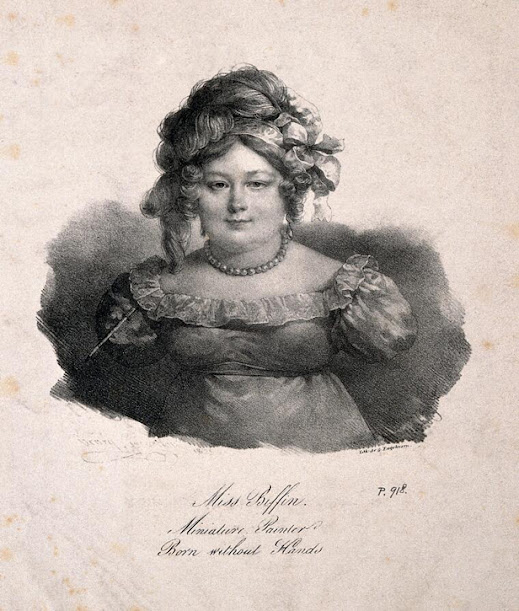
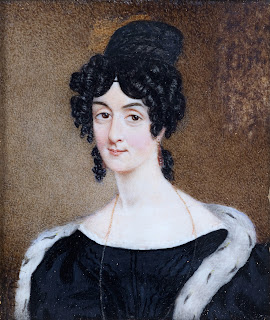
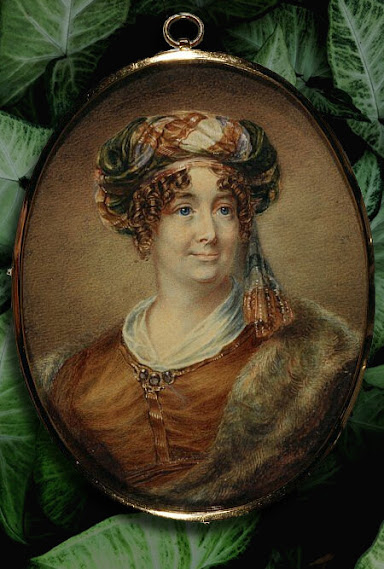
This is the story of an unique woman, a XIXth century painter famous for her impeccable miniature paintings, realistic artworks whose practically microscopic details were lauded as being some of the best in technique and style of her time.
She happened to have been born without legs or arms - which only made her obvious talents that much more incredible. She spent many years exibiting herself at fairs until she gained wealthy patrons, including Queen Victoria herself.
Her skills were hard won and surpassed many of her contemporaries, regardless of her physical differences, and she is remembered as one of the best miniaturist painters of her time. As a disabled woman artist working in the early nineteenth century, her remarkable story is one of perseverance and resilience.
Sarah Biffin was born at East Quantoxhead, near Bridgewater, Somerset, on October 25th, 1784. She was the third of five children and the very first daughter of Henry Biffin, a farm labourer and later a shoemaker, and Sarah Perkins, his wife, and as you can imagine she was of true humble origins since her parents lived in a labourer's cottage. Her baptism certificate records that she was 'born without arms and legs', that is with a rare condition now known as phocomelia. Nevertheless, she learnt to write, sew, use scissors, and became a professional artist.
Her parents were for sure good people, given, at those times, it was used for poors to abandon children when were born with some handicaps and she wasn't able to look after herself at all (she was without arms and legs and 94 cm/35 inches tall as an adult!).
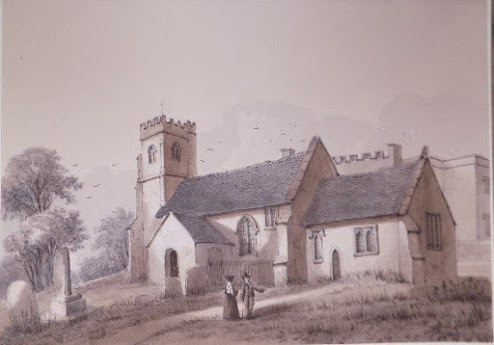
Drawing of East Quantoxhead church from south-east, with man and woman in churchyard, by W.W. Wheatley, 1845, courtesy of Somerset Archaeological and Natural History Society,
sepia & grey watercolour & pencil drawing.
When she was 13 she began her career exhibiting her skills as a curiosity. Her parents placed her under contract with Emmanuel Dukes, a showman who exhibited at fairs. Sarah was sometimes billed as 'the eighth wonder' or 'the limbless wonder.' By her own account, however, Mr and Mrs Dukes treated her well, and she lived with them as part of the family.
Sarah performed regularly at the Bartholomew Fair, the three-day festival at Smithfield in London and William Wordsworth, who attended the fair in 1802, includes this experience of his in his poem The Prelude (1805).
While working at the fairs, she demonstrated her sewing skills, cut out and made clothes, gave out writing samples, and painted portraits. From 1804 she took commissions, as she began her professional career as an artist. Dukes was her first art instructor, and she stayed under his tutelage until around 1816.
Sarah's formal instruction in art began in 1808, after a chance encounter with George Douglas (1761–1827), Earl of Morton, at one of the fairs.
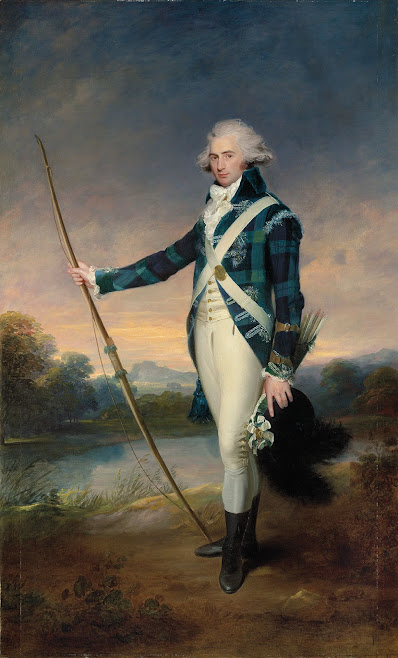
Portrait of George Douglas, 16th Earl of Morton by Sir William Beechey,
Private Collection / Photo © Christie’s Images / Bridgeman Images, oil on canvas.
The Earl commissioned a miniature portrait of himself from Sarah. Impressed by her talent, he sponsored her tuition at the Royal Academy of Arts, where she received lessons from a Royal Academy of Arts painter, William Craig, an artist with important royal patrons.
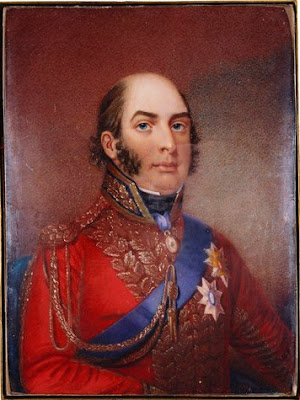
The Earl's presentation of Biffin's work before George III led to further commissions, including a miniature of the Duke of Kent (1839)
Edward, Duke of Kent (1767-1820), Signed and dated 1839,
Watercolour on ivory | 15.3 x 11.0 cm (sight) | RCIN 420202,
bought by his daughter, Queen Victoria, in 1840, which is now in the Royal Collection. The Society of Arts awarded her a medal in 1821 for a historical miniature and the Royal Academy accepted her paintings. It was then that the Royal Family commissioned her to paint miniature portraits of them.
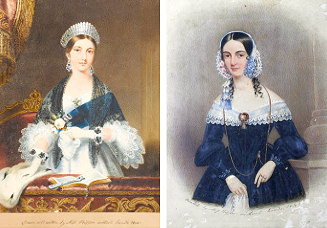
Portraits Miniature of Queen Victoria and of Jane Butt (William Westhall's wife), 1848
Portrait Miniature of H.R.H.Princess Mary Duchess of Gloucester
From 1821 on, when Sarah won the large silver medal at the Royal Society of Arts, she regularly exhibited her work at the Royal Academy of Arts and opened a studio in the Strand in London; then she married William Stephen Wright exactly on September 6th, 1824. Wright was possibly a lieutenant in the Royal Navy. Sarah's death certificate, however, suggests that she was the widow of a banker's clerk, which may have been his second career.
The media was always fascinated by how she performed her ordinary tasks. For example, one American journal included an item on how her wedding ceremony was conducted, stating that:
'Mr. W. was desired to hold the ring against the shoulder of the lady, and afterwards, having put it on a gold chain which she wore around her neck, it was placed in her bosom'.
Several commentators note that the couple separated soon after they married, though the Evangelical Lutheran Intelligencer remarks that 'Wright had long been attached to his wife'.
Many tried to describe her unique tecnique of painting, but in my opinion Sarah's art is well described by Edward Boys Ellman in Recollections of a Sussex Parson (1912). Ellman's cousin, Frances Sankey (later Mrs Ottaway), and his sister Catharine, both took lessons in miniature painting from her while she was in Brighton in 1829. Ellman describes Sarah as:
'... a heavy looking woman; she wore a turban and was always seated on a sofa. Her paint brush was pinned to a large puff sleeve which covered the short stump of the upper part of the arm. She fixed and removed the paint brush with her teeth, when it was necessary to clean or to wash it. When painting she leant her right shoulder forward, almost touching the table. She declared that she considered that for painting she had the advantage of those who had arms, for surely it was easier to paint with a short brush than with a long stick!'
Sarah Biffin's Selfportrait Miniature dating back to January, 2nd, 1830
Ellman recalls that her man-servant would carry her when she needed to move, and that she 'suddenly disappeared from Brighton greatly in debt'. The debts are something of a mystery, though her civil-list pension and the annuity from her estranged husband were modest, but truth is that the Earl of Morton died in 1827 leaving Sarah without a noble shepherd, causing her financial difficulties.
In addition to drawing landscapes, she painted her portraits on ivory. The miniature portraits were set in a gilt-metal frame with an eyelet so the owners could wear as a pendant on a piece of jewelry if they chose.
Sarah Biffin's Miniatures recentrly auctioned by Christie's
Sarah Biffin lived and worked in many places around England, including London, Brighton, Bath, Cheltenham and Liverpool. The 1841 census records that she lived in the High Street in Cheltenham at that time. She is likely to have moved to Liverpool shortly after this, due to her financial troubles, where she lived at 8 Duke Street and where she exhibited her works.
When she retired to Liverpool Queen Victoria granted her a civil pension.
She died in the city on October 2nd, 1850 at the age of 66 and is now buried in St James’ Cemetery in Liverpool. It must be said that she continued to paint up to her last days, indeed, a few months before she died, she exhibited a portrait at the 1850 Royal Academy of Arts exhibition.
In the hope to have entertained You with concern,
I'm wishing You much gladness
See you soon ❤
RITRATTO DI SIGNORA ~ Sarah Biffin, la celebre miniaturista del XIX sec. nata senza braccia e senza gambe
- IMMAGINE 1 - Miss Sarah Biffin in un autoritratto eseguito da giovane
Questa è la storia di una donna unica, una pittrice del XIX secolo famosa per i suoi impeccabili dipinti in miniatura, opere d'arte realistiche i cui dettagli praticamente microscopici erano lodati come i migliori per tecnica e stile del suo tempo.
Era nata senza gambe e senza braccia, il che rese i suoi evidenti talenti ancor più incredibili. Trascorse molti anni esibendosi alle fiere fino a quando non ottenne ricchi mecenati, inclusa la stessa regina Vittoria.
Le sue abilità furono conquistate duramente e superarono molti dei suoi contemporanei, indipendentemente dalle sue differenze fisiche, ed è ricordata come una delle migliori pittrici miniaturiste del secolo XIX. Come artista e donna disabile che lavorò all'inizio del 1800, la sua straordinaria storia è fatta di perseveranza, pertinacia e fermezza.
~⚜~
Sarah Biffin nacque a East Quantoxhead, vicino a Bridgewater, nel Somerset, il 25 ottobre 1784. Era la terza di cinque figli e la prima femmina di Henry Biffin, un bracciante che divenne in seguito calzolaio, e di Sarah Perkins, sua moglie, e come potete immaginare era di umilissime origini poiché i suoi genitori vivevano in un cottage riservato ai braccianti. Il suo certificato di battesimo registra che era "nata senza braccia e gambe", cioè in una condizione allora molto rara ora nota come focomelia. Tuttavia imparò a scrivere, a cucire, ad usare le forbici e divenne una rinomata artista professionista.
I suoi genitori erano sicuramente brave persone, dato che a quei tempi era usuale per i poveri abbandonare i bambini nati con qualche handicap, ed ella non riusciva assolutamente a badare a sé stessa (era senza braccia e senza gambe e misurava 94 cm. di statura da adulta!).
- IMMAGINE 2 - Disegno della chiesa di East Quantoxhead vista da sud-est, con uomo e donna nel cortile di W.W. Wheatley, 1845, courtesy of Somerset Archaeological and Natural History Society, sepia & grey watercolour & pencil drawing.
La sua carriera cominciò all'età di 13 anni quando fu data esibizione delle sue unicità come curiosità. I suoi genitori l'affidarono alle cure di Emmanuel Dukes, uno showman che organizzava fiere. A volte Sarah veniva definita "l'ottava meraviglia" o "la meraviglia senza arti". Per suo conto, tuttavia, i coniugi Dukes la trattarono sempre bene e visse con loro come parte della famiglia.
Ella si esibì regolarmente alla Bartholomew Fair, il festival di tre giorni allo Smithfield di Londra e William Wordsworth, che partecipò alla fiera nel 1802, incluse questa sua esperienza nella poesia The Prelude (1805).
Mentre lavorava alle fiere, Sarah ebbe modo di dimostrare le sue capacità in fatto di cucito, tagliando e realizzando vestiti, distribuendo campioni di scrittura e dipingendo ritratti. Dal 1804 ricevette commissioni e diede così avvio alla sua carriera professionale come artista. Dukes fu il suo primo istruttore d'arte e rimase sotto la sua guida fino al 1816 circa.
L'istruzione formale di Sarah in campo artistico iniziò, però, solamente nel 1808, dopo un incontro casuale con George Douglas (1761–1827), conte di Morton, ad una delle fiere.
- IMMAGINE 3 - Ritratto di George Douglas, 16th conte di Morton di Sir William Beechey,
Private Collection / Photo © Christie’s Images / Bridgeman Images, oil on canvas.
Il conte commissionò a Sarah un ritratto in miniatura di sé stesso ed impressionato dal talento della giovane, egli sponsorizzò le sue lezioni alla Royal Academy of Arts, dove fu seguita da un pittore della Royal Academy of Arts, William Craig, un artista che vantava importanti mecenati reali.
La presentazione del lavoro di Sarah Biffin da parte del conte davanti a Giorgio III portò a ulteriori commissioni, inclusa una miniatura del duca di Kent (1839)
- IMMAGINE 4 - Edward, duca di Kent (1767-1820), Signed and dated 1839, Watercolour on ivory | 15.3 x 11.0 cm (sight) | RCIN 420202,
acquistato da sua figlia, la regina Vittoria, nel 1840, che ora è parte del ROYAL COLLECTION TRUST. La Society of Arts le conferì una medaglia nel 1821 per una miniatura storica e la Royal Academy accettò i suoi dipinti. Fu allora che la famiglia reale le chiese di dipingere altri ritratti in miniatura.
- IMMAGINE 5 - Ritratti in miniatura della regina Victoria e di Jane Butt (moglie di William Westhall), 1848
- IMMAGINE 6 - Ritratto in miniatura di H.R.H.la principessa Mary duchessa di Gloucester
Dal 1821, quando Sarah vinse la grande medaglia d'argento alla Royal Society of Arts, espose regolarmente le sue opere alla Royal Academy of Arts ed aprì uno studio nello Strand a Londra; sposò quindi William Stephen Wright il 6 settembre 1824. Si suppone che Wright fosse un tenente della Royal Navy, anche se il certificato di morte di Sarah suggerisce che fosse la vedova di un impiegato di banca, ma non è da escludersi che quella fosse diventata la professione che intraprese in un secondo tempo.
I media furono sempre affascinati dal modo in cui ella svolgeva i suoi compiti ordinari. Ad esempio, una cronaca americana includeva un articolo su come fu condotta la sua cerimonia di matrimonio, sostenendo che
"Mr W. doveva tenere l'anello contro la spalla della dama, e poi, dopo averlo messo su una catena d'oro che portava al collo, le fu posto in seno".
Diversi commentatori notarono che la coppia si separò subito dopo il matrimonio, anche se l'Evangelical Lutheran Intelligencer osservò che "Wright rimase a lungo legato alla moglie".
Molti hanno cercato di descrivere la sua tecnica pittorica senza eguali, ma secondo me l'arte di Sarah è ben descritta da Edward Boys Ellman nelle sue Recollections of a Sussex Parson (1912). La cugina di Ellman, Frances Sankey (in seguito signora Ottaway), e sua sorella Catharine, presero entrambe lezioni di pittura in miniatura da lei mentre era a Brighton nel 1829. Ellman ci descrive Sarah come:
'... una donna dall'aspetto pesante; indossava un turbante ed era sempre seduta su di un divano. Il suo pennello era appuntato ad una grande manica a sbuffo che copriva il corto moncone della parte superiore del braccio. Ella rimuoveva il pennello con i denti quando era necessario pulirlo o lavarlo. Quando dipingeva piegava la spalla destra in avanti, quasi a toccare il tavolo. Dichiarava di ritenere che per dipingere avesse il vantaggio di chi ha le braccia, perché sicuramente era più facile dipingere con un pennello corto che con una bacchetta lunga'
- IMMAGINE 7 - Autoritratto in miniatura di Sarah Biffin datato 2 gennaio 1830
Ellman ricorda che il suo servitore la portava in braccio quando aveva bisogno di spostarsi e che "all'improvviso scomparse da Brighton molto indebitata". I debiti sono una sorta di mistero, anche se la sua pensione civile e la rendita dal marito separato erano modeste, ma la verità è che il conte di Morton morì nel 1827 lasciando Sarah senza un nobile appoggio, causandole difficoltà finanziarie.
Oltre a disegnare paesaggi, ella dipingeva i suoi ritratti su avorio. I ritratti in miniatura erano inseriti in una cornice di metallo dorato con un occhiello in modo che il proprietario potesse indossarli come ciondoli ad una catena od un bracciale, se lo desiderava.
- IMMAGINE 8 - Miniature di Sarah Biffin recentemente vendute all'asta da Christie's
Sarah Biffin visse e lavorò in molti luoghi dell'Inghilterra, tra cui Londra, Brighton, Bath, Cheltenham e Liverpool. Il censimento del 1841 registra che a quel tempo ella viveva in High Street a Cheltenham. È probabile che si sia trasferita a Liverpool poco dopo, a causa dei suoi problemi finanziari, dove ha vissuto al numero 8 di Duke Street e dove espose le sue opere.
Quando si ritirò a Liverpool, la regina Vittoria le concesse una pensione civile.
Si spense il 2 ottobre 1850 all'età di 66 anni ed è ora sepolta nel cimitero di St James a Liverpool. C'è da dire che continuò a dipingere fino ai suoi ultimi giorni, infatti, pochi mesi prima di morire, espose un ritratto alla mostra della Royal Academy of Arts del 1850.
Nella speranza di averVi intrattenuto con interesse,
Vi auguro tanta gioia
A presto ❤
LINKING WITH: