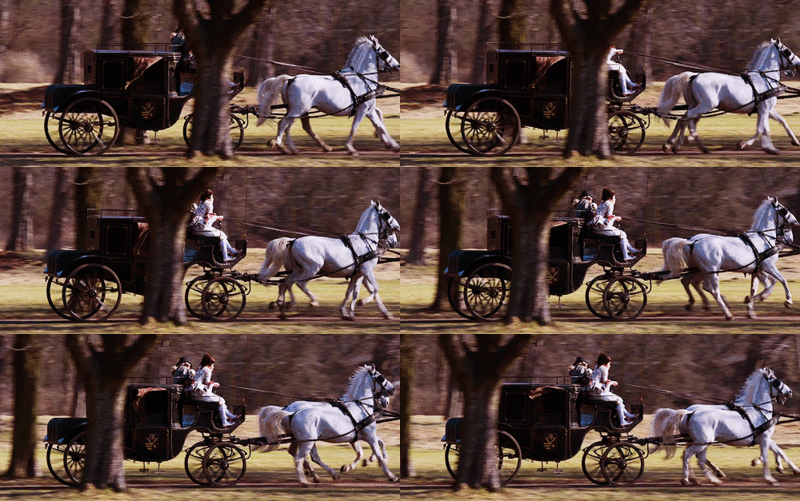
"Archduchess Sophia cared for nobody, or nothing, as long as she continued to reign supreme; and she hated, at first sight, the beautiful and saint-like Elizabeth.
The whole Court, from the first, followed the example of Archduchess Sophia, and seized every opportunity to vex, humiliate and wound the girl-wife." 1

Tutta la Corte, fin dal principio, seguì l'esempio dell'Arciduchessa Sofia, e non perse occasione per affliggere, umiliare e ferire la moglie-adolescente.) 1
Spinta dall'atmosfera tetra, greve, irrespirabile della Corte cui l'adorato consorte non cercava di porre rimedio in modo alcuno - Egli a Corte era cresciuto, dalla madre il suo agire era sempre stato soggiogato, architettato e diretto ed era innanzitutto l'Imperatore, il cui dovere principale era di natura politica e burocratica, gli affetti erano da lui considerati di secondaria importanza - ed amareggiata dalle sue prime relazioni extraconiugali, l'imperatrice Elisabetta d'Austria cercherà di trascorrere a Vienna il minore tempo possibile e di affiancare ai viaggi di rappresentanza, compiuti insieme con l'Imperatore, viaggi di piacere, o forse sarebbe più appropriato dire di necessità, visto che il loro scopo precipuo era di natura evasiva e liberatoria, non di certo maniacale, come spesso veniva sibilato: ella viaggiava per non pensare alle delusioni che la vita continuava a serbarle.
L'imperatrice non era né pazza neppure sempre malinconica o triste; era una donna che non è mai stata udita pronunciare o vista fare qualcosa di poco gentile; ma possedeva un grande orrore per le falsità e le anguste convenzioni praticate da tutti coloro che la circondavano.
Era generosa e di buon cuore ad un tale livello, e spesso mostrava un aspetto allegro ed ilare del proprio carattere ai pochissimi che amava e di cui si fidava. E soprattutto aveva una grande anima artistica, che ambiva ad una vita bella, circondata sempre da cose piacevoli da vedere. 2
Sentendosi quasi un incomodo per l'aristocrazia che la circondava e non potendo neppure manifestare il proprio amore materno, essendole stati i figli Rudolph e Gisela 'sequestrati' dalla suocera che ne seguiva passo passo l'educazione e che su di essi vegliava affinché crescessero come lei ambiva, Sisi cominciò a viaggiare prima della nascita di Marie Valerie (1868), per l'esattezza era il 1860 quando varcò i confini dell'Impero per recarsi a Madeira sullo yacht Osborne prestatole dalle regina Victoria;


L'imperatrice immortalata durante la sua vacanza, probabilmente ad una festa.
Ma non intendo qui oggi farvi un elenco dei luoghi da Sua Maestà Imperiale visitati, quanto piuttosto osservare insieme con voi quali erano i mezzi di trasporto sui quali Ella si spostava.
La maggior parte dei propri viaggi Sisi li compì soprattutto a bordo di una carrozza che poteva agganciarsi all'estremità posteriore dei treni, composta di due vagoni,


© Technisches Museum Wien, Foto: Peter Sedlaczek
una sorta di vettura al cui interno era stato ricostruito un ambiente nobile, una sorta di lussuosa residenza circolante.
A partire dal 1872, infatti, furono realizzati numerosi progetti per la costruzione di una carrozza termica a lei destinata che doveva comprendere due stanze su ruote, ovvero un vagone-letto ed un vagone-salotto; il progetto che venne approvato e divenne realtà, recava la firma della rinomata carrozzeria F. Ringhoffer di Praga, datava 1873 e cominciò a circolare l'anno successivo.

Fotografia d'epoca che ci mostra il Salonwagen all'epoca del suo primo viaggio
L'Hofsalonwagen, la carrozza imperiale, la cui lunghezza superava i 9,5 metri per vagone, constava di un Salonwagen,


ossia di un vagone-letto, dotato di un lussuoso giaciglio, di un tavolino, di uno specchio, di una poltrona, di una zona toilette, con tanto di acqua corrente, e di un piccolo spazio per la dama di compagnia.
Nel 1895 entrambi i vagoni vennero dotati di luce elettrica (grazie alla ditta Hardy di Vienna), di riscaldamento a vapore, di condotti per il freno continuo automatico e di un freno pneumatico per collegare i sistemi di frenatura di entrambi, così come di un segnale elettrico per la comunicazione interna.
Va da sé che dopo la morte improvvisa dell'imperatrice Elisabetta, nel 1898, la carrozza imperiale venne messa fuori servizio e destinata al museo ferroviario austriaco; dal 2004 si puo' ammirare una copia del vagone-salotto nel Sisi Museum, al palazzo della Hofburg.
Risale a quegli stessi anni la costruzione dello kaiserliche Yacht Miramar - Yacht imperiale Miramar, anzi proprio 1872 data questa fotografia che ne ritrae le fasi finali presso i cantieri navali del porto Pola.

Utilizzato sia per viaggi privati dei membri della famiglia al potere, così come in occasioni ufficiali quale yacht di stato, il Miramar venne utilizzato per 40 anni durante i quali fu più volte ristrutturato per renderlo più all'avanguardia sia da un punto di vista tecnico sia in quanto ai comfort di cui di volta in colta veniva dotato, per giungere fino all'elettrificazione operata nel 1882.


Le eleganti scale di accesso al ponte superiore

Sarà durante gli anni 80-90 che Sisi preferirà la via del mare con il quale il dialogo interiore si farà sempre più intenso ed appagante;
"Sopra di te, come i tuoi uccelli marini,
io circolo senza riposo.
Per me la terra non possiede più un angolo
dove costruire un nido duraturo .. "
~ Imperatrice Elisabetta d'Austria
spesso attraccato in prossimità del porticciolo del Castello di Miramare a Trieste, l'imperatrice se ne servirà per compiere le proprie 'crociere' all'interno delle acque del Mediterraneo, soprattutto per scendere l'Adriatico e raggiungere le coste del Peloponneso, da lei amate al punto da far edificare, nel 1890, presso Corfù, l'Achilleion, la sontuosa villa imperiale ( annoverava più di cento stanze) da lei interamente progettata e realizzata da un architetto italiano, interamente ispirata allo stile dei templi greci, immersa in giardini profumati da inebrianti piante mediterranee ed esotiche che divenne il vero, ultimo paradiso in terra di Elisabetta, la quale qui trovava quella pace e quella chetezza che il suo animo non riusciva più a trovare altrove o per costeggiare la Riviera dei Fiori, partendo dalla Costa Azzurra per giungere fino ai promontori liguri e raggiungere i centri dai nomi più rinomati tra l'aristocrazia, da Cap Saint Martin a Cap d'Antibes, a Sanremo, a Genova e saranno proprio quelle di Sanremo le ultime acque che il Miramar con lei a bordo solcherà nell'inverno del 1898.

L'imperatrice schermata dal suo parasole sul ponte del Miramar durante uno dei suoi numerosi viaggi a bordo.
( spesso gli ultimi viaggi in località marittime le saranno consigliati dai medici che ritenevano giovevole per Sua Maestà la respirazione del salmastro per i problemi polmonari e cardiaci che precocemente, e a fasi alterne, fiaccheranno la salute dell'imperatrice, così come il recarsi nelle località termali austriache quali Bad Kissingen e quelle situate tra le Alpi Svizzere, ahimè ! ).
E veniamo infine alle carrozze, di cui difficilmente, se non in rare occasioni, l'imperatrice si serviva, essendo un'abile camminatrice ed un'eccezionale amazzone: quella che vedete nell'illustrazione qui sotto

( Landaulette prodotta da Carl Marius Jr., in Vienna nel 1885 ) era utilizzata dall'Augusta Signora per muoversi indisturbata tra le strade di Vienna e solo in un'occasione servì alla coppia imperiale per raggiungere Budapest ( come illustrato nella fotografia che fa da copertina al post ).
Talvolta Ella portava con sé durante i suoi viaggi questa vettura comoda e confortevole solamente se doveva muoversi all'interno di qualche città.
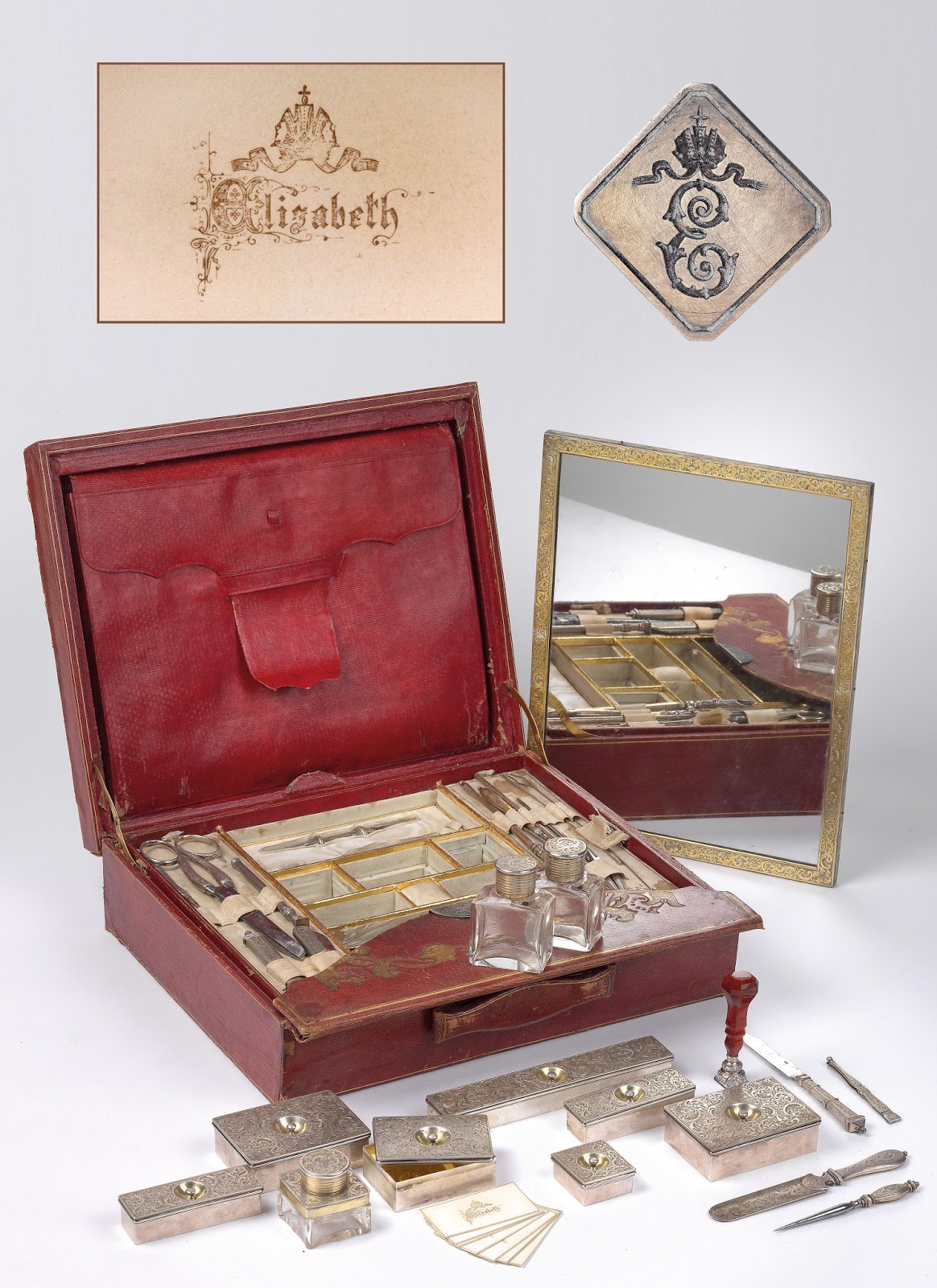
Concludo con due immagini che dedico in modo particolare agli/alle amanti dell'imperatrice: la prima rappresenta la sua toilette da viaggio

e la seconda il suo kit personale per scrivere e cucire.
"Le destinazioni sono auspicabili solo perché un viaggio vi sta nel mezzo. Se fossi giunta in un luogo e avessi saputo che non avrei mai più viaggiato nuovamente, anche un soggiorno in paradiso si sarebbe trasformato in un inferno per me. "
~ Imperatrice Elisabetta d'Austria

Vecchio girocollo che reca un ciondolo con all'interno un'immagine dell'imperatrice.

Con tutto il mio affetto e la più sincera, profonda gratitudine prendo congedo da Voi, carissimi amici e lettori che mi seguite sempre con entusiasmo ed ammirazione, augurandovi tutto il meglio che possiate desiderare.
A presto ♥

Bibliography:
Hellmut Andics, Die Frauen der Habsburger, WILHELM HEYNE VERLAG, München,
1995;
Angela Micaella Battani, L'IMPERATRICE SISSI - "LA FIGLIA SEGRETA", Anatomia di una vita, Edizioni Medicea, Firenze, 2012;
Marie Louise, Countess Larisch von Wallersee-Wittelsbach with Paul Maerker Branden and Elsa Brander, HER MAJESTY Elisabeth of Austria-Hungary, The Beautiful, Tragic Empress of Europe's Most Brilliant Court, DOUBLEDAY, DORAN & COMPANY Inc. GARDEN CITY, NEW YORK, 1934;
Elisabetta d'Austria, Diario poetico, MGS PRESS SAS, 1998;
ELISABETTA D'AUSTRIA NEI FOGLI DI DIARIO DI COSTANTIN CHRISTOMANOS, Adelphi edizioni S.p.A., Milano, 1989;
Maria Valeria d'Asburgo, La prediletta - Il diario della figlia di Sissi, a cura di Martha e Horst Schad, traduzione di Flavia Floradini, MGS PRESS, 2001;
Conte Egon Cesar Corti, L'imperatrice Elisabetta, Mondadori, Milano, 1937;
Brigitte Hamann, Elisabeth. Kaiserin wieder Willen, Amalthea Verlag, Wien, München, 1982;
Brigitte Hamann, (a cura di), ELISABETH Bilder einer Kaiserin, Amalthea Verlag, 1998;
Maria Matray - Answald Kruger, L'attentato, MGS PRESS, Trieste, 1998;
Marguerite Cornell Owen, THE MARTYRDOM OF AN EMPRESS WITH PORTRAITS FROM PHOTOGRAPHS [ 1898], HARPERS & BROTHERS PUBLISHERS, NEW YORK AND LONDON, collected by Benno Loewy, bequeathed to Cornell University - The Cornell University Library Digital Collection;
Xavier Paoli, THEIR MAJESTIES AS I KNEW THEM - Personal Reminescences of the Kings and Queens of Europe, EDITORA GRIFFO (edizione originale Parigi, 1934);
Gabriele Praschl - Bichler, L'Imperatrice Elisabetta, Longanesi & C., Milano, 1997;
Nellie Ryan, My Years at the Austrian Court, John Lane, 1915, ristampa del settembre 2015, edizione Forgotten Books;
Nellie Ryan, My Years at the Austrian Court, John Lane, 1915, ristampa del settembre 2015, edizione Forgotten Books;
Irma Sztáray, Elisabeth gli ultimi anni, L'imperatrice raccontata dalla sua Dama d'onore, MGS PRESS, Trieste, 2010;
Countess Zanardi Landi, THE SECRET OF AN EMPRESS, Fredonia Books, Amsterdam, The Netherlands, 2004, reprinted from the 1915 edition.
Quotations:
Quotations:
1 - Nellie Ryan, My Years at the Austrian Court, John Lane, 1915, ristampa del settembre 2015, edizione Forgotten Books, pag. 17;
2 - op. cit., pag. 38.

Archduchess Sophia cared for nobody, or nothing, as long as she continued to reign supreme; and she hated, at first sight, the beautiful and saint-like Elizabeth.
The whole Court, from the first, followed the example of Archduchess Sophia, and seized every opportunity to vex, humiliate and wound the girl-wife.1
- picture 1
Pushed by the gloomy, heavy, stifling atmospere surrounding the Court to which the adored husband did not try to remedy in any way - He had grown up in Court, by his mother his actions had always been subjugated, masterminded and directed and first of all He was the emperor , whose main duty was of political and bureaucratic nature, afections were considered by Him of secondary importance - and embittered by His first extramarital affairs, Empress Elisabeth of Austria will try to spend in Vienna the least time possible and to put beside the representation trips, She had to do together with the Emperor, leisure travel, or perhaps it would be more appropriate to say trips of necessity, since their primary purpose was of evasive and of liberating nature, certainly not manical, as was often suggested, She was travelling for not to think of the disappointments that life continued to keep Her.
The Empress was neither mad nor even always melancholy or sad. She was a woman who was never heard to say or do an unkind thing; but she possessed a great horror of the shams and narrow conventions practicised by all around her.
She was generous and warm-hearted to a degree, and often showed a merry, laughing side to the very few whom she loved and trusted. And above all she had a great artistic soul, which yearned for a beautiful life, surrounded always by things beautiful. 2
Feeling almost an inconvenience for the aristocracy surrounding Her and unable even to give expression to Her maternal love, given that her children Rudolph and Gisela were 'seized' by Her mother-in-law who wanted to follow step by step their education and who watched over them to grow them exactly as she wanted, Sisi began to travel before the birth of Marie Valerie (1868), to be exact it was 1860 when She crossed over the Empire's borders to travel to Madeira on the yacht Osborne lent Her by Queen Victoria;
- picture 2
- picture 3 - The Empress immortalized during Her holiday, probably at a party.
with the flowing of the time, Her absences from the Hofburg became more frequent, intense and long, especially after the marriage of Her beloved Marie Valerie (1890), the daughter who She tried to grow by 'snatching' her away from the atavistic rituals of the Court - given the illness and then the death of the old Archduchess Sophia - often Her travelling companion, and the tragic demise of the Crown Prince (1889) that will indelibly mark not only Her life, but it will make more feeble also Her state of health, even in Her body.
But today I don't mean to give you a list of the places Her Imperial Majesty visited, but rather to observe along with you what were the means of transport on which she moved.
Sisi made most of her travels especially on board of a carriage which could be engaged to the rear end of the train,
- picture 4 and picture 5 - © Technisches Museum Wien, Foto: Peter Sedlaczek
a kind of car inside which a noble environment was built, it was something like a luxurious circulating residence.
Starting from 1872, in fact, several projects were made for the construction of a thermal carriage to Her intended, which had to include two rooms on wheels, that is, a sleeping-wagon and a living room-wagon; the project which was approved and became reality, bore the signature of the renowned carriages' builders F. Ringhoffer from Prague, dated 1873 and began to circulate the following year.
- picture 6 - Vintage photography showing us the Salonwagen at the time of its first trip.
The Hofsalonwagen or the imperial carriage, whose length was over 9.5 meters per wagon, consisted of a Salonwagen,
- picture 7
- picture 8
or a living room-wagon which was comfortably furnished with a desk and an easy chair to sleep adjacent to the toilet; in the car was also been placed a further chair for the lady in waiting and the whole car was heated through fireplaces placed under the carriage, powered externally with small wood burning coal blocks, and of a Schlafwagen
- picture 9
- picture 10
that is a sleeping-wagon, equipped with a luxurious bed, a small table, a mirror, a chair, a toilet area, complete with running water, and a small space for the lady in waiting.
In 1895 both wagons were equipped with electric light (thanks to the company Hardy from Vienna), steam heating, of ducts for the continuous automatic brake and a pneumatic brake to connect to the braking systems of the two wagons, as well as with an electrical signal for internal communication.
Needless to say that after the sudden death of Empress Elizabeth, in 1898, the car was taken out of service and delivered to the Austrian railway museum; since 2004 you can see a copy of the Living room-wagon in the Sisi Museum at the Hofburg palace.
It dates back to those same years the construction of the kaiserliche Yacht Miramar - Imperial Yacht Miramar, indeed, precisely to 1872 dates this photograph which depicts its final stages at the shipyards of Pula harbor.
- picture 11
Used both for private travel of the family members as well as on official occasions such as state yacht, the Miramar was used for 40 years during which it was repeatedly restructured to make it more advanced both from a technical point of view and adding the comforts with which, little by little, it was equipped, to arrive to the electrification made in 1882.
- picture 12
- picture 13 - The elegant stairs leading to the upper deck
- picture 14
It will be in the years 80-90 that Sisi will prefer the sea route for the inner dialogue with the sea will become more intense and satisfying;
“O'er thee, like thine own sea birds,
I'll circle without rest.
For me earth holds no corner
To build a lasting nest..”
~ Empress Elisabeth of Austria
often moored by the porticciolo of Miramare Castle in Trieste, the Empress will use it to make Her 'cruises' inside the Mediterranean waters, especially to plough the waves along the Adriatic Sea and reach the shores of the Peloponnese, so loved by Her to the point of building, in 1890, in Corfu, the Achilleion, the sumptuous imperial villa (numbering more than a hundred rooms) from her entirely designed, and built by an Italian architect, wholly in the style of the Greek temples, surrounded by fragrant gardens collecting heady Mediterranean and exotic plants which became Elisabeth's true, last paradise on earth, for here she could still find that peace and that stillness which Her soul could no longer find elsewhere, or to skirt the Riviera dei Fiori, starting from the French Riviera to reaching the Ligurian cliffs and the centers by the most famous names amongst the aristocracy, from Cap Saint Martin to Cap d'Antibes, to Sanremo, to Genoa, and they will be precisely those of Sanremo the last waters that the Miramar with Her on board will sall in the Winter of 1898.
- picture 15 - The Empress screen from her parasol on the Miramar bridge during one of Her several trips on board.
( Often the trips to the seaside resorts will be recommended by doctors who considered beneficial for Her Majesty's the breathing salty for her lung and heart problems, which, ups and downs, will etiolate and weaken the Empress, as well as the travels to the Austrian spas such as Bad Kissingen and those located within the Swiss Alps, alas ! )
And finally let's talk about the carriages, of which hardly, except in rare occasions, the Empress will need, being a skilled walker and an exceptional rider: the one you see in the illustration below
- picture 16
(Landaulette produced by Carl Marius Jr., in Vienna in 1885) was used from our Majestic Lady to move unhindered through the streets of Vienna and only on one occasion served the imperial couple to get to Budapest as shown in the photograph that became the cover of this post.
Sometimes, during her trips, she carried this convenient and comfortable car with Her, only if She had to move around some cities.
I conclude with two images I especially dedicate to the Empress's lovers: the first is Her travel toilet
- picture 17
and the second Her personal travel kit to write and sew.
- picture 18
“Destinations are only desirable because a journey lies in between. If I arrived somewhere and knew that I would never leave again, even a sojourn in paradise would turn into hell for me.”
~ Empress Elisabeth of Austria
- picture 19 - Old neck lace bearing a charm with an image inside of the Empress
With all my affection and the most sincere, heartfelt gratitude I take my leave of you, dear friends and readers always following me with enthusiasm and admiration, wishing you all the best you could ever want.
See you soon ♥


Bibliografia:
Angela Micaella Battani, L'IMPERATRICE SISSI - "LA FIGLIA SEGRETA", Anatomia di una vita, Edizioni Medicea, Firenze, 2012;
Elisabetta d'Austria, Diario poetico, MGS PRESS SAS, 1998;
ELISABETTA D'AUSTRIA NEI FOGLI DI DIARIO DI COSTANTIN CHRISTOMANOS, Adelphi edizioni S.p.A., Milano, 1989;
Maria Valeria d'Asburgo, La prediletta - Il diario della figlia di Sissi, a cura di Martha e Horst Schad, traduzione di Flavia Floradini, MGS PRESS, 2001;
Conte Egon Cesar Corti, L'imperatrice Elisabetta, Mondadori, Milano, 1937;
Brigitte Hamann, Elisabeth. Kaiserin wieder Willen, Amalthea Verlag, Wien, München, 1982;
Brigitte Hamann, (a cura di), ELISABETH Bilder einer Kaiserin, Amalthea Verlag, 1998;
Maria Matray - Answald Kruger, L'attentato, MGS PRESS, Trieste, 1998;
Marguerite Cornell Owen, THE MARTYRDOM OF AN EMPRESS WITH PORTRAITS FROM PHOTOGRAPHS [ 1898], HARPERS & BROTHERS PUBLISHERS, NEW YORK AND LONDON, collected by Benno Loewy, bequeathed to Cornell University - The Cornell University Library Digital Collection;
Xavier Paoli, THEIR MAJESTIES AS I KNEW THEM - Personal Reminescences of the Kings and Queens of Europe, EDITORA GRIFFO (edizione originale Parigi, 1934);
Countess Zanardi Landi, THE SECRET OF AN EMPRESS, Fredonia Books, Amsterdam, The Netherlands, 2004, reprinted from the 1915 edition.
Citazioni:
1 - Nellie Ryan, My Years at the Austrian Court, John Lane, 1915, ristampa del settembre 2015, edizione Forgotten Books, page 17;
2 - op. cit., page 38.
With all my affection and the most sincere, heartfelt gratitude I take my leave of you, dear friends and readers always following me with enthusiasm and admiration, wishing you all the best you could ever want.
See you soon ♥
Bibliografia:
Hellmut Andics, Die Frauen der Habsburger, WILHELM HEYNE VERLAG, München,
1995;
Angela Micaella Battani, L'IMPERATRICE SISSI - "LA FIGLIA SEGRETA", Anatomia di una vita, Edizioni Medicea, Firenze, 2012;
Marie Louise, Countess Larisch von Wallersee-Wittelsbach with Paul Maerker Branden and Elsa Brander, HER MAJESTY Elisabeth of Austria-Hungary, The Beautiful, Tragic Empress of Europe's Most Brilliant Court, DOUBLEDAY, DORAN & COMPANY Inc. GARDEN CITY, NEW YORK, 1934;
ELISABETTA D'AUSTRIA NEI FOGLI DI DIARIO DI COSTANTIN CHRISTOMANOS, Adelphi edizioni S.p.A., Milano, 1989;
Maria Valeria d'Asburgo, La prediletta - Il diario della figlia di Sissi, a cura di Martha e Horst Schad, traduzione di Flavia Floradini, MGS PRESS, 2001;
Brigitte Hamann, Elisabeth. Kaiserin wieder Willen, Amalthea Verlag, Wien, München, 1982;
Brigitte Hamann, (a cura di), ELISABETH Bilder einer Kaiserin, Amalthea Verlag, 1998;
Maria Matray - Answald Kruger, L'attentato, MGS PRESS, Trieste, 1998;
Marguerite Cornell Owen, THE MARTYRDOM OF AN EMPRESS WITH PORTRAITS FROM PHOTOGRAPHS [ 1898], HARPERS & BROTHERS PUBLISHERS, NEW YORK AND LONDON, collected by Benno Loewy, bequeathed to Cornell University - The Cornell University Library Digital Collection;
Xavier Paoli, THEIR MAJESTIES AS I KNEW THEM - Personal Reminescences of the Kings and Queens of Europe, EDITORA GRIFFO (edizione originale Parigi, 1934);
Gabriele Praschl - Bichler, L'Imperatrice Elisabetta, Longanesi & C., Milano, 1997;
Nellie Ryan, My Years at the Austrian Court, John Lane, 1915, ristampa del settembre 2015, edizione Forgotten Books;
Nellie Ryan, My Years at the Austrian Court, John Lane, 1915, ristampa del settembre 2015, edizione Forgotten Books;
Irma Sztáray, Elisabeth gli ultimi anni, L'imperatrice raccontata dalla sua Dama d'onore, MGS PRESS, Trieste, 2010;
Countess Zanardi Landi, THE SECRET OF AN EMPRESS, Fredonia Books, Amsterdam, The Netherlands, 2004, reprinted from the 1915 edition.
Citazioni:
1 - Nellie Ryan, My Years at the Austrian Court, John Lane, 1915, ristampa del settembre 2015, edizione Forgotten Books, page 17;
2 - op. cit., page 38.