Visualizzazione post con etichetta Possenhofen. Mostra tutti i post

mercoledì 7 settembre 2016

HERZOG MAX JOSEPH IN BAYERN and his Zither Band.


Herzog Max in Bayern and his Zither Band


Sappiamo tutti che la bellissima ed ammirata Sisi apparteneva, per tramite di padre, al ramo cadetto della casa regnante di Baviera, che mai ne avrebbe ereditato il trono - infatti il Duca Maximilian (1808-1888), figlio del Duca Pius August in Bayern e della Principessa Amalie Luise von Arenberg del ramo cadetto dei Wittelsbach è detto IN BAVIERA, non DI BAVIERA a sottolineare proprio cotale collateralità ... 
Dopo aver frequentato una scuola pubblica come qualsiasi altro cittadino di Monaco, egli si laureò in Storia e Scienza, e nel 1828 dovette sospendere i suoi studi in letteratura per sposare, contro la propria volontà, la Principessa Ludovika Wilhelmine, figlia del Re Maximilian I von Bayern: un matrimonio imposto dal nonno (e re) per sollevare, anche economicamente, le fortune della famiglia e riavvicinare la linea reale della dinastia ... 


Engagement Portrait of Empress Elisabeth's parents Princess Ludovika of Bavaria and Duke Maximilian Joseph in Bavaria, by Joseph Stieler.


Va da sé che il denaro che la famiglia appena costituita poteva possedere era quello di una qualsiasi famiglia medio-alto borghese, completamente estranea agli agi di corte, ma il creativo e versatile duca, di cui già QUI vi parlai a proposito di quanto di gioioso trasmise alla sua prole, soprattutto alla futura imperatrice d'Austria ( alla quale comunicò il suo amore per l'arte, per la mitologia, la musica, per la natura e a cui spesso diceva che doveva muoversi come fosse una farfalla e non strisciando i piedi come fanno le dame ! ) riusciva spesso a trovare il modo per guadagnare proventi sufficienti per fare vivere dignitosamente la numerosa figliolanza che animava le ampie stanze del Castello di Possenhofen (acquistato nel 1838 ), in estate, e quelle del Herzog-Max-Palais nella Münchner Ludwigstraße, il palazzo di Monaco, durante la stagione dal clima più rigido. 

Per chi non lo conoscesse a fondo, il popolo di origine teutonica, che si tratti di abitanti dell'odierna Austria o della Germania, ha la musica nel sangue, come si suol dire, ovvero possiede un'innata inclinazione per la danza e per suonare qualsiasi strumento, ne è l'esempio più eclatante la 'dinastia' degli Strauss che fece danzare tutti gli europei, e non solo, che vissero durante il periodo romantico, ovvero l'era vittoriana ... ebbene, il duca Max, come era familiarmente chiamato e conosciuto, non sfuggiva a tale legge della natura ed era non solo un abilissimo suonatore di cetra e di pianoforte, ma compose anche alcune polke e valzer ( oggi trovate tutte le sue composizioni raccolte in: Die im Druck erschienenen Kompositionen von Herzog Maximilian in Bayern: Ländler, Walzer, Polka, Schottisch, Mazurka, Quadrillen und Märsche für Pianoforte, Zither, Gitarre oder Streichinstrumente, München: Musikverlag Emil Katzbichler, 1992 ).


 Max Joseph in Bayern mentre suona la cetra, sullo sfondo troneggia il castello di Possenhofen che si affaccia sulle acque del lago Starnberg


Si narra che talora indossasse i costumi tradizionali bavaresi - che gli garantivano di muoversi in incognito - e che si recasse a suonare la cetra nei ristoranti, accompagnato dalla sua piccola Elisabeth, che ballava al suono della musica per poi raccogliere denari tra i tavoli.


Dancing the Steirer, with zither music. Drawing by C.B.Binzer. 


'Das war das einzig Ehrlich Verdiente Geld' ('Fu quello l'unico denaro onestamente guadagnato' ), ebbe ad apostrofare anni dopo.


Beh, che ci crediate o no, il Duca Max fu uno dei promotori più importanti della musica popolare bavarese del XIX° secolo. Sotto la sua influenza la cetra cominciò ad essere utilizzata in ambienti di corte per divenire, infine, riconosciuta quale strumento musicale nazionale della Baviera e proprio grazie al suo interesse ricevette il soprannome di cetra-Maxl.


Il padre della sposa, Max in Baviera, strimpella il suo strumento preferito, la cetra, con la coppia imperiale sul lago di Starnberg, sullo fondo Possenhofen.


Durante una visita al castello di Possenhofen, il cugino Ludwig II re di Baviera scorse alcuni spartiti sul pianoforte di Maximilian Joseph siglati dal compositore Richard Wagner, da egli stesso supportato economicamente a partire dal 1863, e probabilmente all'ammirazione che entrambi nutrirono per il musicista nativo di Lipsia si deve l'amore che la stessa Sisi provava per le di lui opere.
Ma non solamente al nome di Wagner quello del Duca Maximilian è legato: Franz Strauss, padre del probabilmente più celebre Richard, fece parte, in qualità di chitarrista, del gruppo musicale capeggiato dal 'nostro' duca !

Leggiamo insieme questo estratto da una delle sue biografie, scritta da Willi Schuh, dal titolo Richard Strauss: A Chronicle of the Early Years 1864-1898: 

[...] Franz aveva quindici anni, nel 1837, quando suo zio gli trovò un posto come chitarrista al servizio del Duca Max a Monaco di Baviera. Altri membri dell'orchestra del duca comprendevano il talento della cetra Johann Petzmayer e due zii di Franz, Joseph Michael Walter e Johann Georg Walter. Il duca stesso suonava la cetra nella sua orchestra. In questa compagnia di musicisti Franz fu incoraggiato dallo zio Joseph a continuare a migliorare la sua formazione pratica e teorica. [...] Fu durante gli anni che Franz trascorse al servizio del Duca Max che riconobbe che il corno era lo strumento per cui si sentiva più portato e per cui avrebbe potuto diventare un 'virtuoso'.


E chissà che, almeno in parte, la costernazione che colse l'Arciduchessa Sofia, madre del futuro Imperatore Francesco Giuseppe, quando il figlio le confessò di voler sposare non già la promessa Nenè, ma la sorella Sisi, non fosse dovuta alla popolarità, o, meglio, alla popolanità - passatemi il termine - di questo nobile che stava sì, divenendo suo parente acquisito, ma con una figlia, futura imperatrice d'Austria, che più di ogni altra gli somigliava ... le si stava parando davanti un gran lavoro da fare per 'addomesticare' una fanciulla che le appariva tanto poco 'signorile' e degna del titolo che stava per acquisire ..., ma la signorilità, l'eleganza e la nobiltà d'animo non le si acquisiscono, sono un dono che la Natura riserva a pochi e quello che sappiamo essere uno spirito libero, indomito per definizione, non lo si 'ammansisce', ... se non lo si comprende, però, e non lo si accetta gli si possono tarpare le ali reprimendo e mortificando, infine, ogni suo slancio vitale, ... questo sì ... ed, ahimè, fu proprio così che accadde, povera amata, ammirata imperatrice !


Sempre più grata per la dedizione e l'affetto con cui seguite ~ My little old world ~, 
auguro ogni bene a ciascuno di voi, carissimi lettori ed amici,


a presto  💕


- picture 1 - Herzog Max in Bayern and his Zither Band


We all know that the beautiful and admired Sisi belonged, by her father, to the junior branch of the ruling family of Bavaria, of which would have never inherited the throne - in fact the Duke Maximilian (1808-1888), son of the Duke Pius August in Bayern and Princess Amalie Luise von Arenberg of the cadet branch of the Wittelsbach were told IN BAYERN, not VON BAYERN, to emphasize the collateral branch of the family they belonged to ...
After attending a public school like any other citizen of Monaco, he graduated in History and Science, and in 1828 he had to suspend his studies in the literature to marry, against his will, Princess Ludovika Wilhelmine, daughter of King Maximilian I von Bayern: a marriage imposed by his grandfather (and king) to raise, even economically, the fortunes of the family and reconnect the royal line of the dynasty ...


- picture 2 - Engagement Portrait of Empress Elisabeth's parents Princess Ludovika of Bavaria and Duke Maximilian Joseph in Bavaria, by Joseph Stieler.


It goes without saying that the money that the newly formed family could afford was that of any upper-middle class family, far from any kind of well-being of the court, but the creative and versatile Duke, whom I already mentioned you HERE for what as joyful he transmitted to his offspring, especially to the future empress of Austria (to which he communicated his love for art, for mythology, for music and nature and to which he often said she had to move like a butterfly and not shuffled as all the ladies do !) could often find a way to earn sufficient income to allow to live in dignity the numerous offspring that animated the large rooms of the Castle of Possenhofen (purchased in 1838), in Summer, and those of the Herzog-Max-Palais in Munich Ludwigstraße, the Monaco Palace, during the season by the harsh climate.

For those unfamiliar with itin the deep, people of Teutonic origin,  both inhabiting of today's Austria and Germany, has music in the blood, as they say, that is a natural inclination for dance and for playing any instrument, the most striking example of it is the 'dynasty' of Strauss which made dance all Europeans, and not only, who lived during the romantic period, or the Victorian era, if you prefer ... well, the Duke Max, as it was familiarly called and known, didn't escape this law of nature and he not only was a skilled player of zither and piano, but also composed some polkas and waltzes (you may find all of his compositions collected in Die im Druck erschienenen Kompositionen von Herzog Maximilian in Bayern: Ländler, Walzer, Polka, Schottisch, Mazurka, Quadrillen und Märsche für Pianoforte, Zither, Gitarre oder Streichinstrumente, München: Musikverlag Emil Katzbichler, 1992 ).


- picture 3 - Max Joseph in Bayern while plays the zither, on the background stands the Possenhofen castle overlooking the waters of Lake Starnberg.


It is said that sometimes, wearing the traditional Bavarian costumes that guaranteed him to move in incognito, he went to play the zither in restaurants, accompanied by his little Elisabeth, who danced to the sound of the music and then collected money among the tables.


- picture 4 - Dancing the Steirer, with zither music. Drawing by C.B.Binzer. 


'Das war das einzig Ehrlich Verdiente Geld' ('That was the only money honestly earned'), he had to say years later.

Well, believe it or not, Duke Max was one of the most important promoters of Bavarian folk music during the XIXth century. Under his influence the zither began to be used in court circles to become, finally, recognized as the national musical instrument of Bavaria and thanks to his interest he received the nickname of zither-Maxl.


- picture 5 - The bride's father, Max of Bavaria, strumming his favorite instrument, the zither, with the imperial couple at Lake Starnberg, the bottom Possenhofen.


During a visit to the Castle of Possenhofen, his cousin King Ludwig II of Bavaria saw some music sheets on Maximilian Joseph's piano signed by the composer Richard Wagner, whom he himself supported financially in 1863, and probably to that admiration them both nurtured for the musician native of Leipzig was due the love the same Sisi felt for his works.
But not only the name of Wagner is linked to that of Duke Maximilian: Franz Strauss, father of the probably most famous Richard, was part, as guitarist, of the band led by 'our' Duke!

Let's read together this excerpt from one of his biographies, written by Willi Schuh, entitled Richard Strauss: A Chronicle of the Early Years 1864-1898: 

[...] Franz was fifteen, in 1837, when his uncle found him a post as guitarist in the service of Duke Max in Munich. Other members of the duke's orchestra included the zither virtuoso Johann Petzmayer and two of Franz's uncles, Joseph Michael Walter and Johann Georg Walter. The duke himself also played zither in his own orchestra. In this company of musicians Franz was encouraged by his uncle Joseph to continue to improve his practical and theoretical education. [...] It was during the years Franz spent in the service of Duke Max that he recognized that the horn was the instrument which meant most to him and on which he could become a virtuoso.

And I wonder if, at least in part, the consternation which seized Archduchess Sophia, mother of the future Emperor Franz Joseph, when his son confessed to want to marry not the already promised Nené, but her younger sister Sisi, wasn't due to the popularity, or rather, to the ordinary person this noble looked at her eyes, who was going, yes, to become her relative in-law, but with a daughter, the future empress of Austria, who more than anyone else was like him ... she was surely thinking of a great amount of work to do to 'tame' a young girl who appeared so little 'elegant' and worthy of the title she was going to acquire ... but the elegance, the gentleness and the and the nobility of heart cannot be taught, they are gifts that nature reserve to a very few people and what we do know to be a free spirit, undaunted by definition, cannot be 'tamed', ... if you do not understand him, though, and you cannot accept him, you might clip his wings repressing and mortifying, eventually, every vital impulse of his, ... yes ... and, alas, it was just the way it happened, poor loved, admired empress !


- picture 6


Increasingly appreciating and loving the dedication and the affection with which you follow  ~ My little old world ~, I'm wishing all my best to each of you, dear readers and friends,

see you soon 💕


LINKING WITH:

BLUE MONDAY

sabato 26 luglio 2014

Per amore di un cavallo - Ludwig, Sisi e l'equitazione.


Chissà se il Duca Max in Baviera, al secolo Maximilian Joseph von Wittelsbach, padre di Sissi, futura Imperatrice d'Austria, fu colui che diede l'avvio a quella che divenne quasi una tradizione per tutti gli appartenenti al suo casato, ... quel che è certo è che con lui la passione per l'equitazione raggiunse livelli al limite della verosimiglianza.


Egli era quasi ossessionato dai cavalli, trascorreva giornate intere lontano dal Castello di Possenhofen, dove abitava con la famiglia, in sella al proprio cavallo, appagando inoltre l'irrefrenabile spirito, così avido di libertà, che lo caratterizzava; amava cavalcare soprattutto in modo spericolato, lasciandosi trasportare dal richiamo della natura selvaggia che il cavallo, quando è libero, avverte.

Quale sistema migliore, inoltre, se non in groppa ad un cavallo, esiste per chi ama immergersi nella natura ... tutti gli animali selvaggi non avvertono la presenza di chi cavalca, ma scorgono solamente il cavallo e perciò, non intimoriti, si lasciano osservare nel loro agire naturalmente, come andando a piedi a nessun uomo è e sarà mai concesso ... quello del cavalcare diviene perciò un mezzo prezioso per entrare in contatto con la vitalità del mondo animale che vive ancora allo stato selvatico ed un mezzo quasi sovrannaturale per dialogare con una creatura non umana ... il cavallo, infatti, avverte non solo la nostra presenza, ma il nostro stato d'animo, le nostre emozioni, intende prima ancora di capire le nostre intenzioni, con il cavallo, quasi per incantesimo, si diventa un 'unicum', indistinto !
Dalle mie parole non è difficile capire quanto anche io ami i cavalli ...

Ma torniamo ai Wittelsbach e soprattutto ai due esponenti più carismatici del periodo vittoriano, Sissi e Ludwig, poichè se è vero che Max cercò di trasmettere questa sua grande passione ad ognuno dei suoi figli, fu, tra di essi, Sissi colei che ad essa più divenne sensibile, e Ludwig, quale assiduo frequentatore del castello di Possenhofen, compagno di giochi della cugina ed amante del clima di quella grande gioiosa, spensierata famiglia di cui si sentiva parte più che della propria, ne subì a sua volta il fascino ed ai cavalli legò il resto della propria vita; per la piccola principessa Max creò addirittura una sorta di circo con tanto di giochi acrobatici da compiersi a dorso di cavalli ed inevitabilmente ella divenne la più famosa ed impavida amazzone del suo tempo 


Sissi a cavallo presso Possenhofen ( autore sconosciuto )


Stampa che ritrae l'Imperatrice Sissi e l'Imperatore Francesco Giuseppe a caccia ( autore sconosciuto )


( al castello di Godollo, in Ungheria, Sissi creò a sua volta un circo equestre in cui dava spettacolo, con l'amata nipote Marie Larisch, figlia del fratello Luigi, tristemente, ripudiata dopo Mayerling ), e Ludwig, a sua volta, spericolato cavaliere, creò una scuderia al tempo senza pari.
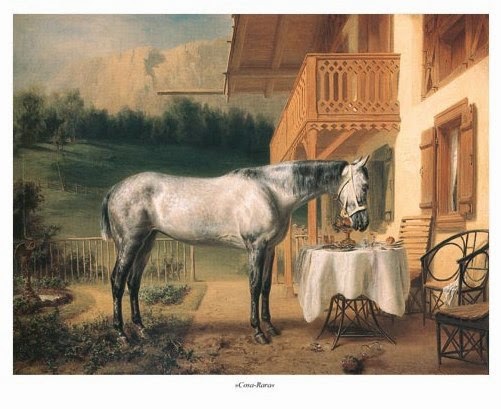
Questi i destrieri del re di Baviera dipinti da Friedrich Wilhelm Pfeiffer (1822 - 1891):


Nel montare un cavallo, noi prendiamo in prestito la libertà. 

(H. Thomson)


"Gli uomini sono migliori quando cavalcano, più giusti e più comprensivi, più attenti, più disinvolti e più animosi, più consapevoli di tutte le contrade e di tutti i percorsi; a dire il vero, le buone abitudini e le buone  maniere provengono da ciò, e anche la salute dell’uomo e della sua anima." 

( Edoardo Plantageneto )


In sella ad un cavallo l'uomo può riuscire a placare il suo slancio verso l'infinito. A sentirsi, anche solo per un istante, più vicino al cielo.

( proverbio arabo )


Era questa una delle tante affinità che lo legavano all'amata ed ammirata cugina, in compagnia della quale spesso faceva lunghe cavalcate nei boschi selvaggi che fiancheggiano lo Starneberger See, e, quando si trovava lontano da Possenhofen, presso uno dei suoi amati castelli, nel momento in cui scendeva il buio, si faceva accompagnare da alcuni dei suoi attendenti in passeggiate a cavallo che duravano ore ed ore, qualsiasi fosse la stagione, con il caldo delle serate estive o con il gelo e la neve di quelle invernali ... quale modo migliore per osservare la luna !
Era la luna infatti l'astro prediletto da Ludwig: se da bambino era solito disegnarla, da adulto adorava la buona, argentea, tacita luna; divenuto re si faceva annunciare la sua apparizione in cielo: un servitore, racconta Anton Hirschberg, entrava nella stanza in cui egli si trovava per annunciare, tra profondi inchini, in modo analogo a quello in cui si annuncia una visita importante, che la luna era appena sorta.


Nächtliche Schlittenfahrt König Ludwigs II, R. Wenig, 1880, © Bayerische Schlösserverwaltung

Una romantica uscita notturna in slitta nell'Ammergebirge, vicino a Linderhof


I cavalli, la natura e gli abitanti delle montagne della sua cara Baviera, erano coloro cui Ludwig teneva di più in assoluto.


Editha


Regina


Il cavallo
Un´anima.
Quattro zoccoli.
Una criniera.
Una coda.
Amici dell´uomo da millenni.
Mai schiavi davvero.
Sempre lontani, un poco selvatici.
Diversi dai cani, un po' simili ai gatti, uguali a nessuno.
Occhi lucidi profondi come canyon.
Groppe.
Muscolose.
Un fiato dolce d'erba, saporito di Fieno
Una voce che fa nitrito.
Gambe di tendini, di forza, di veloce fuga.
Pensieri fatti di ossa, tendini, e muscoli.
Luminose scie nel buio.
Stelle forse.
Nobili angeli con le ali infangate dall'uomo
che tiene le redini
di questi esseri incredibili
e troppo lontani dalle nostre coscienze per essere capiti davvero.
Fiato che si fa nuvola nel freddo del mattino,
ed esce dal morbido naso di velluto
di un essere antico
e ricco di tutto quello che l'Uomo non avrà mai:
La tenerezza di un'anima selvaggia.

( autore sconosciuto)


Erda


Antigone


Thorilde


Sissi, come il cugino, amava il rapporto privilegiato che s'instaura con i cavalli, non nel suo stesso modo amava il proprio popolo dal quale cercherà sempre più, con il trascorrere degli anni, di celarsi, soprattutto quando i segni di un persino precoce invecchiamento veleranno il suo bel volto.


Alcuni dei cavalli dell'Imperatrice


E' noto che anch'ella collezionasse ritratti dei suoi cavalli preferiti in una cappella dove solo pochi intimi amici erano ammessi e proprio a questa serie appartiene la spilla regalatale dalla figlia, l’arciduchessa Marie Valerie, che ne raffigura uno.


Ho sempre pensato che ella, grande cultrice della lingua greca e della tradizione mitologica, in sella ai suoi destrieri sentisse quasi di realizzare il sogno che da sempre l'uomo insegue, quello di volare e di abbandonarsi alle ali del vento, che i suoi cavalli diventassero con lei una sorta di proiezione del cavallo alato generato dal sangue di Medusa caduto a terra quando Perseo la colpì a morte, Pegaso, e che ella, da Titania, s'immedesimasse in Bellerofonte, l'eroe delle cui imprese ci narrano Omero e Pindaro, che grazie alla briglia dorata donatagli da Atena, riuscì, unico, a cavalcarlo, lui, Pegaso, bellissimo ed indomito, sinonimo per eccellenza dell'immaginazione creatrice e dell'estro poetico ...


Acquerello di autore sconosciuto che ritrae la giovane principessa a cavallo con sullo sfondo il Castello di Possenhofen.


Sissi, in sella ai suoi destrieri, non cavalcava, si abbandonava al vento ... e perciò li addestrava a compiere vere e proprie acrobazie, quelle giuste per dare loro lo slancio necessario a conquistare il cielo ... ella davvero sentiva l'aria del Paradiso soffiare tra le orecchie del suo cavallo, come dice un antico proverbio arabo !


Da sinistra in lato verso destra: Sissi con un suo cavallo a Godollo sul finire degli anni '70, nella corte della Hofburg agli inizi degli anni '80, la sua sella rossa per cavalcare all'amazzone, uno dei cavalli 'Lipizzaner' per lei fatti arrivare a Schonbrunn e tutt'ora lì addestrati a rappresentare ancor'oggi uno dei vanti del popolo viennese.


Quante cose ho da raccontarvi sulle sue cavalcate e sui suoi viaggi in Inghilterra ed in Irlanda compiuti in nome di questo suo grande amore, ma credo che dovrò rimandare tutto ad uno dei nostri prossimi incontri, miei cari amici, molto, davvero molto ho ancora da dirvi.

Per ora vi lascio con l'augurio che tutta la serenità che desiderate vi accompagni fino al nostro prossimo incontro.

A presto ♥


Bibliografia: 


Hellmut Andics, Die Frauen der Habsburger, WILHELM HEYNE VERLAG, München, 1995

Elisabetta d'Austria, Diario poetico, MGS PRESS SAS, 1998

Maria Valeria d'Asburgo, La prediletta - Il diario della figlia di Sissi, a cura di Martha e Horst Schad, traduzione di Flavia Floradini, MGS PRESS, 2001


Brigitte Hamann, Elisabeth. Kaiserin wieder Willen, Amalthea Verlag, Wien, München, 1982

Greg King, LUDWIG. Genio e follia di un re, Arnoldo Mondadori Editore S.p.A., 1999

Gabriele Praschl-Bichler, L'IMPERATRICE ELISABETTA, Longanesi & C. Editore, 1997


Loving horses: Ludwig, Sissi and horse-riding.


- picture 1


I wonder if the Duke Max in Bavaria, born Maximilian Joseph von Wittelsbach, Sissi's father, future Empress of Austria, was the one who gave the start to what became almost a tradition for all the members of his family, ... what is certain is that his passion for riding reached level at the limit of plausibility.


- picture 2


He was almost obsessed with horses, spent whole days away from his Castle at Possenhofen, where he lived with his family, riding his horse, satisfying also his irrepressible spirit, so eager for freedom, which characterized him; he especially loved to ride recklessly, drifting by the call of the wild that the horse, when is free, feels.

What better way, also, than riding a horse, for those who love to immerse themselves in nature ... all the wild animals don't feel the presence of who's riding, but they see only the horse and therefore, not intimidated, they let observe themselves such as having a walk no man it will ever be granted ... that of riding becomes, therefore, a valuable means to get in touch with the vitality of the world of the animals that still live in the wild and an almost supernatural way to communicate with a non-human creature ... the horse, in fact, warns not only our presence but our mood, our emotions, intends even before than understanding our intentions, with the horse, as if by enchantment, you become a 'unique', indistinct!
By my words, it is not difficult to understand how I also love horses so much ...

But let's go back to the Wittelsbachs, and especially to the two most charismatic leaders who lived in the Victorian period, Sissi and Ludwig, as if it is true that Max tried to convey his passion to each child of his, Sissi was, among them, the one who became more sensitive to it, and Ludwig, who frequently was guest at Possenhofen, playmate of her cousin and lover of the climate of that great joyful, carefree family of which he felt to belong more to that of his own, was charmed in turn by horses and tied to them the rest of his life; for the little princess Max even created a sort of circus with lots of acrobatic games to be accomplished on the backs of horses and inevitably she became the most famous and fearless horsewoman of her time.


- picture 3 - Sissi riding at Possenhofen ( unknown author )

- picture 4 - Print depicting Empress Sissi and Emperor Franz Joseph during a hunt ( unknown author )


(At Godollo Castle, Hungary, Sissi, created a circus in which she gave the show, with her beloved niece Marie Larisch, daughter of his brother Luigi, sadly, ripudiated after Mayerling affair), and Ludwig, in turn, reckless knight, created a stable like no other at his time.
Here are the King of Bavaria's horses all painted by Friedrich Wilhelm Pfeiffer (1822 - 1891):


- picture 5

- picture 6


While riding a horse, we borrow freedom.

(H. Thomson)


- picture 7

- picture 8


"Men are better when riding, more just and more understanding, more alert, more relaxed and more courageous, more aware of all the lands and all the routes; to be honest, good habits and good manners come from this, and also the health of a man and of his soul. "

(Edward Plantagenet)


- picture 9

- picture 10


In the saddle of a horse the man may be able to quench its momentum towards the infinite and feel, if only for a moment, closer to heaven.

(Arabic proverb)


- picture 11

- picture 12


This was one of the many affinities that bounded him to his beloved and admired cousin, in the company of which he often did long rides in the wild woods that flank the Starneberger See, and when he was far from Possenhofen, at one of his favorite castles, when darkness fell, accompanied by some attendants of his, he went for horseriding that last for hours and hours, whatever the season was, with the heat of the summer evenings or with the frost and the snow of the winter ... what better way to observe the moon !
The moon was in fact Ludwig's favorite star: as a child he used to draw it, as an adult he loved the good, silvery, silent moon; become king they had to announce its appearance in the sky: a servant, as Anton Hirschberg tells, entered the room in which he stood, between deep bows, to announce, in a similar way to that in which it was announced an important visit, that the moon had just risen.


- picture 13 - Gemälde "Nächtliche Schlittenfahrt König Ludwigs II.", R. Wenig, 1880, © Bayerische Schlösserverwaltung


Horses, the nature and the inhabitants of the mountains of his beloved Bavaria, were the things that Ludwig mostly loved.


- picture 14 

- picture 15  


The horse
A soul.
Four hooves.
A mane.
A tail.
Friends of man for thousands of years.
Never really slaves.
Still far away, a little wild.
Different from dogs, a bit similar to cats, equal to none.
Eyes shining like deep canyons.
Croups.
Muscular.
A breath of fresh grass, tasty of hay
A voice that makes nitrite.
Saddle of tendons, of strength, of quick getaway.
Thoughts made of bones, tendons, and muscles.
Light trails in the dark.
Maybe stars.
Noble angels with wings muddy by man
who holds the reins
of these incredible beings
too far from our consciences to be truly understood.
Breath that gets cold cloud in the morning,
and goes out from the soft velvet nose
of an ancient beeing
and full of everything that a Man will never have:
The tenderness of a wild soul.

( unknown author)


- picture 16

- picture 17 

- picture 18


Sissi, like her cousin, loved the special relationship that develops with the horses, not in the same his way she loved her people from whom she'll hide more and more, with the passing of the years, especially when the early signs of an even premature aging will veil her beautiful face.


- picture 19 - picture 20 - picture 21 - Some of the Empress' horses


It is known that she too collected portraits of her favorite horses in a chapel where only a few close friends were allowed to come in and to this series belongs the brooch given to her by her daughter, Archduchess Marie Valerie, who portrays one of them.


- picture 22


I always thought that she, as a great fellow of the Greek language and mythology, riding her horses almost felt to realize the dream that always chases the man, to fly and to surrender to the wings of the wind, that her horses become to her a sort of projection of the winged horse created from the blood of Medusa when Perseus hit her to death, Pegasus, and that she, as Titania, identified herself in Bellerophon, the hero about which Homer and Pindar tell us, who, thanks to the golden bridle given to him by Athena, managed, unique, to ride him, he, Pegasus, beautiful and untamed, synonymous par excellence for the creative imagination and poetic oestrus ...


- picture 23 - Watercolor by unknown artist who portrays the young princess while riding a horse; on the background you can see the Possenhofen Castle.


Sissi, riding her horses, didn't ride, she indulged in the wind ... and therefore trained them to do real stunts, the right ones to give them the momentum needed to conquer the sky ... she really felt the air from Heaven blowing between the ears of her horse, as an old Arab proverb says !


- picture 24 - From the left to the right side: Sissi in Godollo with her horse at the end of the 70s, in the court of the Hofburg at the beginning of the 80s, her red saddle to ride sidesaddle, one of the horses 'Lipizzaner' arrived to Schonbrunn for her and still even today there trained to represent the pride of the people of Vienna.


How many things I have to tell you about her riding and about her travels in England and Ireland, made in the name of this great great love of hers, but I think I'll have to postpone everything to one of our next meetings, my dear friends, so, so much I still have to tell you.

For now I leave you with the hope that all the serenity you wish will accompany you till we meet again.


See you soon ♥


Bibliografia: 

Hellmut Andics, Die Frauen der Habsburger, WILHELM HEYNE VERLAG, München, 1995

Elisabetta d'Austria, Diario poetico, MGS PRESS SAS, 1998

Maria Valeria d'Asburgo, La prediletta - Il diario della figlia di Sissi, a cura di Martha e Horst Schad, traduzione di Flavia Floradini, MGS PRESS, 2001


Brigitte Hamann, Elisabeth. Kaiserin wieder Willen, Amalthea Verlag, Wien, München, 1982

Greg King, LUDWIG. Genio e follia di un re, Arnoldo Mondadori Editore S.p.A., 1999

Gabriele Praschl-Bichler, L'IMPERATRICE ELISABETTA, Longanesi & C. Editore, 1997