Visualizzazione post con etichetta Victorian traditions. Mostra tutti i post

martedì 25 novembre 2025

A Late-Victorian Thanksgiving Day


While  'strolling' around  the  web  and  leafing  through  Victorian  newspapers, I came  across  a  very  interesting  article :  it  is  from  the  El  Dorado  Daily  Republican  and  bears  the  date  of  25 th  November  1897:  that  year,  two  days  later,  Thanksgiving  Day  would  have  been  celebrated. 


I thought it to be interesting to se how this so important day was lived than, so I decided to transcribe this article in its entirety for you. For sure, during the years, the celebrations for this holiday too have changed, but it remains, thanks God, a wonderful day to gather with family and/or friends. 


THANKSGIVING DAY.
___________

A HAPPY TIME WHEN FAMILY CIRCLES ARE REUNITED.
__________

An Occasion When the Turkey Outshines the Eagle — Date of the Festival Chosen In 1782 — Fitting Souvenirs and Games. Seasonable Decorations.

For a long time the observance of Thanksgiving day was an annual custom belonging almost exclusively to the northern states of the Union, but now the observance knows no north, south, east nor west, and everywhere over our broad land the beautiful custom rests upon us like a benediction.  From far and near the members of the family circle who have flown away from the home nest find their way back for Thanksgiving, like carrier pigeons, bearing with them tender thoughts and remembrance of the loved ones who, with the poet, decided that “to stay at home is best.”
There is no law saying that Thanksgiving shall be observed, nor is there need of any, for the law of custom has decided the matter, and the president issues each year a Thanksgiving proclamation setting aside a certain day in the latter part of November for the general celebration. The first public Thanksgiving day appointed officially in this country was observed by the Puritans on Oct. 24, 1621. 


Pilgrims Thanksgiving 1621 - Puritans Fathers And Native Americans Sharing The Harvest At The First Thanksgiving At Plymouth Colony In 1621 - Wood Engraving American 1870.
Credit THE LIBRARY OF CONGRESS.


In 1778 the chaplain of congress recommended that “Wednesday, Dec. 30, be observed as a day of public thanksgiving and praise.” In 1779 the first Tuesday in May was set aside, and in October, 1779, Congressman Root suggested that the day be changed to Thursday, Dec. 9, but in 1782 Thursday, Nov. 28, was chosen, and from that time to the present the last Thursday in November has been the day decided upon for the great festival.
It is a good day to lay aside and forget all differences and to keep in one’s heart only the tenderness and sunshine out of which the lips and eyes will make such loving smiles and glances.
After father and mother, the oldest grandchild and the newest baby, the next most important Thanksgiving personage is the turkey. He is a noble biped, and, while it may not be his aim in life to shine at the festal Thanksgiving board, it is most assuredly his end.  The turkey is the great American bird, and on Thanksgiving days he outshines the lordly eagle in point of utility and as a subject for discussion of the most absorbing kind.  The exact origin of the turkey is buried in obscurity, but he himself is so resplendent that his ancestry may be forgiven him, or rather the haziness of it may be. Any bird so thoroughly satisfactory and admirable as the turkey must have had a noble ancestry, and the proud blood of some great and royal biped must perforce flow gladly through his veins.
In the fore part of the sixteenth century the old world had become acquainted with the charms of the new world bird, and wherever he has been introduced he has made a favorable and lasting impression. Who can imagine a Thanksgiving dinner without its piece de resistance being the turkey stuffed with chestnuts, oysters or truffles and revealing its noble proportions and golden brown breast to the admiring gaze of the assembled diners?
Can it be possible that the turkey will ever occupy a less lofty pinnacle than he at present enjoys? Perish the thought!
Akin to our Thanksgiving day celebration is the green corn dance of the Natives, which probably had its origin hundreds of years ago. It falls due every September and is observed with great enthusiasm and picturesque savagery. The event is commemorative of the yearly ripening of the corn and grain, and all the members of the tribe assemble at a given place, arrayed in the glories of paint, feathers, red blankets, beads, moccasins and other similar adornments. But, alas, there is no roast turkey! 
The exchange of Thanksgiving souvenirs is almost as universal now as that of birthday and Christmas remembrances, and really the occasion is eminently fitting for such a custom. One always enjoys the possession of pretty souvenirs, for many happy little memories cluster around them, like sunbeams around a summer rose. Thanksgiving souvenirs should not be elaborate, but appropriate and suggestive of the merry occasion. All kinds of cunning little bonbon boxes are now shown, decorated with tiny gilt turkeys or silvered baby pigs with tiny candy apples in their innocent little mouths. Small paper pumpkins, filled with dainty bonbons, are also timely little souvenirs, and real Thanksgiving candies in the way of sugar turkeys, an ear of ripe corn in cream paste, nuts and pumpkins in chocolate and barley sugar are especially appropriate decorations.
Autumn leaves and flowers form beautiful adornment for the dining room and the table, the halls and parlors, and only the rich autumn colors of red and russet, tan and gold and brown, should be allowed to hold high revelry at the great autumn carnival of the year.
It is a happy custom now for Thanksgiving evening to be filled up with merry, informal games and dances (emphasis added), in which old and young may both join with equal propriety. Any of the games played during the holidays and on birthday and social occasions are perfectly suitable for Thanksgiving night, and proverbs, buzz, story telling, reading character in the palm, fortune telling, quotations, the memory game and others of a similar nature will afford any amount of fun and pleasure to young and old.
A big, splendid, golden pumpkin, decked with vines about its base, makes a fine centerpiece for a Thanksgiving dinner table, or just the shell of the pumpkin may be used as a vase, and autumn leaves and berries and vines may overflow its golden body in the most gorgeous splendor.
One of the best ways to enjoy Thanksgiving is to contribute something to the fund for supplying the poor and friendless with a good, wholesome Thanksgiving dinner. New York and Brooklyn have many charitable people who will see that the poor are fed that day, and it is one of the sights of the great city to go among the clustering thousands of unfortunates and see them in at least one thankful mood, however short it may be.
It is asserted by many that the first Thanksgiving day in America was not established by the pilgrims, but by the church of England. It is said to have been celebrated at Monhegan, off the cost of Maine, in 1607. A chaplain by the name of Seymour preached the sermon. Thirteen years later the Mayflower reached Plymouth. – New York Tribune.


The Pilgrim Fathers boarding the 'Mayflower' for their voyage to America, 
painting by Bernard Gribble, 1885.


Embarkation of the Pilgrims, painting by Robert Walter Weir, 1857. 
Brooklyn Museum - New York.


The landing of the Pilgrim Fathers in America. A.D. 1620, 
by Popular Graphic Arts.


And now it's time for my heartfelt wishes 
which I send to all of You.


Dany


Un Giorno del Ringraziamento tardo vittoriano


Mentre  'gironzolavo' sul  web  e  sfogliavo  i  giornali  vittoriani,  mi  sono  imbattuta  in  un  articolo  molto  interessante :  è  dell' El  Dorado  Daily  Republican  e  reca  la  data  del  25  novembre  1897 :  quell'anno,  due  giorni  dopo,  si sarebbe  celebrato  il  Giorno  del  Ringraziamento.


IMMAGINE DI COPERTINA - LA CENA DEL RINGRAZIAMENTO


Ho pensato fosse interessante vedere come veniva vissuto questo giorno così importante, quindi ho deciso di trascrivere questo articolo nella sua interezza per voi. Sicuramente, nel corso degli anni, anche le celebrazioni per questa ricorrenza hanno subito cambiamenti, ma rimane, grazie a Dio, un giorno meraviglioso per riunirsi con la famiglia e/o gli amici. 


IL GIORNO DEL RINGRAZIAMENTO.
___________

UN MOMENTO FELICE IN CUI LE FAMIGLIE SI RIUNISCONO.
__________

Un'occasione in cui il tacchino diventa più importante dell'aquila — Data della festa scelta nel 1782 — Souvenir e giochi adatti. Decorazioni stagionali.

Per lungo tempo, la celebrazione del Giorno del Ringraziamento è stata un'usanza annuale appartenente quasi esclusivamente agli stati settentrionali dell'Unione, ma ora non conosce nord, sud, est o ovest, e ovunque nel nostro vasto territorio la splendida usanza si posa su di noi come una benedizione. Da lontano e da vicino, i membri della cerchia familiare che hanno lasciato il nido domestico ritrovano la strada del ritorno per il Giorno del Ringraziamento, come piccioni viaggiatori, portando con sé teneri pensieri e il ricordo dei propri cari e che, come dice il poeta, decidono che "restare a casa è meglio".
Non esiste una legge che stabilisca che il Giorno del Ringraziamento debba essere osservato, né se ne avverte la necessità, poiché la legge della consuetudine ha deciso la questione, e il presidente emana ogni anno un proclama del Giorno del Ringraziamento che riserva un certo giorno nella seconda metà di novembre per la celebrazione generale. Il primo Giorno del Ringraziamento pubblico istituito ufficialmente in questo paese fu osservato dai Puritani il 24 ottobre 1621.


IMMAGINE 2 - Pilgrims Thanksgiving 1621 - Puritans Fathers And Native Americans Sharing The Harvest At The First Thanksgiving At Plymouth Colony In 1621 - Wood Engraving American 1870.
Credit THE LIBRARY OF CONGRESS.


Nel 1778 il cappellano del Congresso raccomandò che "mercoledì 30 dicembre fosse osservato come giorno di ringraziamento e lode pubblici". Nel 1779 fu scelto il primo martedì di maggio e nell'ottobre 1779 il deputato Root suggerì di spostare la data a giovedì 9 dicembre, ma nel 1782 fu scelto giovedì 28 novembre e da allora a oggi l'ultimo giovedì di novembre è stato il giorno stabilito per la grande festa.
È un giorno ideale per mettere da parte e dimenticare tutte le differenze e conservare nel cuore solo la tenerezza e la solarità che da labbra e occhi scaturiranno sorrisi e sguardi così amorevoli.
Dopo il padre e la madre, il nipote più grande e il neonato, il personaggio più importante del Ringraziamento è il tacchino. È un nobile bipede e, sebbene il suo scopo nella vita non sia brillare alla tavola imbandita del Ringraziamento, è sicuramente il suo fine. Il tacchino è il grande uccello americano, e nei giorni del Ringraziamento surclassa la maestosa aquila in termini di utilità e come argomento di discussione del tipo più avvincente. L'origine esatta del tacchino è avvolta nell'oscurità, ma lui stesso è così splendente che la sua ascendenza può essergli perdonata, o meglio, la sua vaghezza. Qualsiasi uccello così soddisfacente e ammirevole come il tacchino deve aver avuto una nobile ascendenza, e il sangue fiero di qualche grande e regale bipede deve per forza scorrere felicemente nelle sue vene.
Nella prima metà del XVI secolo, il vecchio mondo aveva familiarizzato con il fascino dell'uccello del nuovo mondo, e ovunque sia stato introdotto ha lasciato un'impressione favorevole e duratura. Chi può immaginare una cena del Ringraziamento senza il suo pezzo forte, il tacchino ripieno di castagne, ostriche o tartufi, che rivela le sue nobili proporzioni e il petto dorato allo sguardo ammirato dei commensali riuniti? È possibile che il tacchino occupi mai un posto meno elevato di quello di cui gode attualmente? Che il pensiero non ci sia!
Analogamente alla nostra celebrazione del Giorno del Ringraziamento è la danza del mais verde dei nativi americani, che probabilmente ha avuto origine centinaia di anni fa. Si celebra ogni settembre ed è celebrata con grande entusiasmo e pittoresca ferocia. L'evento commemora la maturazione annuale del mais e dei cereali, e tutti i membri della tribù si riuniscono in un luogo prestabilito, adornati con sfarzi di vernice, piume, coperte rosse, perline, mocassini e altri ornamenti simili. Ma, ahimè, non c'è il tacchino arrosto!
Lo scambio di souvenir del Ringraziamento è ormai quasi altrettanto universale quanto quello dei compleanni e dei ricordi di Natale, e in effetti l'occasione è particolarmente adatta a tale usanza. Si apprezza sempre il possesso di graziosi souvenir, perché attorno a essi si raccolgono tanti piccoli ricordi felici, come raggi di sole attorno a una rosa estiva. I souvenir del Ringraziamento non dovrebbero essere elaborati, ma appropriati e evocativi dell'allegra ricorrenza. Ora si vedono in bella mostra ogni sorta di scatoline di caramelle, decorate con minuscoli tacchini dorati o maialini argentati con minuscole mele candite nelle loro innocenti bocconcini. Anche piccole zucche di carta, piene di deliziosi bonbon, sono dei souvenir perfetti, e i veri dolci del Ringraziamento, come tacchini di zucchero, una pannocchia di mais matura in pasta di crema, noci e zucche al cioccolato e zucchero d'orzo, sono decorazioni particolarmente appropriate.
Le foglie e i fiori autunnali formano splendide decorazioni per la sala da pranzo e la tavola, i corridoi e i salotti, e solo i ricchi colori autunnali, rosso e ruggine, beige, oro e marrone, dovrebbero essere ammessi a far festa nel grande carnevale autunnale dell'anno.
È ormai una felice usanza che la sera del Ringraziamento sia ricca di giochi e balli allegri e informali (enfasi aggiunta), a cui grandi e piccini possono partecipare con pari dignità. Tutti i giochi praticati durante le festività, i compleanni e le occasioni sociali sono perfetti per la notte del Ringraziamento, e proverbi, pettegolezzi, racconti, lettura del carattere sul palmo della mano, divinazione, citazioni, giochi di memoria e altri di natura simile offriranno divertimento e piacere a grandi e piccini.
Una grande, splendida zucca dorata, ornata di tralci alla base, è un ottimo centrotavola per la tavola del Ringraziamento, oppure il guscio della zucca può essere usato come vaso, e foglie autunnali, bacche e tralci possono traboccare dal suo corpo dorato nel più splendido splendore.
Uno dei modi migliori per godersi il Ringraziamento è contribuire al fondo per fornire ai poveri e a chi è solo una buona e sana cena del Ringraziamento. New York e Brooklyn hanno molte persone caritatevoli che si assicureranno che gli indigenti ricevano cibo quel giorno, ed è uno degli spettacoli della grande città andare tra le migliaia di sfortunati che si radunano e vederli in stato d'animo grato almeno una volta, per quanto breve possa essere. Molti sostengono che il primo Giorno del Ringraziamento in America non sia stato istituito dai Padri Pellegrini, ma dalla Chiesa d'Inghilterra. Si dice che sia stato celebrato a Monhegan, al largo della costa del Maine, nel 1607. Un cappellano di nome Seymour predicò il sermone. Tredici anni dopo, la Mayflower raggiunse Plymouth. – New York Tribune.


IMMAGINE 3 - The Pilgrim Fathers boarding the 'Mayflower' for their voyage to America, 
dipinto di Bernard Gribble, 1885.

IMMAGINE 4 - Embarkation of the Pilgrims, dipinto di Robert Walter Weir, 1857. 
Brooklyn Museum - New York.

IMMAGINE 5 - The landing of the Pilgrim Fathers in America. A.D. 1620, 
prodotto da Popular Graphic Arts.


Ricevete come sempre i miei più sentiti ringraziamenti, 
e agli amici americani che seguono ~ My little old world ~ 
vanno i miei più sinceri auguri per il 
Giorno del Ringraziamento.
A presto ❤


Dany


LINKING WITH:


It's with utmost gratitude that I'm writing that Angie @ God's Growing Garden has featured this post of mine, that's such a surprise to me which truly made my day!
I heartily thank you once again, sweet Lady ♥


martedì 28 marzo 2023

⊰ Victorian Spring and Easter Traditions ⊱


For much of History, Easter was a more festive day then Christmas and, as it happened for this last one's traditions we still preserve today, the Victorians brought us also the evolution of Easter celebrations. No season was so celebrated as Spring as a promise of rebirth. 
Easter was just the beginning.


~ FLOWERING SUNDAY MADE CEMETERY BECOME FESTIVE ZONES ~

To be more precise, it all begaun with Flowering Sunday. In southern Wales and nearby portions of England, Palm Sunday is called 'Sul y Blodau' ('Flowering Sunday') and it is traditional to decorate graves with flowers on that day, especially in the industrial towns and villages. Scholars Alan and Karen Jabbour have postulated that Flowering Sunday might be connected to Appalachian cemetery decoration traditions. 


Dressing the grave with flowers by Thomas Onwyn (1853)


Welsh cemetery whitecleaning and decoration traditions may have begun as an Easter celebration or seasonal rite before becoming more commonly associated with Palm Sunday.
The Early Tourists in Wales website catalogues tourists’ comments about Wales from 18th and 19th century books, magazines, newspapers and elsewhere. According to Early Tourists in Wales, by the middle of the 19th century, Flowering Sunday attracted large crowds:
“The number of visitors reported to have visited the cemeteries were very large (10,000 to the new cemetery in Cardiff in 1879, 20,000 in 1889 and 50,000 in 1898; 25,000 to Swansea cemetery in 1906). There were problems with crowd control resulting in the need for extra police or the distribution of tickets only to those visiting relatives’ graves. The demand for flowers for this custom was so great that they were sent from London.”
Cemeteries begun a place where to meet in and where to gather for a party or a Spring pic-nic.
It might seem strange from our perch in the present to imagine cemeteries as a party site. But they offered a popular destination for picnics at a time before parks were created for urban populations. Pic-nics were very popular on holidays especially Easter or Easter Monday.


 ~ EASTER DECORATIONS ~

As for churches where people attended Easter services they would be decorated with flowers, as were homes. Women in particular would create lace and beadwork in floral designs in order to cover their tables and shelves and dressed their homes with wreats, branches of blossoming trees or bunches of flowers: they tended to be simple yet beautiful ones such as lilacs, lilies, pansies and tulips.

 ~ EASTER GREETING CARDS ~ 

It was the very beginning of the Victorian age when Sir Rowland Hill created the Uniform Penny Post meaning: in fact January 1840 marked the advent of the Uniform One Penny Postage Rate. Since then cards became a more economical way of staying in touch than ever, especially around Easter time.


Greetings cards featuring symbolic images such as the cross or spring imagery such as lambs and bunnies were distributed. They tended to be printed on brightly coloured paper in order to emphasise the happy and lively nature of spring. People either bought the cards at a cheap price or made their own ones.


 ~ HAVING FUN WITH DYEING, ROLLING AND HUNTING FOR EGGS ~ 

Whilst eggs had always been distributed between people, chocolate eggs were properly introduced around the Victorian era. The famed chocolatier John Cadbury was already releasing them in 1842, but in 1875 in particular, his company released the Cadbury’s Creme Egg. 


An Easter Holiday, the Children of Bloomsbury Parochial School in a Wood at Watford 
by James Aumonier, 1874


The tradition of the Easter egg hunt and egg roll was introduced from Germany to England during the Victorian era. Children still hunt for colorful eggs, with the one with the most declared the winner, often going home with a prize. Egg rolling involves children rolling eggs down hillsides to see who can roll their egg the farthest. Eggs were often given up for Lent, so the eggs used in the hunt and rolling were eaten on Easter Sunday. 
Of course, eggs had to be dyed days before: in order to make different colors eggs were boiled with leaves or onions. They  got red ones by boiling them with onion skins and beetroot, gold with marigold flower, violet with mallow flower, and green with periwinkle leaves.
During the early Victorian age also cardboard eggs were often lined with bits of satin and contained little sweet treats. 


 ~ EASTER BONNETS AND EASTER PARADE ~

The Easter parade as we know it today has its origin in the Victorian era, too. Victorians were devout, and after attending Easter services, were known to stroll through the streets showing off their spring finery. The tradition of the Easter bonnet, born during the Regency period,  became very popular during this age. (HERE you may read My little old world's post about it) 


During Victorian times, a beau might give a pair of gloves to his sweetheart. If she wore them during the parade, it was considered an announcement of her acceptance of his proposal.
One of the biggest Easter parades takes place still today in New York City, where it has been part of the spring tradition for more than 100 years. Fifth Avenue from 49th to 57th Streets plays host from 10 a.m. to 4 p.m. on Easter Sunday to the biggest stroll of finery, including some very fancy bonnets.


~ EASTER MEAL ~

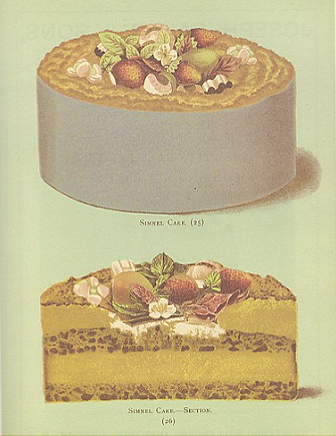
Easter meals were also a popular Victorian tradition. As we have seen at the very beginning of this reading, Easter was for many centuries far more important than Christmas. And thus it was at table too. Chief among the food associated with it in Great Britain in the XIXth century were new season lamb, paired with vegetable dishes (Pray, today let's pay respect to our lambs!). Accompanying them were hot chocolate buns and Easter breads. Additionally, egg dishes were served so as to not waste eggs from the easter egg hunts. As for cakes, particular favourite of the Victorians was the SIMNEL CAKE, 


The Victorian Book of Cakes: Treasury of Recipes, techniques and decorations from the golden age of cake-making: a classic Victorian book reissued for the modern reader 
by Lewis, T. Percy; Bromley, A. G.


a light fruit cake with eleven marzipan balls on top representing Jesus’ disciples (excluding Judas, who had infamously betrayed Jesus to the Romans).
By the way, we must say that in Avis' time it wasn't associated with Easter, but it was more a Mothering Sunday bake, being Mothering Sunday the fourth Sunday in Lent also named Refreshment Sunday of Lent, or Simnel Sunday – just after the cake. It was the day that children working away in service traditionally returned to their Mother Church and saw their families. Over the years Mothering Sunday has become a celebration of real mothers rather than the Mother Church, the largest church in the diocese. They were the Victorians who made of it the Easter Cake par excellence. Today Simnel Cake is enjoyed both on Easter Day and on Mothering Day. 


I'm leaving You with the best wishes for a serene remainder of your week
thanking You as usual for Your kindness and goodwill.
See you soon ❤


⊰ Tradizioni vittoriane legate alla primavera e alla Pasqua⊱ 


IMMAGINE DI COPERTINA - Da una cartolina pasquale tardo vittoriana

Per gran parte della storia la Pasqua è stata un giorno più festivo del Natale e, come è successo per le tradizioni di quest'ultimo che conserviamo ancora oggi, i vittoriani ci hanno portato anche l'evoluzione delle celebrazioni pasquali. Per loro nessuna stagione era celebrata come la primavera in quanto promessa di rinascita.
La Pasqua era solo l'inizio.


~ LA DOMENICA DELLA FIORITURA TRASFORMAVA I CIMITERI IN ZONE DI FESTA ~

Per essere più precisi, tutto cominciava con la Domenica della Fioritura. Nel Galles meridionale e nelle parti vicine dell'Inghilterra, la Domenica delle Palme è chiamata "Sul y Blodau" ("Domenica della fioritura") ed è tradizione decorare le tombe con fiori in quel giorno, specialmente nelle città e nei villaggi industriali. Gli studiosi Alan e Karen Jabbour hanno ipotizzato che la Domenica della Fioritura potrebbe essere collegata alle tradizioni di decorazione dei cimiteri tipica degli Appalachi.


IMMAGINE 2 - Dressing the grave with flowers di Thomas Onwyn (1853)


Le tradizioni di pulitura e decorazione dei cimiteri gallesi potrebbero essere iniziate come celebrazione pasquale o rito stagionale prima di diventare più comunemente associate alla Domenica delle Palme.
Il sito web Early Tourists in Wales cataloga i commenti dei turisti sul Galles da libri, riviste, giornali del XVIII e XIX secolo. Secondo Early Tourists in Wales, verso la metà del XIX secolo, la Domenica della Fioritura attirava grandi folle:
“Il numero di visitatori che hanno riferito di aver visitato i cimiteri era molto elevato (10.000 nel nuovo cimitero di Cardiff nel 1879, 20.000 nel 1889 e 50.000 nel 1898; 25.000 nel cimitero di Swansea nel 1906). Ci sono stati problemi con il controllo della folla che hanno portato alla necessità di polizia extra o alla distribuzione di biglietti solo a coloro che visitavano le tombe dei parenti. La richiesta di fiori per questa usanza era così grande che venivano inviati da Londra.
I cimiteri sono diventati un luogo dove incontrarsi e dove riunirsi per una festa o un pic-nic primaverile.
Potrebbe sembrare strano dal nostro punto di vista oggi immaginare i cimiteri come un luogo di festa. Ma essi offrivano una destinazione popolare per i pic-nic in un'epoca precedente alla creazione di parchi per le popolazioni urbane. I pic-nic erano molto popolari nei giorni festivi, specialmente a Pasqua o Pasquetta.


  ~ LE DECORAZIONI PASQUALI ~

Per quanto riguarda le chiese in cui le persone si recavano per le funzioni pasquali, esse venivano addobbate con fiori, così come lo erano le case. Le donne in particolare creavano pizzi e puntine con disegni floreali per coprire i loro tavoli e le loro mensole e vestivano le loro case con ghirlande, rami di alberi in fiore o mazzi di fiori: essi tendevano ad essere semplici ma, nella loro semplicità, belli come lillà, gigli, viole del pensiero e tulipani. 


~ I BIGLIETTINI AUGURALI ~

Era proprio l'inizio dell'era vittoriana quando Sir Rowland Hill creò il significato di Uniform Penny Post: infatti il gennaio 1840 segnò l'avvento dell'Uniform One Penny Postage Rate. Da allora le carte sono diventate un modo più economico che mai per rimanere in contatto, soprattutto nel periodo pasquale.


IMMAGINE 3 - Cartolina pasquale vittoriana


Venivano consegnati biglietti augurali con immagini simboliche come la croce o con immagini primaverili come agnelli e coniglietti. Essi erano generalmente stampati su carta dai colori vivaci per enfatizzare la natura felice e gioiosa della primavera. Le persone compravano le cartoline a un prezzo basso o ne creavano di proprie.


~ DIVERTIRSI TINGENDO, FACENDO ROTOLARE E CACCIANDO LE UOVA ~

Mentre le uova sono sempre state distribuite tra le persone, quelle di cioccolato sono state propriamente introdotte in epoca vittoriana. Il famoso cioccolatiere John Cadbury le aveva già progettate nel 1842, ma fu nel 1875 in particolare, che la sua azienda mise in commercio le Cadbury's Creme Egg.


IMMAGINE 4 - An Easter Holiday, the Children of Bloomsbury Parochial School in a Wood at Watford by James Aumonier, 1874


Le tradizioni della caccia alle uova di Pasqua e quella di farle rotolare lungo i pendii furono introdotte dalla Germania all'Inghilterra durante l'era vittoriana. I bambini vanno ancora a caccia di uova colorate, e quella che ne trova di più torna a casa vincitrice con un premio. Il rotolamento delle uova coinvolge i bambini che rotolano le uova lungo i declivi per vedere chi può rotolare il proprio uovo più lontano. Le uova venivano spesso non consumate durante la Quaresima, quindi le uova utilizzate nella caccia e nel rotolamento venivano mangiate la domenica di Pasqua.
Certo, le uova dovevano essere tinte giorni prima: per ottenere colori diversi le uova venivano bollite con foglie o cipolle. Se ne ottenevano di rosse facendole bollire con rezzole di cipolla e barbabietole, di dorate con fiori di calendula, di violette con fiori di malva e verdi con foglie di pervinca.
Durante la prima età vittoriana anche le uova di cartone erano spesso rivestite con pezzetti di raso e contenevano piccoli dolcetti.


  ~ I CAPPELLINI DI PASQUA E LA PARATA PASQUALE ~

Anche la parata pasquale come la conosciamo oggi ha origine nell'era vittoriana. I vittoriani erano persone molto devote e, dopo aver assistito alle funzioni pasquali, erano note per passeggiare per le strade sfoggiando i propri abiti primaverili. La tradizione del cappellino pasquale, nata durante il periodo Regency, divenne molto popolare proprio in questa epoca.
(QUI potete leggere il post che My little old world dedicò all'argomento).


IMMAGINE 5 - Cartolina raffigurante una giovane Lady che sfoggia il suo cappellino di Pasqua ed il suo nuovo abito della festa


Durante l'epoca vittoriana, un fidanzato poteva regalare un paio di guanti alla sua dolce metà. Se questa li indossava durante la sfilata, significava che accettava la sua proposta.
Una delle più grandi parate pasquali si svolge ancora oggi a New York City, dove fa parte della tradizione primaverile da oltre 100 anni. La Fifth Avenue dalla 49a alla 57a strada ospita dalle 10:00 alle 16:00 la domenica di Pasqua la più grande passeggiata di raffinatezza, comprese alcuni cappellini molto fantasiosi.


~ IL PRANZO DI PASQUA ~

Anche i pasti pasquali erano una popolare tradizione vittoriana. Come abbiamo visto proprio all'inizio di questa lettura, la Pasqua è stata per molti secoli molto più importante del Natale. E così lo era anche a tavola. Il primo tra i cibi ad essa associati in Gran Bretagna nel XIX secolo era l'agnello di nuova stagione, abbinato a piatti di verdure (Vi prego, rispettiamo i nostri agnelli oggi!). Ad accompagnarli c'erano focacce al cioccolato caldo e pani pasquali. Inoltre, venivano serviti piatti a base di uova per non sprecare le uova della caccia alle uova di Pasqua. Per quanto riguarda le torte, particolarmente apprezzata dai vittoriani era la SIMNEL CAKE,


IMMAGINE 6 - La SIMNEL CAKE tratta da The Victorian Book of Cakes: Treasury of Recipes, techniques and decorations from the golden age of cake-making: a classic Victorian book reissued for the modern reader di Lewis, T. Percy; Bromley, A. G.


una torta leggera alla frutta con undici palline di marzapane in cima che rappresentano i discepoli di Gesù (escluso Giuda, che lo aveva infamemente tradito consegnandolo ai romani).
A proposito, dobbiamo dire che ai tempi degli avi essa non era associata alla Pasqua, ma era più un dolce della Domenica della Madre, essendo la Domenica della Madre la quarta domenica di Quaresima chiamata anche Domenica del Ristoro di Quaresima, o Domenica di Simnel – nome mutuato dalla torta, appunto. Era il giorno in cui i bambini che lavoravano lontano da casa tornavano tradizionalmente alla loro Chiesa Madre e vedevano le loro famiglie. Negli anni la Domenica della Madre è diventata una festa delle vere madri piuttosto che della Chiesa Madre, la chiesa più grande della diocesi. Furono i vittoriani a farne il dolce pasquale per eccellenza. Oggi la SIMNEL CAKE si gusta sia il giorno di Pasqua che il giorno della Festa della Mamma.


 Vi lascio con i migliori auguri per un sereno prosieguo di settimana,
ringraziandoVi come sempre 
per la Vostra gentilezza e benevolenza.
A presto ❤


Dany


LINKING WITH:


domenica 12 febbraio 2017

A romantic tea for two.


“Surely everyone is aware of the divine pleasures which attend a wintry fireside; candles at four o'clock,
 warm hearthrugs, tea, a fair tea-maker, shutters closed,
curtains flowing in ample draperies to the floor,
whilst the wind and rain are raging audibly without.” 

 Thomas de Quincey (1785 - 1859), Confessions of an English Opium Eater


"Sicuramente tutti sono consapevoli dei piaceri divini che sono coinvolti nel sedersi davanti un caminetto in inverno; 
con le candele accese alle alle quattro del pomeriggio,
 i parafiamma incandescenti, il tè ed una graziosa fanciulla che lo prepara, le persiane chiuse,
tende ampiamente drappeggiate che raggiungono il pavimento,
mentre il vento e la pioggia si odono infuriare fuori. "

  Thomas de Quincey (1785 - 1859), Confessions of an English Opium Eater


Quale occasione migliore se non un romantico tè per due con cui festeggiare i nostri compleanni, separati da una sola settimana l'uno dall'altro, ed il giorno di San Valentino, per inaugurare il servizio vittoriano recato con tanto amore dall'Inghilterra da Susy, la dolcissima, amorevole amica che cura il blog SUSYCOTTAGE ?


Il camino del salone è acceso, Semplicità ed Amore sono nostri ospiti,


e ci sediamo intorno al fuoco, la cui luce da sola crea l'atmosfera giusta per ogni cosa od evento che comporti intimità familiare, seguendo il rituale descritto da Thomas de Quincey per gustare una tazza di tè caldo, la bevanda che come asseriva William Ewart Gladstone, Primo Ministro durante il Regno di sua Maestà la Regina Vittoria nominato per ben quattro volte per un totale di più di tredici anni di servizio:


“If you are cold, tea will warm you;
if you are too heated, it will cool you;
If you are depressed, it will cheer you;
If you are excited, it will calm you.” 


"Se avete freddo, il tè vi scalderà;
se siete troppo accaldati, vi rinfrescherà;
Se siete depressi, vi allieterà;
Se siete agitati, esso vi calmerà. "


E le candele ed i vecchi lumi a petrolio fanno il resto aggiungendo quel calore che arriva dritto al cuore.

Scoperto da fanciulla quando rappresentava una piacevole pausa ristoratrice durante i pomeriggi di studio, quello del tè è divenuto a pieno titolo un momento irrinunciabile per me, ritempra il mio animo, rasserena la mia mente, scalda il mio cuore ...

E quest'oggi ho voluto prepararlo usando il bollitore che tengo sulla vecchia stufa a legna in ghisa che abbiamo in  lavanderia - nella stagione fredda può essermi utile per asciugare i panni - accesa stamani per scaldare questa fredda giornata d'inverno.


Il servizio recatomi da Susy è completo di piattini da dolce e di piatto da torta, davvero una chicca d'altri tempi che solo il suo buon gusto poteva riuscire a trovare tra gli antiquari che periodicamente visita nella terra d'oltremanica dove si reca alla ricerca di rarità !


“There are few hours in life more agreeable 
than the hour dedicated to the ceremony 
known as afternoon tea.” 

― Henry James, The Portrait of a Lady


"Poche sono le ore della vita più gradevoli
di quella dedicata alla cerimonia
conosciuta come il tè del pomeriggio. "

- Henry James, The Portrait of a Lady


Ah, dimenticavo, noi oggi abbiamo inaugurato anche le nostre vecchie poltrone, appena rimesse a nuovo (abbiamo finito di tappezzarle stamani mattina ! )


E concluso questo delizioso intervallo romantico, auguro a tutti coloro che lo festeggiano un dolcissimo San Valentino ...


... e a chi non lo festeggia giunga gradito il mio più sincero e forte abbraccio !

A presto 💕


“Surely everyone is aware of the divine pleasures which attend a wintry fireside; candles at four o'clock,
 warm hearthrugs, tea, a fair tea-maker, shutters closed,
curtains flowing in ample draperies to the floor,
whilst the wind and rain are raging audibly without.” 


 Thomas de Quincey (1785 - 1859), Confessions of an English Opium Eater


- picture 1


What better occasion than a romantic tea for two with which to celebrate our birthdays, separated one another by only one week, and our Valentine's Day, to inaugurate the Victorian service brought with much love from England by Susy, the sweet, loving friend who cares the blog SUSYCOTTAGE ?


- picture 2


The fireplace in the living room is lit, Simplicity and Love are our Guests,


- picture 3


and we are sitting around it, the light of which, alone, creates the right atmosphere for every thing or event that involves family intimacy, following the ritual described by Thomas de Quincey to enjoy a cup of hot tea, that drink which, as said William Ewart Gladstone, Prime Minister during the reign of her Majesty Queen Victoria nominated for four times for a total of more than thirteen years of service:


“If you are cold, tea will warm you;
if you are too heated, it will cool you;
If you are depressed, it will cheer you;
If you are excited, it will calm you.” 


Candles and oil lamps do the rest by adding that warmth that arrives straight to our heart.

Discovered when I was a girl as a nice refreshing break during the afternoons of study, the afternoon tea has become fully an essential moment for me, it restores my soul, calms my mind, and warms my heart ...

And today I wanted to prepare it using the kettle that I keep on the old wood-burning cast iron stove that we have in our scullery - during the cold season it can be useful for drying clothes - on this morning to warm this cold Winter day.


- picture 4 - Our old stove in the scullery


- picture 5 - The old kettle is boiling


The set from Susy is complete with cake plates and a big cake-dish, truly a gem of ancient times that only her good taste could be able and find amongst the antiquarians whom she periodically visits in the land on the other hand of the Channel where she goes looking for rarity!


- picture 6 - Details on our tea-table


- picture 7 -  Details on our tea-table


- picture 8 -  Details on our tea-table


- picture 9 -  Details on our tea-table


- picture 10 - Our tea-table is ready


“There are few hours in life more agreeable 
than the hour dedicated to the ceremony 
known as afternoon tea.” 

― Henry James, The Portrait of a Lady


Oh, and today we also inaugurated our old armchairs, just broughtto a new life (we finished to coat them this very morning !)


- picture 11 - Hubby smoking his pipe


- picture 12 - Our armchairs with their 'new dress'


- picture 13 - Hubby smoking his pipe


and to conclude this delightful romantic interlude, I wish all those who are celebrating it a sweet Valentine's Day ...


- picture 14 - Amore


... And for those who doesn't celebrate the Day of Love, may it reach you welcome my most sincere and big hug!

See you soon 💕


LINKING WITH:

VALENTINE'S LINK PARTY


 I was featured 
by Marci at Stone Cottage Adventures !
Thank you sweet friend, you've made my day ❤

AMAZE ME MONDAY