domenica 4 dicembre 2022

Marija Alexandrovna Romanova, Queen Victoria's daughter-in-law who loathed Her


Loved and esteemed by Her people, or maybe we should say by the entire Old Continent, revered by Her whole family, by sons-in-law, daughters-in-law and grandchildren, Queen Victoria had close to her an acquired relative who didn’t love her very much, but who, indeed, loathed her: she was the wife of Alfred, her second son lovingly called 'Affie'.
The daughter-in-law who was hostile to Her was Marija Romanova, daughter of Tsar Alexander II and her consort, Maria of Hesse Darmstadt, who became Tsarina with the name of Maria Alexandrovna.
Princess Marija was born in Tsarskoe Selo on October 17, 1853; she had seven siblings, one girl and six boys, but her sister died in 1849 and she lost a brother too in 1865; thus she, the only girl remained, grew up with a strong character: she was the Tsar's favorite child. By all accounts she was very intelligent and well-educated, and besides Russian she spoke English, German and French perfectly. Being the Tzarina in poor health, she suffered from the Russian climate and therefore often went to visit her relatives in Germany with her three youngest children, Marija, Sergej and Pavel. It was 1868 when Marija met Alfred, Duke of Edinburgh, visiting her sister Alix, wife of the Grand Duke of Hesse:


The two young princes in 1868


he was an officer in the Royal Navy, always traveling around the world, and they won’t meet again until the summer of 1871, when the Tsar and the Tsarina, again in Darmstadt with their three younger children, met Alfred with his brother Albert, Prince of Wales, and his wife, Princess Alexandra.
Alfred was handsome, but very shy, and spent a lot of time together with Marija: although it was clear that a feeling was born between them, there were no agreements for an engagement. The families were against it: Queen Victoria thought the Russians to be barbarians while the Tsarina considered the English cold and unfriendly. The Tsar was doubtful: in Russia, after the Crimean war, a clear hostility towards the British was widespread, but the thing that worried him most was to lose his daughter, so he asked her to wait for a year. Thin news was received with enthusiasm by Queen Victoria who judged the matter concluded. The resumption of negotiations in January 1873 irritated Her not a little: the two youths had been presented with other candidates, but all were rejected, and so on July 11, Marija and Alfred got engaged.


Marija and Alfred in their engagment ufficial photograph


The Queen of the United Kingdom was left with nothing but to swallow her bitter morsel. To her daughter Vittoria, the Royal Princess, she will write "The murder is out"! 
As the beginning of a relationship between mother-in-law and daughter-in-law, not always easy in itself, it was not a harbinger of good prospects. When the time came to meet the future daughter-in-law, Vittoria, resigned, arranged for the young woman to be accompanied to Balmoral in Scotland. The Tsar proposed a meeting in Cologne which was rejected by Victoria: even if She was a queen and he an Emperor, Her will was worth more because She had been on the throne for longer, so he was the one who had to move. Victoria also refused the appointment of Her son as Colonel of a Russian Regiment promoted by Alexander II, considered an affront. Since he saw her daughter so in love, Alexander II ended up resigning himself to her marriage, but Vittoria showed no sympathy for this 'expansion' of her family.
The Tsar prepared for his daughter a trousseau of a magnificence never seen before, provided her with dowry and income, gave her priceless family jewels, including a parure that belonged to Catherine the Great, and, for the honeymoon of the couple, made prepare a luxurious apartment in the Alexander Palace Tsarkoe Selo, hoping they would settle in Russia.


Marija on her wedding day


Marija and Alfred got married in St. Petersburg on January 23, 1874, with two ceremonies, one Orthodox and one Anglican and, to the great sorrow of the Tsar, the couple decided to take up residence in England, in London, at Clarence House, where they arrived in March. Marija, the only Romanov to marry into the British royal family, had arrived in England with a lot of enthusiasm but, for several reasons, she was very disappointed. Vittoria welcomed the young Princess with apparent affection, although she believed her to be "not beautiful or graceful and she did not know how to behave herself " but her problems immediately began with the matter of rank. Marija, Imperial Highness by birth, was demoted to Royal Highness by marriage, which did not meet the Tsar's favor. After long discussions Marija was moved to second place, before the Royal Highnesses by birth but after Alexandra, Princess of Wales, born Alexandra of Denmark. Even the jewels of the Russian Princess were a cause of discontent as they created envy being many more and much more worthy of admiration than those of the Queen and Her daughters.


Clarence House


As for London and its royal residences, they appeared bare and gloomy to her eyes accustomed to the splendor of the Russian imperial palaces and they were also decidedly cold: this is because Victoria skimped on the heating and sent the servants to turn off the fireplaces Marija had lit up, as soon as she came out of the rooms. She also found the food terrible, and the Queen's frequent visits to Osborne, Windsor and Balmoral very boring and endless. Furthermore, the English did not like to see a Princess smoking in public, which was customary for Marija, but which was then only characteristic of men, and furthermore they judged her to be narrow-minded and unfriendly. At court she managed to establish a good emotional relationship only with Beatrice and Leopold: she did not like the Princess of Wales, she considered her ignorant, just as she judged her mother-in-law to be "a crazy and stupid old woman".


Queen Victoria with her daughter-in-law Marija and her last-born daughter Beatrice


Since the main purpose of royal marriages was to give birth to a lineage, Marija did her duty by giving Alfred five children (Alfred, Marie, Victoria Melita, Alexandra, Beatrice), but, despite the mutual love that, initially, animated the two young princes, theirs cannot be defined a happy union. In 1887 the family moved to Coburg: Alfred was the heir of his paternal uncle Ernest II - now elderly and childless - to the throne of the Duchy of Saxe-Coburg and Gotha, given the resignation of his brother Albert, Prince of Wales, destined to the throne of Great Britain. In 1893 Ernest II died and Alfred had to leave the Royal Navy, for which he had continued to serve, in order to take on the new role of Duke of Saxe-Coburg and Gotha. But without the possibility of traveling and forced into his family, he withdrew into himself, smoked and drank more and more, had extramarital affairs and the relations with his wife became very bad. Marija still kept the marriage going, at least in her appearances, happy with her role as Duchess, but the two were together only on official occasions and travels. On February 3, 1899, their first-born son Alfred, called ‘young Affie’,


'Young Affie' aged 20


shot himself and died 3 days later. It is correct to say that Queen Victoria and Her offspring were relatives with all the most important European courts: when he died he was the cousin of Tzar Nicholas II, of King George V of Great Britain, of Kaiser Wilhelm II. Some believe that this gesture was due to having contracted syphilis, others to some marriage negotiations going on when the boy was already secretly married and didn’t know how to get out of the situation. He was only 24 years old. Needless to say, Alfred blamed his wife for his son's suicide: he attributed this gesture to the bad education she had given him. In July of the following year Alfred left Marija a widow, who, forgetting old grudges, decided to return to England and assisted her mother-in-law until the last day of Hers, that was January 22, 1901. She still lived several years: those of the Great War, of the Russian Revolution, which brought about the decline of all her assets and reduced her to poverty, and of the dissolution of the old Duchy of Saxe-Coburg and Gotha. Forced to retire to Switzerland, Marija was a destroyed woman who had never recovered from the death of her son and described herself as disgusted by humanity. She'll die on October 25, 1920, of a heart attack, at the age of 67.


Hoping to have entertained you with interest and delight, 
Dearest Friends and Readers of mine,
I wish myself to have You here again 
to have another walk through History.
See you soon ❤  



Marija Alexandrovna Romanova, la nuora della regina Vittoria che la detestava


IMMAGINE 1 - Ritratto di Marija giovane donna


Amata e stimata dal suo popolo, o forse dovremmo dire dall’intero Vecchio Continente, venerata da tutta la sua famiglia, da generi, nuore e nipoti, la regina Vittoria aveva vicino a sé una parente acquistata che non provava alcun affetto per lei, ma che, anzi, la detestava: era la moglie di Alfred, il figlio maschio secondogenito, chiamato in famiglia ‘Affie’.
La nuora che le era ostile era Marija Romanova, figlia dello zar Alessandro II e della sua consorte, Maria d’Assia Darmstadt, divenuta zarina con il nome di Marija Alexandrovna.
Marija era nata a Tsarskoe Selo il 17 ottobre 1853; aveva sette fratelli, una femmina e sei maschi, ma la sorella era morta nel 1849 e un fratello lo perse nel 1865, per cui, unica femmina rimasta, crebbe con un carattere forte e volitivo da figlia prediletta dello zar. A detta di tutti era molto intelligente e colta, e oltre al russo parlava perfettamente inglese, tedesco e francese. Essendo la zarina di salute cagionevole, soffriva il clima russo e si recava spesso a trovare i parenti in Germania con i tre figli più piccoli, Marija, Sergej e Pavel. Era il 1868 quando Marija conobbe Alfred, duca di Edimburgo, proprio in Germania, dove era in visita a sua sorella Alix, moglie del granduca d’Assia: 


IMMAGINE 2 - I due giovani principi nel 1868


egli era ufficiale nella Royal Navy, sempre in giro per il mondo, e non si rividero fino all’estate del 1871, quando lo zar e la zarina, nuovamente a Darmstadt con i tre figli minori, vi incontrarono Alfred con il fratello Albert, principe di Galles, e sua moglie, la principessa Alexandra. 
Alfred era di bell’aspetto, ma molto timido, e trascorse molto tempo insieme con Marija; pur essendo chiaro che fra i due era nato un sentimento non vi furono accordi per un fidanzamento. Entrambe le famiglie erano contrarie: la regina Vittoria considerava i russi dei barbari mentre la zarina reputava gli inglesi freddi e poco simpatici. Lo zar era dubbioso: in Russia, a seguito della guerra di Crimea, era diffusa una palese ostilità verso gli inglesi, ma la cosa che maggiormente lo preoccupava era perdere la figlia, per cui le chiese di attendere un anno, cosa che riscosse l’entusiasmo della regina Vittoria che giudicava l’argomento accantonato. La ripresa delle trattative nel gennaio del 1873 la irritò non poco: ai due ragazzi erano stati presentati altri candidati, ma tutti furono rifiutati, e così l’11 luglio Marija ed Alfred si fidanzarono. 


IMMAGINE 3 - Marija e Afred nella foto ufficiale del loro fidanzamento


Alla regina del Regno Unito non rimase altro che 'bere dall'amaro calice'. Alla figlia Vittoria, principessa reale, scriverà: "The murder is out" (l’omicidio è compiuto)! Come inizio di una relazione tra suocera e nuora, già di per sé non sempre facile, non era un concetto foriero di buone prospettive. Giunto il momento d’incontrare Marija, Vittoria, rassegnata, stabilì che la giovane venisse accompagnata a Balmoral in Scozia. Lo zar propose piuttosto un incontro a Colonia che però venne rigettato da Vittoria: anche se lei era una regina e lui un imperatore, forse valeva di più la sua volontà poiché sul trono da più tempo, per cui era lui a doversi muovere. Rifiutò anche la nomina del figlio a Colonnello di un Reggimento russo promossa da Alessandro II, considerato un affronto. Poiché vedeva la figlia così innamorata, Alessandro II finì con il rassegnarsi al suo matrimonio, ma Vittoria non dimostrava alcuna simpatia verso questo ‘ampliamento’ della sua famiglia.
Lo zar fece preparare per la figlia un corredo di una magnificenza mai vista prima, la fornì di dote e rendita, le donò gioielli di famiglia inestimabili, compresa una parure appartenuta a Caterina la Grande, e, per la luna di miele degli sposi, fece preparare un lussuoso appartamento nel Palazzo Alessandro a Tsarkoe Selo, sperando che si stabilissero in Russia. 


IMMAGINE 4 - Marija fotografata il giorno del suo matrimonio


Marija e Alfredo si sposarono a San Pietroburgo il 23 gennaio 1874 con due cerimonie, una ortodossa e una anglicana e, con grande dolore dello zar gli sposi decisero di prendere residenza in Inghilterra, a Londra, presso Clarence House, dove arrivarono in marzo. Marija, la sola Romanov che entrò a far parte della famiglia reale inglese, era arrivata in Inghilterra con tanto entusiasmo ma, per più motivi, rimase molto delusa. Vittoria accolse la giovane principessa con apparente affetto, anche se riteneva che "non fosse bella o aggraziata e non sapesse comportarsi bene", ma i problemi cominciarono subito con le precedenze di rango. Marija, Altezza Imperiale per nascita, venne retrocessa ad Altezza Reale per matrimonio, cosa che non incontrò il favore dello zar. Dopo lunghe discussioni Marija venne spostata al secondo posto, prima delle Altezze Reali per nascita ma dopo Alexandra, principessa del Galles. Anche i gioielli della principessa russa furono motivo di malumori poiché crearono invidie essendo molti di più e ben più degni di ammirazione di quelli della regina e delle sue figlie. 


IMMAGINE 5 - Clarence House


Quanto a Londra e alle sue residenze reali, esse apparivano spoglie e tetre ai suoi occhi abituati allo sfarzo dei palazzi imperiali russi ed inoltre erano decisamente fredde: questo perché Vittoria lesinava sul riscaldamento e inviava la servitù a spegnere i caminetti fatti accendere da Marija non appena questa usciva dalle stanze. Trovava terribile anche il cibo e noiosissimi e interminabili i frequenti soggiorni della regina a Osborne, a Windsor e a Balmoral. Inoltre gli inglesi non amavano vedere una principessa fumare in pubblico, cosa che per Marija era consueta, ma che allora, in Inghilterra, era caratteristica solo degli uomini, ed inoltre la giudicavano, gretta e scostante. A Corte riuscì a stabilire un buon rapporto affettivo solamente con Beatrice e Leopoldo: la principessa del Galles non le piaceva, la reputava ignorante, così come giudicava sua suocera "una vecchia pazza e stramba". 


IMMAGINE 6 - La regina Vittoria con la nuora Marija e la figlia ultimogenita Beatrice


Visto che lo scopo principale dei matrimoni reali era quello di dar vita ad una discendenza, Marija fece il suo dovere dando ad Alfred cinque figli (Alfred, Marie, Victoria Melita, Alexandra, Beatrice), ma, nonostante l’amore reciproco che aveva animato in origine i due giovani principi, la loro non si poté definire un’unione felice. Nel 1887 la famiglia si stabilì a Coburgo: Alfred era erede dello zio paterno Ernesto II - ormai anziano e senza figli - al trono del Ducato di Sassonia-Coburgo e Gotha, data la rinuncia del fratello Albert, principe di Galles, destinato al trono di Gran Bretagna. Nel 1893 Ernest II morì ed Alfred dovette lasciare la Royal Navy, per cui aveva continuato a prestare servizio, al fine di assumere il nuovo ruolo di duca di Sassonia-Coburgo e Gotha. Ma senza avere più la possibilità di viaggiare e costretto in famiglia si chiuse in se stesso, fumava e beveva sempre di più, aveva relazioni extraconiugali e i rapporti con la moglie divennero pessimi. Marija teneva comunque in piedi il matrimonio almeno nelle apparenze, contenta del suo ruolo di duchessa, ma i due erano insieme solo nelle occasioni e nei viaggi ufficiali. Il 3 febbraio 1899 il figlio Alfred, chiamato in famiglia 'young Affie' (piccolo Affie)

IMMAGINE 7 - Il piccolo Affie fotografato a 20 anni


si sparò un colpo di pistola e morì 3 giorni dopo. Non è improprio dire he la regina Victoria e la Sua discendenza erano imparentati con le più importanti Corti europee: quando morì egli era cugino dello zar Nicola II, del re del Regno Unito Giorgio V e del Kaiser Guglielmo II. Qualcuno ritiene che il suo gesto disperato fosse dovuto all’aver contratto la sifilide, altri alle trattative matrimoniali del ragazzo che era invece già segretamente sposato e non sapeva come uscire dalla situazione. Aveva solamente 24 anni. Inutile dire che Alfred incolpò la moglie del suicidio del figlio: lo attribuiva alla cattiva educazione che ella gli aveva impartita. Nel luglio dell’anno seguente Alfred lasciò Marija vedova, la quale, dimenticando vecchi rancori, decise di tornare in Inghilterra ed assistette la suocera fino all’ultimo dei suoi giorni, il 22 gennaio 1901. Ella visse ancora diversi anni: quelli della Grande Guerra, della Rivoluzione russa, che procurò il declino di tutti i suoi beni e la ridusse in povertà, e della dissoluzione del vecchio Ducato di Sassonia-Coburgo e Gotha. Costretta a ritirarsi in Svizzera, Marija, che non si era più ripresa dalla morte del figlio, era una donna distrutta che si definiva disgustata dall’umanità. Morirà il 25 ottobre del 1920 a causa di un infarto all’età di 67 anni.


Nella speranza di avervi intrattenuti dilettevolmente e con interesse, 
Carissimi Amici e Lettori,
mi auguro di riaverVi ancora qui
per un'altra passeggiata nella Storia.
A presto ❤  


LINKING WITH:


venerdì 25 novembre 2022

The Oread Institute in Worcester (MASS.), the first College for Girls in History


Saturday, March 19, 1853, the GLEASON'S PICTORIAL of Boston read:

THE OREAD INSTITUTE, WORCESTER, MASS.,
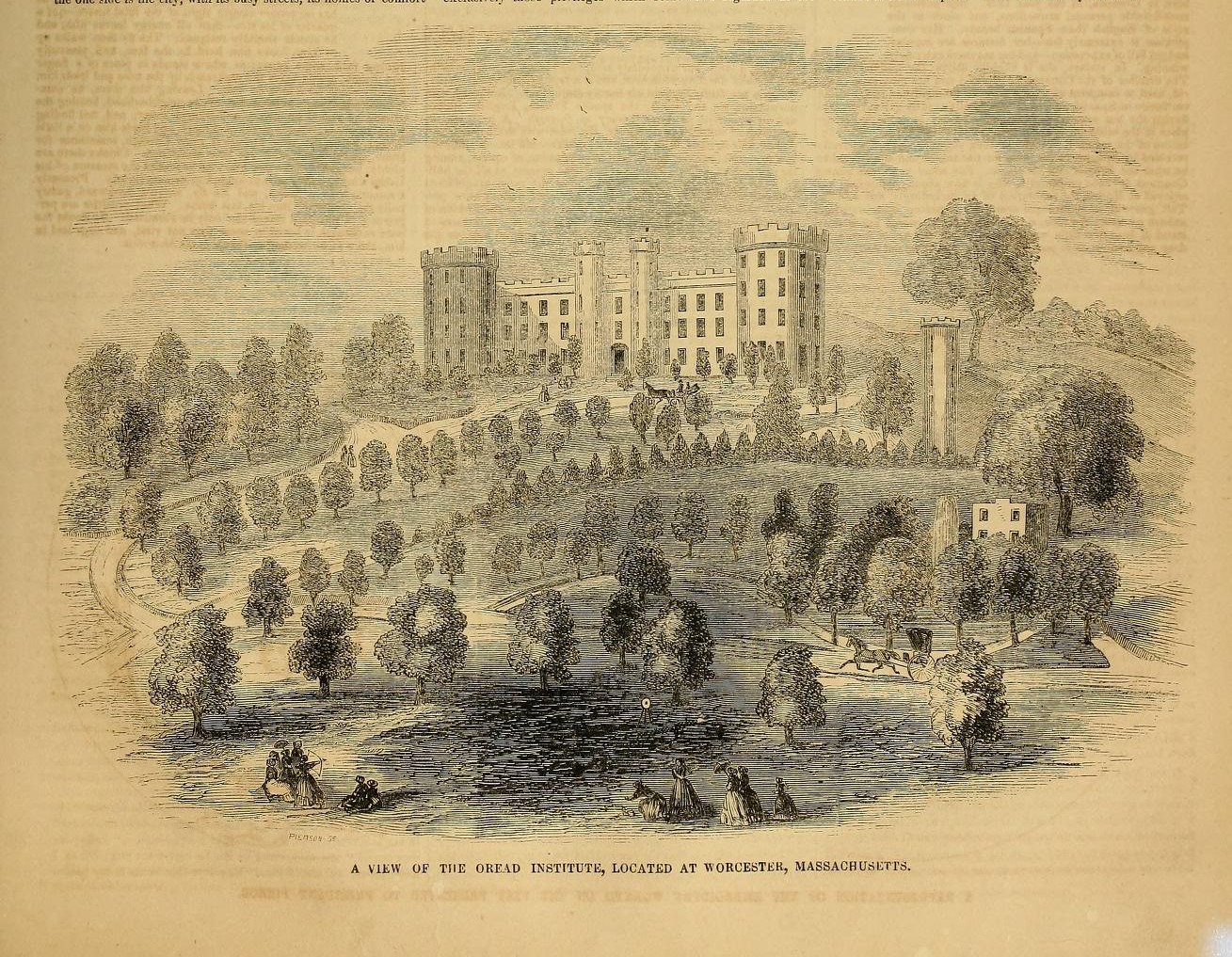
[...] is a Female Collegiate Seminary, founded in 1848, by Eli Thayer, A. M., the present Principal, and incorporated in 1851. The building is 250 feet in length, and affoids ample accommodations to 150 pupils. The walls are of stone, and varying in thickness from two to four feet. The whole structure is grand and imposing, reminding one of the feudal castles of the middle ages. This Institute has a commanding site, overlooking the beautiful city of Worcester and the surrounding country, so that the landscape spread to the view of the dwellers within was scarcely ever exceeded in beauty. On the one side is the city, with its busy streets, its homes of comfort and peace, and its heaven-pointing steeples, seen perchance be- neath the rising curtain of mist which morning lifts from the valley, or in the brightness of noontide, or in the mild radiance of the sunset's glory. On the other, is the open countiy, with its hills, its groves, and its vales, through which tlie streamlet wanders, softly singing to the music of the wind harp. And not brighter is the scene without the castle than within. There a band of sisters dwell together in perfect unity, rejoicing in the beautiful light of learning and love. Climbing together the steep sides of the "Hill of Science," each strives that time, in its swift flight, may bear some worthy record to the throne of God. Here woman enjoys exclusively those privileges which some have regarded as the rightful prerogative of the other sex, having the advantages of a collegiate course of study, if she chooses. And in the attainment of that to whic she has long aspired, she is happy. The stranger, passing through the almost endless halls, and glancing into the numerous and cheerful apartments of the castle, is gladdened by the sight of many happy countenances, and the beaming of eyes that reveal the powerful workings of the mind within. Nor is the moral nature neglected in the culture of the intellectual ; and the morning and evening prajer ascends from the grateful hearts of that loving band of sisters to a common Father; while day by day the blossoms of piety — the becoming ornaments of woman — are tended in an atmosphere of Chiristian charity and love. (p.177)

This is the high-sounding presentation of the institute that was read in perhaps the most popular newspaper in the entire New England region. Opened on May 14, 1848, when it was not yet fully completed, it had already reached the pinnacle of its fame.

 
Eli Thayer was born in Mendon, Massachussets, on June 11th, 1819 from Benjamin Thayer and Ruth Alden, daughter of Rev. Noah Alden of Bellingham. He received his early education  in the district schools of Mendon, at the  Bellingham  High  School,  and  in  the  Academy at  Amherst. He was prepared for college at the Worcester "Manual  Labor  School," afterwards  the Worcester Academy, and graduated from Brown in 1845, the Salutatorian of his class. On  his return to Worcester, the following autumn, he taught in the Worcester Academy and soon  became its Principal, but gave up this position in 1849 in order to assume the management of  his own new school, the Oread Institute, situated on the opposite hill. He was married in 1846 to Miss Caroline M. Capron of Millville, Massachussets, and had seven children. His five daughters, Clara, Ida, Eva, Cora and Anna, were all pupils at the Oread, and his eldest son, John Alden, was Principal of the school in 1879. His other son, George, went to live to New York City. Mr. Thayer died in Worcester, on April 15th, 1899. 

When Mr. Thayer looked for of a place for his institute, he thought Goat Hill to be perfect for the school he dreamed about: it was near enough to the city to make the literary, musical and church opportunities of the latter accessible, and it was, at the same time, quite a little outside of the very heart of it.

"To live in the city is one thing, and to live a long way out of it, where nothing is going on, not nearly so much as on a farm, and to be allowed to go to the city only at stated times, is quite another." wrote one of the new-comers at the Oread in the fall of 1855. In another letter written by a girl still arrived in the fifties we can read: "There seemed to be a charming freedom and a really poetic element in those days to the hill-top with such a boundless view in all directions, and such a full and enjoyable liberty in the inner life of the school," and also: "The scholars were all expected to spend an hour at least every day out of doors. How beautiful we thought that to be always, but in the bright June days with the whole country-side  around us it was ideal — perfect! And towards New Worcester, towards the wild open country, we had no limit to our walks if we returned in time for the next duties of school. One may well imagine the exquisite sense of freedom and enjoyment which this daily exercise gave to us young girls!"(p.11-12)

Actually when Eli Thayer decided to give life to a school for girls, it was a romantic age that inspiried him also from an architectural point of view, that of the serving knights and of ladies locked in the towers of magnificent castles waiting for who could save them: I'm talking about the Middle Ages. He dreamed of 

a building in the form of a quadrangle with an inner court about 170 feet square. Circular towers 50 feet in diameter and four stories high were to be placed at the four corners. These were to be connected by four halls, each three stories high  and 40 feet deep, the whole to be used for dormitories, recitation and lecture rooms, dining rooms, reception rooms, and other apartments which such an institution would require. The  building thus planned was  designed to accommodate about six hundred students, more than were then found in any American college. The foundation of the north  tower was laid in 1848 and the tower completed in 1849. The south tower was finished in 1850, and the east hall, connecting these two towers, in 1852, the whole having a frontage of  250  feet. The other parts included in the original plan were never begun. It is an interesting  fact that the stone used in the construction of the building was quarried from the hill on which it was to be erected. (p.1)

In fact if you look at the images above, you truly think them to come from a fairy tales book. They come from the book the title of which is HISTORY of The Oread Collegiate Institute, WORCESTER, MASS. (1849-1881) WITH BIOGRAPHICAL SKETCHES


and they date back to the '70s. 
But where does the name of this stunning castle come from? 
Oreade (Oread in English) was a nymph of the mountains and hills drawn from the classical literature who followed Diana (he read about her in Virgil's Aeneid).

The course of study includes a preparatory in an academical department, the latter occupying for years. In mathematics the students are taken through a thorough corse, including the Calculus. Natural science is illustrated by nature and art. Latin and Greek are studied with care. […] Art and poetry are carefully attended to and outside to study hours ornamentals have a due share of attention. Music has a high place in the curriculum. Drawing, painting, elocution and the art of composition have their proper place. Regular gymnastic exercises are engaged in by every pupil as a means of health as well as of graceful carriage. The study of German, Italian, Spanish is optional. The French language is part of the course, and in the advances classes recitations are conducted in French. The library contains about four thousand volumes. The social, moral and religious culture of the students is a matter of the utmost care. Bible study by the principle, together with family devotions, Bible-class and Sabbath services, while entire free, […] are directed to the religious and moral development of the mind and heart of the students. (p.123)

And how was a day at Oread Castle organized?
Here's what a pupil wrote in her own words:

"Breakfast was at 6.30 summer and winter. As we went to the dining  room each carried down her oil lamp to be filled and carried back when we went  from dinner. At breakfast while the rolls were coming in we each recited a verse of Scripture. After breakfast we had to care for our rooms. All the water used for toilet purposes had to be carried to their rooms by the girls themselves. For the first two or three years of the school it was brought from a spring, half way down the hill to the left. Afterwards we brought it from the dining room. Every morning before school began a certain time was set apart for each one in turn of every two occupants of a room to be in her chamber quite alone for whatever devotional purpose she chose. School was opened at half past eight, and morning devotions  were presided over by Mr. Thayer. Then followed recitations and study periods. At least an hour's recreation was required every day,  and this was, as has been said, usually taken in the form of rambles over the country roads and pastures to the southwards.

An attempt was made to introduce archery about this time, but for some reason it did not become popular and was soon given up. Evening devotions were presided over by the Preceptress, and at this time the roll was called and reports on conduct made. Friday evening we were all invited to an 'at home' in the parlor, were we were received by the teachers. We made a little change in our dress, principally by unbuttoning our sleeves and basting a muslin puff into the cap of the sleeves. Short sleeves in winter made our evening dress. Music, games, capping poetry and sometimes charades formed the entertainment. Capping poetry was one of Mr. Thayer's favorite diversions. He even gave his Geometry class  practice in it for a few moments every day, thinking it one of the best ways to stimulate the memory. Someone started a line of poetry, chosen at random, and anyone who could think quickest repeated another line which must begin with the letter with which the last quotation ended."

But these young women were prepared to their practical life too.

"Saturday there were no recitations. The morning was devoted to domestic matters. The laundry was made ready, and all who chose could go and do up their collars, ruffles and puff's. Each one must sweep and carefully dust her own room. In the afternoon we were supposed to do our mending, write letters, etc., and there were short study hours in the evening." (HISTORY of The Oread Collegiate Institute, WORCESTER, MASS. (1849-1881) WITH BIOGRAPHICAL SKETCHES, pp.14-15)

The school operated until 1881 when Eli Thayer's son, John Alden Thayer, director of the Oread Istitute then, took ill. Nobody took his place thus the collegiate was closed and the castle remained abandoned for several years. After 17 years it was opened the Oread Institute of Domestic Science. Although it has no connection of any kind with the Oread Collegiate Institute, yet Oread Castle was Oread Castle still to all who ever knew and loved it, and a brief account of its new occupants and the changes which have taken place in the Castle and its surroundings in the past cannot fail to be of interest to all who knew it in former days. After that school closed, the building spent many years as a Gothic ruin, crumbling before the eyes of the city. It's truly a pity that the city of Worcester decided to demolish it in the 1930s. Today the site remains an open space, preserving the memory of Oread Castle: its name is Oread Castle Park.


SOURCES:

GLEASON'S PICTORIAL

HISTORY of The Oread Collegiate Institute, WORCESTER, MASS. (1849-1881) WITH BIOGRAPHICAL SKETCHES

History of Worcester County, Massachusetts, embracing a comprehensive history of the county from its first settlement to the present time, with a history and description of its cities and towns (1879)


I sincerely hope not to have bored you with such a long tale, but I thought it to be so interesting and enjoyable to know about this institute which went down in history. 
And I wanted you to know that it's still remembered today in Worcester and, to be more precise, in the park which still bare the name of Oread Castle.
I thank you all from the deep of my heart!

See you soon 


L'Istituto Oread a Worcester (Massachusset), primo college femminile della storia


IMMAGINE 1 - FRONTESPIZIO RAFFIGURANTE UNA VEDUTA DELL'OREAD INSTITUTE, SITUATO A WORCESTER, MASSACHUSETTS, TRATTA DAL GLEASON'S PICTORIAL (18/03/1853)

Sabato 19 marzo 1853, sul GLEASON'S PICTORIAL di Boston si leggeva:

L'ISTITUTO OREAD, SITO A WORCESTER, NELLO STATO DEL MASSACHUSSETS,
[...] è un collegio di preparazione femminile, fondato nel 1848 da Eli Thayer, A. M., l'attuale preside, e legalmente riconosciuto nel 1851. L'edificio è lungo 250 piedi e offre ampie sistemazioni per 150 alunne. Le pareti sono di pietra e di spessore variabile da due a quattro piedi. L'intera struttura è grandiosa e imponente, e ricorda un castello feudale del medioevo. Questo istituto ha una collocazione imponente, che domina la bellissima città di Worcester e la campagna circostante, scelta per far sì che il paesaggio diffuso alla vista degli abitanti dall'interno non fosse quasi mai superata in bellezza. Da un lato vi è la città, con le sue strade trafficate, le sue case pacifiche e confortevoli, e i suoi campanili che puntano verso il cielo, visti forse sotto la cortina di foschia crescente che il mattino si solleva dalla valle, o nel chiarore del mezzogiorno, o nel mite splendore della gloria del tramonto. Dall'altra vi è la contea aperta, con le sue colline, i suoi boschetti e le sue valli, attraverso le quali vaga il ruscello, che canta dolcemente la musica dell'arpa del vento. E non più fulgida è la scena fuori del castello che dentro. Là un gruppo di sorelle abita insieme in perfetta unità, gioendo nella bella luce dell'apprendimento e dell'amore. Scalando insieme i ripidi pendii della "Collina della Scienza", ciascuno si impegna affinché il tempo, nel suo rapido volo, possa portare un degno ricordo al trono di Dio. Qui la giovine gode esclusivamente di quei privilegi che alcuni hanno ritenuto legittima prerogativa dell'altro sesso, avendo i vantaggi di un corso di studi collegiale, se lo desidera. E nel raggiungimento di ciò a cui ha a lungo aspirato, ella è felice. Un estraneo, passando per le sale quasi infinite, e guardando nei numerosi e allegri appartamenti del castello, è rallegrato dalla vista di molti volti felici e dal bagliore degli occhi che rivelano il potente lavoro della mente. Ma la natura morale non è trascurata nella cultura dell'intellettuale; e la preghiera mattutina e serale ascende dai cuori grati di quell'amoroso gruppo di sorelle a un Padre comune; mentre giorno dopo giorno i fiori della pietà — ornamenti divenuti della donna — sono curati in un'atmosfera di carità e di amore cristiani. (p.177)

Questa l'altisonante presentazione dell'istituto che si leggeva sul quotidiano forse più divulgato dell'intera regione del New England. Aperto il 14 maggio del 1848, quando ancora non era stato del tutto ultimato, aveva già raggiunto l'apice della sua fama. 

IMMAGINE 2 SULLA SINISTRA: Eli Thayer da giovane

Eli Thayer nacque a Mendon, Massachussets, l'11 giugno 1819, da Benjamin Thayer e Ruth Alden, figlia del Rev. Noah Alden di Bellingham. Ricevette la sua prima educazione nelle scuole distrettuali di Mendon, alla Bellingham High School e all'Accademia di Amherst. Fu preparato per il college presso la "Manual Labor School" di Worcester, in seguito all'Accademia di Worcester, e si diplomò alla Brown nel 1845, il "Salutatorian" (secondo per voto) della sua classe. Al suo ritorno a Worcester, l'autunno successivo, insegnò all'Accademia di Worcester e ne divenne presto il preside, ma rinunciò a questa posizione nel 1849 per assumere la direzione della sua nuova scuola, l'Oread Institute, situata sulla collina di fronte. Si sposò nel 1846 con la signorina Caroline M. Capron di Millville, Massachusetts, ed ebbe sette figli. Le sue cinque figlie, Clara, Ida, Eva, Cora e Anna, erano tutte allieve dell'Oread e suo figlio maggiore, John Alden, ne divenne il preside nel 1879. L'altro figlio, George, andò a vivere a New York City. Eli Thayer morì a Worcester, il 15 aprile 1899.

Quando Mr.Thayer cercò un luogo in cui collocare il suo istituto, pensò che Goat Ill fosse perfetto per la scuola dei suoi sogni: era vicino alla città quanto bastava perché venissero colte opportunità d'incontri in ambito letterario, musicale ed ecclesiastico, ed era, al tempo stesso, lontano dal cuore pulsante di essa. 

"Vivere in città è una cosa, vivere molto lontano da essa, dove non succede niente, ma proprio lontanamente come si fosse in una fattoria, e poter andare in città solo a orari prestabiliti, è tutt'altro." scriveva uno dei nuovi arrivati ​​all'Oread nell'autunno del 1855. In un'altra lettera scritta da una ragazza arrivata sempre negli anni cinquanta si legge: "Sembrava vi fosse un'incantevole libertà ed un elemento realmente poetico in quei giorni vissuti sulla vetta della collina con una vista così sconfinata in tutte le direzioni, e una libertà così piena e piacevole anche nella vita interna della scuola", e ancora: "Gli studiosi attendevano tutti di trascorrere almeno un'ora ogni giorno all'aperto. Pensavamo che fosse sempre bellissimo, ma nelle luminose giornate di giugno con tutta la campagna che ci circondava era l'ideale, era perfetto! E verso New Worcester, verso l'aperta campagna selvaggia, non avevamo limite nelle nostre passeggiate se tornavamo in tempo per gli impegni scolastici che ancora ci attendevano. Si può ben immaginare lo squisito senso di libertà e di divertimento che questo esercizio quotidiano dava a noi giovani ragazze!" (p.11-12)

In realtà quando Eli Thayer decise di dar vita a una scuola per ragazze, fu ispirato da un'era romantica anche da un punto di vista architettonico, quella dei cavalieri serventi e delle dame chiuse nelle torri di magnifici castelli in attesa di chi potesse salvarle: sto parlando del Medioevo. Egli sognava

un edificio a forma di quadrilatero con corte interna di circa 16 metri quadrati. Ai quattro angoli dovevano essere collocate torri circolari di poco più di 15 metri di diametro e alte quattro piani. Queste dovevano essere collegate da quattro sale, ciascuna alta tre piani e profonda 12 metri, il tutto da utilizzare per dormitori, sale di recitazione e conferenze, sale da pranzo, sale di ricevimento e altri appartamenti che una tale istituzione avrebbe richiesto. L'edificio così progettato era concepito per accogliere circa seicento studenti, più di quanti se ne trovassero allora in qualsiasi college americano. Le fondamenta della torre nord furono posate nel 1848 e la torre fu completata nel 1849. La torre sud fu terminata nel 1850 e la sala est, che collegava queste due torri, nel 1852, il tutto con una facciata di 250 piedi. Le altre parti previste dal progetto originario non furono mai iniziate. La cosa interessante è che la pietra utilizzata nella costruzione dell'edificio fu estratta dalla collina su cui doveva essere eretto. (pag.1)

Infatti, se guardate le immagini qui sotto, viene davvero da pensare che siano tratte da un libro di fiabe. Esse provengono da un libro intitolato HISTORY of The Oread Collegiate Institute, WORCESTER, MASS. (1849-1881) WITH BIOGRAPHICAL SKETCHES e risalgono agli anni '70 del 1800

IMMAGINE 3 ED IMMAGINE 4: L'Oread Castle visto dall'esterno

Ma da dove proviene il nome di questo incantevole castello?
Oreade (Oread in inglese) era una ninfa delle montagne e delle colline tratta dalla letteratura classica che succedette a Diana (egli ne lesse nell'Eneide di Virgilio).

Il corso di studi prevede una propedeutica in un dipartimento accademico, che occupa alcuni anni. In matematica gli studenti seguono un corso approfondito, compreso il calcolo. La scienza naturale è illustrata dalla natura e dall'arte. Il latino e il greco sono studiati con cura. […] L'arte e la poesia vengono affrontate con cura e, al di fuori delle ore di studio, le piante ornamentali hanno la dovuta parte di attenzione. La musica occupa un posto importante nel curriculum. Il disegno, la pittura, l'elocuzione e l'arte della composizione hanno la dovuta importanza. Regolari esercizi ginnici sono praticati da ogni allieva come mezzo per la salute oltre che per l'acquisizione di un portamento aggraziato. Lo studio del tedesco, dell'italiano e dello spagnolo sono facoltativi. La lingua francese fa parte del corso e nelle classi avanzate le recitazioni sono condotte in francese. La biblioteca contiene circa quattromila volumi. La cultura sociale, morale e religiosa degli studenti è oggetto della massima cura. Lo studio biblico prende avvio dal principio e, insieme alle devozioni familiari, alle lezioni bibliche e ai servizi del sabato, pur se completamente gratuiti, […] sono diretti allo sviluppo religioso e morale della mente e del cuore degli studenti. (pag.123)

E come era organizzata una giornata all'Oread Castle?
Ecco cosa scisse un'allieva con parole sue:

"La colazione era alle 6.30 sia d'estate che d'inverno. Mentre andavamo in sala da pranzo, ognuna portava giù la propria lampada a olio perché fosse riempita per riportarla nella stanza conclusa la cena. A colazione, mentre arrivavano i panini, ognuna di noi recitava un versetto tratto dalle Scritture. Dopo colazione dovevamo occuparci delle nostre stanze - tutta l'acqua usata per i servizi igienici doveva essere portata nelle stanze dalle ragazze stesse: per i primi due o tre anni di scuola veniva presa da una sorgente situata a metà del collina a sinistra. Successivamente l'abbiamo presa dalla sala da pranzo. Prima dell'inizio delle lezioni, ogni giorno veniva dato a ciascuna di noi un certo tempo da poter dedicare all'attività devozionale che avevamo scelto; a turno di due per volta venivamo, perciò, lasciate nella nostra stanza per il tempo stabilito. La scuola veniva aperta alle otto e mezza e le devozioni mattutine erano presiedute dal signor Thayer in persona, seguivano poi le recitazioni e lo studio. Ogni giorno ci spettava almeno un'ora di ricreazione, che, come si è detto, si trascorreva di solito gironzolando sulle strade di campagna e sui pascoli verso sud.

IMMAGINE 5: Alcune studentesse fotografate durante il tempo trascorso all'aperto in ricreazione

Fu fatto un tentativo di introdurre il tiro con l'arco in questo periodo, ma per qualche motivo non divenne popolare e venne presto abbandonato. Le devozioni serali erano presiedute dalla Precettrice, e, in quell'occasione, veniva fatto l'appello e redatti i rapporti sulla condotta che le allieve avevano tenuto durante la giornata. Venerdì sera eravamo tutte invitate ad un amichevole raduno in salotto, dove venivamo ricevuti dagli insegnanti. Per l'occasione, apportavamo una piccola modifica al nostro vestito, principalmente sbottonando le maniche e imbastendo un volant di mussola nella parte di manica avvolta su sé stessa. Le maniche corte in inverno facevano del nostro abito un abito da sera. Musica, giochi, poesie e talvolta sciarade costituivano l'intrattenimento con cui ci deliziavamo allora. La poesia di chiusura era uno dei diversivi preferiti del signor Thayer, che mirava ad irrobustire la memoria. Ci faceva persino pratica di geometria per alcuni istanti ogni giorno, pensando che fosse uno dei modi migliori per stimolarla. Qualcuno iniziava citando il verso di una poesia, scelto a caso, e chi riusciva a pensare più velocemente ripeteva un altro verso che doveva cominciare con la lettera con cui terminava l'ultima citazione."

Ma queste giovani donne erano preparate anche alla vita pratica che avrebbero dovuto affrontare da adulte.

"Sabato non vi erano recitazioni. La mattinata era dedicata alle faccende domestiche. Si preparava la biancheria da lavare e chi voleva poteva andare ad aggiustarsi colletti, balze e sbuffi. Ciascuna doveva spazzare e spolverare con cura la propria stanza. Nel pomeriggio dovevamo provvedere a rammendare, scrivere lettere, ecc., e c'erano brevi ore di studio la sera." (HISTORY of The Oread Collegiate Institute, WORCESTER, MASS. (1849-1881) WITH BIOGRAPHICAL SKETCHES, pp.14-15)

La scuola operò fino al 1881 quando il figlio di Eli Thayer, John Alden Thayer, allora direttore dell'Oread Institute, si ammalò. Nessuno prese il suo posto così l'istituto venne chiuso e il castello rimase abbandonato per diversi anni. Dopo 17 anni fu aperto l'Oread Institute of Domestic Science. Sebbene non avesse alcun legame di alcun tipo con l'Oread Collegiate Institute, l'Oread Castle era ancora il l'Oread Castle per tutti coloro che lo conoscevano e lo amavano; e un breve resoconto dei suoi nuovi occupanti e dei cambiamenti che hanno avuto luogo nel Castello e nel suo circondario in passato non poteva non interessare tutti coloro che l'hanno conosciuto. Dopo la chiusura di quella scuola, l'edificio trascorse molti anni come un rudere gotico, crollando a poco a poco davanti agli occhi della città. È davvero un peccato che la città di Worcester abbia deciso di demolirlo negli anni '30. Oggi il luogo rimane uno spazio aperto che conserva la memoria dell'Oread Castle: il suo nome è Oread Castle Park.


Spero sinceramente di non avervi annoiato con un racconto così lungo, ma ho pensato che fosse così interessante e gradevole conoscere da vicino questo istituto passato alla storia. E sapere che ancora oggi è ricordato. 
Ringrazio tutti voi dal profondo del cuore!

A presto 


LINKING WITH: 


martedì 15 novembre 2022

VICTORIAN LADIES' WORKS OF ART: Making Jewels with Hair


If you do reflect upon it, nothing lasts forever...

Sometimes a love ends,

sometimes a friendship fades away...

How many bonds can deteriorate.

But cut a lock of hair to the person you love,

and it will keep its color, her light for decades,

indeed, even for centuries. 


The Victorians taught us that. In fact, the art of working human hair, one of the many traditions of the XIXth century, has come down to us as if it had remained frozen in time. And My Little Old World has already mentioned it to you by discussing, some time ago, the importance that, in the collective imagination, female hair had in the Victorian era, so much so that, if their robustness allowed it, they were not cut for a whole life.


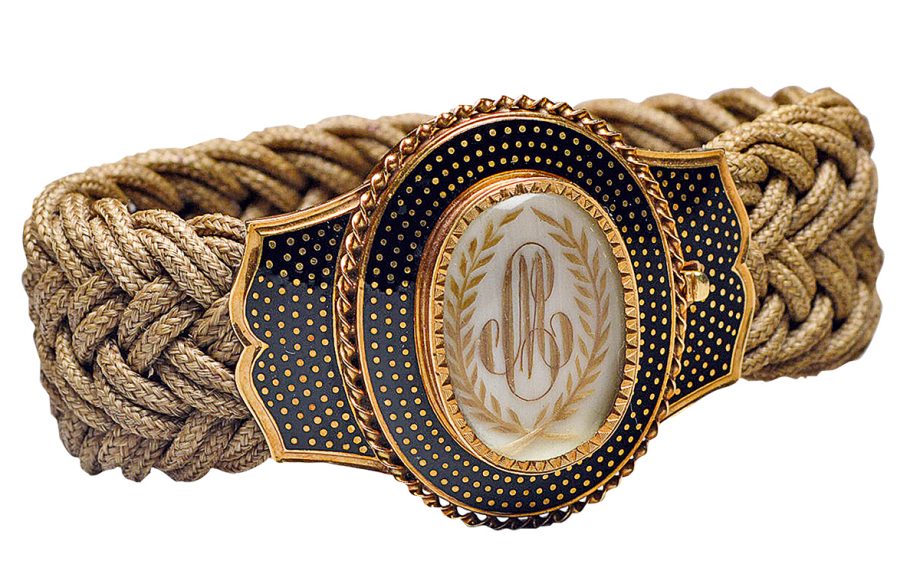
Back then, locks of hair were wisely woven into jewels, wrapped around themselves to resemble flower petals, even ground to be used in pigments and what we find ourselves today to confront with are authentic masterpieces made to defeat the laws of existence. The hair of a loved one, and who had been lost, was preserved as a memento mori already during the Shakespearean period and probably from well before eras. In fact, in some Egyptian tombs there are frescoes that seem to represent scenes in which pharaohs and queens exchange locks of hair as a sign of love. From 1600-1700 a sort of cult, aimed at preserving the memory of deceased loved ones, began: at that time infant mortality was very high, but also that of adults reached exorbitant numbers. And making personal objects, especially jewelry, with locks of their hair, gradually became a custom. But in the Victorian era, this art, which became more and more widespread and practiced, was mainly aimed at making paintings with family trees, objects to be exchanged as a token of love or friendship, frames for portraits, etc. using the hair of people who were still alive. It was not unusual that to be wowen were hair of different colors because it belonged to different people, perhaps united by a family bond: for example, a gift given to a father by three daughters of his. It could also have been a simple bookmark, but to insert it in a journal assumed the meaning of having with you the true essence of who had donated that hair. In the image below, a tree represents an American Methodist congregation: the shoots covering the branches are made with the hair of each member who was part of it.


From the collection of John Whitenight and Frederick LaValley. Photo by Alan Kolc. Courtesy of the College of Physicians of Philadelphia and the Mütter Museum


And here they are some other jewels and a framed drawing to hang to a wall belonging to private collections.


It is likely that they were, above all, the Victorian ladies who devote themselves to this art, which today appears so unusual to us and which reached the peak of its diffusion around 1850; probably it was a parlor pastime, as it was making wax flowers (click HERE to read the post that My Little Old World dedicated to this topic), to embroider, to sew, to create photocollages (click HERE to read the post that My Little Old World dedicated to this topic). But among all the artistic works mentioned, the one who worked human hair was certainly the most particular, that which required much skillness and that only high-ranking people could afford: not everybody could buy what it was needed and, let's remember it, many were the women who had to work to support their families and certainly they had no way to think about leisure.

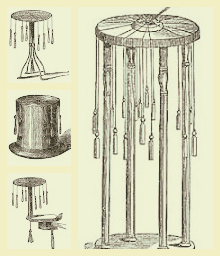
To wrap the strands of hair it was necessary to have a working table with a circular base that had to meet certain requirements. In reality there were several types of braiding tables: one was made in the shape of a pouf and was named ladies' table; it could be used while seated, but often cluttered to the point of hindering the lady who was sitting beside. The other had longer legs and was a full-fledged perch table, but it was more inconvenient to work on it because you had to lean forward. There was still another, the smallest one, which had to be anchored to a side of a table. But there were also those ladies who were clever enough to simply use an inverted cylindrical container, or a hat, on the bottom of which, in the center, they had made a hole; various pieces of twine branched off from it as many as they were required by the pattern they'd chosen, and the strands were tied to them. At the head of each piece of twine they were tied wooden shuttles or lead weights to use them easily. Finally, special patterns, collected in catalogs or manuals, were a valid help to create these very complex artistic objects. The image below represents the cover of the best known, and probably most used one, dating back to 1870.


A. Bernhard & Co. Catalogue, 1870 Manufacturers of Diamond Work & Ornamental Hair Jewelry importers of German Jewelry, Watches, Diamonds, etc.etc.
169 Broadway, Gilsey Building, Rm. 3 New York


But the more sophisticated families and the less industrious ladies went to real artisans who had handed down this art for generations. Unfortunately the names of the various artists have not reached us and all the works that have been preserved are anonymous.
The first thing to do was to prepare the hair strands by properly cleansing them following some instructions with much care. The following are taken from a 1850s serie of issues of The Godey’s Lady’s Book

Sort the tress, which is about to be used, into lengths, tie the ends firmly and quite straight with pack thread, put the hair into a small saucepan with about a pint and a half of water, and a piece of soda of the size of a nut, and boil it for a quarter of an hour or twenty minutes; take it out, shake off the superfluous moisture, and hang it up to dry, but not near a fire.”

When it has become perfectly dry, divide it into strands containing from twenty to thirty hairs each, according to the fineness of the hair or the directions given for the pattern about to be worked. It must be observed that every hair in the strand should be of the same length, and the strands should be all of an equal length.” 

"Knot each end of each strand, then take the requisite number of leaden weights, weighing about three quarters or half an ounce each, and affix about a quarter of a yard of pack thread to each of them; lay them down side by side on the table, and to the other ends of the pack thread affix the strands of hair already prepared, knotting them on with a weaver's or sailor's knot; care must be taken all this time to prevent any entanglement or derangement of the hair."

"The other ends of the strands must now be gathered together, firmly tied with pack thread, and then gummed with a cement composed of equal parts of yellow wax and shellac melted together and well amalgamated, and then rolled into sticks for use. We now come to the table and the arrangement of the strands on it."

And thus had come the time to proceed following the creativity or the chosen models, letting oneself be guided by the patterns.


Here you are some pages from the A. Bernhard & Co. Catalogue, 1870 Manufacturers of Diamond Work & Ornamental Hair Jewelry representing some models of jewels or small keepsakes in hair


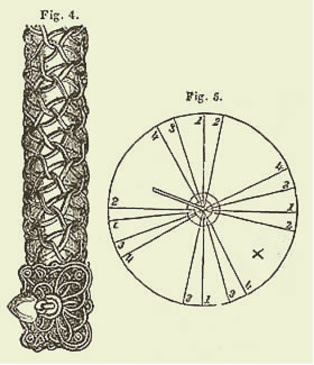
I don't go into the descriptive details of every single pattern because they look like real puzzles just reading them; I limit myself to publishing some images and just the starting indications, always taken from the same issues of The Godey's Lady's Book, so that you can at least realize what these ladies of ours were capable of:


A PATTERN FOR A BRACELET (Fig. 4.)

"Sixteen strands of twenty-five or thirty hairs each, according to the fineness of the hair. For this pattern the strands must be arranged in fours, and numbered."


CHAIN OR GUARD PATTERN (Fig. 6.)

"Ten strands only, of about twenty hairs each, are required for this. They must be arranged thus."


A PATTERN FOR A CHAIN OR A GUARD (Fig. 2.)

"For this pattern, sixteen strands, each consisting of about twenty hairs, are required. These must be arranged in pairs on the circle on the table, at equal distances, and so that the opposite pairs shall be in direct lines with each other."


And I'm stopping here, Victorian ladies were much more patient and ingenious than us, that's sure! But it must be said that they could afford to devote much more time to leisure than we can dedicate to it today, perhaps this is what we lack most, alas!


Thanking you with all my heart for following me up to here,
I'm giving you an appointment at the next post,
while sending you much love.
See you soon ❤  


LE OPERE D'ARTE REALIZZATE DALLE LADIES VITTORIANE: Gioielli creati con capelli veri


IMMAGINE 1 - Orecchini fatti con capelli veri montati su oro

Se ci pensate bene, nulla dura per sempre...

Talvolta finisce un amore,

talvolta si logora un'amicizia...

Quanti legami possono deteriorarsi.

Ma tagliate una ciocca di capelli alla persona che avete cara,

ed essa manterrà il suo colore, la sua luce per decenni,

anzi, persino per secoli.


Ce lo hanno insegnato i Vittoriani. Infatti l'arte che lavorava capelli umani, una delle numerose tradizioni del XIX° secolo, è giunta fino a noi come fosse rimasta congelata nel tempo. My Little Old World ve ne ha già fatto cenno trattando, tempo fa, dell'importanza che, nell'immaginario collettivo, avevano, in epoca vittoriana, i capelli femminili tanto che, se la loro robustezza lo consentiva, non si tagliavano per una vita intera. 


IMMAGINE 2 - Lady vittoriana con la sua lunga chioma


A quel tempo ciocche di capelli venivano sapientemente intrecciate in gioielli, avvolte su sé stesse per assomigliare a petali di fiori, persino macinate per essere utilizzate in pigmenti e ciò con cui ci troviamo a confrontarci oggi  sono autentici capolavori realizzati per sconfiggere le leggi dell'esistenza. I capelli di una persona amata, e che si era perduta, erano conservati come memento mori già a partire dal periodo shakespeariano e probabilmente da epoche ben antecedenti. In alcune tombe egizie si trovano, infatti, affreschi che sembrano rappresentare scene in cui faraoni e regine si scambiano ciocche di capelli in segno d'amore. Dal 1600-1700 prese avvio una sorta di culto volto a preservare il ricordo dei cari deceduti: allora era altissima la mortalità infantile, ma anche quella degli adulti raggiungeva cifre esorbitanti. E fabbricare oggetti personali, soprattutto gioielli, con ciocche della loro chioma, divenne a poco a poco una consuetudine. Ma in epoca vittoriana, questa arte che divenne sempre più diffusa e praticata, era più che altro volta a fabbricare quadri con alberi genealogici, a confezionare oggetti da scambiare come pegno d'amore o d'amicizia, ad incorniciare ritratti, etc. utilizzando chiome di persone ancora in vita. Non era inusuale che venissero intrecciati capelli di colori differenti perché appartenenti a persone diverse, magari unite da un legame di parentela: per esempio un dono fatto ad un padre da tre figlie. Poteva anche trattarsi di un semplice segnalibro, ma inserirlo in un diario personale assumeva il significato di avere con sé la vera essenza di chi aveva donato quei capelli. Nell'immagine qui sotto un albero rappresenta una congregazione metodista americana: i germogli che ne rivestono i rami sono fatti con i capelli di ciascun membro che ne faceva parte.


IMMAGINE 3 - Dalla collezione di John Whitenight e Frederick LaValley. Fotografia di Alan Kolc. Courtesy of the College of Physicians of Philadelphia and the Mütter Museum


Ed eccovi altri monili ed un disegno incorniciato e da conservare appeso ad una parete come ornamento che fanno parte di collezioni amatoriali.


IMMAGINI 4-5-6-7-8-9


Si suppone che a dedicarsi a quest'arte, che oggi ci appare così inconsueta e che raggiunse il culmine della sua diffusione attorno al 1850, fossero soprattutto le ladies vittoriane e che si trattasse di un passatempo da salotto, così come lo erano fabbricare fiori di cera (clicca QUI per leggere il post che all'argomento ha dedicato My Little Old World), ricamare, cucire, creare photocollages (clicca QUI per leggere il post che all'argomento ha dedicato My Little Old World).
Ma tra tutti quelli menzionati, quello che lavorava capelli umani era di sicuro il lavoro artistico più artificioso e che potevano permettersi solamente persone altolocate, non fosse altro per ciò di cui ci si doveva munire per realizzare intrecci di ogni tipo. Non tutti potevano acquistare ciò che occorreva e, ricordiamolo, molte erano le donne che dovevano lavorare per sostentare la propria famiglia e non avevano di certo modo di dedicarsi ad occupazioni dilettevoli.


IMMAGINE 10 A SINISTRA - Esempi dei vari tavoli da lavoro utilizzati per intrecciare capelli


Per avvolgere su sé stessi i capelli era necessario munirsi di un tavolino da lavoro con base circolare che doveva rispondere a determinati requisiti. In realtà ne esistevano diversi tipi: uno era fatto a forma di pouf e veniva chiamato ladies' table - tavolino per signore; poteva essere utilizzato stando seduti, ma spesso ingombrava al punto da impicciare la dama che era seduta accanto. L'altro aveva gambe più lunghe ed era un tavolino fatto a trespolo a tutti gli effetti, ma era più scomodo lavorarvi perché si doveva stare protratti in avanti. Un altro ancora, il più piccolo, veniva ancorato su di un lato di un tavolo. Ma vi era anche chi si ingegnava ed usava semplicemente un contenitore cilindrico rovesciato, o un cappello, sul cui fondo, al centro, aveva praticato un foro; da esso si diramavano i vari fili di spago, cui venivano legate le ciocche di capelli, a capo dei quali erano fissate delle navette in legno o pesi di piombo per impugnarli agevolmente. Appositi schemi erano, infine, un valido aiuto per realizzare questi oggetti artistici così tanto complessi, ed erano raccolti in cataloghi o manuali. L'immagine riportata di seguito rappresenta la copertina di quello più noto, e probabilmente il più utilizzato, risalente al 1870.


IMMAGINE 11 - A. Bernhard & Co. Catalogue, 1870 Manufacturers of Diamond Work & Ornamental Hair Jewelry importers of German Jewelry, Watches, Diamonds, etc.etc.,169 Broadway, Gilsey Building, Rm. 3 New York


Ma le famiglie più sofisticate e le ladies poco operose si rivolgevano a veri e propri artigiani che si tramandavano questa arte da generazioni. Purtroppo i nomi dei vari artisti non sono pervenuti a noi e  tutte le opere che si sono conservate sono anonime.
La prima cosa da fare era preparare le ciocche di capelli detergendole adeguatamente seguendo scrupolosamente alcune istruzioni. Le seguenti sono tratte da alcuni numeri del  del Godey's Lady's Book risalenti agli anni '50 del 1800:

"Separare la treccia, che sta per essere utilizzata, in lunghezze, legare le estremità saldamente e abbastanza dritte con filo da impacco, mettere i capelli in una piccola casseruola con circa mezzo litro d'acqua e un pezzo di soda della dimensione di una noce e fare bollire per un quarto d'ora o venti minuti; tirare fuori i capelli, scrollare via l'umidità superflua e appenderli ad asciugare, ma non vicino al fuoco."

"Quando saranno diventati perfettamente asciutti, dividerli in ciocche contenenti da venti a trenta capelli ciascuna, secondo la finezza del capello o le indicazioni date per il disegno da lavorare. Si deve prestare attenzione a che tutti i capelli della ciocca siano della stessa lunghezza e che le ciocche siano tutte lunghe uguali."

"Annodare ciascuna estremità di ogni ciocca, quindi prendere il numero richiesto di pesi di piombo, del peso di circa tre quarti o mezza oncia ciascuno, e attaccare circa un quarto di iarda di filo da imballaggio a ciascuno di essi; adagiarli uno accanto all'altro su di un tavolo, e alle altre estremità del filo legare le ciocche di capelli già preparate, annodandole con un nodo da tessitore o da marinaio; bisogna fare molta attenzione, durante tutte queste operazioni, al fine di evitare che i capelli si aggroviglino o si scompongano".

"Le altre estremità delle ciocche devono ora essere raccolte insieme, legate saldamente con filo da impacco, quindi gommate con una malta composta da parti uguali di cera gialla e gommalacca fuse insieme e ben amalgamate, e quindi arrotolate in bastoncini per l'uso. Raggiungere infine il tavolo da lavoro e disporre le ciocche su di esso."

Era così giunto il momento di procedere seguendo la creatività o i modelli scelti, lasciandosi guidare dagli schemi.


IMMAGINE 12 - Artigiano al lavoro

IMMAGINE 13 - Alcune pagine tratte dall' A. Bernhard & Co. Catalogue, 1870 Manufacturers of Diamond Work & Ornamental Hair Jewelry che riportano modelli cui ispirarsi per creare gioielli di ogni tipo e per tutti i gusti


Non scendo nei dettagli descrittivi di ogni singolo schema perché sembrano degli autentici rompicapo solo a leggerli; mi limito a pubblicare alcune immagini e le indicazioni di partenza, sempre tratte dai medesimi numeri del Godey's Lady's Book, perché vi rendiate almeno conto di cosa erano capaci queste nostre ladies:


SCHEMA PER UN BRACCIALETTO (IMMAGINE 14

"Sono necessarie sedici ciocche di venticinque o trenta capelli ciascuna, a seconda della finezza dei capelli. Per questo modello le ciocche devono essere disposte a quattro e numerate."


SCHEMA PER INTRECCIARE UNA CATENA (IMMAGINE 15)

"Solo dieci ciocche, di circa venti capelli ciascuna, sono necessarie per questo schema. Devono essere disposte come illustrato dall'immagine:


SCHEMA PER UNA CATENA O UN GIROCOLLO (IMMAGINE 16)

"Per questo schema, sono necessarie sedici ciocche, ciascuna composta da circa venti capelli. Queste devono essere disposte in coppia sul piano del tavolo da lavoro, a pari distanze, e in modo che le coppie opposte siano perfettamente di rimpetto tra loro."


Ed io mi fermo qui, le ladies vittoriane erano decisamente molto più pazienti ed ingegnose di noi. Ma va detto anche che potevano permettersi di dedicare agli svaghi molto più tempo di quanto possiamo dedicarvi noi oggi, forse è questo che più ci fa difetto, purtroppo!


Ringraziandovi con tutto il cuore per avermi seguita fino a qui, 
vi do appuntamento al prossimo post,
e vi auguro ogni bene.
A presto 


LINKING WITH: