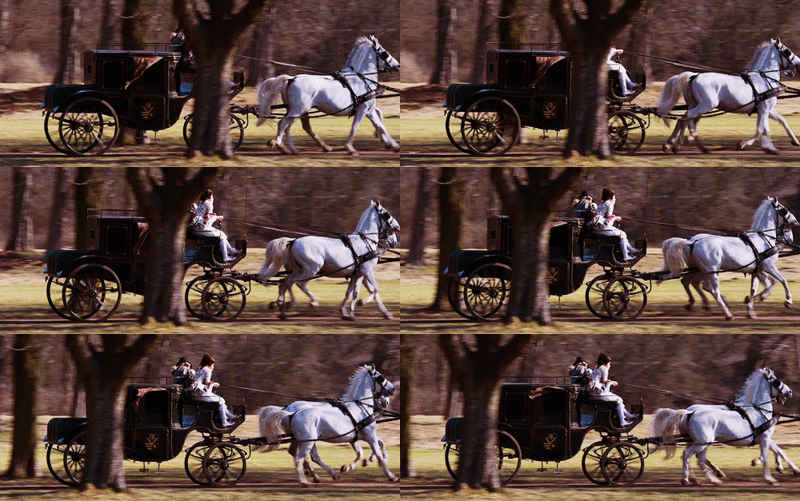
Beatrix was a country girl at heart

Dalguise was as quite as London was bustlin. The air was clean [ ... ] Light slanted in through forests carpeted with the soft needles of conifers, delighting a fanciful little girl "the woods were peopled by the mysterious good folk" she later wrote " the Lords and the Ladies of the last century walked with me along the overgown paths". Beatrix flourished at Dalguise. 1
Vi ho già raccontato di quanto fosse pratica diffusa durante il periodo vittoriano per le giovani fanciulle e per le ragazze già adulte - talora vi ci si dilettavano anche le Ladies mature - quella di tenere un diario botanico, un 'Nature Journal' in cui venivano raccolte specie varie di fiori e di foglie essiccate e catalogate con il loro proprio nome ( come fece la piccola Emily Dickinson - ne parlammo qui) oppure venivano rappresentate, generalmente per tramite della tecnica pittorica dell'acquerello, specie arbustive, arboree, floreali, bacche e fiori, conosciuti e o raccolti nei giardini e durante le passeggiate in campagna ( come fecero Edith Holden - lo abbiamo visto qui e Fanny Robinson - ne trattammo qui) dando così, talvolta con l'ausilio di citazioni poetiche, un'impronta più diaristica, intimistica e perciò meno scientifica, ma non meno prestigiosa alla raccolta.
Ebbene, anche la deliziosa Helen Beatrix Potter, meglio conosciuta con il suo secondo nome, Beatrix, tenne un 'Nature Jornal', ve ne ho già fatto cenno
(http://sweetlydreamingofthepast.blogspot.it/2013/09/beatrix-potter-life-in-nature.html), che in gran parte, come già detto, rimane tutt'oggi da decifrare poiché era scritto in un codice infantile parzialmente ancora ignoto, ma noi oggi in parte vi attingiamo in quanto alle immagini che conteneva ed agli scritti che ci sono noti, ed in parte ripercorriamo i primi anni della sua vita per comprendere il 'naturalismo' che innatamente recava la sua indole: aveva solamente otto anni quando cominciò con il rappresentare tutte le specie di funghi che trovava all'esterno dei muri di casa, l'abitazione londinese dei Potters situata nella zona residenziale di South Kensington, acquistata dai genitori poco prima che ella nascesse, una residenza signorile, ma il cui giardino lasciava un po' a desiderare, era umido, incolto e non facile da curare ... in compenso rigoglioso quanto a specie fungine che per prime stimolarono la sua creatività artistica...

Lo sguardo infantile di Beatrix, percepiva le aiole curate e stagionalmente mutate per mantenere sempre viva la fioritura come distese a ventaglio e curve di colore. La grande serra tropicale in vetro era calda in inverno, una giungla per una piccola fanciulla ricca di fantasia. 2;
South Kensington poteva inoltre avvalersi di un grande parco accessibile agli abitanti sotto il pagamento di una tassa che ne avrebbe contribuito al mantenimento, e così fecero i Potters, ottenendo le chiavi del cancello di questo piccolo paradiso, che era il polmone verde della città, spesso sommersa dal fumo, e la fucina della fantasia dei due piccoli, Beatrix ed il fratello minore Bertram che con lei condivideva le attitudini e le curiosità naturalistiche e botaniche.

Beatrix and Miss Davidson at Dalguise, 1878
che proseguì il filone educativo naturalistico già avviato dalla nurse, nonchè dal padre, poichè Rupert Potter non solo lo condivideva, ma a suo modo lo stimolò egli stesso
"Con il padre Beatrix visitò gallerie d'arte e lo studio del suo amico, il pittore di acquisita fama nella società Sir John Everett Millais. Rupert Potter, un bravissimo fotografo dilettante scattava fotografie a modelli e sfondi paesistici per Millais, un grande aiuto per un pittore che trascorreva gran parte della suo tempo nel proprio studio, piuttosto che en plein air. Negli anni successivi Beatrix scrisse: "Quando ero giovane era ancora di moda ammirare i Pre Raphaelites. La loro copia meticolosa di fiori e piante .... mi ha di sicuro influenzata."
Raggiunta l'età dei dieci anni i suoi disegni di piante cominciarono col dimostrare promesse.

Ella imparò dai libri della biblioteca Potter - dai quaderni di James Andrews e Vere Foster. Imparò dalle lezioni d'arte, sia private sia alla Scuola d'Arte di South Kensington. Imparò, osservando, in vacanza con la famiglia, così come a Londra 3
E fu la Scozia la meta prediletta per le vacanze dei Potters durante i mesi estivi che vedevano Londra così calda, polverosa ed inospitale tanto da spronare chiunque ne avesse l'opportunità economica di lasciarla per la durata dei mesi più afosi dell'anno, la Scozia che con il verde della sua sorgiva natura ed il fasto delle sue antiche residenza signorili spronava a lunghe passeggiate immerse nella natura, la Scozia che offriva i primi fiori dell'anno rappresentò per la creatività della piccola Betrix una grande fonte d'ispirazione.
"I Potters trascorsero undici lunghe vacanze in Dalguise (pronunciato Dahl-gais), una casa padronale situata sulle colline boscose vicino a Dunkeld sul lato occidentale del vasto fiume Tay. Dal 1871 al 1881 la famiglia soggiornò per diversi mesi ogni anno per sfuggire alla polvere, per non parlare di rischi per la salute, delle estati londinesi. A differenza di Bolton Gardens, che Beatrix descrisse più tardi come "il mio luogo di nascita non amato", ella ricordò Dalguise come "la bella, casa dolce casa." 4

Dalguise House
Perciò, facendo il punto della situazione, potremmo dire che durante l'infanzia di Beatrix tre furono senza alcun dubbio i luoghi che alimentarono la sua vena artistica, ovvero South Kensington, Dalguise and Camfield Place.

From the first edition of Sir Henry Chauncy's Historical Antiquities of Hertfordshire published in 1700. The Tudor Manor House shown on this engraving was demolished by Beatrix Potter's Grandfather who rebuilt the house in 1867
Quando non si trovavano a Londra o in Scozia i Potters spesso facevano visita a Camfield Place, la casa del nonno paterno.

... Capability Brown, un nome che presto e più volte nomineremo qui a proposito di giardinaggio e paesaggismo, ma torniamo agli acquerelli botanici della piccola Beatrix, pensate, ne portò a termine ben 450 di cui pochi sono accessibili pubblicamente... il suo primo interesse fu quello per la micologia, come già detto, per cui i suoi primissimi disegni sono disegni delle più svariate specie fungine ...


Osservando china a terra i funghi probabilmente fu catturata dalla presenza di insetti che furono il suo secondo fulcro d'interesse, soprattutto i coleotteri ...


per approdare infine, con sempre maggior attenzione ai dettagli, al mondo vegetale che per ultimo avrebbe affinato le sue qualità prima di farne un'autentica disegnatrice del mondo animale reinventato, con l'unicità che ben ci è nota, nei suoi libri di racconti per l'infanzia.
In realtà Ella inventava storie da sempre. Anche durante i giorni più scientifici della sua fase di studio sui funghi, immaginava un gruppo di funghi in un paesaggio del Lake District dall'aspetto simile a quello di piccole persone "che cantavano e si dondolavano e danzavano nell'erba e sotto le foglie tutti giù, in basso, come il fischio che alcune persone non possono ascoltare, o i topi o i pipistrelli itineranti, ed io seduto in alto che faccio la loro conoscenza."6


Non trovate anche voi che lascino già percepire il talento di colei che sarebbe divenuta la 'mamma' di Peter Coniglio e di tutti gli altri ?
Beatrix Potter era nata naturalista, la sua educazione, profondamente rispettosa di questa sua propensione, la fece crescere come tale e naturalista maturò e rimase fino agli ultimi dei suoi giorni come anche questa fotografia, che la ritrae già non più giovanissima, sta a testimoniare ...
E dopo il matrimonio, con l'acquisto di Hill Top Farm, da naturalista e botanica divenne appassionata giardiniera e profondamente convinta ambientalista.

Vi lascio con una sua citazione che trovo incredibilmente tenera e bella, così come trovo che incredibilmente tenero e bello fosse il suo animo, il suo mondo interiore ...
.jpg)
A presto, carissimi, a tutti voi, un abbraccio, dato con tutto il cuore e ricordate che
Chi lavora con le proprie mani è un lavoratore,
chi lavora con le proprie mani e la propria testa
è un artigiano, chi lavora con le proprie mani, la
propria testa ed il proprio cuore è un artista.
San Francesco d'Assisi (1182 - 1226)


Bibliografia:
Linda Lear, Beatrix Potter. The extraordinary Life of a Victorian genius, Penguin books U.K., London, 2006
Martha McDowell, BEATRIX POTTER'S GARDENING LIFE, Timber Press, Portland, London, 2013
Citazioni:
1 - Martha McDowell, BEATRIX POTTER'S GARDENING LIFE, Timber Press, Portland, London, 2013, pag. 30
2 - Ibidem, pag. 21
3 - Ibid. pag. 26
4 - Ibid.pag. 29
5 - Ibid. pag. 33
6 - Ibid.pag. 55

Beatrix was a country girl at heart
- picture 1
Dalguise was as quite as London was bustlin. The air was clean [ ... ] Light slanted in through forests carpeted with the soft needles of conifers, delighting a fanciful little girl "the woods were peopled by the mysterious good folk" she later wrote " the Lords and the Ladies of the last century walked with me along the overgown paths". Beatrix flourished at Dalguise. 1
I have already told you it was common practice during the Victorian period, for young and sometimes even for adults girls too that of keeping a 'Nature Journal' in which they were collected and catalogued with their own names various species of flowers and dried leaves (as the little Emily Dickinson did - as we saw here) or were represented, usually by means of the technique of watercolor painting, shrubs, trees, flowers, berries picked up in the gardens or during pleasant walks in the countryside (as Edith Holden - as we saw here and Fanny Robinson did - as seen here) giving, with the help of poetic quotations, a more intimate accent, more diaristic and so less scientific, but not at all less prestigious to the whole collection.
Well, even the lovely Helen Beatrix Potter, better known by her middle name, Beatrix, held a 'Nature Journal', (http://sweetlydreamingofthepast.blogspot.it/2013/09/beatrix-potter-life-in-nature.html), which in large part, as already mentioned, still today remains to decipher because it was written in a childish code partially still unknown, but today we'll draw something from it because what we do know about it is precious to us, both as images and as news, and in part will retrace the early years of her life to understand the 'naturalism' which innately bore her character: she was only eight years old when began with representing all species of fungi that were outside the walls of her house, the Potters' London home located in the residential area of South Kensington, purchased by her parents just a little before that she was born, a true mansion, but the garden of which left 'much to be desired', it was moist, uncultivated and not easy to care ... in return lush as fungal species that first stimulated her artistic creativity ...
- picture 2 on the left - Young Beatrix, under the authority of Nurse MacKenzie, knew its shaded walks, winding through shrubberies, around lawns, and alongside flowerbeds.Beatrix and her nurse continued their constitutionals to the Royal Horticultural Society's Horticultural Gardens, a pinnacle of Victorian prowess nestled next to the South Kensington Museum, now the Victoria and Albert Museum. At Beatrix’s child’s-eye view, the intricate flower-beds (changed seasonally to maintain peak bloom) stretched out in fans and curves of color. The large glass conservatory was warm and tropical in winter, a jungle to a young, imaginative girl. 2;
South Kensington could also take advantage of a large park accessible to the inhabitants under the payment of a fee that would have helped to maintain it, and so did the Potters, getting the keys to the gate of this little paradise, which was the city's green lung, often submerged by the smoke, and the forge of the imagination of the two little children, Beatrix and her younger brother Bertram that shared with her attitudes and natural and botanical curiosities.
To Miss MacKenzie took over, as governess, the strict Miss Madeline Davidson
- picture 3 - Beatrix and Miss Davidson at Dalguise, 1878
who went on the naturalisticeducation trend already initiated by the nurse, as well as by her father, as Rupert Potter not only shared it, but, in his way, stimulated it himself
" With her father Beatrix visited art galleries and the studio of his friend, successfull society painter Sir John Everett Millais. Rupert Potter, an accomplished amateur photographer, shot sitters and landscape backgrounds for Millais, a great help to a painter who spent much of his time in his studio rather than en plein air. In later years Beatrix wrote,"When I was young it was still the fashion to admire Pre Raphaelites. Their meticulous copying of flowers and plants .... influenced me. " By age ten her drawings of plants showed promise.
- picture 4 -
She learned from books in the Potter library - copybooks by James Andrews and Vere Foster. She learned from art lessons, both private and to the South Kensington Art School. She learned by looking, on family holidays, as well as in London." 3
And It was Scotland the favorite destination for the Potters' holidays during the summer months which saw London so hot, dusty and inhospitable enough to inspire anyone in the economic opportunity to leave it for the duration of the sultry months of the year, Scotland, which with the green of its pristine nature and the splendor of its ancient stately residences urged to long walks immerged into the nature, Scotland, which offered the first flowers of the year was for the creativity of the little Betrix a great source of inspiration.
"The Potters spent eleven long holidays in Dalguise (pronounced dahl-guys), a manor house in the forested hills near Dunkeld on the western side of the broad River Tay. From 1871 to 1881 the family sojourned there for several months each year escaping the dust, not to mention health risks, of London summers. In contrast to Bolton Gardens, which Beatrix later described as “my unloved birthplace,” she remembered Dalguise as “ beau-tiful, home sweet home.” " 4
- picture 5 - Dalguise House
So, summing up the situation, we could say that during her childhood for Beatrix three were undoubtedly the places that fueled her artistic talent, South Kensington, Dalguise and Camfield Place.
- picture 6 - From the first edition of Sir Henry Chauncy's Historical Antiquities of Hertfordshire published in 1700. The Tudor Manor House shown on this engraving was demolished by Beatrix Potter's Grandfather who rebuilt the house in 1867
When not in London or Scotland, the Potters often visited Camfield Place, her paternal grandfather's home.
- picture 7
Jessy Crompton Potter and Edmund Potter bought the three hundred-acre estate in rural Hertfortshire north of London the year Beatrix was born. To her, it had always been there. At Camfield "all is bound up together in fact and fancy, my dear grandmother, the place I love best in the world and the sweet balmy air where I have been so happy as a child". She could run in the garden, only returning when the fire bell was rung as the summons home. Great banks of rhododendrons bloomed in the spring, concealing a faux medieval grotto. A hollow but living elm was perfect to climb and explore for bird's nests. A yellow rose grew up the brick wall of the kitchen garden, along with the more tender fruit tree. Edmund Potter employed fifteen gardeneres to manage the park, walled garden, ornamental beds, and greenhouses. The landscape of this childhood idyll acquainted the young Beatrix with the work of another artist, Capability Brown. 5
... Capability Brown, a name that soon and again will appoint here about gardening and landscaping, but let's come back to the botanical watercolors of the little Beatrix, just think, she painted more than 450 watercolours just few of which are publicly accessible ... her first interest was the mycology, as already said, that's why her first drawings are drawings of various fungal species ...
- picture 8
- picture 9
- picture 10
- picture 11
- picture 12
Observing bent near the ground the mushrooms, she was probably was by the presence of insects that were her second fulcrum of interest, especially beetles ...
- picture 13
- picture 14
- picture 15
to arrive finally, with more and more attention to even little details, to the plant world that would last honed her qualities before making of her a real designer of the animal world reinvented with the uniqueness that we are well-known in her books of short stories for childhood.
Actually, She had always invented stories. Even during the most scientific days of her fungus phase, she imagined a group of mushroom in a Lake District landscape looking like tiny "people singing and bobbing and dancing in the grass and under the leaves all down below, like the whistling that some people cannot hear, or stray mice and bats, an I sitting above and know something about them." 6
- picture 16
- picture 17
- picture 18
- picture 19
- picture 20
- picture 21
- picture 22
- picture 23
- picture 24
- picture 25
- picture 26
- picture 27
- picture 28
Don't you also perceive the talent of the woman who would become the 'mother' of Peter Rabbit and of all the others?
Beatrix Potter was born as a naturalist, her education, deeply respectful of this propensity, made her grow in this perspective and as naturalist she matured and remained until the last of her days as even this photograph, which portrays her not so young anymore, can testify...
And after her wedding, with the purchase of Hill Top Farm, from naturalist and botanist she became a passionate gardener and a deeply convinced environmentalist.
- picture 29
I leave you with a quote from her Journal that I find incredibly tender and beautiful, as I find that incredibly tender and beautiful was her soul, her inner world ...
- picture 30
See you soon, dear friends, I hug all of you with all my heart, and remeber that
Anyone who works with his hands is a laborer,
who works with his hands and his head is a
craftsman, who works with his hands, his head
and his heart is an artist.
St. Francis of Assisi (1182 - 1226)
Bibliography:
Linda J. Lear, Beatrix Potter: A Life in Nature, Griffin, 2008
Linda Lear, Beatrix Potter. The extraordinary Life of a Victorian genius, Penguin books U.K., London, 2006
Martha McDowell, BEATRIX POTTER'S GARDENING LIFE, Timber Press, Portland, London, 2013
Quotations:
1 - Martha McDowell, BEATRIX POTTER'S GARDENING LIFE, Timber Press, Portland, London, 2013, page 30
2 - Ibidem, page 21
3 - Ibid. page 26
4 - Ibid. page 29
5 - Ibid. page 33
6 - Ibid. page 55
This post is linked up to the lovely parties:


.jpg)