giovedì 13 novembre 2014

Franz Xaver Winterhalter (1805 - 1873), celebrato ritrattista delle corti europee dell'ottocento.


"La pittura è una poesia muta, e la poesia è una pittura 
cieca, e l’una e l’altra vanno imitando la natura quanto 
è possibile alle loro potenze, e per l’una e per l’altra si può 
dimostrare molti morali costumi...".


 Leonardo da Vinci, Trattato della Pittura.


Franz Xaver Winterhalter, Empress Eugenie surrounded by her Ladies in Waiting


Nato in un piccolo villaggio sito nella Foresta Nera, in Germania, Franz Xaver Wintehalter divenne un celebrato pittore e litografo tedesco, divenuto rinomato soprattutto per la sua maestria nel riprodurre su tela in maniera fedelissima tutte le pieghe e le caratteristiche tattili di abiti e acconciature delle più famose dame appartenenti all'aristocrazia e alle case reali d'Europa dell'ottocento, nonché di Imperatori e re ai quali, unico fino ad allora, seppe dare doverosa espressione d'autorità.

Precocemente avviato allo studio della pittura, lasciò ancora fanciullo la sua casa a Monaco di Baviera per frequentarne l'Accademia e all'età di sedici anni era già in grado di farsi apprezzare per i propri dipinti, ma fu dopo un soggiorno a Roma presso un circolo di pittori francesi che, seguendo la lezione di Raffaello, affinò la propria tecnica; dopo un breve soggiorno a Baden nel 1842 durante il quale si dedicò ai ritratti del granduca Leopoldo 


e della granduchessa Alessandrina sua figlia


lasciò la Germania per recarsi a Parigi dove fatalmente ebbe inizio il suo grande successo, quando venne in contatto con gli Orléans: Luigi Filippo I, re di Francia,


lo nominò pittore di corte e gli diede l'incarico di ritrarre l'intera sua famiglia e discendenza.


Maria Amelia of Borbone


Helen Louise Elisabeth of Mecklenburg Schwerin, Duchess of Orleans with Prince Louis Philippe Albert d’Orleans, Count of Paris, 1839


A quel tempo gli abiti e le acconciature delle dame dell'alta società erano molto elaborate e riprodurle con dovizia di particolari richiedeva realmente una straordinaria capacità, un estro artistico non comune, per questo le principali corti europee, quella Belga, Russa, Austriaca, Inglese, da allora, cominciarono con il contenderselo - paradossalmente la terra che gli aveva dati i natali fu l'unica a non riconoscerne debitamente i meriti - perchè nessuno aveva ancora dipinto come Winterhalter; il suo stile era unico, le sue tele pulite, nitide, di un nitore impensabile per colori ad olio stesi con un pennello su di una tela .... pensate, egli dipingeva direttamente sulla tela e ciò non mancava di stupire chi veniva da lui ritratto, soprattutto per l'occhio con cui riproduceva anche i minimi dettagli dando loro la luce che al vederli ancor oggi sembrano in rilievo, passando da uno stile neoclassico, a cui appartengono i suoi primi dipinti degli anni '40 ( data anche l'influenza francese) per poi approdare, intorno agli anni '50 -'60, ad un espressivismo più propriamente inquadrabile nello stile neo-rococò  ...

... pizzi ricamati da abili mani, trine, nastri di raso con riflessi catturati dalle deboli luci dei lumi a petrolio, 


Countess Varvara Alekseevna Musina Pushkina


Queen Olga of Wuerttemberg, née Grand Duchess Olga Nikolaevna of Russia


Countess Marie Branicka de Bialacerkiev, detail, 1865


Alexandra Iosifovna Grand-duchess of Russia, Princess Alexandra of Altenburg 


la sofficità dei velluti che sulle sue tele diventa tangibile


Louises von Orléans, detail, 1841


le increspature 'rocciose' del taffetà o il lucore dei tessuti di seta si fa vero, reale, concreto, da accarezzare


Princess Tatiana Alexandrovna Yusupova, detail


Countess Alexander Nikolaevitch Lamsdorff (Maria Ivanova Beck, 1835-1866), detail, 1859 


Queen Victoria, detail, 1842


 ... e poi perle, monili, gioielli erano questa una particolarità dei suoi ritratti


Portrait of Empress Maria Alexandrovna, 1857


Lievi veli di tulle che sembrano fatti unendo insieme ali di libellula


Princess Anna of Prussia, Landgravine of Hesse
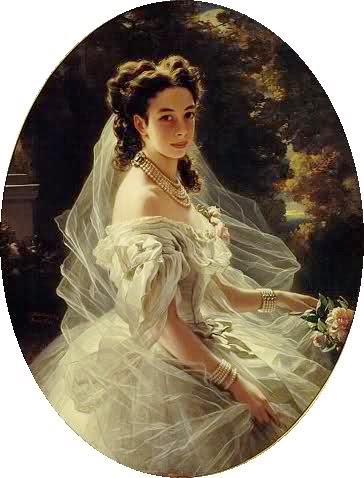


Pauline Sándor de Szlavnicza (1836-1921), wife of Richard Metternich ( son of the great Chancellor, Austrian Ambassador in Paris, friend and confident of the Emperor )


Queen Victoria with Prince Arthur, 1850


L'impératrice Eugénie en robe de cour, detail, 1862


che ornano volti noti alla storia, noti ai libri su cui la storia l'abbiamo imparata, ma le riproduzioni che abbiamo sempre visto sui nostri libri privavano questi dipinti dei più raffinati dettagli ...

Anche le figure maschili, osservate nei suoi dipinti, sembrano voler comunicare l'autorevolezza del ruolo che politicamente rivestivano, quasi volesse egli farsi messo in immagini del clima morale che nella Corte regnava; tra di essi sicuramente il più eloquente lo sguardo dell'Imperatore Francesco Giuseppe, che palesemente appare assorto nelle apprensioni e turbamenti di natura politica che sostanzialmente colmavano le sue lunghe giornate


Kaiser Franz Josef, 1865


mentre negli occhi del Principe Albert, consorte della Regina Vittoria è evidente quella dolcezza che si evince dalle pagine scritte dalla Regina del Popolo nel suo diario, il 'Bertie', affettuoso padre di famiglia ed ingegnoso compagno di siffatta Maestà, l'attento diplomatico scevro da ogni tipo di preoccupazione politica.


Prince Albert of Saxe-Coburg and Gotha wearing the Golden Fleece,1842


Ma è innegabile che il maggior fascino ce lo riservino le figure femminili, quando, per esempio, ci soffermiamo dalle 'cascate' di capelli, rigorosamente volute dalla moda vittoriana, lasciate scendere con naturalezza 


Barbara Dmitrievna Mergassov-Rimsky-Korsakova, 1864


Kaiserin Elisabeth von Osterreich, 1864


o raccolti nel più elegante dei modi tra quelli allora conosciuti, con stelle che anche noi vediamo brillare come quelle di una costellazione osservata alzando lo sguardo al Cielo


Elizabeth of Bavaria, Empress of Austria, 1865


sguardi colti rapiti da un romantico contemplare o da un pudico atteggiamento


Queen Victoria, Prince Albert, and children, detail, 1846


 Princess Charlotte of Belgium, 1842


ma ditemi, non trovate anche voi che questi dipinti siano ben più realistici, espressivi e suggestivi di una fotografia dei nostri giorni ?

Sento di dover ringraziare Winterhalter per averci lasciato questi tesori di inestimabile valore, osservare questi dipinti ferma davvero il tempo e quasi sembra, per loro tramite, di fare esperienza dell'aristotelica 'catarsi' ( concetto trattato nella Politica a proposito dell'arte della musica che indurrebbe alla meditazione, alla riflessione e che libera dalle cure quotidiane - secondo noi la musica non va praticata per un unico tipo di beneficio che da essa può derivare, ma per usi molteplici, poiché può servire per l’educazione, per procurare la catarsi (...) e in terzo luogo per il riposo, il sollevamento dell’animo e la sospensione dalle fatiche. Aristotele, Politica [ 7, 1341b 32 - 1342a 16 ], trad. di Augusto Viano, poi esteso all'arte in generale, Poetica [ 6, 1449b 24-30 ] ), ed un grazie, dal profondo del cuore, anche voi, miei cari amici e lettori,


a presto ♥


Bibliografia: 

Richard Ormond, Carol Blackett-Ord, Franz Xaver Winterhalter and the Courts of Europe, 1830-70, Harry N Abrams, 1992


Franz Xaver Winterhalter (1805 - 1873), celebrated portrait painter of the XIXth century European Courts.


"Painting is silent poetry, and poetry is blind painting,

and the one and the other should imitate nature as much as possible

in order to their powers, and by mean of the one and of the other you

 can demonstrate many moral habits ... ".


Leonardo da Vinci, Trattato della Pittura.


- picture 1 - Franz Xaver Winterhalter, Empress Eugenie surrounded by her Ladies in Waiting


Born in a small village in the Black Forest in Germany, Franz Xaver Wintehalter became 

a celebrated German painter and lithographer, best known for his mastery in 

reproducing on canvas in a faithful manner all the folds and tactile characteristics of 

dresses and hairstyles of the most famous ladies belonging to the aristocracy and the 

royal houses of Europe of the XIXth century, as well as emperors and kings to whom, 

only one until then, he was able to give rightful expression of authority.


Early started to the study of painting, he left as a boy his home in Monaco of Bavaria to 

attend its Academy and at the age of sixteen he was already able to be appreciated for

his paintings, but it was after a stay in Rome by a circle of French painters who, 

following the lessons of Raphael, he honed his technique; after a short stay in Baden in 

1842 during which he devoted himself to the portraits of the Grand Duke Leopold


- picture 2


and his daughter Grand Duchess Alexandrine


- picture 3


he left Germany to go to Paris, where he fatally began his great success when came into 

contact with the Orleans: Louis-Philippe I, King of France,


- picture 4


appointed him Court Painter and commissioned him to paint his entire family and 

descendants.


- picture 5 - Maria Amelia of Borbone


- picture 6 - Helen Louise Elisabeth of Mecklenburg Schwerin, Duchess of Orleans with Prince 

Louis Philippe Albert d’Orleans, Count of Paris, 1839


At that time the clothes and hairstyles of the high society ladies were very elaborate 

and to reproduce them in great detail really required an extraordinary ability, an

uncommon artistic talent, that's why the major European courts, the Belgian, Russian,

Austrian, English since then, began to compete with each other for its art - 

paradoxically the land that had given his birth was the only one that didn't recognize his

merits – because, until then, no one had painted as Winterhalter; his style was unique,

his paintings were clean, crisp, with a clarity impossible for oil paint applied with a 

brush on a canvas .... well, think about it, he painted directly onto the canvas and 

obviously it didn't fail to impress those who was portrayed by him, especially for the eye 

whith which he reproduced even the finest details giving them the light as to see them

like appearing in relief, starting from a neoclassical style, to which belong his early 

paintings of the '40s (probably due to the French influence) to moving, in the '50s and

'60s, to an expressivism more properly belonging to the background of the neo-rococo 

style …

... Laces embroidered by skilled hands, satin ribbons with reflections captured by the 

weak light of oil lamps,


- picture 7 - Countess Varvara Alekseevna Musina Pushkina


- picture 8 - Queen Olga of Wuerttemberg, née Grand Duchess Olga Nikolaevna of Russia


- picture 9 - Countess Marie Branicka de Bialacerkiev, detail, 1865


- picture 10 - Alexandra Iosifovna Grand-duchess of Russia, Princess Alexandra of Altenburg 


the softness of velvet that becomes tangible on canvas


- picture 11 - Louises von Orléans, detail, 1841


the 'rocky' ruffles of the taffeta or the glow of silk fabrics becoming real, true, to be 

caressed


- picture 12 - Princess Tatiana Alexandrovna Yusupova, detail


- picture 13 - Countess Alexander Nikolaevitch Lamsdorff (Maria Ivanova Beck, 1835- 

1866), detail, 1859 


- picture 14 - Queen Victoria, detail, 1842


... And pearls, moniles, jewels were this a peculiarity of his portraits


- picture 15 - picture 16 - picture 17 - Portrait of Empress Maria Alexandrovna, 1857


Slight tulle veils that seem to be made by joining together dragonfly wings


- picture 18 - Princess Anna of Prussia, Landgravine of Hesse


- picture 19 - Pauline Sándor de Szlavnicza (1836-1921), wife of Richard Metternich ( son of the 

great Chancellor, Austrian Ambassador in Paris, friend and confident of the Emperor )


- picture 20 - Queen Victoria with Prince Arthur, 1850


- picture 21 - L'impératrice Eugénie en robe de cour, detail, 1862


adorning faces familiar to the history, known to books on which we've learned and 

studied history , but the reproductions that we have always seen on our books deprived

these pictures of the finest details ...

Even the male figures seen in his paintings seem to want to communicate the authority 

of the role that they politically covered, as if he himself wanted to put in images the 

moral climate that prevailed in that Court; among them certainly the most eloquent are

the eyes of the Emperor Franz Joseph, who is obviously engrossed in the misgivings and 

anxieties of political nature which basically heaped his long long days


- picture 22 - Kaiser Franz Josef, 1865


while in the eye of Prince Albert, Queen Victoria's consort, is evident that sweetness 

that we can read in the pages written by the Queen of the People in her diary, 'Bertie', 

loving family man and ingenious partner of such Majesty, the careful diplomatic devoid 

from any kind of political concern.


- picture 23 - Prince Albert of Saxe-Coburg and Gotha wearing the Golden Fleece,1842


But it is undeniable that the greatest charm is reserved to us by the female figures, 

when, for example, we look at the 'waterfall' of hair, strictly desired by the Victorian 

fashion, let naturally fall


- picture 24 - Barbara Dmitrievna Mergassov-Rimsky-Korsakova, 1864


- picture 25 - Kaiserin Elisabeth von Osterreich, 1864


- picture 26 - Kaiserin Elisabeth von Osterreich, 1864


or collected in the most elegant of ways among those known at the time, with diamnond

stars that we see shine like those of a constellation seen looking up to Heaven


- picture 27 - Elizabeth of Bavaria, Empress of Austria, detail, 1865


- picture 28 - Elizabeth of Bavaria, Empress of Austria, 1865


- picture 29 - Elizabeth of Bavaria, Empress of Austria, detail, 1865


eyes caught abducted by a romantic contemplate or in a prudish attitude


- picture 30 - Queen Victoria, Prince Albert, and children, detail, 1846


- picture 31 - Princess Charlotte of Belgium, 1842


but tell me, don't you also think that these paintings are far more realistic, expressive 

and suggestive of a photograph of our days?


I feel the need to thank Winterhalter for these priceless treasures he has left us, 

observing these paintings really stops the time and almost seems, through them, to 

experience the Aristotelian 'catharsis' (A concept discussed in the Politica about the art 

of music that would lead to meditation, reflection and feel men free from daily cares - 

we think music should not be practiced by a single type of benefit that can be derived 

from it, but for multiple uses, since it can be used for education, to provide catharsis

(...) and in third place for rest the soul and lift the suspension from the strain. 

Aristotle, Politica [ 7, 32 1341b - 1342a 16 ], trans. Augusto Viano, then extended to all 

arts in general among the pages of the Poetica [ 6, 1449b 24-30 ] ), and a big thank to 

you, from the bottom of my heart, to you too, my dear friends and readers,


see you soon ♥


Bibliography: 

Richard Ormond, Carol Blackett-Ord, Franz Xaver Winterhalter and the Courts of Europe, 1830-70, Harry N Abrams, 1992


sabato 8 novembre 2014

XIXth century 'Spectacles'.


Come avrete ormai compreso, molti, per non dire tutti, gli 

oggetti che erano in uso durante il XIX secolo, con il loro

 fascino, da sempre suscitano la mia curiosità …. 

oggi voglio approfondire con voi la conoscenza degli

"Spectacles” come venivano al tempo chiamati gli occhiali 

da vista.


François Martin Kavel (1861 - 1931), Young Lady wearing pink Dress and Eyeglass


Teniamo innanzitutto presente che stiamo per calarci in un tempo in cui piuttosto precocemente, rispetto ad oggi, veniva perso l'uso della dentatura e dell'organo della vista, per cui quella degli occhiali era una necessità piuttosto diffusa fin dalla giovane età; affascinante già il termine, Spectacles, che sembra tutto un programma, come se a chi li indossava avesse dovuto aprirsi un mondo nuovo ( mutuato dal francese in cui significa 'esibizione', 'spettacolo' ) e forse era proprio così se la carenza visiva era notevole, la realtà tutta riprendeva corpo in un vero e proprio spettacolo ! 

Durante la loro vita, che conta più di ottocento anni, essi hanno conosciuto svariate trasformazioni prima di divenire come li conosciamo noi oggi e sembra quasi impossibile scoprire che già nel 1727 Edward Scarlett, un inglese, inventò gli occhiali forse più simili a quelli odierni, con le lenti fissate su di una montatura che poggiava sia sul naso che sulle orecchie, ma non vennero considerati un accessorio alla moda e perciò non furono apprezzati dal bel mondo che rivolse la propria attenzione su altri modelli ritenuti più eleganti e distinti.


L'epoca Regency conobbe la grande popolarità del “quizzing glass”, come veniva chiamata una unica lente con una piccola impugnatura, legata ad una catenella o ad un nastro e portata al collo quasi come fosse un ciondolo, 


che veniva accostata ad un singolo occhio per migliorarne la capacità visiva: era questo l'accessorio che le Ladies delle classi più agiate desideravano invece degli occhiali proposti da Scarlett, le quali, a partire dagli anni '50 del 1800, lo indossavano quasi come fosse un gioiello, talmente apprezzato che lo vestivano anche coloro che non avevano alcun problema di vista, molto spesso per vezzo o per atteggiarsi, da cui il nome “quizzing” ovvero “interrogarsi”, poiché molto spesso il quizzing glass veniva avvicinato ad un occhio per scrutare con fare interrogativo o di disapprovazione una persona che si stava approssimando.


Vignetta di epoca Regency che ironizzava sull'uso più diffuso del quizzing glass


Vi era chi invece preferiva usare la “lorgnette”,


che aveva due lenti ed era sorretta da un lato da un'impugnatura, e poggiava alla radice del naso, che poteva essere prescritta solo da un ottico optometrista e che conquistò definitivamente il pubblico femminile a partire dal 1830; i gentlemen continueranno a preferire l'uso di una sola lente, passando dal quizzing glass, sul finire del 1800, al
“monocle”, 


costituito sempre da una sola lente, ornata semplicemente da un fiocco o da una catenella, senza alcuna impugnatura.


Ed infine pensate, cinquecento anni dopo essere stati inventati gli occhiali che si reggevano esclusivamente sulla parte superiore del naso grazie ad una leggera compressione a molla, riapparvero intorno al 1840 per divenire celebri con il nome di “pince-nez”,


La cantante lirica Adelina Patti in una fotografia del 1900, ritratta con indosso un paio di pince-nez


raggiungendo larga diffusione presso la classe media, sia per le donne che per gli uomini, fino agli inizi del XX° secolo. 

E poi gli occhiali, quelli fatti con tanto di montatura e bacchette, si diffusero nel periodo vittoriano e furono proprio questi ad essere più propriamente definiti “spectcles”, con montatura dapprincipio in metallo e poi, solo più tardi, di avorio o di osso di tartaruga.

Concludo con una deliziosa cartolina augurale vittoriana con cui, oltre che mostrarvi i suddetti spectacles, rendo edotti coloro che, tra di voi, ancora non lo fossero, circa la venerazione che i Victorians nutrivano per i gatti, tanto da ironizzare su di loro e dar loro un aspetto antropomorfo, argomento per me meraviglioso di cui presto vorrei parlarvi.


Auguro a tutto voi tanta gioia e tanto bene, ringraziandovi come sempre per il dono che mi fate seguendomi con il vostro affetto.


A presto ♥


Bibliografia:

Rosenthal, J. William, Spectacles and other vision aids: A History and Guide to Collecting, Norman, San Francisco, 1996


As you may have understood by now, most, if not all, of the


objects that were in use during the XIXth century, with their


charm, have always aroused my curiosity ....


Today I want to explore with you the knowledge of


"Spectacles" as they were called at the time the eyeglasses.


- picture 1 - François Martin Kavel (1861 - 1931), Young Lady wearing pink Dress and 

Eyeglass


First of all we have to think that we are about to immerse ourselves in a time when 

quite early, compared to today, they lost the use of the teeth and of the sight, that's 

why that of the eye glasses was a necessity rather widespread since youth; so fascinating

the term, Spectacles, which seems a whole program, as if to who had to wear them had 

to open up a new world (borrowed from French, it means 'performance', ) and perhaps, 

if the visual deficiency was remarkable, they led him truly into a real perfomance, that 

of reality !


During their lifetime, which is lasting more than eight hundred years, they have

experienced several changes before becoming as we know them today and it seems 

almost impossible to read that already in 1727, Edward Scarlett, an Englishman, 

invented eyeglasses so very similar to those of today, with the lens fixed on a frame 

that was based on both the nose and the ears, but they weren't considered a fashion 

accessory, and therefore weren't appreciated by the beautiful world which turned its 

attention to other models considered the most elegant and distinguished - looking.


- picture 2


During the Regency period it met a great popularity the "quizzing glass" as it was called 

a single len with a small handle, attached to a chain or ribbon and worn around the neck 

almost like a pendant,


- picture 3

- picture 4


that was drawn near a single eye to improve its vision: this was the accessory that well - 

to - do Ladies wanted instead of the eyeglasses proposed by Scarlett, which, until the 

50s of 1800, will be wore like a jewel, so popular to be worn even by those who had no

vision problem, very often for whim or to pretend to be elegant, hence the name 

"quizzing" because very often the quizzing glass was used to express a questioning air or 

the disapproving for a person who was approaching.


- picture 5 - Regency-era vignette satirizing on the most widespread use of the

quizzing glass


There were those who preferred to use the "lorgnette"


- picture 6


which had two lenses and was supported on one side by a handle, and rested on the 

top of the nose, which could only be prescribed by an optometrist and definitively

conquered the female audience since 1830; the gentlemen still preferred the use of a 

single len, going from the quizzing glass, at the end of 1800, to the "Monocle"


- picture 7 - The opera singer Adelina Patti in a photograph dated 1900, wearing a pair 

of pince-nez


also consisting of a single len, simply adorned with a bow or by a chain, without any 

handle.


And finally, you have to know that, five hundreds years after they were invented, the

eyeglasses that are held up exclusively on the top of the nose thanks to a slight 

compression made by a spring, reappeared in the 1840s to become famous with the 

name of "pince-nez",


- picture 8


achieving widespread among the middle class, for both women and men, until the 

beginning of the XXth century.


And then the eyeglasses, those made with a hype and chopsticks, spread in the Victorian 

period and they were these to be more properly called "spectcles", with a frame made of

metal, as first, and then, only later, of ivory or of tortoise bone.


I'm going to conclude with a lovely Victorian greeting card with which not only I'm 

showing you the spectacles, but I also want to let know, to those among you, who yet 

aren't aware of it, about the veneration which Victorians had for cats, much to be 

ironical with them (or with men ?!? ) and give them an anthropomorphic look, wonderful

argument to me of which I would like to talk to you about soon.


- picture 9


I wish you all much joy and much love, thank you as usual for the gift that you make me,

following me with your affection.


See you soon ♥


Bibliography:


Rosenthal, J. William, Spectacles and other vision aids: A History and Guide to Collecting, Norman, San Francisco, 1996


domenica 2 novembre 2014

John of the United Kingdom, the 'Lost Prince'.


Spesso, sfogliando le pagine della storia, ci si trova di fronte a 

punti oscuri, non chiari, non facilmente giustificabili .....

quello che sto per raccontarvi ne fa parte.


Il 12 luglio del 1905 nasceva, accolto con grande clamore, il quinto ed ultimo figlio della real coppia degli allora Principi di Galles, Prince Gorge - figlio del futuro re Edoardo VII, primogenito della regina Vittoria e del principe Alberto di Sassonia-Coburgo-Gotha e della principessa Alessandra di Danimarca, e Princess Mary, nata Victoria Mary di Teck ( più tardi incoronata Queen Mary ) cui venne dato il nome di John Charles Francis.


Princess Mary of Wales con Prince John


 Royal Shopping Trip: Prince George e Prince John (sulla destra) 


Rubicondo, vivace, con grandi occhi chiari ed una carnagione rosata


il piccolo crebbe tra le coccole e l'affetto dei genitori che per lui non nascondevano di avere una particolar inclinazione, manifestata da una ben maggiore permissività rispetto a quella palesata per i figli maggiori; nonostante fosse il quinto in ordine di successione al trono il piccolo John 


 The Royal Children in 1912: l-r Albert, John, Henry, Mary, Edward e George


venne educato come gli altri fratelli in nome del decoro e dell'immagine che la famiglia reale britannica doveva preservare vivendo un'infanzia felice fino all'età di quattro anni quando, improvvisamente, cadde a terra colto da un malore successivamente attribuito ad una forma di epilessia.


Prince George mentre tiene Prince John, fotografia di James Lafayette, 1909


Fu questo un momento tragico per la famiglia reale, per più motivi: innanzitutto il mal caduco, come allora era definita l'epilessia, non godeva della considerazione che la medicina moderna ci consente di riservarle, non era attribuito ad una lesione neurologica, anzi, spesso, all'inizio del xx° secolo, era ancora circondato da un alone di superstizione che lo legava per affinità alla possessione demoniaca ...
come spesso accadeva in passato, ciò che non si riusciva a giustificare razionalmente cadeva nell'oscurità dell'occulto e delle credenze popolari; in 
secondo luogo come poter tenere in famiglia un figlio la cui salute destava preoccupazione ed era destinata solamente a peggiorare ....


La decisione che venne presa nell'anno 1916, dopo l'aggravarsi della malattia, fu piuttosto drastica e sicuramente dolorosa: seguito dalla sua tata Charlotte "Lala" Bill e da un tutore, il piccolo venne alloggiato presso di una fattoria situata nelle vicinanze della residenza reale di Sandrigham, Wood Farm, dove taluni dicono ricevesse spesso visite da parte della madre, altri sostengono che fossero invece rare le visite della regina e del tutto assenti quelle del re ... un figlio malato di un male che rappresentava quasi un onta era da lasciare nell'ombra, da dimenticare.
Rappresentava certo un rischio concreto che un attacco epilettico potesse coglierlo d'improvviso durante la visita di duchi o conti o altri nobili invitati e perciò, in tal caso, il 'terribile' segreto di famiglia sarebbe irrimediabilmente stato svelato; inoltre, con ogni probabilità, l'averlo tenuto comunque a contatto diretto con i fratelli sarebbe stato dannoso per loro
( l'attacco epilettico suscita molto spavento soprattutto agli occhi in un bambino ).

John non appariva mai in pubblico, ed infatti non presenziò con gli altri membri della famiglia reale alla cerimonia d'incoronazione del padre l'11 giugno del 1911 anche se, per non destare l'indignazione dell'opinione pubblica, lo vediamo comparire comunque nei ritratti di famiglia con uno sguardo che sempre più, con il trascorrere del tempo, denota tristezza e forse anche un ritardo mentale; ogni Natale, egli presenziava al tavolo per il pranzo di famiglia a Sandrigham, per essere poi subito dopo riaccompagnato a Wood Farm.
Quando usciva nel giardino e nella campagna circostante la fattoria John non era mai lasciato da solo, si diceva, per il timore che potesse nuocersi, e pochi erano gli amici che aveva tra i figli dei membri della servitù della vicina residenza reale.


Lo York Cottage dove andarono ad abitare i Duchi di York ( fino al 1901 Prince George and Princess Mary, da che contrassero matrimonio, recavano il titolo di duchi di York ), più tardi Principi di Galles ed infine dal 1911 Sovrani del Regno Unito, presso Sandrigham House della cui tenuta faceva parte Wood Farm; nonostante, quali sovrani, la loro residenza ufficiale divenne Buckingham Palace, il re rimase sempre molto legato a questi luoghi dove spesso continuava ad intrattenersi per lunghi soggiorni con la famiglia.


Al tempo s'ignorava l'utilizzo dei barbiturici che, in qualità di anticonvulsivanti, tengono sotto controllo gli attacchi epilettici ( che hanno come conseguenza l'aggravarsi della lesione neurologica che li procura ) e perciò quello dell'epilessia era un male del tutto misterioso ed inguaribile, senza alcuna possibilità di risanamento e di guarigione. Le crisi epilettiche, non debitamente controllate con i farmaci, aumentarono con il tempo, in frequenza ed intensità, fino a che il 18 gennaio 1919, dopo una crisi più grave del solito, John si spense nel sonno a Wood Farm.


Queen Mary scriverà nel suo diario che la notizia " fu un terribile shock, nonostante per l'anima inquieta del povero ragazzino, la morte sia sopraggiunta come un grande sollievo." Wikipedia

Da allora il nome John viene considerato di malaugurio per i membri facenti parte la Famiglia Reale Inglese e si leggeva su di un articolo apparso sul Daily Mail nell'anno 2008 


che il piccolo John fu presto dimenticato dai Windsor al punto che in almeno uno degli alberi genealogici della famiglia egli non è neppure presente, cosa che irritò molto gli inglesi.

... ma come poter giudicare con serenità e spirito di giustizia la decisione presa dai Principi di Galles ... chissà, forse anche noi, nella stessa epoca storica, inseriti nel medesimo contesto culturale in cui molto ancora rappresentavano le famiglie reali, pensando anche la bene del resto della prole, forse avremmo agito in modo analogo ... chissà .. sta di fatto che Queen Mary è tra le regine appartenute alla casa dei Windsor che più hanno lasciato un ottimo ricordo di sé.


Lasciate che sempre, con grande affetto e gratitudine, mi congedi da voi augurandovi ogni bene.

A presto ♥


Often, flipping through the pages of History, we are faced with 

blind, not clear, not easily justifiable points ..... 

I'm going to tell you something belonging to them.


- picture 1

On July 12th, 1905, received with great fanfare, was born the fifth and last child of the royal family of the then Princes of Wales, Prince George - son of the future King Edward VII, the eldest son of Queen Victoria and Prince Albert of Saxe-Coburg and Gotha and of Princess Alexandra of Denmark - and Princess Mary, born Victoria Mary of Teck ( later crowned Queen Mary ) whom was given the name of John Charles Francis.


- picture 2 - Princess Mary of Wales  with Prince John

- picture 3

- picture 4 -  Royal Shopping Trip: Prince George and  Prince John (on the right) 


Ruddy, lively, with big blue eyes and a rosy complexion


- picture 5


the baby grew between parental cuddling and love, as they didn't hide that had a particular inclination for him manifested by a much more permissive  education than that for the older children; despite being the fifth in order of succession to the throne, the  little John


- picture 6 -  The Royal Children in 1912: l-r Albert, John, Henry, Mary, Edward and George


was educated like his siblimgs in the name of the dignity and the image that the British royal family had to preserve living a happy childhood until the age of four when he, suddenly, fell to the ground seized by an illness later attributed to a form of epilepsy.


- picture 7 - Prince George holding Prince John,  photograph by James Lafayette, 1909


This was a tragic moment for the royal family, tragic for several reasons: first, the falling sickness, as it was then called epilepsy, didn't have the consideration that modern medicine allows us to reserve it today, it wasn't attributed to a neurologic injury, indeed, often, in the beginning of the XXth century, it was still surrounded by an aura of superstition that bound it, for affinity, to the demonic possession ...
as often happened in the past, what they couldn't rationally justify, fell in the darkness of the occult and of the popular beliefs; on the other hand, how to keep at home a child whose health concern aroused and was intended only to get worse .... 


- picture 8 on the right - The decision that  was taken in 1916, after the worsening of the disease,  was rather drastic and surely painful: followed by his nanny Charlotte "Lala" Bill and a turur, the child was sent to live to a farm located near the royal residence of Sandringham called  Wood Farm, where it was said that he often received visits from his mother, others claimed that they were very  rare the  visits of the queen and the king's none at all ... a sick son of an evil which was almost a shame it was to leave shadows, was to forget. 

Certainly it represented a real risk that a seizure could catch him suddenly while visiting Dukes or Counts or other well -to-do people, and, in that case, the 'terrible' family secret would be irreparably been revealed; moreover, in all probability, have held him  in direct contact with his siblings would be harmful to them (the crises are quite impressive especially  in the eyes of a child). 
John never appeared in public, and in fact he wasn't present with the other members of the royal family at the coronation ceremony of his father on 11 June 1911, although, not to arouse public indignation, however, we see him appearing in every family portraits with a look that more and more, with the passage of time, denotes sadness and maybe even mental retardation; every Christmas, he sat at  the table for the family lunch at Sandrigham, to be, after it,  immediately taken back to Wood Farm. 
When he went out in the garden and the countryside surrounding the farm John was never left alone, they said, for fear that he could injure himself, and few were the friends he had among the children of the members of the servants of the nearby royal residence.


- picture 9


At the time they ignored the use of barbiturates which, as anticonvulsants, by controlling epileptic seizures (which result in the worsening of neurologic injury causing them) ------ and that's why that of epilepsy was a desease mysterious and incurable at all, with no chance of recovery and healing. Epileptic fits, not appropriately controlled with medicines, increased with the flowing of the time,  as frequency and intensity, until January on 18th, 1919, after a crisis more serious than usual, John died in his sleep at Wood Farm.


- picture 10


Queen Mary wrote in heis diary that the news "a great shock, tho' for the poor little boy's restless soul, death came as a great relief." Wikipedia
Since then, the name John is considered a bad omen for the members belonging to the British Royal Family and it was read on an article appeared on the Daily Mail in 2008


- picture 11


that little John was soon forgotten by Windsors to the point that at least in  one of the family trees he isn't even present, fact  that made the British people grow very angry. 
... But how to judge with serenity and a spirit of justice the decision taken by the Princes of Wales ... maybe, perhaps we too, in the same historical period, in the same cultural context in which so much the royal family still represented, keeping in mind the wellness and the health  of the rest of the children, maybe we might have acted in the same way ... maybe ... the fact is that Queen Mary is one of the queens belonged to the House of Windsor which have left the best memory of themselves.

Let me take my leave of you with great affection and gratitude wishing you all the best. 


See you soon ♥