Se il destino e la storia non avessero voluto fare di Alexandrina Victoria la grande regina che fortunatamente divenne, celebrata ancor'oggi quale ispiratrice di un'intera epoca, quella vittoriana, il suo nome sarebbe, senza alcun dubbio, ricordato quale quello di una talentuosa acquerellista.

The Children at Osborne, 1850
Watercolour
Tutti i regnanti inglesi che l'hanno preceduta, a partire dal nonno re Giorgio III, avevano prima di lei dimostrato grande propensione ed attitudine per la pittura, per cui il suo talento sembra appartenere ad una sorta di predisposizione genetica per non dire che grandi pittori che frequentavano la corte già al tempo, inoltre, hanno sicuramente esercitato la loro influenza su questa sua vocazione, da Edwin Landseer a William Leighton Leitch a Richard Westhall che fu colui che per primo di tale marcata inclinazione per le arti figurative si avvide e che la coltivò.
Victoria ricevette la sua prima lezione di disegno a Kensington Palace quando aveva otto anni, per la precisione la mattina del 4 dicembre 1827, alle ore 9,30 ... era un martedì, un momento che per sempre rimarrà impresso nella sua memoria, e la lezione si tenne tra quelle di religione e di storia prima, e quelle di poesia e di cultura generale dopo; il suo insegnante era proprio Richard Westall (1765-1836), che continuò a seguirla in lezioni che si tenevano due volte la settimana, fino a che, nel 1836, si spegnerà.

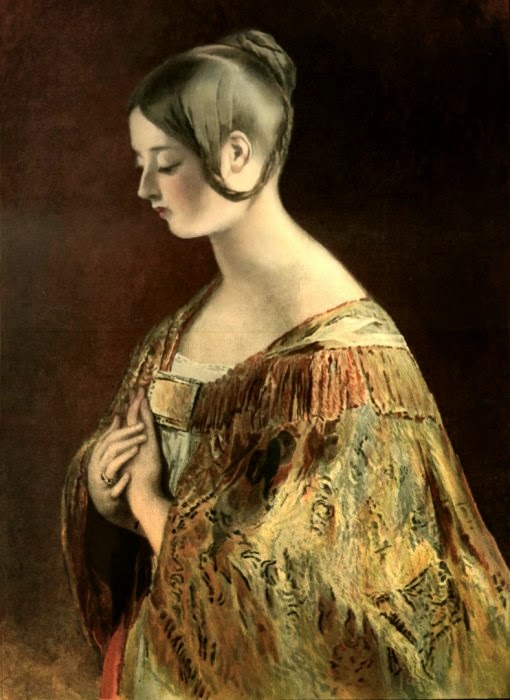
Queen Victoria, when Princess Victoria,
Schrewsbury, Watercolour, after Richard Westhall

Queen Victoria, when Princess Victoria
A young girl filling a pitcher from a spring, 17 August 1831
Pencil, watercolour and pen and ink
RCIN 980014.j
A lui subentrerà a partire dal 30 settembre del 1846 William Leighton Leitch ( 1804 - 1883 ), celebre acquerellista ed illustratore scozzese, a cui probabilmente si deve la maturità di Victoria nel dipingere, visto che fu colui che la seguirà da allora per ben 22 anni.
Analogamente a quanto fece Westhall, Leitch metteva a disposizione della giovane regina dei fogli con dei suoi acquerelli che ella doveva cercare di copiare come meglio sapeva, ma questi voleva che Victoria imparasse soprattutto come creare una vasta gamma di colori differenti partendo dai tre colori primari.


Astuccio da disegno e pittura Winsor-Newton appartenuto a Victoria
Dall'età di otto anni, perciò i disegni e gli acquerelli, a penna ed inchiostro cominceranno con il corredare il suo diario ( va detto che si tratta molto spesso di schizzi che erano fatti per puro diletto, senza prevedere che un giorno avrebbero potuto trovare pubblicazione ), mentre ai dipinti veri e propri, quelli più impegnati, ella dedicherà da adulta un album speciale.

Autoritratto del 1835

Queen Victoria's eldest daughter Princess Royal Victoria, is seen as a baby crawling along with a ball of wool in an intimate drawing from 1841

Three views of Victoria, the Princess Royal, at bath time. Her nickname, Pussy, is inscribed at the top.

Queen Victoria in Bal Costumé outfit as Queen Philippa - pen and ink sketch with watercolor by Queen Victoria, Thursday 12th May 1842

Prince Albert in Bal Costumé outfit- pen and ink sketch with watercolor by Queen Victoria,
Thursday 12th May 1842

Three views of the Princess Royal in her finery, in a sketch from February 1844

Victoria, Princess Royal and Queen Victoria in costume - pen and ink sketch with watercolor by Queen Victoria, Friday 6th June 1845
Da bambina ritraeva le cose che la circondavano: la sua governante, il suo cane Dash, le Ladies in visita a Kensington Palace e le stelle del mondo del teatro spesso ammirate sul palcoscenico,

Last scene from The Charade at Chatsworth, Watercolour from Victoria's Journal,
30 October 1832
mentre da adulta volgerà la propria attenzione più alla famiglia ed agli scorci paesistici dei luoghi in cui si trovava a soggiornare; senza alcun dubbio le lezioni di Leitch consentirono alla regina di affinare le proprie qualità e di divenire una pittrice di acquerello di autentico talento. Quando il pittore Clarkson Stanfield (1793-1867) vide un suo disegno nello studio di Leitch gli disse: ' Dipinge troppo bene per essere solo una dilettante. Entrerà presto a far parte della schiera degli artisti professionisti '; ovviamente questi non sapeva che l'artista in questione era la regina !
.+RL+K.62+(Sketchbook+illustration)..jpg)
The Prince of Wales with a parrot. Watercolour of Albert Edward, Prince of Wales,
by Queen Victoria, 1843

Landscape watercolour practice sheet, painted c.1846

Bertie, 1849
Watercolour, pen and ink, and pencil

Archie & Annie Macdonald with Daphne a Fanny at the kennel. Watercolour portrait of two Highland children, by Queen Victoria, 31 March 1850
+Watercolour,+by+Queen+Victoria,+July+1855.+Queen+Victoria%E2%80%99s+Journals+(www.queenvictoria...).+RL+K.56.+f.1+(Sketchbook+illustration)..jpg)
View of St. James’s Park. Watercolour by Queen Victoria, July 1855.

From my Sitting room window. Market Day. Watercolour of market day at Coburg,
by Queen Victoria, 29 September – 3 October 1860.

From The Drawing Room Window, Muckross, August 29, 1861
Solamente il grave lutto che colpì Victoria il 14 dicembre del 1861, quando perse improvvisamente il proprio consorte Principe Albert, facendo sì che si chiudesse in sè stessa sprofondando in un abisso in cui non vi era parte neppure per l'espressività artistica, poteva interrompere la sua produzione pittorica, ma ella irrimediabilmente riprenderà con il dipingere durante l'estate del 1863, quando come di consueto, si trovava in vacanza a Balmoral ... quella per le arti figurative era realmente una radicata vocazione che non poteva rimanere sopita troppo a lungo e che continuerà con il deliziare i momenti più intimi della Regina del Popolo anche da anziana.

View from my window at Balmoral by moonlight. Watercolour by Queen Victoria,
October 1864.
Si conclude così questa mia antologia di incantevoli immagini ... pensate che sono più di duecento quelle che ci sono state tramandate ... sì, ammetto che mi affascina sempre scoprire aspetti poco noti di personaggi importanti che hanno fatto la nostra storia e mi piace proporveli così come li conosco io, come nessun libro di storia ci ha mai dato l'opportunità di apprenderli ed apprezzarli ... la storia non è fatta solo di date da ricordare, di battaglie, di nomi celebri, ma è stata anche, e soprattutto, vissuta, da persone che come noi avevano sentimenti, emozioni, stati d'animo ... persone fallibili, vulnerabili, con pregi, difetti ... imperfette ... persone vere, con un loro mondo interiore, che sono esistite ... realmente ... proprio come noi.
E' giunto quindi il momento di congedarmi da voi, e con rinnovato affetto, vi saluto e vi auguro ogni bene fino al nostro prossimo incontro, qui, tra le pagine del nostro passato,
ancora da sfogliare.
A presto miei cari amici e lettori ♥


Tutti i dipinti ed i disegni pubblicati appartengono al Royal Collection Trust, © HM Queen Elizabeth II

If the fate and the story hadn't wanted to do of Alexandrina Victoria the great queen which fortunately became, celebrated even today as the inspiration for an entire era, the Victorian one, with no doubt her name would be remembered as that of a talented watercolorist.
- picture 1 - The Children at Osborne, 1850, Watercolour, RCIN 980055.ab
All British kings preceding her, from her grandfather King George III, had shown before than her great willingness and aptitude for painting, so her talent seems to belong to some sort of genetic predisposition, not to say that the great painters who frequented the court already at the time, also, have certainly exerted their influence on her attitude, from Edwin Landseer to William Leighton Leitch and Richard Westhall who was the first to discover and cultivate this already strong inclination of hers for the figurative arts.
Victoria received her first drawing lessons at Kensington Palace when she was eight years old, to be precise on the morning of December 4, 1827, at 9:30 am ... it was a Tuesday, a moment that will forever remain etched in her memory, and the lecture was held between those of religion and history first, and those of poetry and general culture after; her teacher was just Richard Westall (1765-1836), who continued to follow her into lessons, that were held twice a week, until, in 1836, he will pass away.
- picture 2 - Queen Victoria, when Princess Victoria, Schrewsbury, Watercolour, after Richard Westhall
- picture 3 - Queen Victoria, when Princess Victoria, A young girl filling a pitcher from a spring, 17 August 1831, Pencil, watercolour and pen and ink RCIN 980014.j
On September 30, 1846 William Leighton Leitch (1804-1883), will take the place of him: he was a famous Scottish watercolourist and illustrator and probably has lead to the maturity Victoria in the paint, as it was the one that followed her for 22 years since then.
Similar to what Westhall did, Leitch put at the disposal of the young queen leaves with his watercolors that she had to try to copy as best as she knew, but he wanted Victoria to learn especially how to create a wide range of different colors starting from the three primary ones.
- picture 4 - RCIN 981349
Combining latent talents, enthusiasm and talented teaching Victoria became soon a capable designer and a watrcolour painter of prestige, taking such pleasure in transferring experiences in pictures so that, as I got to tell you here treating of her beautiful dolls and of the care that she had reposed in designing before than making them, it became her passion as a teenager, a passion that will accompany every significant moment of her life, even as an adult, until the end of her days.
- picture 5 - A drawing and painting case Winsor-Newton belonged to Victoria
From the age of eight years, therefore, drawings and watercolors, by pen and ink, will begin with the accompany her diary ( it must be said that very often they're sketches that were made for simply pleasure, without foreseeing that one day they could find publication ), while the paintings, those most committed, will be collected in a special album.
- picture 6 - Queen Victoria's selfportrait
- picture 7 - Queen Victoria's eldest daughter Princess Royal Victoria, is seen as a baby crawling along with a ball of wool in an intimate drawing from 1841
- picture 8 - Three views of Victoria, the Princess Royal, at bath time. Her nickname, Pussy, is inscribed at the top.
- picture 9 - Queen Victoria in Bal Costumé outfit as Queen Philippa - pen and ink sketch with watercolor by Queen Victoria, Thursday 12th May 1842
- picture 10 - Prince Albert in Bal Costumé outfit- pen and ink sketch with watercolor by Queen Victoria, Thursday 12th May 1842
- picture 12 - Victoria, Princess Royal and Queen Victoria in costume - pen and ink sketch with watercolor by Queen Victoria, Friday 6th June 1845
As a child she depicted the things around her: her governess, her dog Dash, the Ladies in visit to Kensington Palace and the stars of the world of theater often admired on the stage,
- picture 13 - Last scene from The Charade at Chatsworth, Watercolour from Victoria's Journal,
30 October 1832.
while as an adult she will turn her attention more to he family and to the landscapes within the places where she'll stay; without any doubt the lessons of Leitch allowed the queen to hone her quality and to become a watercolour painter of genuine talent. When the painter Clarkson Stanfield (1793-1867) saw a drawing of hers in the study of Leitch said: ' She paints too good to be just an amateur, she'll soon join the ranks of the professional artists'; obviously he didn't know that the artist in question was the queen!
- picture 14 - The Prince of Wales with a parrot. Watercolour of Albert Edward, Prince of Wales, by Queen Victoria, 1843
- picture 15 - Landscape watercolour practice sheet, painted c.1846
- picture 16 - Bertie, 1849, Watercolour, pen and ink, and pencil, RCIN 980024.ck
- picture 17 - Archie & Annie Macdonald with Daphne a Fanny at the kennel. Watercolour portrait of two Highland children, by Queen Victoria, 31 March 1850
- picture 18 - View of St. James’s Park. Watercolour by Queen Victoria, July 1855.
- picture 19 - From my Sitting room window. Market Day. Watercolour of market day at Coburg, by Queen Victoria, 29 September – 3 October 1860.
- picture 20 - From The Drawing Room Window, Muckross, August 29, 1861
Only the bereavement that struck Victoria on December 14, 1861, when she suddenly lost her consort Prince Albert, causing her to get closed in herself sinking into an abyss where there wasn't part even for the artistic expression, could stop her painting, but she inevitably will resume with painting during the summer of 1863, when, as usual she was on holiday at Balmoral ... that for the figurative arts was really a deep-rooted vocation that couldn't remain dormant for a too long time and will continue to delight the most intimate moments of the Queen of the People also as an elderly.
- picture 21 - View from my window at Balmoral by moonlight. Watercolour by Queen Victoria, October 1864.
So my anthology of these enchanting images ends ... just, think that they're more than two hundreds those that we've inherited ... yes, I admit, I'm always fascinated to discover little-known aspects of important people who have made our history and I like to present them to you just as I know them, like no history book never has given us the opportunity to learn and appreciate them ... history isn't made up only of dates to remember, of battles, of famous names, but it was also, and above all, lived by people like us who had feelings, emotions, moods ... fallible, vulnerable, with their merits, defects ... imperfect ... real people with their own inner world, that have existed ... really ... just like us.
The time to take my leave of you has arrived and with renewed affection I greet you and wish you all the best well until we meet again, here, among the pages of our past, still to browse.
See you soon my dear friends and readers ♥
Notes:
All the drawings and paintings published here belong to the Royal Collection Trust, © HM Queen Elizabeth II




.+by+Thomas+Jones+Barker.jpg)


