Visualizzazione post con etichetta Habsburgs. Mostra tutti i post

sabato 10 maggio 2025

SOFIA L'IMPERATRICE NELL'OMBRA di Daniela Lasagnini


Questa è la stupenda locandina con cui si celebra nelle librerie l'uscita del mio ultimo libro, il terzo, che è nuovamente una biografia storica pubblicata per la casa editrice MGS PRESS di Trieste, la prima che esce in Italia dell'arciduchessa Sofia, madre dell'imperatore Francesco Giuseppe I.


E' trascorso più di un anno da che ho letto i suoi scritti privati, i suoi carteggi e quanto del suo diario personale è stato reso noto. Ebbene, in quell'occasione mi sono trovata a dialogare con una donna straordinaria per l'epoca in cui visse, ma dire solo questo sarebbe davvero riduttivo. Proprio la sua eccezionalità e quanto poco si sa di lei mi ha spronata a raccontarne la vita, perché l'arciduchessa Sofia che tutti siamo abituati a conoscere non ha nulla a che spartire con quella che realmente visse alla Corte di Vienna. Nell’immaginario collettivo ella incarna l’archetipo della suocera scomoda ed impicciona, superba e presuntuosa, così come l’hanno voluto coniare le pellicole e i testi diffusi con l’intento di mettere in luce la natura tormentata della mitica imperatrice d’Austria. L’inarrivabile Sissi, icona di bellezza, di classe e di stile, era nota anche per la sua mestizia, in parte legata alla perdita dei due figli, in parte causata dal clima che respirava a Corte: vi si sentiva uno spirito libero prigioniero in una gabbia dorata di cui, si deduce, fosse proprio Sofia a detenerne la chiave. Ma la storia, quella vera, quella con la 'S' maiuscola che attinge a fonti che ancora possiamo leggere, ci racconta altro. Questo libro, prima biografia italiana dell’arciduchessa Sofia Federica, nata principessa di Baviera dai monarchi Massimiliano I e Federica Carolina nel 1805, scritto dopo un’attenta lettura di quanto rinvenuto nei suoi documenti personali, ne presenta al lettore un ritratto del tutto inedito. 

Da queste pagine emerge la figura di una donna dall’intelligenza singolare rispetto agli uomini del suo tempo, che la rese dotata di numerosi talenti, cultrice di tutte le arti, amante di politica e capace di rinunciare al trono, che un tempo sognava, in nome del figlio primogenito che volle imperatore. Ma Sofia era anche genuina, affabile e di buon cuore. Andata in sposa all’arciduca Francesco Carlo d’Asburgo-Lorena nel 1824 fu subito ammirata dall’intera Corte viennese: per la sua eleganza era oggetto delle attenzioni dei signori della nobiltà e dell’aristocrazia, mentre le dame vedevano in lei un ideale, un esempio da seguire. Ciò che più amava era riunire la famiglia per avere accanto i quattro figli, cui si era unita la sua “amata bambina” – così chiamava Sissi che per lei sarà sempre la figlia che il destino non le concesse – e, come fosse una madre e una nonna borghese, tenere vivi i valori legati al focolare domestico: la spontaneità, l’intimità e la solidità dei legami tra congiunti. Ciò che più la fece soffrire fu non riuscire a trovare corrisposti i sentimenti per la sua “bambina” che mai smise di amare ed ammirare nonostante, dopo i primi tempi, questa sempre più si allontanò da lei dimostrando ostilità nei suoi confronti. Dico dopo i primi tempi perché dapprincipio Sissi contraccambiava le sue attenzioni ed il suo amore confessando di aver trovato in lei la madre che mai aveva avuto: Ludovica era una donna fredda, staccata, attenta a crescere con cura solo la figlia primogenita, Helene detta Nené, ed il figlio maschio cadetto, Karl Theodor detto Gackel. Così le aveva aperto il suo cuore. Sofia era diventata la spalla su cui la giovane imperatrice rimpiangeva la sua Baviera, i suoi boschi e dava sfogo ai suoi crucci coniugali. Ma accadde qualcosa che l'allontanò per sempre dalla suocera: fu come se un'incantesimo si fosse irrimediabilmente rotto, Sissi era molto suscettibile e non era capace di perdonare. Altro non vi voglio raccontare, mi spingerei troppo oltre. Concludo dicendovi che sarà la tragica morte di Massimiliano, divenuto imperatore del Messico e giustiziato a Querétaro dalle truppe di Benito Juarez il 19 giugno 1867 a ridurre Sofia l’ombra di sé stessa: irrimediabilmente minata nel fisico e nello spirito gli sopravviverà di soli cinque anni. Si spegnerà alle prime luci dell'alba del 28 maggio 1872 all'età di 67 anni.
Chi desidera acquistarlo lo trova già vendita, oltre che sul sito della CASA EDITRICE MGS PRESS, su AMAZON e su IBS.

RingraziandoVi come sempre per il tempo che mi dedicate, 
auguro a Tutti, cari Amici e Lettori di ~ My little old world ~ 
un sereno weekend di primavera
A presto ❤ 


Dany


Sophie, the Empress in the Shadows

IMAGE 1 - Presentation poster

This is the outstanding poster that celebrates the realased in bookstores of my latest book, the third, which is once again a historical biography published by the MGS PRESS publishing house of Trieste, the first to be published in Italy of Archduchess Sophie, mother of Emperor Franz Joseph I.


More than a year has passed since I read her private writings, her correspondence and what has been made known of her personal diary. Well, on that occasion I found myself talking to an extraordinary woman for the time in which she lived, but to say only that would be truly reductive. Her exceptionality and how little is known about her has spurred me to tell her life, because the Archduchess Sophie that we are all used to know has nothing to do with the one who actually lived at the Court of Vienna. In the collective imagination she embodies the archetype of the inconvenient and intrusive, haughty and presumptuous mother-in-law, as the films and texts released with the intent of highlighting the tormented nature of the legendary Empress of Austria have coined. The unrivaled Sissi, an icon of beauty, class and style, was also known for her sadness, partly linked to the loss of her two children, partly caused by the climate she breathed at Court: she felt like a free spirit imprisoned in a golden cage of which, it is deduced, Sofia herself held the key. But the story, the real one, the one with a capital 'S' that can still be read in documents, tells us something else. 


IMAGE 2 - Cover of the book


This book, the first Italian biography of Archduchess Sophie Frederica, born Princess of Bavaria to the monarchs Maximilian I and Frederica Carolina in 1805, written after a careful reading of what was found in her personal documents, introduces the reader to a completely new portrait of her. From these pages emerges the figure of a woman with a singular intelligence compared to the men of her time, which made her gifted with numerous talents, a scholar of all the arts, a lover of politics and capable of renouncing the throne, which she once dreamed of, in the name of the firstborn son of hers who she wanted to be emperor. But Sophie was also genuine, affable and kind-hearted. Having married Archduke Franz Charles of Habsburg-Lorraine in 1824, she was immediately admired by the entire Viennese Court: for her elegance she was the object of attention of the lords of the nobility and the aristocracy, while the ladies saw in her an ideal, an example to follow. What she loved most was to reunite the family to have her four children at their side, joined by her “beloved little girl” – that’s what she called Sissi, who for her will always be the daughter that fate denied her – and, as if she were a bourgeois mother and grandmother, to keep alive the values ​​linked to the domestic hearth: spontaneity, intimacy and the solidity of the bonds between relatives. What made her suffer most was not being able to find reciprocation of the feelings for her “little girl” who she never stopped loving and admiring even though, after the first times, the girl increasingly distanced herself from her, demonstrating hostility towards her. I say after the first times because at first Sissi reciprocated her attentions and her love, confessing that she had found in her the mother she had never had: Ludovica was a cold, detached woman, careful to lovingly raise only her firstborn daughter, Helene called Nené, and her younger son, Karl Theodor called Gackel. That’s why she had opened her heart to her. Sophie had become the shoulder on which the young empress longed for her Bavaria, her woods and vented her marital worries. But something happened that distanced her from her mother-in-law forever: it was as if a spell had been irremediably broken, Sisi was very susceptible and incapable of forgiving. I don't want to tell you anything else, I'd go too far. I will conclude by telling you that it was the tragic death of Maximilian, who had become Emperor of Mexico and was executed in Querétaro by Benito Juarez's troops on 19 June 1867, that reduced Sophie as a shadow of herself: irremediably undermined in body and spirit, she survived him by only five years. She passed away at the very first lights of the dawn on May 28, 1872 at the age of 67.
Who wants to by it can find it already on sale on the website CASA EDITRICE MGS PRESS, on AMAZON and on IBS.
Of course, it's written in Italian.


Thanking You as usual for the time You always devote to me,
I wish All the Friends and Readers of ~ My little old world ~
a peaceful Spring weekend
See you soon ❤

Dany


domenica 21 maggio 2023

The "Rose of Brabant"


On its publishing days, here there are the very first lines which my biography about Marie Henriette von Habsburg-Lorraine begins with.
I've translated them from Italian into English just to bring you into the world these pages discloses.
I've done it heartily, and I've written them for the Italian readers too, to let them try a little bit of this book which they may buy and read, if the wish... Alas, I cannot translate all the 296 pages which it consists of, but it is with much enthusiasm that I share the beginning of the first chapter with you - it's something like an introduction, a preface to all Marie Henriette's story; this was the moment in which her life changed hopelessly and irreparably. She had to leave her Country for Belgium, of which she'll become the second Queen. A far goodhearted Lady gifted with a very strong temper, she'll never surrender herself facing all the difficulties her fate will reserve her, indeed, she seemed even, with the flowing of the time, that, once she became woman and crowned Queen, she grew stronger and stronger. 
Until she became elderly, of course.


Marie, Duchess of Brabant (1836-1902), later Queen of the Belgians, by Sir William Charles Ross, 1853. He was named painter and miniaturist in Queen Victoria's court when she ascended the throne (1837). The Queen of the United Kingdom commissioned this portrait in November 1853 on the occasion of the visit of the Dukes of Brabant on their honeymoon.
Today it belongs to the ROYAL COLLECTION TRUST (RCIN 420384).


CHAPTER I 

THE "ROSE OF BRABANT"

It was a warm evening in the late Spring of 1853. The Viennese diplomats, nobles and aristocrats had been invited to a reception at the Hofburg. The occasion was a Ball bei Hof, a real gala ball. (In imperial times, two types of dances were organised: the Hofball
and the Ball bei Hof. The first was the Court ball, whose audience was very selected and the ceremonial very rigid, while the second was the gala ball, more solemn and sumptuous, which attracted a much larger number of personalities.)
The Großer Galerie, in its full splendor, was crowded with important personalities who awaited the arrival of the Emperor. Satin and silk dresses, kept in shape by stiff crinolines and enriched with precious decorations, rustled on the freshly waxed floor and the thousands of lighted candles made that festive evening sumptuous, illuminating the salon as day. The imposing chandeliers and candelabras, hanging on the walls alongside the mirrors, reverberated a warm light, similar to that which, through the large windows, diffused the setting sun. Outside, the scents of the flower gardens spread in the air and, from the open balconies, they entered the salon, mingling with the essences with which the ladies, in the Victorian era, used to perfume their hair collected in evening hairstyles. A background chatter seemed to harmonize with the notes of the very first Strauß waltzes that the orchestra was going to play while waiting for the Emperor to officially start the celebrations.
Franz Joseph reached the Großer Galerie around 5.30 pm, since it had been established that the balls would be held from 6 to 8 pm. One by one, the guests approached Him to offer their respects. Marie Henriette entered the hall amongst the archdukes and archduchesses giving her arm to her knight and was enraptured by everything around her. She was 16 and it was the very first time she was at the Hofburg for an official ball; until that day she had been invited to the imperial palace only for family dinners (Archduchess Marie Henriette was a niece of Archduke Ferdinand and therefore a first cousin of Archduke Franz Karl of Habsburg-Lorraine, father of Emperor Franz Joseph).
She, speechless while facing all that magnificence, approached Franz Joseph with deference and, after greeting Him with a bow, she danced a polonaise, a dance of Polish origin very popular at the time, similar to a slow rhythmic march. She then undid her corset, which she felt excessively constrained by, and she delighted herself listening to her mother who, stroking the keys of her piano, showed her virtuosity playing a waltz, and she followed her brother who entertained the moustached, gallant and indomitable Magyars in an interesting conversation.
She didn't have the slightest suspicion of what was about to happen to her until she was approached by an officer. He was accompanied by a young man, also in uniform who, she was told, would soon marry her: he was the Duke of Brabant, son of King Leopold I
of Belgium...

HERE I HAVE TO STOP MYSELF, ALAS!
But for sure you're wondering where does the surname, which gives the title to this post of mine, come from; page 19 reads: 

When she reached Brussels and got out of her carriage, half an hour later than scheduled, Marie Henrihette wore a light gray silk muslin dress, a black cape and on her head she wore a tulle hat, also black, adorned with small pink flowers. Despite her drawn face, her smile will win over her new people who will welcome her joyfully and coin the nickname of "Rose of Brabant" in honor of her beauty.
«Marie Henrihette is a beautiful and rosy princess as fresh as the dawn, with such a lively and eloquent physiognomy», the Countess of Fiquelmonte would write enthusiastically in her correspondence after seeing the future daughter-in-law of the king upon her arrival.
(This text is drawn from MARIA ENRICHETTA. DA VIENNA A BRUXELLES UN'ASBURGO REGINA DEI BELGI by Daniela Lasagnini, MGS PRESS, Trieste ©)

AND THAT'S TRULY ALL, I CANNOT GO FURTHER!
But I don't want to leave you before than publishing some images of hers:


Portrait of Marie Henriette by Nicaise de Keyser (1813-1887), 1853


(Detail)


Marie Henriette, young Duchess of Brabant, in a photograph by unknown author,
© Royal Collection Trust


And here you have a photograph of hers portraying her in riding attire in 1868: she was crowned Queen of the Belgians for three years, and her expression tells you how sad her life was going to become: no heir to the throne, yet, and a life so hard to live with a young boy she'd never seen before than getting married to him, a boy who became an arrogant man!


To write this book was a delight to me, it came all at once, I wrote it in un a flash with much passion and enthusiasm, and hope to convey just this enthusiasm to whoever will read it.


In the hope You've enjoyed the time we spent together today, 
with sincere thankfulness I'm sending my dearest hug to You,  
Dearest Readers and Friends of mine!
See you soon  ❤


La "Rosa di Brabante"

Nei giorni della sua pubblicazione, eccovi le primissime righe con cui inizia la mia biografia su Maria Enrichetta d'Asburgo-Lorena. Le ho tradotte con tutto il cuore per i lettori di lingua madre inglese, al fine di trasportarli nel mondo che queste pagine dischiude, e le ho trascritte per quelli italiani perché sia una sorta di 'assaggio' del testo che loro, se credono, possono acquistare e leggere per intero. E' con entusiasmo che condivido con tutti voi l'inizio del primo capitolo che rappresenta una sorta d'introduzione, una prefazione a tutta la storia su Maria Enrichetta; è questo il momento in cui la sua vita si appresta a cambiare irrimediabilmente. 
Ella dovrà lasciare il suo Paese per il Belgio, di cui diverrà la seconda regina. 
Giovane di buon cuore dotata di forte temperamento, ella mai si arrenderà messa di fronte alle difficoltà che il destino le serberà, anzi, sembrò persino che, con il trascorrere del tempo, divenuta donna ed incoronata regina, ella si fosse fatta sempre più forte. Fino a che subentrerà l'età ad indebolirla, ovviamente.


IMMAGINE DI FRONTESPIZIO - Questo dipinto è opera di Sir William Charles Ross (1794-1860), nominato pittore e miniaturista alla Corte della regina Vittoria quando ella salì sul trono (1837). La regina del Regno Unito gli commissionò questo ritratto nel novembre del 1853 in occasione della visita dei duchi di Brabante durante il loro viaggio di nozze. Con il titolo Marie, Duchess of Brabant (1836-1902), later Queen of the Belgians l’opera fa tutt’oggi parte del ROYAL COLLECTION TRUST (RCIN 420384).

CAPITOLO I 

LA "ROSA DI BRABANTE"


Era una tiepida serata di tarda primavera del 1853. I diplomatici, i nobili e gli aristocratici viennesi erano stati invitati a un ricevimento alla Hofburg. L’occasione era un Ball bei Hof, un vero e proprio ballo di gala1. La Großer Galerie, nel pieno del suo splendore, era gremita
di personalità importanti che attendevano l’arrivo dell’imperatore. Abiti in raso e in seta, tenuti in forma da rigide crinoline e arricchiti di preziose decorazioni, frusciavano sul pavimento appena incerato e le migliaia di candele accese rendevano sontuosa quella serata di festa illuminando a giorno il salone. Gli imponenti lampadari e i candelabri, appesi alle pareti a lato degli specchi, riverberavano una luce calda, simile a quella che, attraverso le ampie vetrate, diffondeva il sole al tramonto. Fuori, i profumi dei giardini fioriti si spargevano nell’aria e dai balconi aperti entravano nel salone confondendosi con le essenze con cui le dame, in epoca vittoriana, usavano profumarsi i capelli raccolti in acconciature da sera. Un chiacchiericcio di sottofondo sembrava armonizzare con le note dei primissimi valzer di Strauß che l’orchestra intonava in attesa che l’imperatore desse ufficialmente avvio ai festeggiamenti. Francesco Giuseppe raggiunse la Großer Galerie intorno alle 17.30, visto che si era stabilito che i balli si sarebbero tenuti dalle 18 alle 20. Ad uno ad uno, i convenuti gli si avvicinarono per offrirgli i propri omaggi. Maria Enrichetta fece il suo ingresso nel salone tra gli arciduchi e le arciduchesse dando il braccio al suo cavaliere e rimase estasiata da tutto ciò che la circondava. Aveva 16 anni ed era la prima volta che si trovava alla Hofburg per un ballo ufficiale; fino a quel giorno era stata invitata al palazzo imperiale solamente per cene di famiglia2. Ammutolita di fronte a tutto quello sfarzo, si avvicinò con deferenza a Francesco Giuseppe e, dopo averlo salutato con un inchino, danzò una polonaise, un ballo di origine polacca molto in voga a quel tempo, simile ad una lenta marcia ritmata. Si slacciò quindi il corsetto, da cui si sentiva eccessivamente costretta, e si deliziò nell’ascoltare la madre che, accarezzando i tasti del piano, mostrò il suo virtuosismo suonando un valzer, e seguì il fratello che intratteneva i baffuti, galanti ed indomabili magiari in un’interessante conversazione3.
Non aveva il benché minimo sospetto di quanto stava per accaderle fino a che non fu avvicinata da un ufficiale. Lo accompagnava un giovinetto, anch’egli in divisa che, le fu detto, sarebbe diventato presto suo sposo: era il duca di Brabante, figlio di re Leopoldo I del Belgio.

E QUI, PURTROPPO, DEVO FERMARMI!
Per certo vi chiederete da dove provenga il soprannome che dà il titolo al post; a pagina 19 si legge: 

Quando raggiunse Bruxelles e scese dal suo vagone, con mezz'ora di ritardo rispetto a quanto stabilito, Maria Enrichetta indossava un abito di mussola di seta grigio chiaro, una mantellina nera e sul capo portava un cappellino di tulle, anch'esso nero, adornato di piccoli fiori rosa. Nonostante il volto tirato, il suo sorriso conquisterà il suo nuovo popolo che l'accoglierà festoso e conierà in suo onore il soprannome di “Rosa di Brabante” per omaggiare la sua bellezza.
«Maria Enrichetta è una bella e rosea principessa fresca come l'aurora, dalla fisionomia così vivace ed eloquente», scriverà entusiasta, nella sua corrispondenza, la contessa di Fiquelmonte dopo aver visto la futura nuora del re al suo arrivo. 
(Il testo è tratto da MARIA ENRICHETTA. DA VIENNA A BRUXELLES UN'ASBURGO REGINA DEI BELGI di Daniela Lasagnini, MGS PRESS, Trieste ©)

E QUESTO E' DAVVERO TUTTO, NON POSSO SPINGERMI OLTRE!
Ma non voglio lasciarvi prima di aver pubblicato alcune sue immagini:


IMMAGINE 2 - Ritratto di Marie Henriette by Nicaise de Keyser (1813-1887), 1853

IMMAGINE 3 - Ritratto di Marie Henriette by Nicaise de Keyser (1813-1887), 1853, dettaglio

IMMAGINE 4 - Marie Henriette, young Duchess of Brabant, in una fotografia scattata da un autore ignoto, © Royal Collection Trust

IMMAGINE 5 - Ed eccovi un'immagine che la ritrae in tenuta da amazzone nel 1868: era già regina dei belgi da tre anni e la sua espressione vi dice quanto triste stesse diventando la sua esistenza: non era ancora nato alcun erede al trono e la sua vita coniugale era così dura da viversi con un giovane ragazzo che non aveva mai visto prima di sposarlo, un ragazzo che si fece uomo decisamente arrogante!


Scrivere questo libro è stato delizioso per me, l'ho fatto di getto, l'ho scritto in un lampo con molta passione ed entusiasmo e mi auguro di trasmettere proprio questo entusiasmo a coloro che lo leggeranno.


Nella speranza che Vi sia stato gradito il tempo trascorso insieme oggi, 
Con la massima gratitudine Vi invio il mio caro abbraccio,  
Carissimi Lettori ed Amici!
         A presto ❤        
               

Dany


LINKING TO:


martedì 15 marzo 2022

Gisela, Sisi's estranged daughter


The Kaiser portrayed with Gisela and Rudolf in 1860


Gisella Louise Marie was born at 5.30 on July 12th, 1856 at Laxenburg Castle.
She was baptized Gisella, with two 'l', but she will always write her name with one 'l', and she will become for everyone Gisela.
It is not nice to say, but unfortunately her birth was a moment of great disappointment.
After Sophie, born on March 5th, 1855,


The birth of Sophie


everyone was waiting for an heir to whom one day could assign the throne and, when it was still a female who opened her eyes to this world of ours, the frustration was also profound for her godmother, her maternal grandmother Ludovika, who announced that she wouldn't be present for her baptism. In fact, she was represented by the other grandmother of hers, Archduchess Sophie. As required by the ceremonial, Gisela too was removed from the care of the Empress, and that was a thing that deeply marked their relationship from the very beginning which soon became cold and detached.


The birth of Gisela


Perhaps Elizabeth discharged on her the frustration of having to undergo further pregnancies until the birth of the desired heir, but it should not be forgotten that a fundamental role also played the princes of Archduchess Sophie, Sisi's mother-in-law, as well as her aunt, who considered her too much young and still unwary to take care of the education of her daughters. The disappearance of the little Sophie, eldest daughter of the imperial couple, during the official trip to Hungary in 1857, which took place on May 29th, only further alienated mother and daughter. Followed by her paternal grandmother and cared for by her nurse who had chosen her, Gisela grew well: her progress was promptly recorded by Archduchess Sophie who wrote:

"At 9 I went to Laxenburg, where due to the heat I sat for an hour in the garden with our dear Unica who was serene and joyful. She is growing fast and enjoys playing like she were older. So on her birthday, dad (Archduke Franz Karl) and I gave her a tiny coffee set and she, without anyone urging her, started pouring teaspoons of sugar and coffee from the pot and offered everyone a cup. "(From a letter sent to his son Karl Ludwig dated 23.7.1857). 

The relocation to the Hofburg, as well as the arrangement of her room next to her mother's, brought a certain serenity to the Court.
On August 21st, 1858, Rodolfo will be born and the little Gisela immediately fell in love with him:


The birth of Rudolf


“Every day after returning from the walk, the little one had to go to her; it was she who called him "Komm here, mein Birirem (Come to me little brother), and he was happy to be with her while she played",

Archduchess Sophie wrote to her son Ferdinand Maximilian on 12.1.1859. Much more than little Rudolf manifested, Gisela showed that she suffered from the long absence of her mother who had been in Madeira for six months to recover. Over time, Archduchess Sophie, together with the nanny she had chosen, Baroness Karolina von Welden, had replaced the maternal figure that the little ones obviously needed so badly.


With her father, on the other hand, Gisela always had a good relationship, also due to the common character affinities. At sixteen she married Prince Leopold of Bavaria (1846-1930), her second cousin. The wedding, wisely planned by the empress, involved the estrangement of the Bavarian prince from Princess Amalie von Sachsen-Coburg und Gotha, whom Maximilian, one of her beloved brothers, had fallen in love with, who intended to marry her. Leopold certainly could not refuse the hand of the emperor's daughter who also enjoyed a substantial dowry (the sum received by her paternal grandparents alone amounted to half a million florins). On April 20, 1873, the wedding was celebrated in the Augustinerkirche in Vienna.
Even Johann Strauss II wanted to make a special gift to the emperor's daughter on the occasion of such a celebration and composed in her honor Wiener Blut-Viennese blood,


perhaps what will become and still remains today the best known waltz of the son of the composer Strauss, the one who ... 'invented' it!
But it seems almost obvious to say that the empress, with her beauty and charm, even without having her intention, obscured the bride and every other pomp of the celebrations.


The wedding of Gisela and Leopold


The bond between brothers never failed, however the painful separation affected the character of Rudolf, who became even more introverted after the change that had been given to his education that had to pursue the formative ideals of an heir to the throne. With a deep sense of duty, obedient to the principles infused by her grandmother Sophie, Gisela, turned out to be a good wife and a good mother, passionate about hunting and an expert amazon.


Gisela, young woman


The new family welcomed her with joy. With his son-in-law Leopold, a career officer and expert hunter, the emperor had a good understanding, so much so that he was often a guest in the Munich palace, the construction of which he himself had generously supported. While the relationship between father and daughter intensified over the years - especially after the tragic death of Rudolf and his mother - those between mother and daughter will always remain only formal. At the birth of the first granddaughter who bore her name - Elisabeth - Sisi showed such coldness that she wrote to Ida Ferenczy, lady of the Court and an affectionate confidant of hers:

"Thank God the day has passed! It hurts me a lot to stay here, all alone and without a person with whom to exchange a word. (In fact, she resided in the hotel rather than with her daughter).
Today there was the baptism, the mother and the baby are just fine. They will reach a hundred years. I am telling you this to reassure you that their state of health will not keep me here."

(in B. Hamann, Elisabeth. Kaiserin wider Willen, 1982, p. 302). Even more sad the Empress' consideration of her second grandchild, a little girl "von seltener Häßlichkeit" (of rare ugliness) who looked like her mother. Gisela had become for her mother "Eine rackerdürre Sau" (a thin grind sow) and she called her four grandchildren "Ferkeln" (piglets).


Archduchess Gisela of Austria with her husband Leopold of Bavaria and their children 
(Left to right Elisabeth, Konrad, Georg and Auguste), 1885, by Josef Albert 


Gisela will take care of her grandmother Ludovika until her death on January 25th, 1892, when she was 84 years old after premature aging and slow decay.
And perhaps few people even know of the sensitivity that the Kaiser's daughter had for social issues: she was very sensitive to the problems of the people and during the Great War she set up a military hospital for the wounded inside her palace. During the 1918 revolution, although her entire family fled the city, she remained to participate in the elections to the Weimar General Assembly, the first in which women had the right to vote.
From her mother he will inherit 4 million florins and the Achilleion that Sisi had made build in Corfu between 1889 and 1891.
Gisella and Leopold had a long life together, so much so that in 1923 they celebrated their golden anniversary; her husband passed away seven years later, she in 1932 at the age of 76.
Both of them rest in the St. Michael's Church in Munich.


With sincere gratitude for the affection you always show me,
I'm sending you all my biggest hug

See you soon ❤


Gisella, la figlia di Sisi allontanata


IMMAGINE 1 - Il Kaiser ritratto con la figlia Gisella ed il piccolo Rodolfo in braccio nel 1860


Gisella Louise Marie nacque alle 5.30 del 12 luglio 1856 nel castello di Laxenburg. 
Venne battezzata Gisella, con due 'l', ma ella scriverà sempre il proprio nome con una 'l' sola, e diventerà per tutti Gisela.
Non è bello da dirsi, ma purtroppo la sua nascita fu un momento di grandissima delusione. 
Dopo Sophie, venuta alla luce il 5 marzo del 1855, 


IMMAGINE 2 - La nascita dell'arciduchessa Sophie, primogenita dell'imperatore Franz Josef e dell'imperatrice Elisabeth (Sisi)


tutti attendevano un erede cui un giorno poter assegnare il trono e, quando ad aprire gli occhi su questo nostro mondo fu ancora una femmina la frustrazione fu profonda anche per la sua madrina, la nonna materna Ludovika, la quale annunciò che non sarebbe stata presente per il battesimo. La rappresentò infatti l'altra nonna, l’arciduchessa Sophie. Così come imposto dal cerimoniale, anche Gisela venne sottratta alle cure dell'imperatrice, cosa che segnò profondamente il loro rapporto già dal principio che si fece presto freddo e staccato. 


IMMAGINE 3 - La famiglia imperiale al completo dopo la nascita di Gisella


Forse Elisabetta scaricò su di lei la frustrazione di doversi sottoporre ad ulteriori gravidanze fino alla nascita del sospirato erede, ma non va dimenticato che un ruolo fondamentale giocarono anche i principi dell'arciduchessa Sophie, suocera di Sisi, nonché sua zia, che la riteneva troppo giovane ed ancora incauta per occuparsi dell'educazione delle sue figliole. La scomparsa della piccola Sophie, primogenita della coppia imperiale, durante il viaggio ufficiale in Ungheria del 1857, avvenuta il 29 maggio, non fece che allontanare ulteriormente madre e figlia. Seguita dalla nonna paterna e accudita dalla nutrice che questa le aveva scelto, Gisela cresceva bene: i suoi progressi venivano puntualmente registrati dall’arciduchessa Sophie che scriveva:

”Alle 9 mi recai a Laxenburg, dove per il caldo rimasi seduta un’ora in giardino con la nostra cara Unica che era serena e gioiosa. Sta crescendo velocemente e si diverte giocando come se fosse più grande. Così nel giorno del suo compleanno, papà (l’arciduca Franz Karl) e io le abbiamo regalato un minuscolo servizio da caffè e lei senza che alcuno la spronasse iniziò a versare dei cucchiaini di zucchero e il caffè dal bricco e offerse a tutti una tazza” (da una lettera inviata la figlio Karl Ludwig datata 23.7.1857). 

Il trasferimento alla Hofburg, nonché la sistemazione della cameretta vicino alla madre, riportò a Corte una certa serenità.
Il 21 agosto 1858 nacque Rodolfo cui la piccola Gisela si affezionò immediatamente:


IMMAGINE  4 - La famiglia imperiale con Gisella ed il piccolo Rodolfo


 “Ogni giorno di ritorno dalla passeggiata, il piccolo doveva andare da lei; era lei che lo chiamava “Komm her, mein Birirem (Vieni da me fratellino), e lui era felice di stare con lei mentre giocava”,

scriveva l’arciduchessa Sophie al figlio Ferdinand Maximilian il 12.1.1859. Molto più di quanto manifestasse il piccolo Rudolf, Gisela dava a vedere di soffrire per la lunga assenza della madre che da sei mesi si trovava a Madeira per ristabilirsi. Con il tempo, l'arciduchessa Sophie, insieme con la bambinaia da lei stessa scelta, la baronessa Karolina von Welden, si era andata sostituendo alla figura materna di cui i piccoli, ovviamente, avevano un gran bisogno.


IMMAGINI  5 - 6 - 7 - Rodolfo e Gisella ritratti mentre giocano insieme


Con il padre, invece, Gisela ebbe sempre un buon rapporto, anche per le comuni affinità caratteriali. A sedici anni andò sposa al principe Leopold di Baviera (1846-1930), suo cugino di secondo grado. Il matrimonio, sapientemente pianificato dall'imperatrice, prevedeva l’allontanamento del principe bavarese dalla principessa Amalie von Sachsen-Coburg und Gotha, di cui si era innamorato Maximilian, uno dei suoi amati fratelli, che intendeva prenderla in sposa. Leopold non poteva certo rifiutare la mano della figlia dell’imperatore che godeva inoltre di una dote cospicua (la sola somma ricevuta dai nonni paterni ammontava a mezzo milione di fiorini). Il 20 aprile 1873 nell'Augustinerkirche a Vienna furono celebrate le nozze. 
Persino Johann Strauss II volle fare un dono speciale alla figlia dell'imperatore in occasione di una tale celebrazione e compose in suo onore Wiener Blut - Sangue viennese,


IMMAGINE 8 - Locandina del valzer 


forse quello che diverrà e che rimane ancor oggi il valzer più conosciuto del compositore figlio di colui che il valzer lo aveva...'inventato'. 
Ma sembra quasi cosa scontata dire che l’imperatrice, con la sua bellezza ed il suo fascino, pur senza averne l'intenzione, oscurò la sposa e ogni altro fasto dei festeggiamenti. 


IMMAGINE 9 - Il matrimonio di Gisella e Leopoldo


Il legame fra fratelli non venne mai meno, tuttavia la dolorosa separazione incise sul carattere di Rudolf, che diventò ancora più introverso di quanto già non l'avesse reso il mutamento che era stato impresso alla sua educazione che doveva perseguire ideali formativi propri di un erede al trono. Con profondo senso del dovere, obbediente ai principi infusi dalla nonna Sophie, Gisela, si rivelò essere una buona sposa e una buona madre, appassionata di caccia ed esperta amazzone.


IMMAGINE 10 - Gisella giovane donna


La nuova famiglia l’accolse con gioia. Con il genero Leopold, ufficiale di carriera ed esperto cacciatore, l’imperatore aveva una buona intesa, tanto da essere spesso ospite nel palazzo monacense, la cui costruzione era stata da lui stesso generosamente sostenuta. Mentre i rapporti fra padre e figlia si intensificarono nel corso degli anni – in particolare dopo la tragica morte di Rudolf e della madre – quelli fra madre e figlia si manterranno sempre solo formali. Alla nascita della prima nipotina che portava il suo nome, Elisabeth, Sisi mostrò una tale freddezza da scrivere a Ida Ferenczy, sua dama di Corte ed affezionata confidente: 

Grazie a Dio la giornata è passata! Mi pesa molto restare qui, tutta sola e senza una persona con cui scambiare una parola. (Dimorava infatti in Hotel anziché presso la figlia). 
Oggi c’è stato il battesimo, la madre e la bambina stanno più che bene. Arriveranno a cent’anni. Te lo dico per rassicurarti che il loro stato di salute non mi tratterrà qui.

(in B. Hamann, Elisabeth. Kaiserin wider Willen, 1982, p. 302). Ancora più triste – e sicuramente non le fa onore – la considerazione sulla secondogenita, una bambina “von seltener Häßlichkeit” (di rara bruttezza) che assomigliava alla madre. Gisela era diventata per l'imperatrice sua madre “Eine rackerdürre Sau“ (una secca scrofa sgobbona) ed i suoi quattro nipoti li definiva “Ferkeln” (maialini). 


IMMAGINE 11 - Archduchess Gisela of Austria with her husband Leopold of Bavaria and their children (Left to right Elisabeth, Konrad, Georg and Auguste), 1885, by Josef Albert


Gisela si prenderà cura della nonna Ludovika fino alla sua morte avvenuta il 25 gennaio 1892, quando aveva raggiunto gli 84 anni dopo un precoce invecchiamento ed un lento decadimento. 
E forse sono in pochi anche a sapere della sensibilità che la figlia del Kaiser ebbe per il sociale: 
ella era molto sensibile ai problemi del popolo e durante la Grande Guerra allestì un ospedale militare per i feriti all'interno del suo palazzo. Durante la rivoluzione del 1918, nonostante l'intera sua famiglia abbandonò la città, ella rimase per partecipare alle elezioni dell'assemblea generale di Weimar, la prima in cui ebbero diritto di voto le donne.
Dalla madre erediterà 4 milioni di fiorini e l’Achilleion che Sisi aveva fatto costruire a Corfù tra il 1889 ed il 1891.
Gisella e Leopold ebbero una lunga vita insieme, tanto che nel 1923 festeggiarono le nozze d'oro; suo marito si spense sette anni dopo, lei nel 1932 all'età di 76 anni.
Entrambi riposano nella chiesa di San Michele a Monaco di Baviera.


Con sincera gratitudine per l'affetto che sempre mi dimostrate, 
invio a tutti voi il mio più caloroso abbraccio

A presto ❤


LINKING WITH:


domenica 9 gennaio 2022

"I'm glad that you're in contact with the forgotten descendants" - U.S. Hapsburgs


Mr and Mrs James Longstreet Cleveland
HAPSBURG (US) AND WIFE
© Daniela Lasagnini


"I'm glad that you're in contact with the forgotten descendants"

That's a phrase taken from an e-mail I received some days ago from a member of the House of Habsburg-Lorraine which is the further confirmation I was looking for after having written my book.
For sure you do remembrer that in late Winter of 2021 I published my history essay Il figlio americano di Rodolfo d'Asburgo - Rudolf von Habsburg's American son, for MGS PRESS, in which, after almost three years of researches and work on private documents taken hidden, I was able to rebuilt the love-story between the misterious Princess K (Tsar Alexander II's last illegitimate daughter) and Crown Prince Rudolf, the 'fruit' of which was a baby boy born in Hot Springs, Arkansas.
He lived in Missouri, Washington DC and Colorado, was known with the name of James Longstreet Cleveland and had such an adventurous life that sounds almost like a romantic novel.
But everything's true and ratified (I also received a confirmation from a descendant of His belonging to the Habsburgs).
This story is told and published for the very first time and for the first time too I succeded in giving both an identity and a face to Princess K... You can just imagine how many people grew enthusiastic, but also how many, with a soul filled with distrust and hatred, have tried to denigrate this story and have written malicious words on socials, trying to limit its diffusion, without thinking that even speaking publicly not well about something, you make it become famous and viral! 

We know that when Crown Prince Rudolf's son died, on July 1st, 1938, he left a very young wife, Mrs Gertrude, and a little child aged 4, James Gillaspy, but after the census dating back to 1940 the data colleceted are approachable only by those people who are able and demostrate consanguineity, that's why I was cut off from going on further.
But my publisher and I didn't give up... He encouraged me to go on with my researches... Ascertained that James Longstreet Cleveland was Crown Prince Rudolf's American son, how about his offspring?
It sounded like it was impossible to find it...
And after all these months I've eventually reached a result: in America, and to be more precise in the State of Missouri, they're still living the grandchildren of James Cleveland Longstreet; his child had a few children, they have now another surname - in the United States it is very easy to change identities - and they lead the life of ordinary people. Of their ancestors, Archduke Rudolph, their great-grandfather, and James, their grandfather, they keep the memory alive even in not wanting to exhibit their noble roots as well as in the remarkable similarity of the facial features.
The confirmation, as mentioned, came to us from a member of the Habsburg-Lorraine Family. For months, despite the insistent e-mails we exchanged, he managed to gloss over the question I asked him:

"Are there any descendants of James Cleveland Longstreet in America?"

Then, suddenly, after I promised him in the last e-mail that it was not our intention to spread the names of James's descendants, he put me in contact with a person who lives in Missouri ... And from this contact came the confirmation, then sealed by the phrase quoted at the beginning.
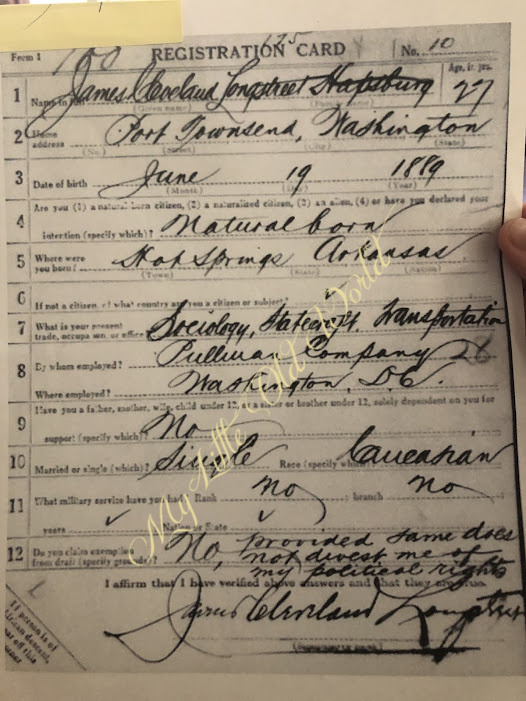
I reiterate that we firmly want to keep the word given both to the Habsburg-Lorraine and to the American branch of their descent and I conclude by saying that I have also come into possession of a document - tha enlistment certificate thanks to which he took part in the Great War - compiled by James himself, claiming to be James Cleveland Longstreet Hapsburg, document which I deal with in my book on page 64 of which there is no trace in the American public archives.
I publish it below for you!


Oh, by the way, I'm publishing below also the original of a draft of an article appeared in a newspaper or magazine in the USA on July 31st, 1934 which is a unique copy I found on the back side of the photo I put as 'frontispiece' which I bought by an antiquarian.
That's also a quite curious story.
As an antiques lover I found myself, shortly after the middle of last month, leafing through an online catalog of an Icelandic antiques dealer based in Reykjavík; it had been published only ten days earlier and dealt exclusively with images that portray famous personalities from the world of entertainment, politics, sport, culture in general who were in the limelight from the beginning to the end of the last century.
These original single-copy photographs have been found in photographic archives of mainly British and Scandinavian editorial presses; kept for many years - the most recent date back to 30/40 ago, the oldest over 100 - in the archive of a European newspaper based in Latvia (Riga), far from everyone's eyes, they have only recently been put up for sale as a collector's items.
And this is how, quite by chance, I found myself in front of the image of James Longstreet Cleveland portrayed together with his wife in a photograph that bears the stamping of a prestigious photographic studio in New York.
As I wrote before, it is dated 1934 and together with it I bought the draft of the article which, on July 31st of the same year, was published together with the image.
Obviously I purchased this material which I consider very precious!
Not only beacuse the photograph comes from New York, but since the draft is written in English, I consider for sure that the European newspaper that published both the photograph and the article bought them from a US publisher.
I hope you'll be able to read it, it's quite faded by the time which has passed since then...


U.S. HAPSBURGS TURN DOWN CHANCE TO AUSTRIAN THRONE.


© Daniela Lasagnini


And thus, after having added another small piece to the unfortunate Crown Prince Rudolph of Habsburg-Lorraine's life through his American son and his descendants still living in Missouri, our time together is ending today too, alas!
In the hope that what we dealed today with, which is the tail end of the content of my book, has also thrilled you - given it's everything absolutely unpublished -
I wish you all a happy week.

See you soon ❤


"Sono lieto che sia in contatto con i discendenti dimenticati" - Gli Asburgo d'America


- IMMAGINE 1 - Mr and Mrs James Longstreet Cleveland
ASBURGO (STATUNITENSE) CON LA MOGLIE
© Daniela Lasagnini


Il titolo riprende una frase tratta da una e-mail ricevuta alcuni giorni fa da un membro della Casa d'Asburgo-Lorena che rappresenta l'ulteriore conferma che cercavo dopo aver scritto il mio libro.
Di sicuro ricordereta che a fine inverno dello scorso anno pubblicai il mio saggio di storia dal titolo Il figlio americano di Rodolfo d'Asburgo per la Casa Editrice MGS PRESS, in cui, dopo quasi tre anni di ricerche e lavoro su documenti privati ​​tenuti nascosti, sono riuscita a ricostruire la storia d'amore tra la misteriosa Principessa K (ultima figlia illegittima dello zar Alessandro II) e il principe ereditario Rodolfo d'Asburgo, il cui 'frutto' fu un figlio maschio nato a Hot Springs, in Arkansas.
Egli visse in Missouri, a Washington DC ed in Colorado; conosciuto con il nome di James Longstreet Cleveland ebbe una vita talmente avventurosa e romantica da sembrare quasi un romanzo.
Ma è tutto vero e confermato (ricevetti a suo tempo conferma di questa storia da un discendente degli Asburgo).
Nel mio libro questa storia viene raccontata per la prima volta e anche per la prima volta sono riuscita a dare sia un'identità nonché un volto alla Principessa K... potete immaginare quante persone si siano entusiasmate, ma anche quante, con l'animo intossicato da diffidenza ed astio, abbiano cercato di denigrare questa storia e hanno scritto parole malevole sui social, cercando di limitare la divulgazione del libro, senza pensare che anche parlando male di qualcosa pubblicamente, la si fa diventare famosa e virale!

Sappiamo che, quando morì, il 1 luglio 1938, il figlio dell'arciduca Rodolfo lasciò una giovanissima moglie, Mrs Gertrude, e un bambino dell'età di 4 anni, James Gillaspy, ma dopo il censimento del 1940 i dati raccolti sono avvicinabile solo da coloro che sono in grado di dimostrare consanguineità, ed è così che mi si è impedito di andare oltre.
Ma il mio editore ed io non ci siamo arresi... Egli mi ha incoraggiata a proseguire con le mie ricerche ed, appurato che James Longstreet Cleveland era il figlio americano del principe ereditario Rodolfo, che ne è stato della sua discendenza?
Sembrava impossibile trovarne traccia.
E dopo tutti questi mesi alla fine sono stata in grado di raggiungere un risultato: in America, e per la precisione nello Stato del Missouri, vivono ancora i nipoti di James Cleveland Longstreet; suo figlio ebbe più figli, i quali ora hanno un altro cognome - negli Stati Uniti è molto facile cambiare identità - e conducono una vita da gente comune. Dei loro antenati, l'arciduca Rodolfo, loro bisnonno, e James, loro nonno, mantengono vivo il ricordo anche nel non voler esibire la loro nobile ascendenza oltre che nella notevole simiglianza dei tratti somatici.
La conferma, come detto, ci è arrivata da un membro della Famiglia Asburgo-Lorena. Per mesi, nonostante le mail insistenti che ci scambiavamo, Questi è riuscito a sorvolare sulla domanda che gli ponevo:

"Ci sono discendenti di James Cleveland Longstreet in America?"

Poi, all'improvviso, dopo avergli promesso nell'ultima mail che non era nostra intenzione diffondere i nomi dei discendenti di James, mi ha messo in contatto con una persona che abita nel Missouri... E da questo contatto è arrivata la conferma, poi suggellata dalla frase citata all'inizio.
Ribadisco che vogliamo fermamente mantenere la parola data sia agli Asburgo-Lorena che al ramo americano della loro discendenza e concludo dicendo che sono anche entrata in possesso di un documento - il certificato di arruolamento grazie al quale prese parte alla Grande Guerra - compilato dallo stesso James che si dichiara James Cleveland Longstreet Hapsburg, documento che ho citato nel mio libro a pagina 64, ma di cui non vi è traccia negli archivi pubblici americani.
Lo pubblico qui di seguito per voi!


- IMMAGINE 2 - FOTOGRAFIA DEL DOCUMENTO DI ARRUOLAMENTO DI JAMES CLEVELAND LONGSTREET HAPSBURG (Grande Guerra)


Ah, a proposito, pubblico qui sotto anche l'originale di una bozza di un articolo apparso su un giornale o una rivista negli USA il 31 luglio 1934 che ho trovato sul retro della foto che ho messo come 'frontespizio' acquistata da un antiquario.
Anche questa è una storia abbastanza curiosa.
Da cultrice di antiquariato mi sono trovata, poco dopo la metà del mese scorso, a sfogliare un catalogo on-line di un antiquario islandese con sede a Reykjavík; era stato pubblicato solo dieci giorni prima e trattava esclusivamente di immagini che ritraggono personaggi famosi del mondo dello spettacolo, della politica, dello sport, della cultura in generale, che furono alla ribalta delle cronache dagli inizi alla fine del secolo scorso.
Queste fotografie originali in copia unica sono state rinvenute in archivi fotografici di stampa editoriale principalmente britannici e scandinavi; custodite per molti anni – le più recenti datano 30/40 fa, le più vecchie oltre 100 – nell’archivio di una testata giornalistica europea con sede in Lettonia (Riga), lontano dagli occhi di tutti, sono state messe in vendita solo di recente come materiale da collezione.
Ed è così che, in modo del tutto fortuito, mi sono trovata di fronte l’immagine di James Longstreet Cleveland ritratto, insieme con la moglie, in una fotografia che reca il timbro di un prestigioso studio fotografico di New York, nel 1934, cui è acclusa la bozza dell’articolo che il 31 luglio dello stesso anno venne pubblicato insieme con essa.
Ovviamente ho acquistato questo materiale che ritengo decisamente prezioso.
Poiché la bozza è scritta in inglese ritengo con certezza che la testata giornalistica europea che ha pubblicato sia la fotografia che l’articolo abbia acquistato entrambi da un giornale statunitense.
Di seguito traduco il testo dello scritto:


- ASBURGO (AMERICANO) CON LA MOGLIE -

GLI ASBURGO STATUNITENSI RIFIUTANO LA POSSIBILITA' DI SALIRE AL TRONO AUSTRIACO.

PROVIDENCE, MO. --- A PROVIDENCE, IN MISSOURI, QUESTA COPPIA E' CONOSCIUTA COME COMPOSTA DAL SIGNOR JAMES CLEVELAND LONGSTREET E SIGNORA. IN AUSTRIA SAREBBERO CONOSCIUTI COME RUDOLF ALEKSANDER NICHOLAS MARIE D'ASBURGO E CONSORTE.
NONOSTANTE SIA STATO ALLEVATO IN ALCUNI ORFANOTROFI DI ST.LOUIS MR. LONGSTREET E' ACCLAMATO COME IL FIGLIO DEL PRINCIPE EREDITARIO RUDOLF D'AUSTRIA E PERCIO' DIRETTO EREDE ALLA CORONA. QUESTO PERSONAGGIO E' AVVOLTO DA UN RAGGUARDEVOLE MISTERO E ROMANTICISMO. LA CONTESSA LARISCH, NIPOTE DELLA SPOSA DEL FU IMPERATORE FRANZ JOSEF SI STA FACENDO PROMOTRICE DI UNA MOSSA MONARCHICA IN SUO FAVORE.
LA VERITA' E' CHE QUESTI NON VORREBBE SALIRE AL TRONO ANCHE QUALORA GLI VENISSE OFFERTO. EGLI SOSTIENE CHE NON LO HA MAI RECLAMATO NONOSTANTE LE PRESSIONI CHE GLI SONO STATE FATTE. TENTO' DI CONQUISTARE UN SEGGIO AL SENATO PER LO STATO DI WASHINGTON ANNI FA, MA FU BATTUTO. SI CONSIDERA UN CITTADINO AMERICANO A PIENO TITOLO.

 © Daniela Lasagnini


E così, dopo aver aggiunto un altro piccolo tassello alla vita dello sfortunato principe ereditario Rodolfo d'Asburgo-Lorena attraverso il suo figlio americano ed i suoi discendenti che vivono tutt'oggi in Missouri, 
anche oggi il nostro tempo insieme sta finendo, ahimè!
Nella speranza che ciò di cui abbiamo trattato oggi, che è 'la coda' del contenuto del mio libro, abbia entusiasmato anche voi - dato che si tratta interamente di materiale che vede la pubblicazione per la prima volta -
auguro a tutti una felice settimana.

A presto ❤