mercoledì 1 luglio 2015

'Hortense', he used to name her ...

Hortense è un nome che suona particolarmente romantico, antico, altolocato, forse udito in qualche film che non ricordo o letto tempo fa tra le pagine di un libro che racconta una storia d'amore ... - mi viene in mente per esempio Hortense Hulot ne “La cousine Bette” di Honoré de Balzac - e tale fu proprio il sentimento che legò per tutta la vita Philibert Commerson, esploratore e naturalista francese il cui nome è legato a quello di Bougainville, ad Hortense, pardon, Nicole-Reine Lepaute, famosa astronoma, moglie di Jean-André Lepaute, noto orologiaio di corte che con lei costruì un orologio fornito di funzioni astronomiche che potessero aiutarla nel suo lavoro, che aveva in Commerson un grande e sincero amico.


Come sovente accade Nicole-Reine non solo era la moglie del migliore amico di Commerson ma la donna di cui egli sarà follemente e segretamente innamorato per tutta la vita, per cui anche questo fiore incantevole, come molti altri, deve il proprio nome ad una vera storia d'amore.

Vi chiederete a questo punto quale sia l'attinenza di quanto vi sto raccontando con il nome Hortense, ma andiamo con ordine senza dimenticare alcun dettaglio.

Nel corso di una breve ma intensa vita, Commerson accompagnò Louis Antoine de Bougainville, in qualità di naturalista, nel viaggio intorno al mondo che gli venne ufficialmente commissionato da Re Luigi XV con l'ordine di restituire le Isole Malvine agli spagnoli passando, però, dallo Stretto di Magellano in modo da 'circumnavigare' la terra, raccogliendo così migliaia di specie di piante nuove, insetti, pesci e uccelli ancora sconosciuti che furono offerti al Giardino del Re; il viaggio fu avventuroso, durò due anni e toccò tra le altre terre l'America del Sud ( in Brasile trovarono la pianta che da Bouganville mutua il proprio nome ), la Terra del Fuoco e la Patagonia per poi raggiungere Tahiti, l'Australia, La Nuova Guinea, il Madagascar e l'Oriente dove trovarono quella che viene comunemente detta Ortensia, originaria dell'Asia meridionale ed orientale (Cina, Giappone, Corea, Himalaya, ed Indonesia furono le regioni dove ne rinvennero la maggior quantità di specie) e delle Americhe. 
Per lo più in natura quelli di Ortensia sono arbusti alti 1-3 metri, alcuni sono piccoli alberi, e altri liane che raggiungono i 30 m. arrampicandosi sugli alberi, possono essere sempreverdi o decidui nelle terre di origine, anche se le specie che si sono adattate alle zone temperate e che sono ampiamente coltivate da noi sono tutte decidue.
In primo luogo egli assegnò a questa nuova pianta il nome di Peautia coelestina in omaggio a Madame Lepaute con evidente riferimento al suo cognome e alla sua professione, l'astronomia, ma cambiò poi idea, forse nel timore di destare troppi sospetti, e le mutò il nome in Hortense, come Madame Lepaute era da lui chiamata nell'intimità.

Dite che sia in nome di questo nobile sentimento che i vittoriani, così devoti al romanticismo, riservassero un posto speciale ad almeno un cespuglio di Ortensia, classificata in seguito da Lamarck, nel 1789, con il nome scientifico di Hydrangea, nei propri giardini ?


In effetti, in nome di questa storia che ne cela l'introduzione in Europa, essa è da allora annoverata tra le piante che simboleggiano amore e romanticismo ed anche gratitudine, quella che Commerson tributava alla sua Nicole Reine per avergli fatto conoscere un sì nobile sentimento.

Sappiamo che per vittoriani il giardino non era semplicemente uno spazio verde, un angolo di paesaggio, ma era vissuto come un prolungamento delle loro case e da qui comprendiamo l'esigenza di creare bow-windows in cui collocare piante più delicate, ancora in casa, ma già in giardino; durante il secolo scorso il giardino era il posto più fresco in cui trovare sollievo dal caldo dell'estate, e ciò lo rendeva il luogo ideale per intrattenere conoscenti, prendere il tè e per rilassarsi. 
Ma torniamo all'Ortensia che, come già detto, era una pianta caratteristica e comune nei giardini vittoriani e non solo, pensate che molti londinesi le ponevano persino sui loro davanzali per dare vita ad un piccolo spazio verde che contrastasse il dilagare del fumo che promanavano le prime industrie tessili della periferia alimentate a carbone.

Qui ormai le nostre Ortensie sono tutte nel colmo della loro festosa fioritura segnando il pieno dell'estate e facendo presagire il periodo più caldo dell'anno, aspergendo il mattino presto e la sera all'imbrunire le note delicatamente cipriate emanate dai loro più piccoli capolini.

Vi auguro che il prosieguo di questa calda estate sia lieto per ciascuno di voi, miei affezionati lettori ed amici, e mi congedo come sempre salutandovi con un tutto il mio affetto, e dandovi appuntamento 

a presto ♥


Hortense is a name that sounds very romantic, ancient, highly placed, perhaps heard in a movie that I don't remember or read long ago among the pages of a book telling a love story ... - I remind, for example, of Hortense Hulot in  "La cousine Bette" by Honore de Balzac - and that was precisely the feeling that bounded for life Philibert Commerson, a French explorer and naturalist whose name is linked to that of Bougainville, to Hortense, pardon, Nicole-Reine Lepaute, famous astronomer, wife of Jean-André Lepaute known watchmaker of the Court who built with his wife a watch equipped with astronomical functions that could help her in her work, who had in Commerson a great and sincere friend.


- picture 1 - Nicole Reine Lepaute, Hydrangea YOU & ME, Hydrangea AYESHA


As often happens Nicole-Reine wasn't only Commerson's best friend's wife but the woman he was secretly madly in love with throughout his life, so also this beautiful flower, like many others, owes its name to a real love story.

Probably you're wondering, at this point, what is the relevance of what I'm telling you with the name Hortense, but let's go on with order without forgetting any detail.

During his short but intense life, Commerson accompanied Louis Antoine de Bougainville, as naturalist, in his travel around the world that was officially commissioned by King Louis XV with the order to return the Falkland Islands to the Spanish passing, from the Strait of Magellan to 'circumnavigate' the hearth, to collecting thousands of new species of plants, insects, fish, birds still unknown that were offered to the King's Garden; the trip was adventurous, lasted two years and touched, among other lands, South America (in Brazil they found the plant which takes its name from Bouganville), Tierra del Fuego and Patagonia and reached Tahiti, Australia, New Guinea, Madagascar and the Asia where they found what is commonly known as Hydrangea, native to South and East of this continent (China, Japan, Korea, the Himalayas, and Indonesia were the regions where they found the greatest amount of species) and to the Americas.
Most of the Hydrangea  are in nature shrubs tall 1-3 meters, some are small trees, and others are lianas reaching 30 m. climbing trees, they can be evergreen or deciduous in their lands of origin, although the species that have adapted to temperate zones and which are widely cultivated by us are all deciduous.
First he gave to this new plant the name Peautia coelestina in homage to Madame Lepaute with obvious reference to her last name and her profession, astronomy, but then changed his mind, perhaps for fear of arousing too much suspicion, and changed its name in Hortense, as Madame Lepaute was called by him in the intimacy.

Do you think that it's in the name of this noble sentiment that the Victorians, so devoted to romance, reserved a special place, at least to one bush of Hortense, classified later by Lamarck, in 1789, with the scientific name of Hydrangea, in their gardens?


- picture 2 - Hydrangea Paniculata Quercifolia 'Snow White' ed Hydrangea Annabelle 'Invincibelle' 


- picture 3 - Hydrangea Macrophylla 'Hanabi'


- picture 4 - Hydrangea Macrophilla Freedom ed Hydrangea Mariesii Variegated Lacecaps


In fact, in the name of this story that conceals the introduction in Europe, since then it is considered one of the plants that symbolizes love and romance and even gratitude, what Commerson granted his Nicole Reine for having made him know such a noble sentiment .

We know that the Victorian garden was not just a green space, a corner of the landscape, but it was seen as an extension of their homes and from here we understand the need to create bow windows in which to place more delicate plants, 'still in the house, but already in the garden'; during the last century the garden was the coolest place where to find relief from the heat of summer, and that made of it the ideal place to entertain acquaintances, take tea and relax.

But let's come back to Hortense that, as already mentioned, was a plant characteristic and common in Victorian gardens and not only, just think that lots of Londoners placed them even on their windowsills to give birth to a small green space to  oppose to the spread of smoke which wafted from the first textile factories in the suburbs fueled by coal.

Here our Hydrangeas are all in full bloom in their festive party marking the height of summer and foreshadowing the hottest time of the year, sprinkling in the early morning and in the evening dusk gently powdery notes issued by their smaller heads .

In the hope that  the rest of this hot summer is happy for each of you, my faithful readers and friends, i'm going to leave you as usual greeting you with all my affection, and giving you appointment


very soon ♥


mercoledì 24 giugno 2015

Patrick Branwell, the 'lost' Brontë.


"Non piango perchè colta dal lutto ... ma per il relitto del talento, la rovina della promessa, l'estinzione triste e prematura di quella che avrebbe potuto essere una luce splendente ed ardente. Mio fratello era di  un anno più giovane di me. Tempo fa nutrii  ambizioni ed aspirazioni per lui, che sono tristemente perite ... C'è una tale amarezza ed un senso di pietà in me sia per la sua vita che per la sua dipartita, come uno sgomento per il vuoto che ha connotato tutta la sua esistenza che non sono capace di descrivere. "


(Lettera di Charlotte Brontë all'amico William S. Williams, il giorno dopo il funerale del fratello Branwell avvenuto il 2 ottobre 1848).


Anne, Emily e Charlotte Brontë, ritratte dal loro fratello Branwell (1 gennaio 1834).
Egli si dipinse fra le sorelle, ma successivamente rimosse la sua immagine in modo da non ingombrare il dipinto.


Il cognome Brontë ci suggerisce volti femminili della tanto fertile, artisticamente parlando, epoca vittoriana, e romanzi divenuti famosi in quanto dettati da un insolito talento, ma della famiglia facevano parte anche Maria, Elizabeth e Branwell, non meno talentuoso delle tre più note sorelle Charlotte, Emily Jane ed Anne che gli sopravvissero. 

Patrick Branwell nacque il 26 giugno 1817 ed in qualità di unico figlio maschio il padre, il pastore anglicano di Hawthorn, Patrick Brontë, volle educarlo a casa per farne un erudito e mentre le sue cinque sorelle furono inviate in collegio perché fossero seguite in modo più adeguato al loro sesso, egli rimase a casa per studiare greco e latino; la morte prematura di Maria ed Elizabeth rispettivamente a 9 e a 10 anni di tubercolosi date le malsane condizioni del pensionato femminile colpirono emotivamente Branwell nel profondo rendendolo ancor più vulnerabile di quanto già non fosse di sua natura.
Dotato di spirito artistico palesò presto inclinazione per le arti figurative e già da fanciullo cominciò con lo scrivere con le tre sorelle che divennero famose poemetti e storie, ma sicuramente era la pittura che più rispondeva alla sua espressività.
Eppure proprio Branwell, snello, di bassa statura, con un volto dai bei lineamenti e dall'espressione che palesava un temperamento bizzarro ma un ingegno vivissimo, dai capelli fulvi e la carnagione rosea, colori tipici degli irlandesi  il cui sangue nelle vene gli proveniva dal padre, cordiale ed espansivo, com’è tipico di quel popolo, dai modi galanti - questo il suo ritratto tracciato dalla scrittrice Elizabeth Gaskell che scrisse la biografia della sfortunata amica Charlotte Brontë - dotato di ottima memoria e di fervida immaginazione era indubbiamente il più geniale di tutta la famiglia e le sue tre sorelle lo amavano, lo ammiravano e lo viziavano. ( sotto un ritratto attribuito a Sir Edwin Landseer datato 1838 delle tre sorelle Brontë )


Nel 1835 scrisse una lettera alla Royal Academy of Arts nella speranza di esservi ammesso. I primi biografi annotarono un trasferimento a Londra per studiare pittura, che si concluse rapidamente in seguito seguito all'aver speso in modo dissoluto nel bere il denaro che gli era stato dato; altri biografi hanno ipotizzato che fosse troppo timido per presentarsi presso l'Accademia, più recentemente vi è chi addirittura suggerisce che Brontë non inviò neppure la lettera o tanto meno compì il viaggio a Londra. Secondo Francis Leyland, amico di Branwell e futuro biografo di famiglia, il suo primo lavoro fu quello di usciere in una scuola di Halifax ed è certo che egli lavorò come ritrattista a Bradford nel 1838 e 1839 - celebre quello della sua padrona di casa la signora Kirby e un ritratto di Emily che dimostrano un vero talento sia per lo stile satirico che per la ritrattistica.
Sta di fatto che purtroppo nel 1839 egli tornò ad Haworth sommerso dai debiti: stava facendosi strada in lui la malìa per il vizio che lo condurrà velocemente alla dipendenza dall'alcool e dall'oppio al punto di manifestare vere e proprie manie ( viene da pensare che le sorelle Brontë, per la drammaticità dei loro personaggi maschili quali Heathcliff in Wuntering Heights di Emily, e Mr.Rochester in Jane Eyre di Charlotte, si siano ispirate proprio agli eccessi del fratello, eroe romantico che spesso si trasfigurava al punto da incutere in loro timore ).

Branwell compose inoltre poesie, che inviò ai maggiori poeti del tempo, come Wordsworth  e Coleridge, ricevendone giudizi lusinghieri; reca la data del 19 gennaio 1837 la lettera che egli scrisse al poeta Wordsworth, nella quale lo invitava ad esprimere un giudizio sulla sua poesia, accludendo  anche sei strofe di un suo componimento:


'Signore,
ardentemente vi supplico di leggere e sottoporre al vostro giudizio quanto vi ho inviato, perché dal giorno della mia nascita, fino a questo diciannovesimo anno della mia vita, ho vissuto tra colline isolate, dove non potevo né so quello che è stato, o che cosa avrei potuto fare. Ho letto per la stessa ragione per cui ho mangiato o bevuto, perché è stato un vero e proprio desiderio di natura. Ho scritto sullo stesso principio per cui ho esternato  ciò che prova la mente; né ho potuto farne a meno, poiché è venuto, è venuto fuori da sé, e si è concluso. Infatti, così come la presunzione, che non può alimentarsi che con lusinghe, fino ad oggi non una mezza dozzina di persone in tutto il mondo sanno che io abbia mai scritto una riga.

'Ma un cambiamento è avvenuto, signore; e sto raggiungendo un'età in cui devo fare qualcosa per me stesso: le possibilità che possiedo devono essere mettere a frutto per un fine preciso, e siccome io ancora non le conosco devo chiedere ad altri se sono valenti. Ma non c'è uno qui una persona capace di dirmelo; e ancora, se sono senza valore, il tempo sarà d'ora in poi troppo prezioso per essere sprecato su di loro.

'Perdonatemi, signore, se ho osato consultarvi per primo, voi le cui opere sono quelle che ho più amato nella nostra letteratura, e che siete per me una divinità della mente, perché posiate per primo il vostro sguardo su di uno dei miei scritti, e possa chiedervi sentenza del suo contenuto. Devo consultare per primo colui la cui sentenza sia inoppugnabile e tale è colui che ha sviluppato la teoria della poesia e del suo esercizio in modo da richiedere un posto nella memoria di mille anni a venire.

'Il mio obiettivo, signore, è quello di sbucare nel mondo, e per questo mi fido solo della poesia, che potrebbe lanciare la nave, ma non può sostenerne la scia; sforzi sensibili e prosa scientifica, audaci e vigorosi nel mio cammino nella vita, darebbero un ulteriore titolo a conoscenza del mondo; e poi, ancora, la poesia deve fare luce ed incoronare quel nome con la gloria; ma niente di tutto questo può essere mai iniziato senza mezzi, e siccome io non possiedo che questi, devo in ogni forma sforzarmi per guadagnarli. Sicuramente, in questo giorno, quando non c'è un poeta la cui scrittura merita una moneta da sei pence, il campo deve essere aperto, se un uomo migliore può fare un passo in avanti.


'Quello che vi mando è la Prefatory Scene di un soggetto molto più lungo, in cui ho cercato di sviluppare forti passioni e principi deboli alle prese con una immaginazione elevata e sentimenti acuti, finché, come i giovani induriscono verso la vecchiaia, le azioni malvagie ed i  brevi godimenti finiscono in miseria mentale e corporea rovina. Ora, inviarvi tutto questo sarebbe come farmi beffa della vostra pazienza; ciò che vedete, non pretende di essere nulla più che la descrizione di un bambino fantasioso. Ma leggetelo, signore; e, come se fosse una luce in una totale oscurità, quanto tenete alla vostra bontà di cuore, fornitemi una risposta, anche una sola parola, dicendomi se devo scrivere, o scrivere non di più. Perdonate l'indebita ardore, perché i miei sentimenti in questa materia non possono essere freddi; e credetemi, signore, con profondo rispetto,

'Il vostro davvero umile servitore,


Là dov’Egli  in gloria splendente regna,
oltre i  notturni cieli stellati,
nel  Suo paradiso di luce,
ah! Perché io non posso esservi?

Spesso sveglio all’alba del Natale,
nell’insonne crepuscolo disteso e solo,
pensieri strani m’affollano la mente
di com’Egli per me sia morto.

E spesso giacendo nella mia camera
mi sono destato piangendo
risvegliato dai sogni in cui lo contemplavo morente
sul palo maledetto.

E spesso mia madre ha detto,
mentre il capo le abbandonavo sul grembo,
che temeva ch’io non per il tempo fossi fatto
ma per l’Eternità. 

Perciò posso ben chiaro leggere il mio diritto
a dimorare nei cieli,
e  lasciate ch’io dalle paure mi congeda
ed i miei occhi piangenti asciughi!

Su questa lastra di marmo giacerò,
ed ignorerò  il mondo
per contemplare, sul suo trono di ebano,
la luna che avanza nella gloria. 1


Scoraggiato dalla lunga attesa senza risposta alcuna dall'amico, in seguito, portato analogamente agli altri Brontë per l’arte grafica, si dedicò alla pittura, 


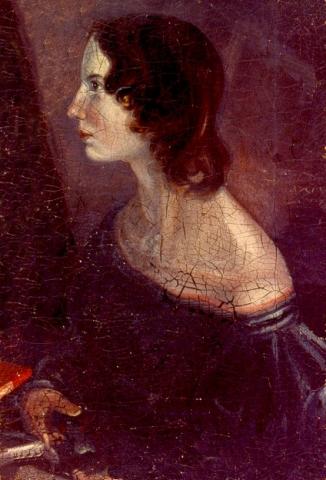
Ritratto di Emily, 1834


raggiungendo risultati eccellenti che suscitarono le lodi di tutti, ma Branwell, pur con innate attitudini per ogni attività in cui si cimentasse era incostante e non portava mai a termine le sue opere, per cui di questo talentuoso ed eclettico talento, quasi nulla ci è pervenuto, ed anche il suo nome è scivolato nell’oblio, soverchiato dalla fama di quello delle, seppur meno dotate, ben valenti sorelle.

Nel 1839 vi fu un altro allontanamento di Branwell da casa, poichè andò a studiare pittura a Bradford, ma dopo poco ritornò deludendo ancora una volta tutta la sua famiglia; nel 1842, dopo aver tentato la carriera di pittore ritrattista, aver smesso di dipingere ed essersi impiegato come precettore nel Cumberland, trovò un lavoro nella ferrovia Manchester- Leeds, ma ben presto perse anche quest’impiego perché licenziato per incuria.
Nel gennaio del 1845 approdò, infine, a Thorp Green, in qualità di precettore del figlio maschio dei Robinson, la stessa famiglia in cui insegnava Anne; gradevole d’aspetto, galante, abile conversatore, scrittore, pittore, con tutte queste attitudini non mancò di affascinare Mrs. Lydia Robinson, maggiore di lui quasi vent’anni; i due s’innamorarono ed intrecciarono  una relazione, ma quando il marito venne a conoscenza di questa relazione cacciò Branwell per 'indegnità' e fu questa la più grande, ultima amarezza riservatagli dalla sua breve esistenza.


Negli ultimi anni della sua vita egli cominciò ad usare l’oppio per alienarsi gradatamente, stordendosi, da una vita che lo aveva solamente deluso, finché, distrutto dall’alcool, dalla droga, dai fallimenti della sua esistenza e dal male di famiglia, la tisi, si spense tra le braccia della povera Emily che per il dolore gli sopravvisse non più di tre mesi: era il 24 settembre del 1848.


Scriverà Thomas Merton (1915 - 1968) circa un secolo più tardi:


L’arte ci consente di trovare noi stessi e di perdere noi stessi nel medesimo momento.


Con sempre più grande affetto e devozione vi giunge il mio caloroso abbraccio, miei carissimi amici e lettori,

a presto ♥


Bibliografia:

Juliet Barker, The Brontës, Weidenfeld and Nicolson, London, 1994;

Daphne du Maurier, The Infernal World of Branwell Brontë, (Victor Gollancz 1960 ), Penguin Books, 1972;

THE BRONTË FAMILY WITH SPECIAL REFERENCE TO PATRICK BRANWELL BRONTË, BY FRANCIS A. LEYLAND IN TWO VOLUMES, VOL. I, HURST AND BLACKETT, PUBLISHERS, LONDON, 13, GREAT MARLBOROUGH STREET, 1886.


Citazioni:

1 - THE BRONTË FAMILY WITH SPECIAL REFERENCE TO PATRICK BRANWELL BRONTË, BY FRANCIS A. LEYLAND IN TWO VOLUMES, VOL. I, HURST AND BLACKETT, PUBLISHERS, LONDON, 13, GREAT MARLBOROUGH STREET, 1886, CHAPTER XIII, Branwell's Letter to Wordsworth, with Stanzas‌, pag.193.


“I do not weep from a sense of bereavement…but for the wreck of talent, the ruin of promise, the untimely dreary extinction of what might have been a burning and shining light. My brother was a year my junior. I had aspirations and ambitions for him one-long ago-they have perished mournfully…There is such a bitterness of pity for his life and death-such a yearning for the emptiness of his whole existence as I cannot describe.” 


(Letter from Charlotte Brontë to her friend William S. Williams, the day after Branwell’s funeral on October 2, 1848) 


- picture 1 - Anne, Emily and Charlotte Brontë, portrayed by their brother Branwell (1 January 1834).
He painted himself among his sisters, but later removed his image so as not to clutter up the painting.


The name Brontë suggests female faces belonging to the so fertile, artistically speaking, Victorian era, and novels became famous as dictated by an unusual talent, but there were also other family members such as Maria, Elizabeth an Branwell, no less talented than the three most famous sisters Charlotte, Emily Jane and Anne who survived him.


- picture 2 on the left - Patrick Branwell was born on June 26th, 1817 and as the an only son his father, the Anglican pastor of Hawthorn, Patrick Brontë, wanted to educate him at home to make him a scholar and so, while his five sisters were sent to a boarding school because they were followed in a way more appropriate to their sex, he staied at home learning greek and latin ; the premature death of Maria and Elizabeth at 9 and 10 years of tuberculosis given the unhealthy conditions of the boarding school struck emotionally Branwell in his deep making him even more vulnerable than he was in his nature ( Maria and Elizabeth were his older sisters ).
Endowed by artistic spirit he showed early inclination for the arts, and already as a child began by writing together with his three sisters who became famous, poems and stories, but surely it was the painting that most responded to his expressiveness.
And yet Branwell, slender, short of stature, with a face with fine features and an expression that revealed itself a bizarre temperament but a lively wit, red-haired and with a rosy complexion, typical colors of the Irish whose blood came from his father, friendly and outgoing, as it is typical of those  people, by the gallant ways - this is the portrait drawn by the writer Elizabeth Gaskell, who wrote the biography of her unfortunate friend Charlotte Brontë - with an excellent memory and imagination was undoubtedly the most brilliant of the whole family and his three sisters loved him, admired him and spoil him. (Beneath a portrait attributed to Sir Edwin Landseer dated 1838 of the three Bronte sisters)


- picture 3 on the right - In 1835 he wrote a letter to the Royal Academy of Arts in the hope of being admitted. The early biographers wrote down that he moved  to London to study painting, but he spent the money he was given in profligate way, that is in drinking; other biographers have speculated that he was too shy to go to the Academy, more recently there are those who even suggests that Brontë neither sent a letter, or did the journey to London. According to Francis Leyland, Branwell's friend and future biographer of the family, his first job was to usher in a school in Halifax and it's certain that he worked as a portrait painter in Bradford in 1838 and 1839 - the most famous ones are those of his landlady Mrs. Kirby and a portrait of Emily showing a real talent for both satirical style and for portraiture.
The fact is, unfortunately, that in 1839 he returned to Haworth heavily in debt: he was making his way in the spell for the vice that will lead him quickly to dependence on alcohol and opium to the point of manifesting real delusions (we could think that the Brontë sisters, for the drama of their male characters such as Heathcliff in Emily's Wuntering Heights, or Mr.Rochester in Charlotte's Jane Eyre, are inspired by the excesses of their brother, romantic hero often transfigured enough to instill in their even fear).

Branwell also composed poems, which he sent to the major poets of the time, such as Wordsworth and Coleridge, receiving flattering judgments; it is dated January 19th, 1837 a letter he wrote to the poet Wordsworth, in requesting him to make a judgment on his poetry, also enclosing six stanzas of a poem of his:


- picture 4


                                                                                                                   'Haworth, near Bradford,

                                                                                                          'Yorkshire, January 19th, 1837.
'Sir,
'I most earnestly entreat you to read and pass your judgment upon what I have sent you, because from the day of my birth, to this the nineteenth year of my life, I have lived among secluded hills, where I could neither know what I was, or what I could do. I read for the same reason that I ate or drank—because it was a real craving of nature. I wrote on the same principle as I spoke—out of the impulse and feelings of the mind; nor could I help it, for what came, came out, and there was the end of it. For as to self-conceit, that could not receive food from flattery, since to this hour not half-a-dozen people in the world know that I have ever penned a line.

'But a change has taken place now, sir; and I am arrived at an age wherein I must do something for myself: the powers I possess must be exercised to a definite end, and as I don't know them myself I must ask of others what they are worth. Yet there is not one here to tell me; and still, if they are worthless, time will henceforth be too precious to be wasted on them.

'Do pardon me, sir, that I have ventured to come before one whose works I have most loved in our literature, and who most has been with me a divinity of the mind, laying before him one of my writings, and asking of him a judgment of its contents. I must come before some one from whose sentence there is no appeal; and such a one is he who has developed the theory of poetry as well as its practice, and both in such a way as to claim a place in the memory of a thousand years to come.

'My aim, sir, is to push out into the open world, and for this I trust not poetry alone—that might launch the vessel, but could not bear her on; sensible and scientific prose, bold and vigorous efforts in my walk in life, would give a further title to the notice of the world; and then, again, poetry ought to brighten and crown that name with glory; but nothing of all this can be ever begun without means, and as I don't possess these, I must in every shape strive to gain them. Surely, in this day, when there is not a writing poet worth a sixpence, the field must be open, if a better man can step forward.

'What I send you is the Prefatory Scene of a much longer subject, in which I have striven to develop strong passions and weak principles struggling with a high imagination and acute feelings, till, as youth hardens towards old age, evil deeds and short enjoyments end in mental misery and bodily ruin. Now, to send you the whole of this would be a mock upon your patience; what you see, does not even pretend to be more than the description of an imaginative child. But read it, sir; and, as you would hold a light to one in utter darkness—as you value your own kind-heartedness—return me an answer, if but one word, telling me whether I should write on, or write no more. Forgive undue warmth, because my feelings in this matter cannot be cool; and believe me, sir, with deep respect,

'Your really humble servant,

'P. B. Brontë.'


Mrs. Gaskell gives the following six stanzas, which are about a third of the whole, and declares them not to be the worst part of the composition:—


'So where He reigns in glory bright,
Above those starry skies of night,
Amid His Paradise of light,
Oh, why may I not be?
'Oft when awake on Christmas morn,
In sleepless twilight laid forlorn,
Strange thoughts have o'er my mind been borne
How He has died for me.
'And oft, within my chamber lying,
Have I awaked myself with crying,
From dreams, where I beheld Him dying
Upon the accursed tree.
'And often has my mother said,
While on her lap I laid my head,
She feared for time I was not made,
But for Eternity.
'So "I can read my title clear
To mansions in the skies,
And let me bid farewell to fear,
And wipe my weeping eyes."
'I'll lay me down on this marble stone,
And set the world aside,
To see upon her ebon throne
The Moon in glory ride.' 1


Downhearted for having not received any answer from his friend, he, later, like all the others Brontë brought to graphic art, decided to devote himself to painting,


- picture 5 - Emily's portrait, 1834


achieving excellent results that aroused the praise of everyone, but Branwell, even with innate aptitudes for each activity in which he confronted himself was uneven and never enden his works, so of this talented and  eclectic genius, almost nothing has survived , and also his name has slipped into oblivion, overwhelmed by the fame of that of, though less equipped, his well-talented sisters.

In 1839 there was another departure of Branwell from home, as he went to study painting in Bradford, but soon returned disappointing once again all his family; in 1842, after attempting a career as a portrait painter, he stopped painting and was assumed as a tutor in Cumberland, than found a job in the railroad Manchester- Leeds, but soon lost even this because fired for negligence.
In January of 1845 he arrived, finally, at Thorp Green, as tutor to the son of Robinsons, the same family where taught Anne; nice-looking, gallant, clever conversationalist, writer, painter, with all these attitudes Branwell didn't fail to fascinate Mrs. Lydia Robinson, almost twenty years older than he; the two fell in love and intertwined a relationship, but when her husband came and know this, dismissed Branwell for 'unworthiness'.

During the last years of his life he began to use opium to gradually alienate himself from a life that had only disappointed him, until getting destroyed by alcohol, drugs, from the failures of his life and from the evil of the family, tuberculosis, till he died in the arms of the poor Emily that for the pain survived him no more than three months: it was September 24th, 1848.


Thomas Merton (1915 - 1968) will write about a century later:


Art enables us to find ourselves and lose ourselves at the same time.


With more and more great affection and devotion it comes to you my warm embrace, my dear friends and readers,

see you soon ♥


Bibliography:

Juliet Barker, The Brontës, Weidenfeld and Nicolson, London, 1994;

Daphne du Maurier, The Infernal World of Branwell Brontë, (Victor Gollancz 1960 ), Penguin Books, 1972;

THE BRONTË FAMILY WITH SPECIAL REFERENCE TO PATRICK BRANWELL BRONTË, BY FRANCIS A. LEYLAND IN TWO VOLUMES, VOL. I, HURST AND BLACKETT, PUBLISHERS, LONDON, 13, GREAT MARLBOROUGH STREET, 1886.


Quotations:

1 - THE BRONTË FAMILY WITH SPECIAL REFERENCE TO PATRICK BRANWELL BRONTË, BY FRANCIS A. LEYLAND IN TWO VOLUMES, VOL. I, HURST AND BLACKETT, PUBLISHERS, LONDON, 13, GREAT MARLBOROUGH STREET, 1886, CHAPTER XIII, Branwell's Letter to Wordsworth, with Stanzas‌, page 193. 

mercoledì 17 giugno 2015

Did Anna Magdalena Bach write her husband's most famous masterpieces?


Il suo nome da nubile era Anna Magdalena Wilcke e divenne nota 
nella sua terra, la Germania, nell'arco del XVIII secolo, come una 
delle più capaci e giovani soprano e musiciste del tempo, ma il suo 
ricordo è legato a qualcosa di molto più importante ...


Nata in una famiglia di musicisti a Zeitz in Sassonia il 22 settembre del 1701 aveva vent'anni ed era già affermata nel campo della musica quando si unì in matrimonio con Johann Sebastian Bach a Köthen il 3 dicembre 1721, diciassette mesi dopo che la sua prima moglie Maria Barbara Bach morì. Tra il 1723 e il 1742 ebbero tredici figli, di cui sette perirono in giovane età, cosa, ahimè, piuttosto consueta al tempo.


E' facile per noi immaginare che la loro fosse un'unione felice visto che li legava l'interesse per la musica: il celebre compositore, al tempo già Konzert-meister e Hoforganist (maestro di musica e organista di corte) presso il principe Leopoldo di Anhalt-Köthen ( al servizio del quale compose dal 1717 al 1723 ) raccolse in un quaderno dal titolo Notenbüchlein für Anna Magdalena Bach le composizioni che ad ella dedicò ed ella, dal canto suo, lo aiutava regolarmente a trascrivere le sue musiche.

Durante il soggiorno della famiglia Bach a Lipsia (1723 - 1750) che vide Johann Sebastian divenire finalmente Cantor et Director Musices , ovvero insegnante di canto degli studenti della Thomasschule, e compositore per le due chiese principali di Lipsia di cui divenne Maestro di Capppella, Anna Magdalena organizzava regolarmente delle serate in cui invitava amici di famiglia ad ascoltare tutta la famiglia che suonava e cantava, poiché analogamente a come accadrà qualche anno più tardi per un'altro celeberrimo compositore in Austria, Wolfgang Amadeus Mozart, la casa della famiglia Bach divenne un luogo d'interesse musicale a Lipsia.


Morning Hymn at Sebastian Bachs' (Toby Edward Rosenthal, 1870)


Ma ciò che sto di seguito per rivelarvi ha del sensazionale: recenti ricerche condotte in Australia avrebbero dimostrato che le arie più celebri di Johann Sebastian Bach sarebbero state non già trascritte ( all'epoca il compositore era malato e contava molto sull'aiuto di Anna Magdalena di 19 anni più giovane di lui ) bensì direttamente composte dalla sua amata consorte !

Questo è quanto rivelò il Daily Mail lo scorso 26 ottobre, in cui si leggeva che Martin Jarvis, professore di musica presso la Charles Darwin University in Australia, ha trascorso anni per mettere insieme prove, con uno studio completo di scrittura e manoscritti, che attesterebbero che alla luce di un'attenta analisi dell' inchiostro e dello stile della scrittura, che Frau Bach avrebbe fatto molto più lavoro sui pezzi musicali di quanto si sia fin'ora pensato; 


Immagine tratta dal film documento Written by Mrs Bach (2014)


egli sostiene, nello specifico, che Anna scrisse anche l'Aria delle Goldberg Variations: Aria  ed il primo Präludium aus dem Wohltemperierten Klavier Buch I ( J.S.Bach - Praeludium 1 BWV 846 (Das Wohltemperierte Klavier 1) oltre alle Suiten für Violoncello - J.S. Bach Cello Suites No.1-6 BWV 1007-1012


Frontespizio delle Suiten für Violoncello vergato da Anna Magdalena Bach


Nell'autunno scorso venne sull'argomento persino prodotto un film documentario dal titolo "Written by Mrs Bach" presentato dal compositore britannico Sally Beamish, che conteneva evidenze fatte emergere da uno scienziato americano che analizzò la firma di Bach e le sue partiture; anche Heidi Harralson, ispettore forense, sostiene la tesi secondo cui 'con un ragionevole grado di certezza scientifica', il compositore sarebbe davvero Anna Magdalena, poichè le partiture rivelano che ella scriveva come componeva, quando invece chi si limita a trascrivere lo fa adottando uno stile di scrittura lento e con l'utilizzo di caratteri 'pesanti'.


Una delle prime pagine della partitura delle Suiten für Violoncello


Anna Magdalena Wilcke Bach, dettaglio da un ritratto dell'epoca di autore sconosciuto.


Credo che si tratterebbe sicuramente di una scoperta sensazionale che renderebbe il dovuto merito ad una donna geniale vissuta in un secolo che poco, se non sensualità, attribuiva al gentil sesso e, senza nulla togliere al suo consorte che molto ammiro, soprattutto per i Brandenburgische Konzerte, vorrei davvero che corrispondesse a realtà; a questi pezzi sono emotivamente molto legata, essi hanno per me un forte potere evocativo perché mi riportano ai tempi in cui, ragazzina, cantavo nella cantoria della Parrocchia di San Lorenzo nel paese dell'entroterra ligure in cui andavo a trascorrere le vacanze estive e l'organista, mio carissimo amico al quale sono tutt'ora vincolata da tenero e sincero affetto, spesso esordiva la domenica mattina con queste arie ... ne ho allegato i links con i titoli originali, perché possiate ascoltarli direttamente anche voi e, se li ascoltate con attenzione, scoprirete che realmente palesano una sensibilità decisamente femminile ... alimentando questa tesi che sempre più sento di condividere.

E dopo questo salto a ritroso nel settecento per raccontarvi di questa curiosità prendo congedo da voi augurandovi quanto meglio possiate desiderare e ringraziandovi, sempre più, per essermi accanto con il vostro affetto ed il vostro entusiasmo.

A presto ♥


Her maiden name was Anna Magdalena Wilcke and became known
in Germany, her homeland, during the XVIIIth century, as one of 
the most capable and young soprano and musician of the time, 
but her memory is linked to something far more important ...


- picture 1


Born into a musical family in Zeitz, Saxony, on September 22nd, 1701 she was twenty years old and was already quite famous when she got married with Johann Sebastian Bach in Köthen on December 3rd, 1721, seventeen months after he became widower of his first wife, Maria Barbara Bach. Between 1723 and 1742 they had thirteen children, seven of whom died at a young age, what, alas, was quite usual at the time.


It 's easy for us to imagine that theirs was an happy marriage because they were linked by the interest in music: the famous composer, who at that time was already Konzert-meister and Hoforganist (music teacher and organist of the court) for the Prince Leopold of Anhalt-Köthen (at whose service he composed from 1717 to 1723) collected in a book entitled Notenbüchlein für Anna Magdalena Bach all the compositions he dedicated to her and she, in turn, regularly helped him transcribing his music.

During the family's stay in Leipzig (1723 - 1750) that saw Johann Sebastian finally become Cantor et Director Musices, or singing teacher for the student of the Thomasschule, and composer for the two main churches of Leipzig where he became Master of Capppella, Anna Magdalena organized regular evenings in which they receivedfamily to listen to the whole family playing and singing, because, just similarly to how it will happen a few years later for another famous Austrian composer, Wolfgang Amadeus Mozart, the Bachs home  became a place of musical interest in Leipzig.


- picture 2 - Morning Hymn at Sebastian Bachs' (Toby Edward Rosenthal, 1870)


But what I'm about to reveal you has something sensational: recent researches conducted in Australia have shown that the most famous arias of Johann Sebastian Bach were not transcribed (at the time the composer was quite ill and Anna Magdalena, who was 19 years younger than him, helped him a  lot in everything) but directly composed from his beloved wife!

This is what the Daily Mail revealed last October 26th, where I read that Martin Jarvis, professor of music at the Charles Darwin University in Australia, has spent years putting together evidences, with a comprehensive study of writing and manuscripts, which attest that after a careful analysis of 'ink and style of writing, Frau Bach would have done much more work on the pieces of music than we have thought so far';


- picture 3 -  Image drawn from the film Written by Mrs Bach (2014)


he specifically declares that Anna also wrote the: Goldberg Variations: Aria, the first Präludium aus dem Wohltemperierten Klavier Buch I ( J.S.Bach - Praeludium 1 BWV 846 (Das Wohltemperierte Klavier 1)  and the  Suiten für Violoncello - J.S. Bach Cello Suites No.1-6 BWV 1007-1012 


- picture 4 - Frontispiece of the Suiten für Cello penned by Anna Magdalena Bach


Last Autumn on this subject was produced a documentary film entitled "Written by Mrs Bach" presented by the British composer Sally Beamish, which contained evidences made out by an American scientist who analyzed the signature of Bach and his scores; Heidi Harralson, forensic examiner, supports the argument that 'with a reasonable degree of scientific certainty', the composer would really Anna Magdalena, as the scores reveal that she wrote just in the same way that she composed, whereas those who simply transcribe, does it using a slow writing style with 'heavy' characters.


- picture 5 - One of the first pages of the score of the Suiten für Violoncello


- picture 6 - Anna Magdalena Wilcke Bach, detail from a portrait by an unknown artist of the time


I think it would definitely be a sensational discovery that would make due credit to a brilliant woman lived in a century that very little, if not sensuality, attributed to the fairer sex and, without taking anything away from his husband that I admire a lot, especially for the far too famous Brandenburgische Konzerte, I really wish that it correspond to reality; to I'm emotionally very connected to these pieces, they have a strong evocative power to me because bring me back to the days when, as a young girl, I sang in the choir of the Parish of San Lorenzo in the Ligurian village where I used to spend my summer holidays, and the organist,  a dear friend of mine whom I'm still bound by tender and sincere affection to, often made his debut on Sunday morning with these tunes ... I have attached the links with the original titles, so that you can listen to them directly and you too, if you can listen to them carefully, will discover that actually they reveal a decidedly feminine sensibility ... and I feel more and more to agree with this argument.

And after this trip back in the XVIIIth century to tell you about this curiosity, I take leave of you, wishing you the best you can desire and thanking you, more and more, to be always so close to me with your affection and your enthusiasm.


See you soon ♥


This post is linked to the lovely Blog-party at